Part 2: A Hunter Found a Silent Dog Crushed Inside His Bear Trap — Five Years Later, That Three-Legged Survivor Changed the Law
Part 2 — The Name I Gave Him
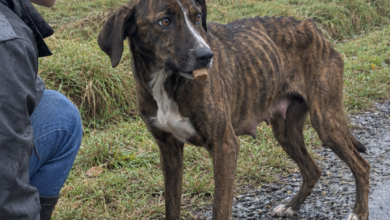
The clinic listed the dog as Unknown Shepherd Mix 47 until animal control completed the required stray hold.
No microchip was found.
The red collar had no writing inside it.
Local shelters circulated his photograph. The sheriff’s office posted notices. A radio station mentioned a three-legged dog rescued from the north woods.
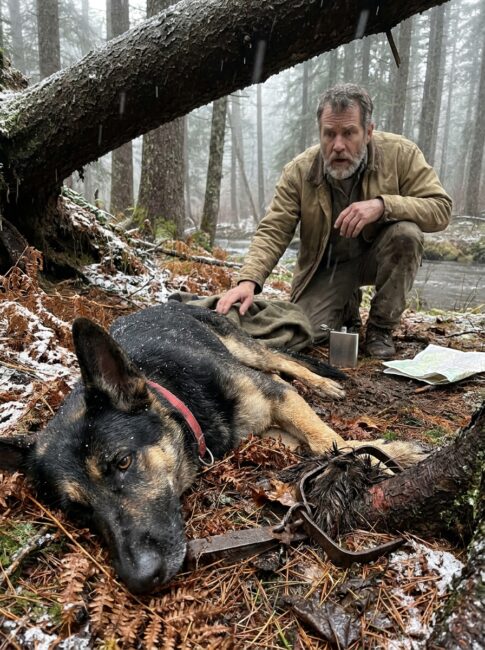
Nobody claimed him.
For the first three days, he remained sedated and weak. The veterinary team managed infection, pain, dehydration, and the effects of prolonged exposure. His bloodwork suggested he had not eaten properly for weeks before the trap caught him.
That detail bothered me.
A healthy owned dog can become lost.
A dog already thin, collar faded, tags gone, wandering miles from any road—his story had likely begun badly before mine entered it.
I visited twice a day.
At first, he did not seem to recognize me. He slept beneath warming blankets, body curved around the empty space where his right front leg had been. Whenever he woke, confusion moved through him before pain medication softened it again.
On the fourth day, I sat beside the kennel and spoke his temporary number.
“Forty-seven.”
His left ear lifted.
“That’s no name.”
His eye opened.
I had been thinking of names during the drive.
Bear.
Ridge.
Scout.
Each sounded dishonest, an attempt to turn the accident into adventure.
The truth was steel.
The truth was the device that changed his body and mine.
“I’m calling you Trap,” I said.
He stared at me.
“I know it’s ugly.”
His tail tapped once beneath the blanket.
The technician at the desk wrote it on the board.
TRAP — GERMAN SHEPHERD MIX — MALE
Some people later accused me of cruelty for the name. They said it forced the dog to carry his trauma as an identity.
Maybe they were right.
But I did not name him to remind him.
I named him so I could never forget.
Trap’s first attempt to stand happened six days after surgery.
Rebecca placed a padded support sling beneath his chest while I knelt several feet away. He pushed with his back legs and remaining front leg, rose halfway, then fell against the bedding.
His eyes widened.
He tried again immediately.
“Slow,” Rebecca said.
Trap did not understand slow.
He had awakened in a world where balance no longer followed the rules his body remembered. Every time he leaned forward, the missing leg seemed to appear inside his expectation, and he toppled toward empty space.
The third attempt lasted three seconds.
The fourth lasted five.
After the fifth, he lay panting, ears lowered, and looked toward me.
I reached through the kennel door.
Trap crawled closer and rested his chin on my hand.
That was the first time he chose contact.
The stray hold expired without an owner.
Animal control asked whether I wanted to adopt him.
The question felt almost insulting in its simplicity.
I had not saved Trap in any clean moral sense. I had freed him from the thing I set. The difference mattered.
Still, the alternatives were limited. The local shelter was full. Breed-specific rescues had waiting lists. Trap required rehabilitation, follow-up surgery, and a home without slippery stairs.
My cabin had one floor.
I had no children.
My wife had died six years earlier.
There was room.
“I’ll take him,” I said.
Rebecca folded her arms.
“As guilt?”
I looked at Trap.
“Does it matter to him?”
“It will matter when guilt gets tired.”
I deserved that.
“What would make it acceptable?”
“Commitment after the story stops being dramatic.”
I signed the papers.
Trap came home seventeen days after I found him.
He was carried from the clinic wearing a red support harness. Snow had deepened outside. When the cold air touched his face, he lifted his nose and inhaled for several seconds.
I expected fear.
Instead, his eyes sharpened.
The forest remained somewhere inside him—not only as the place of injury, but as the largest world he knew.
At the cabin, Trap refused the orthopedic bed I placed near the woodstove. He chose the floor beside the front door.
I moved the bed there.
He moved off it.
So I folded my old hunting jacket beneath his head.
That, he accepted.
For the first month, life became a series of physical negotiations.
Trap learned to rise without throwing himself forward.
He learned to turn left before turning right.
He learned that polished kitchen boards were dangerous while rugs were safe.
He learned stairs through one low porch step at a time.
I learned to wake before he tried standing alone.
I learned how to clean the surgical site.
I learned which pain medication made him nauseated and which made him sleep.
I also learned that Trap did not hate the woods.
He hated metal sounds.
The snap of a toolbox latch made him flatten.
A shovel striking frozen ground sent him beneath the table.
The first time I cleaned one of my steel traps in the workshop, Trap saw it through the open door.
His body stopped.
He did not bark.
He backed away until his spine touched the wall.
I stood holding the trap.
Steel jaws.
Chain.
Springs.
A tool I had handled thousands of times without seeing anything except function.
Then I looked at the missing space beside Trap’s chest.
I placed the trap on the bench and closed the workshop door.
The next morning, I did not check my line.
That was the first day in thirty years I deliberately left my traps unset.
It was not yet a decision.
It was an inability.
Sometimes the body refuses before the mind admits why.
Part 3 — The Hunter Who Could No Longer Look Away
I began trapping with my father when I was twelve.
He taught me how to read tracks, choose trails, hide scent, and anchor steel deep enough that a captured animal could not drag it away. In our family, trapping was spoken of as skill, heritage, and necessary management.
We did not consider ourselves cruel.
That distinction mattered to us.
We respected the animals we killed.
We used what we could.
We checked our lines.
We followed the law.
I had spent decades believing responsibility inside a system made the system responsible.
Trap broke that logic.
Not through argument.
Through presence.
Every morning, I saw the way he compensated for the missing front leg. He shifted weight backward before rising. He hopped twice to gain momentum. On uneven ground, he placed his remaining paw carefully, calculating each step.
He adapted because animals adapt or die.
People often confuse adaptation with proof that the harm no longer matters.
Trap became competent on three legs.
The trap remained wrong.
During the first winter, Evan continued checking our shared line alone. He brought pelts to my cabin, drank coffee, and avoided discussing why my equipment stayed stacked in the workshop.
Eventually he asked.
“You coming back out?”
Trap was asleep near the woodstove.
“I don’t know.”
“We’ve done this since we were kids.”
“I know.”
“One accident doesn’t erase thirty years.”
I looked at the dog.
“It erased a leg.”
Evan stared into his mug.
“You think I haven’t been thinking about it?”
That softened my anger.
We had both been taught the same language. Skill. Tradition. Regulation. The assumption that unintended victims were rare exceptions rather than part of the moral cost.
Evan said, “It was a dog.”
“And next time?”
“We check more often.”
“The creek made that impossible.”
“Then don’t trap near the creek.”
“What if it’s somebody else’s dog? A lynx? An eagle?”
He shook his head.
“Now you’re turning everything into Trap.”
“Yes.”
That was exactly what had changed.
Once an abstract possibility becomes a body you feed each morning, abstraction is no longer available.
I could not set another steel jaw without imagining a red collar.
I could not tighten a chain without seeing amber eyes.
I could not tell myself the animal would die quickly, because Trap had survived long enough to show me what not dying quickly looked like.
Evan left angry.
I did not blame him.
My rejection of the practice felt, to him, like a rejection of our history together.
In part, it was.
But Trap had taught me something I did not want to know:
Intention does not cancel impact.
I never intended to catch a domestic dog.
The trap did not care.
I never intended for an animal to remain there through a storm.
The steel did not loosen itself.
I considered selling the equipment. Then I imagined another man setting it.
Instead, I dismantled every trap I owned.
There were thirty-eight.
Some had belonged to my father.
One had his initials stamped into the plate.
I set up a workbench in the yard and used an angle grinder to cut the jaws, springs, and chains into unusable pieces. Sparks flew into the winter air. Trap watched from the porch.
When I reached the trap that caught him, my hands stopped.
The blood had been cleaned away, but one tooth still held a strand of black fur caught beneath the hinge.
I removed it with pliers.
Then I cut the trap in half.
Trap stood.
He descended the porch step, crossed the snow in his uneven three-beat gait, and approached the pieces.
My chest tightened.
I expected him to retreat.
Instead, he sniffed the broken steel.
Then he urinated on it.
That was the first time I laughed in months.
Evan heard about the destroyed traps and did not call me for three weeks.
Other hunters did.
Some said I had become soft.
Some said I was using one unfortunate incident to attack people who followed the law.
One man told me dogs did not belong loose in trapping country.
That sentence changed my private decision into a public one.
I asked him, “Did Trap know where trapping country began?”
He hung up.
The local paper requested an interview after Rebecca posted a photograph of Trap learning to walk in a support harness. I agreed only because the reporter promised not to frame me as a hero.
I told the truth.
I had set the trap.
I had failed to check it during the storm.
I had benefited from a law that treated prolonged suffering as acceptable risk.
I said I would never trap again.
The article ran under the headline:
THREE-LEGGED DOG ENDS LOCAL HUNTER’S THIRTY-YEAR TRADITION
The reaction split the town.
Some people donated to Trap’s medical bills.
Others called me a traitor.
A few hunters contacted me privately and admitted they had found non-target animals in traps before—dogs, raccoons, owls, porcupines, even another trapper’s boot.
Nobody had reported most of those incidents.
That was when I realized Trap’s injury was not as exceptional as I had been taught to believe.
It was simply visible.
And visibility changes what silence protects.
Part 4 — The Dog Who Returned to the Mountain
Trap’s rehabilitation lasted almost a year.
By spring, he could walk around the cabin without the support harness.
By early summer, he could cross the yard.
By August, he attempted his first run.
It was ugly.
Beautifully ugly.
His remaining front leg reached forward while both back legs pushed at once, creating a rolling stride that looked more like a controlled fall than running. He covered twenty yards, stumbled, rolled onto one shoulder, and stood again before I reached him.
His tail whipped through the grass.
He wanted more.
Rebecca warned me not to overexercise him. Three-legged dogs can damage remaining joints by compensating. We built strength slowly with swimming, controlled hill work, and short walks on soft ground.
The first time I took him back into the forest, I chose a trail far from the trap line.
Trap stopped at the tree line.
His body became rigid.
I knelt beside him.
“We can go home.”
He looked into the woods.
Wind moved through spruce branches. A chickadee called overhead. Somewhere deeper, water crossed stone.
Trap took one step.
Then another.
He did not need me to drag him back toward what hurt him.
He needed the choice not to enter.
Because he had that choice, he went.
We walked half a mile that day.
A month later, two.
By autumn, Trap could climb moderate trails better than many four-legged dogs. He chose his footing carefully and rested without shame. When hikers stared at the missing leg, he ignored them. When children asked what happened, I told a version appropriate to their age:
“A trap hurt him.”
The children almost always asked the next question adults avoided.
“Why would someone make something that could hurt a dog?”
At first, I answered, “It was meant for a bear.”
Then one girl, perhaps eight years old, said, “Did the trap know that?”
No.
It did not.
The question stayed.
With trapping behind me, I needed work. My savings would not last, and guiding hunting trips felt impossible. I knew the forest better than anything else, so I began taking visitors on hiking and wildlife-tracking tours.
People were initially skeptical of a former trapper marketing himself as a conservation guide. Trap solved the branding problem.
He came on every easy trip.
Tourists loved him.
Children followed his three-legged rhythm.
Older hikers took courage from the fact that Trap rested whenever needed and resumed without embarrassment.
I named the small business Three-Step Wilderness Guides.
Our logo showed three paw prints climbing toward a mountain.
The work changed how I used my knowledge. The same tracking skills once used to capture animals helped people observe without interfering. I showed visitors claw marks on trees, deer beds beneath hemlocks, fox routes along stone walls, and the safe distance required around nesting birds.
Trap became unusually good at finding lost objects.
Gloves.
Water bottles.
Once, a child’s stuffed moose.
He would follow scent, locate the item, then sit beside it with the solemn expression of an officer awaiting paperwork.
The forest also revealed another side of him.
Trap was not fearless.
Certain metallic clicks still stopped him.
When hikers used collapsible trekking poles, the locking snap made his ears flatten. He became uneasy near narrow game trails where leaves covered the ground too evenly.
But he kept moving.
People praised his courage.
I thought courage was too simple.
Trap did not defeat fear.
He carried fear without letting it choose every direction.
That lesson spread beyond the dog.
I began speaking at schools and rescue fundraisers. I brought the broken half of the trap in a locked display case. Trap lay beside me while I explained how foothold traps worked, how long animals could remain confined, and how non-target captures happened.
I did not pretend all hunters were monsters.
That would have been dishonest and ineffective.
I said many were people like me—following tradition, obeying regulations, and avoiding questions that threatened the structure of their identity.
Then I pointed toward Trap.
“The law allowed this,” I said. “My intention did not prevent this. Tradition did not heal this.”
Those talks attracted Mara Ellison, an attorney from Bangor who worked with an animal-welfare organization. She approached me after a community meeting and asked whether I would testify before a legislative committee supporting stricter trapping regulations.
“I’m not a politician.”
“You are the person who set the trap.”
“That makes me the worst spokesman.”
“It makes you the one they cannot dismiss as ignorant.”
At first, we pursued stronger inspection rules and mandatory warning signs near public trails. The proposals failed.
Trapping associations argued that existing regulations were sufficient. Legislators called non-target injuries rare. One committee member suggested Trap’s case proved the system worked because the dog survived.
I leaned toward the microphone.
“Trap survived because three men carried him five miles and a veterinarian cut off his leg.”
The room went quiet.
“That is not the system working.”
The bill died anyway.
I went home furious.
Trap met me at the door, turned three awkward circles, and lowered himself onto the rug.
I sat beside him.
“We lost.”
His tail tapped once.
Trap did not understand legislative sessions.
He understood returning.
So we returned.
Part 5 — The Campaign Nobody Expected Me to Lead
The movement began with seven people in the back room of a diner.
Mara.
Rebecca.
Two rescue volunteers.
A retired game warden named Harold Pierce.
A woman whose Labrador lost two toes in a trap.
Me.
Trap lay beneath the table, his chin resting on my boot.
We called the group Safe Trails Maine.
Our first goal was not a complete ban. That seemed politically impossible. We focused on gathering records because every official discussion returned to the claim that accidental captures were too rare to justify change.
The problem was that no central database existed.
Veterinary clinics had cases.
Shelters had cases.
Hunters had private stories.
Wildlife officers had incomplete reports.
We created an online form and requested documentation.
Within six months, we had reports of eighty-seven non-target captures across the state over ten years.
Twenty-three involved domestic dogs.
Several required amputations.
Four dogs died.
The number was almost certainly incomplete.
We verified as many cases as possible through medical records, photographs, law-enforcement reports, or witness statements. Then we mapped them.
The red markers spread across the state.
Near homes.
Near public trails.
Near campsites.
Near places where ordinary people assumed walking a dog was safe.
The opposition became louder.
I received threatening messages.
Some callers said I had invented Trap’s story for attention.
Others accused me of betraying rural culture.
One morning, I found a rusted trap hanging from my mailbox.
Trap stopped ten feet away and would not approach.
That was the first time the campaign frightened me enough to consider quitting.
I carried the trap into the shed using gloves.
Then I called Evan.
We had repaired our friendship slowly. He still hunted, but he had stopped using steel traps after finding a fox alive with a shattered jaw. He never announced the decision publicly.
Evan came over, removed the trap, and replaced my mailbox before lunch.
“You done?” he asked.
“I don’t know.”
He looked at Trap sleeping inside the doorway.
“You carried him five miles.”
“So?”
“So maybe carry this farther.”
That became our unofficial motto.
Carry it farther.
Trap’s story spread through regional media after a video showed him climbing Mount Kineo with one of my trekking groups. The video did not focus on his injury. It showed him moving.
Three legs.
Steady pace.
Tail high.
At the summit, Trap stood facing Moosehead Lake while wind pushed his ears back.
The caption read:
The trap took one leg. It did not get the mountain.
Millions watched.
That attention brought donations and volunteers, but it also brought simplification. People wanted a clean villain and a perfect survivor. Real policy work offered neither.
Some trappers joined us quietly. They supported alternatives, tighter placement restrictions, and better reporting but feared losing their communities.
I understood.
The hardest identity to question is one built with family memory.
I invited them to speak.
That cost us support from activists who wanted total condemnation.
But change required people who knew the equipment.
We held demonstrations using disabled traps. Former trappers explained spring strength, chain placement, and common causes of non-target capture. Veterinarians described tissue death after prolonged compression. Wildlife biologists discussed indiscriminate mechanisms.
Trap attended many events.
He did nothing dramatic.
He lay on a blanket.
That was enough.
People could see the empty sleeve of his harness.
They could watch him rise carefully.
They could understand that the injury did not end when the wound closed.
During the third legislative session, the proposed bill expanded. It sought to prohibit large steel-jaw traps on public land, require permits and signage elsewhere, mandate shorter inspection intervals, and create reporting requirements for non-target captures.
It passed one committee.
Failed another.
We tried again.
On the fourth year, a twelve-year-old boy testified about finding his Beagle dead in a trap less than a mile from a campground.
The boy placed the dog’s collar on the desk.
Trap, lying beside me, lifted his head.
The committee chairman looked away.
That year, the bill reached the full legislature.
The final vote was close.
The governor vetoed it.
I read the news in the kitchen and threw the paper across the room.
Trap startled.
He tried to stand too quickly and slipped.
Shame replaced anger instantly.
I knelt beside him.
“I’m sorry.”
He leaned into my chest.
That was when I remembered the first day—his nose pressed into my wrist because my hand was the only safe place available.
He had trusted me before I deserved it.
Now hundreds of people trusted us not to stop because the process was humiliating.
We organized again.
Stronger.
More precise.
Less interested in dramatic speeches and more interested in votes.
During the fifth year, we proposed a clearer ban on steel-jaw bear traps and other high-force foothold devices, while expanding nonlethal wildlife-management programs and funding conflict-prevention education for rural property owners.
Several hunters supported the compromise publicly.
Evan testified.
He described thirty years of trapping and the moment he saw Trap beneath the spruce.
“I used to think checking traps made me responsible,” he said. “Now I think responsibility means asking whether the device should be waiting there at all.”
The bill passed the House.
Then the Senate.
The governor signed it on a rainy morning in June.
Mara called while I was leading a hiking group.
I stepped off the trail to answer.
“It’s done,” she said.
I looked at Trap.
He stood beside a cluster of ferns, nose lifted toward the wind.
For five seconds, I could not speak.
The group behind me began asking what happened.
I crouched and placed both hands around Trap’s face.
“They banned it,” I whispered.
His tail moved.
He had no idea what I meant.
He only knew I was crying and his face was involved.
Trap licked my chin once.
The hikers applauded.
The sound rolled through the trees.
Part 6 — The Lives We Never Met
People asked how many animals the law saved.
There was no honest number.
Prevention does not create photographs.
No emergency surgery is documented.
No owner receives a midnight call.
No dog lies silent beneath a spruce.
The saved lives remain invisible because the harmful event never occurs.
I used to find that frustrating. Trap’s injury was concrete. The animals protected by change were theoretical.
Then Rebecca corrected me.
“They’re not theoretical,” she said. “They’re walking somewhere.”
That sentence stayed.
Somewhere, a family’s dog followed a deer scent into the woods and returned with four legs.
Somewhere, a fox crossed an old trap line without steel closing behind it.
Somewhere, a hiker heard only birds and wind instead of an animal struggling beyond the trail.
Those lives did not know Trap.
They benefited from him anyway.
Safe Trails Maine continued working after the ban. We offered programs for wildlife conflict prevention, supported lost-dog searches, and funded emergency veterinary care for animals injured outdoors.
Trap became the symbol, though I tried to prevent the organization from using him only as tragedy.
Our photographs showed him hiking.
Swimming.
Sleeping beside campfires.
Stealing sandwiches from inattentive tourists.
His life was not the missing leg.
It was everything he did around it.
Every year on the anniversary of his rescue, Evan, Tommy, Rebecca, and I walked the five-mile route from the old trap site to the former logging road. Trap joined as long as he was able.
At the spruce tree, we placed a small wooden marker:
FOUND HERE.
CARRIED OUT.
CARRIED FORWARD.
We never marked the exact coordinates publicly.
It was not a shrine.
It was a reminder.
The first year, Trap approached the tree and sniffed the ground for several minutes.
The second, he avoided the spot.
The third, he urinated on the marker.
Tommy laughed until he had to sit down.
By the fifth year, Trap no longer appeared to recognize the place.
I was grateful.
Humans often demand that animals remember for our narrative satisfaction.
Trap was allowed to forget.
I was not.
That was my responsibility.
My life after trapping became quieter and larger at the same time. Guiding hikers paid less than successful trapping seasons had, but I slept differently. I no longer woke calculating lines, weather, and what might be waiting in steel.
Instead, I planned routes around wildflowers, wildlife tracks, and places where Trap could rest.
He became slower with age.
His remaining front shoulder developed arthritis from years of extra load. We shortened trips. I fitted him with a light support harness and kept anti-inflammatory medication in my pack.
Visitors still requested him specifically.
Some arrived because they had seen the summit video.
Others came after losing animals of their own.
One man brought his daughter, whose rescue dog had survived abuse and remained frightened of strangers. Trap did not approach the girl.
He sat twenty feet away.
She sat too.
By the end of the hike, they walked side by side without touching.
That was Trap’s gift.
He never forced healing into spectacle.
He showed what continuing looked like.
Three steps.
Pause.
Three steps.
Rest.
Then the next hill.
Part 7 — What Trap Saved
Trap lived twelve years after the rescue.
That made him approximately sixteen when his body finally began refusing the mountains.
His muzzle turned white.
His hearing faded.
His remaining front leg bowed slightly under years of carrying more than its share.
Still, every morning when I reached for my hiking boots, he lifted his head.
During his last summer, I built a small wheeled support cart for longer paths. Trap hated it at first. He sat down and stared at me with the expression of a man whose dignity had been professionally insulted.
After I placed a piece of chicken ten feet ahead, he reconsidered.
We took one final group hike in September.
Only a mile.
Flat ground beside the lake.
Evan came.
Rebecca came.
Mara came carrying a folder containing the signed copy of the trapping-ban legislation.
At the overlook, we spread a blanket. Trap lay facing the water while leaves moved across the surface.
Mara placed the folder beside him for a photograph.
Trap rested one paw on it accidentally.
The image spread online with the caption:
He lost a leg to a trap. Then he helped remove thousands of traps from the future.
I disliked the wording at first.
Trap did not lobby.
He did not testify.
He did not understand statutes.
Then I realized influence does not require comprehension.
Trap changed the person who set the trap.
That person changed his behavior.
Behavior became testimony.
Testimony became organization.
Organization became law.
A dog does not need to understand the chain to become its first link.
Trap declined quickly that winter.
He stopped eating breakfast.
Then dinner.
He struggled to rise even with support.
Rebecca came to the cabin on a January afternoon while snow fell through still air.
Trap lay on my old hunting jacket—the same one I placed beneath his head in the woods twelve years earlier.
Evan sat near the stove.
Tommy stood at the window.
I rested my hand on Trap’s chest.
His heartbeat was slow.
I had rehearsed words for years.
None seemed useful.
So I told him the truth.
“I’m sorry I put it there.”
His eye opened.
The amber had faded but remained clear.
“I’m glad I found you.”
His tail moved once.
Perhaps reflex.
Perhaps recognition.
As before, I chose the meaning that helped me carry what came next.
Rebecca administered the medication.
Trap’s breathing softened.
His head grew heavier against my hand.
Then he was gone.
We buried him on the hill behind the cabin where the morning sun reached first.
The marker does not show a trap.
I would not let the thing that hurt him become the final shape above his body.
It shows three paw prints climbing toward a ridge.
Beneath them are the words:
TRAP
HE WALKED OUT.
OTHERS NEVER HAD TO ENTER.
Years have passed.
I still guide hikers.
Safe Trails Maine still operates.
The law still stands.
Some people continue arguing that one dog changed too much.
I think they misunderstand.
Trap did not change the law because he was more valuable than wild animals.
He changed it because people could finally imagine the cost when the victim had a collar, a name, and eyes that looked back.
Then, once the cost became visible, we could no longer justify hiding it when the animal was a fox, bear, coyote, bobcat, or anything else without a human waiting at home.
I have been called the man who saved Trap.
That description makes me uncomfortable.
I opened the steel.
I carried him out.
I paid the bills.
I gave him a home.
Those things were real.
But Trap did the harder work.
He forced me to live after knowing.
Before him, I could claim ignorance.
After him, every trap had his face.
I could not unknow the silence beneath that spruce.
I could not unknow the weight of his body on the stretcher.
I could not unknow the missing space beside his chest.
So I stopped.
Then I spoke.
Then others spoke.
Five years later, the steel jaws were prohibited.
Sometimes, while leading a trail group, I see a dog running ahead of its family through the trees. Four legs. Tail high. No fear of what might be hidden beneath the leaves.
The owners call.
The dog returns.
They continue walking.
They never know the danger that is not there.
That is Trap’s real monument.
Not the law.
Not the marker.
Not the articles.
A dog goes into the forest.
And comes home whole.
Trap could not stand up to thank the people who carried him.
He never needed to.
By surviving once, he changed what could happen to thousands who came after him.
I caught him in a trap.
He caught me inside a truth.
Only one of us lost a leg.
But both of us walked out different.
Follow this page for more unforgettable dog stories about rescue, courage, and the lives one survivor can change.