Part 2: A Hospice Nurse Brought a Dying Shelter Dog to a Dying Man So Neither Would Be Alone at the End. Three Weeks Later She Walked in and Found Them Both — and Understood What They’d Decided.
Part 2
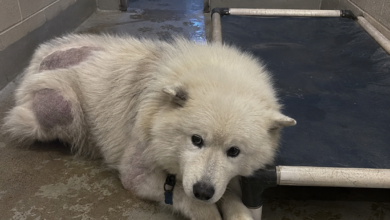
The dog had a name on his card. Bingo. Denise looked at it and decided no.
A dog who had lived fifteen years and was about to finish deserved better than a name from a children’s song. On the drive over she tried a few out loud in the empty car. Nothing fit. She gave up.
Walter named him an hour later, by accident.
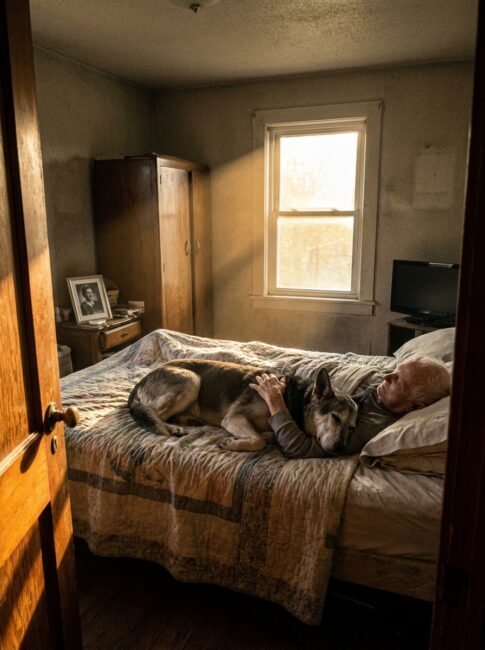
When Denise carried the dog into the house, Walter was in the recliner with a blanket over his knees and the television going. He was a small man by then — illness had folded him down — with white hair he still combed every morning out of a discipline that had outlived its reasons, and big spotted hands that shook a little when they weren’t holding onto something.
He looked at the dog in Denise’s arms for a long moment.
“Well,” he said. “Where’d you come from, old man.”
And that was it. Old Man. The dog had a name.
Denise set Old Man down on the floor near the recliner. The dog stood there swaying for a second on stiff legs. Then he walked — slow, careful, picking each foot up like it cost something — straight to the side of Walter’s chair, and he lowered himself down onto the floor against it with another of those whole-body sighs, and he put his gray chin on the toe of Walter’s slipper.
The same thing he’d done to Denise’s shoe.
Oh. There you are.
Walter looked down at him for a while. Then he reached one shaking hand off the armrest and laid it on the dog’s head, and the dog’s eyes closed, and neither of them moved.
Denise stood in the kitchen doorway and watched two creatures who had each been alone find out they didn’t have to be anymore, and she did not say anything, because there was nothing to add to it.
Part 3
She started coming twice a day instead of once.
She told herself it was to manage Walter’s medications, which was half true, and to check on the dog’s heart, which was the other half. Old Man was on a low dose of something to keep the fluid off his lungs. It bought him comfort, not time. Everyone understood that. Nobody said it.
For three weeks, Denise watched a thing she has spent the rest of her life trying to describe to people and mostly failing.
Walter got better at the things that don’t show up on a chart.
He started turning the television off. This was the first thing she noticed, and it landed harder than she expected, because she had spent two weeks before the dog listening to that television fill the silence in that house like water filling a sinking room. Now she’d come in and it would be quiet, and Walter would be talking — to the dog, in a low running murmur, about nothing. About the weather. About a man named Sal he used to work with at the rail yard in 1961. About his wife, whose name was Ruth, which Denise had never once heard him say in the weeks before.
Old Man didn’t understand a word of it. That wasn’t the point. He’d lie there with his chin on Walter’s slipper or, when Walter moved to the bed, up on the mattress against his side, and he’d thump his tail twice whenever Walter’s voice rose at the end of a sentence like a question.
They ate at the same time. Walter wasn’t eating much by then — the dying don’t — but he’d eat a little more if Denise put a plate down for the dog at the same moment, because Walter would not, it turned out, eat in front of a dog and not share, and he would not eat poorly in front of someone depending on him. So she’d put down two plates. Walter would eat half a piece of toast. Old Man would eat his soft food. They’d look at each other doing it.
She brought the dog’s blanket from the car and put it on the foot of Walter’s bed. Within two days the dog had moved up the blanket, inch by inch over the course of each night, until he slept pressed full-length against Walter’s left side, his head on Walter’s chest, rising and falling with the old man’s breathing.
Walter slept better with the weight there. He told her so. “Like a hand on you,” he said. “Reminds you you’re still here.”
There was a window in that bedroom that faced east, and on clear nights the moon came up over the neighbor’s roofline and threw a long pale rectangle of light across the bed. Denise saw it once on a late evening visit — the two of them already asleep, the old man on his back and the old dog along his side, both of them silver in the moonlight, both of them breathing, the breath of each one a little uneven in its own way, the two uneven rhythms overlapping into something that almost, if you didn’t look too close, sounded steady.
She stood in the doorway that night for a long time.
She thought: I did one good thing.
She had no idea how good. She thought she was buying a lonely man some company for his last few days. She thought the kindness was in the keeping-company. She did not yet understand that she had not arranged a companionship at all — that she had, without knowing it, arranged something the two of them would take much further than she ever intended, and decide between themselves, on a night she wasn’t there.
On the morning of the twenty-first day, Walter’s daughter called Denise from Phoenix, the way she did every few days, and asked how her father was doing.
Denise told her the truth. She said he seemed peaceful. She said, and she remembers choosing the word, that he seemed ready. She said he wasn’t alone — that there was a dog, and that it had changed something, and that the daughter shouldn’t worry about her father dying in a silent house with the television on, because that wasn’t going to happen now.
The daughter cried on the phone and thanked her.
Denise hung up and drove over for her evening visit.
That was the last evening.
Part 4
He went in his sleep, sometime in the night.
Denise wasn’t there — there’s no shift that covers every hour, and Walter had been stable enough that no one was sitting with him through the night. He simply did the thing the very old and very tired sometimes get to do, the thing everyone in hospice hopes for and almost no one gets. He lay down in his own bed, in his own house, with a weight on his chest reminding him he was still here, and at some point in the dark he stopped being here, quietly, without struggle, without fear, without waking.
Denise has seen a great many ways for a life to end. She will tell you that one is the good one. That one is the one you pray for.
She got to the house at 7:40 the next morning with her key and a bag of the dog’s soft food.
She knew before she reached the bedroom. You learn the quality of the quiet. A house with someone sleeping in it is quiet one way. A house with no one breathing in it is quiet another, and after nineteen years your body knows the difference before your mind agrees to.
She set the bag down on the kitchen counter.
She walked back to the bedroom and stopped in the doorway.
The morning light was coming in low and gold through the east window, the same window that held the moon. Walter was on his back, his face turned slightly toward the door, his expression — and Denise has held to this word every time she’s told it — unbothered. Like a man who’d set something down.
And the dog was on his chest.
Old Man lay full-length along the old man’s body the way he had every night, his gray head over Walter’s heart, one paw stretched up across the still chest as if he’d reached for something in the night. His eyes were closed. He looked asleep.
Denise crossed the room. She put her hand on the dog.
He was gone too.
Part 5
The vet who came later put the dog’s time of death several hours after Walter’s. Not at the same moment. After.
Which means the dog was there for it.
That is the part Denise could not get past, the part she still can’t, the part that turns this from a sad story into the other kind of story. Old Man did not die with Walter. Old Man outlived Walter by a matter of hours — lay on the chest of the man as that chest went still under him, as the warmth went out of it, as the rhythm he had matched his own breathing to for three weeks simply stopped — and Old Man stayed.
He did not get up. He did not go to the door. A dog in distress, a dog whose person has stopped responding, will often get up, will pace, will whine, will seek help.
He stayed where he was, on the chest of the man who had named him, and somewhere in the hours after, with his head over a heart that had finished, his own failing heart finished too.
The vet said, carefully, that it could be coincidence. A fifteen-year-old dog in congestive heart failure is a dog who could go at any hour, and the stress of a still and cooling body beneath him could have been enough to tip an already-failing heart over its edge.
That is the medical version. Denise listened to all of it and nodded and signed the forms.
And then she said, to me, the thing she believes instead.
“I brought that dog there so a man wouldn’t die alone,” she said. “And I keep thinking I had it backwards the whole time. I thought the dog was company for the dying. I think now the dog was a witness. I think he stayed so that Walter wouldn’t go into the dark by himself — and then I think Old Man looked around and decided he wasn’t going to do it by himself either, and he went where Walter went.”
She paused.
“They didn’t die alone,” she said. “Either of them. That was the whole thing I was trying to fix. And they fixed it better than I did. They didn’t just keep each other company at the end. They went together.“
Part 6
I keep going back over the three weeks now and seeing them differently.
The nose on the shoe. Oh, there you are. I thought it was just a tired old dog looking for a soft place. I think now it was something closer to recognition. Two creatures at the same point on the same road, meeting on it, knowing each other for what they were.
The television going off. I thought Walter just liked the dog’s company better than the noise. I think now the silence had stopped being the thing he couldn’t face, because he wasn’t facing it alone anymore. You can sit in a quiet room with someone. You can’t sit in one by yourself when you’re dying. That’s the difference the dog made, and it’s the whole difference.
The weight on the chest. Like a hand on you. Reminds you you’re still here. Walter said that about why he slept better. I think now it was true in a way he didn’t fully mean. The weight reminded him he was still here — and at the end, I think it did one more thing. I think it meant that the last thing Walter felt in this world, as he let go of it, was not the cold and not the silence and not the empty house. It was warmth. It was breathing. It was the steady living weight of someone who had decided not to leave him.
And the moonlight on the two of them, breathing out of rhythm into something that almost sounded steady.
I think they made it steady, in the end. I think they synced the only way two failing hearts can. Not by beating together — by stopping close enough together that the gap didn’t matter.
Walter’s daughter flew in from Phoenix. His son drove from Seattle. They sat in the house their father had died in, with the chair by the window and the television finally off for good, and Denise told them everything — the shelter, the red dot on the card, the nose on her shoe, the three weeks, the morning.
The daughter asked Denise to repeat one part. The part about the dog dying after. About staying.
Then she looked at her brother, and her brother nodded before she even said it, the way siblings do when they’ve arrived at the same place at the same time.
They asked the funeral home if it could be done.
It could.
Part 7
They were cremated together.
Walter and Old Man, the man and the dog, three weeks of acquaintance and a whole shared ending — their ashes mixed into one urn, at the family’s request, and buried in the plot beside Ruth, Walter’s wife, in a cemetery on a hill north of Scranton.
The stone has Walter’s name and his dates. And underneath, smaller, the family had four more words cut into it.
And Old Man. Together.
Denise goes there. Not on a schedule — she’s not a woman who builds rituals on purpose — but a few times a year she finds herself driving north out of the city with no particular errand, and she ends up on that hill.
She does one thing when she’s there. She told me about it once and asked me not to make it sound like more than it is, so I’ll say it plain. She brings a dog biscuit. One. She sets it on the base of the stone, on the side with the four small words.
She doesn’t pray over it. She doesn’t say anything most of the time.
She just leaves it there, on the grave of a dog who stayed, and she drives back down the hill.
Part 8
I asked Denise once if she ever felt guilty. For bringing a dying dog into a dying man’s last weeks. For arranging, without meaning to, the thing that happened.
She thought about it.
“No,” she said.
The window faced east. The light came up gold.
“I wanted him not to be alone,” she said. “He wasn’t.”
Then she said the last thing.
“Neither of them was.”
Follow this page for more stories about the company we find in the last rooms, and the ones who refuse to let us go in alone.