Part 2: My Autistic Son Hadn’t Spoken In Four Years — Then I Adopted A Pit Bull And Hid A Microphone In His Collar, And What I Heard My Son Whispering Every Night Took Me Three Years To Understand
For the first three months, the recordings were a small private miracle that I did not tell another human being about.
I would put Eli to bed at nine. I would brush my teeth. I would pour myself a small glass of wine that I would mostly not drink. I would go into my bedroom closet — the only room in our house with a door that locked — and I would sit on the floor with my back against my hanging coats. I would plug the recorder into my laptop. I would put my headphones on. I would press play.
The first night I listened, I had captured forty-two minutes of audio over the course of one full day with Tank.
Of those forty-two minutes, twenty-nine were Eli speaking. To Tank. In a small steady whisper, the kind of whisper a child uses when he is reading aloud to himself in a library.
I had not heard my son’s voice for that long, in that many words, in over four years.
He told Tank about a boy in his class named Marcus who had a Power Rangers lunchbox. He told Tank that the cafeteria had served corn dogs and that he had not eaten the cornbread part because it was too soft. He told Tank that the bus driver, Miss Linda, had been wearing a sweater with butterflies on it. He told Tank that on the bus, a girl named Cora had given him a sticker shaped like a rocket ship, and that he had wanted to say thank you, but he could not, so he had nodded twice instead, and she had smiled and turned around. He told Tank that Cora was nice.
I sat on my closet floor in headphones and I cried so hard the headphones got wet. I had to take them off and dry them on my sleeve.
That was a Tuesday. I listened to that Tuesday recording four times before I went to bed.
I did not tell Eli’s therapist what I was doing. I did not tell my mother. I did not tell my best friend, a woman named Nia, who had been with me through the diagnosis and the divorce and the worst nights of the last decade.
I knew what I was doing was not okay. I knew it. I want to be clear with you that I knew it the whole time.
There is a kind of motherhood I have not seen written about much, which is the motherhood of a child who has stopped giving you the thing every parenting book in the world tells you to look for. Listen to your child. Hear what your child is saying. I had no child saying. For four years, I had no child saying. I had a child humming, gesturing, drawing, making small sounds in the bath, being a person whose interior life I had to assemble from fragments.
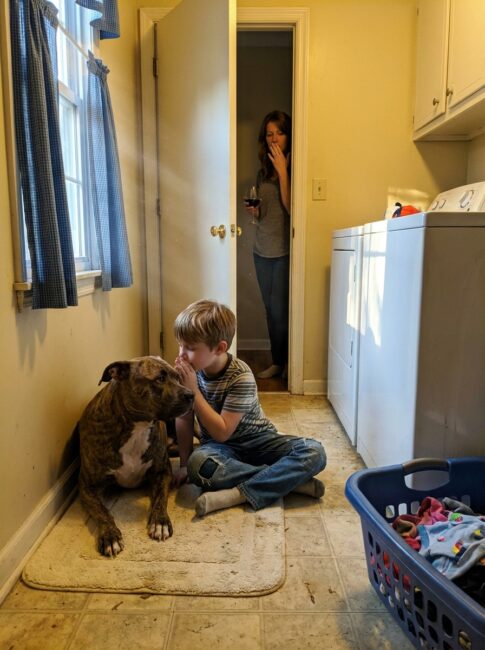
When I heard him say “Hi, Tank” through a laundry-room door, I cracked open like an old wall.
I am not going to defend what I did with the recorder. I am only going to tell you that I did it because I had been starving for four years, and a sound came out of my son’s mouth, and I did not trust myself to live without hearing more of it.
I listened every night for three months.
Eli’s whispers to Tank were short and constant. He would talk to Tank when they were alone together — in the laundry room, in his bedroom, on the back patio when I was inside cooking dinner. He never spoke to Tank when I was visibly in the room. He never spoke to Tank when other people were in the house. He spoke to Tank when he believed they were the only two creatures awake.
The content was, at first, what I had thought it was — small fragments of his day, trivia, observations, the names of his classmates, his teacher, his bus driver. He told Tank what he had drawn in art class. He told Tank what color the sky was on the way to school. He told Tank about a thunderstorm that had scared him.
He talked about Cora a lot. Cora was a girl in his fifth-grade class with red hair and freckles and the rocket-ship sticker. Cora sat next to Eli in the cafeteria on Wednesdays and Fridays. Cora had asked Eli, several times, what his favorite animal was, and Eli — who could not answer her out loud — had drawn a picture of a Pit Bull on a napkin and slid it across to her, and Cora had folded it into her notebook.
I sobbed through the Cora recordings. I did not tell anyone.
In month four, in November of 2021, I noticed the pattern.
Eli was not telling Tank random things. He was telling Tank specific things in a specific order. He was telling Tank, every single afternoon when he got home from school, what had happened that day.
He said, “Hi, Tank. Today at school —”
And then he would walk Tank through the day. The bus ride in. The classroom. The teacher’s name. Who had been absent. Who had sat next to him in homeroom. Who had been kind to him at lunch. Who had laughed at him in gym class. Who had not picked him for kickball.
He was reporting.
He was reporting in the exact tone of a boy who is making sure that someone, somewhere, knows what happened to him today.
I sat in my closet at one a.m. on a Sunday in early November and I listened to a Friday recording in which Eli told Tank, very seriously, that a boy named Tucker had pulled the back of his shirt at recess and had whispered the word retard in his ear, and that a yard-duty teacher named Mrs. Avila had not seen it. He told Tank that he had not cried, because crying made it worse. He told Tank that he had stood under the slide for the rest of recess so that Tucker could not find him.
He paused.
He said, very quietly, “Tank. Can you tell him? Can you tell him please.”
I did not know who him was at first.
I sat in the closet with the recording playing in my ears and I tried to figure out who Eli could possibly be asking the dog to tell.
It took me four more days to figure it out.
I was driving home from the firm on a Wednesday evening when I remembered a sentence Brandon had said in the doorway in March of 2017.
“I’ll call you every day after school and you can tell me about your day. Promise.”
I had to pull the car over.
I sat on the shoulder of South Boulevard in Charlotte with my hazards on and I cried into the steering wheel for ten minutes, and when I could finally see the road again, I drove home, and I went to my closet, and I started listening to the recordings again, and this time I understood what I was hearing.
Eli had been told, on the day his father left, that someone was going to want to hear about his day after school every single day.
That person had not called.
That person had never called.
But Eli had been a six-year-old boy when he was told this. He had absorbed the promise part. The every day part. The you can tell him about your day part. He had not been given any way to fit, into his small ordered child’s mind, the failure of that promise.
So he had simply waited.
He had waited four years.
He had waited four years to have someone to tell about his day, the way his father had said someone would.
And then I had brought home a 70-pound brindle Pit Bull from a rescue in Greensboro, and the dog had lain down at his feet on the laundry-room floor on day six, and Eli had finally, finally found the someone.
He had been talking to Tank as if Tank were his father.
He had been reporting to Tank as if Tank could carry the message.
I sat in my closet that night and I listened to a recording from a Tuesday two weeks earlier, in which Eli had said to Tank, in his small steady whisper, “Today was good. You can tell him today was good.”
I started shaking.
I did not stop for a long time.
I want to talk about Brandon for a minute, because he is the absent center of this whole story, and I do not want to leave him as a flat villain.
Brandon was twenty-four when I married him. I was twenty-three. He worked in commercial insurance. He was funny. He was tender with babies. He sang to Eli when Eli was an infant — old country songs, Hank Williams, in a voice that was not a good voice but was an honest one.
When Eli was diagnosed at three, Brandon went silent for about a week. Then he started reading. He bought books. He went to one parents’ group with me and decided he hated it. He stopped going. By the time Eli was five, Brandon was working late three nights a week and traveling on weekends. By the time Eli was six, he was already gone in every sense that mattered. The Saturday in March 2017 was just the day his body caught up to the rest of him.
I do not hate Brandon. I do not have the energy to. I have had years of therapy about him.
What I will say is this. He told a six-year-old boy a promise, on his way out the door, that he had no intention of keeping. He did it because he wanted Eli to let him leave without crying, and he wanted me to let him leave without screaming, and he was willing to spend his son’s faith to buy himself an easier exit.
He paid for that exit with four years of my son’s silence.
Tank paid for it too, in the end.
We all did.
I let the recordings keep going for two more months after I figured out what they were. I am not proud of that either. I told myself it was because I needed to be sure of the pattern. I think the truer reason is that I needed to keep hearing his voice.
I stopped in early February of 2022.
I stopped because I went to listen to a Friday recording, and I heard Eli ask Tank, “Are you tired? You can rest. You don’t have to remember all of it. Just the important parts.”
I closed the laptop. I took the recorder out of Tank’s collar. I never put it back.
Eli had been worried about overworking the messenger. I was not going to make my son carry that.
I went to my therapist, a woman named Dr. Maya Aldridge, the next week. I told her everything. I told her about the recorder. I told her about the laundry room. I told her about Brandon’s promise and Tank in the brindle coat and the way I had cried in a closet for six months without telling another human being.
Dr. Aldridge listened to me without interrupting once.
When I was done, she said, “Joanna. You did a thing that has both a clear ethical problem and a clear maternal urgency. I am not going to pretend the ethical problem is not there. But I want to ask you something more important. What do you want to do now?”
I said I did not know.
She said, “Joanna. He is talking. Whatever the dog is to him — your son is talking. You have a window. What do you want to walk through it carrying?”
I went home that night. I sat at the kitchen table with Tank lying at my feet. Eli was asleep upstairs.
I made a decision.
I was not going to tell Eli about the recordings. Not then. Possibly not ever. I was going to let Tank stay the only one who heard him. I was going to let Eli have that.
But I was also going to start writing letters. To Eli. From me.
I started that night. I wrote my son a one-page letter. I told him that I loved him. I told him I was so glad we had Tank. I told him that I was here, and that I would always be here, and that he could tell me anything, in any way, in any form, whenever he was ready, and I would listen.
I left the letter on the kitchen table.
He read it the next morning. He did not say anything. He folded the letter into a small square and he put it in his pocket and he carried it with him to school.
That was February 2022.
I have written him a letter on the kitchen table almost every Sunday night since. He has not missed reading one. He keeps them in a shoebox under his bed. I know because I have seen the shoebox. I have not opened it. It is his.
Eli started speaking to me out loud in the spring of 2023, when he was twelve. The first sentence he said directly to me — across the kitchen, with Tank lying between us on the rug — was, “Mom. Tank wants water.”
I cried so hard I had to sit down on the floor. He looked at me, alarmed. He said, “Mom. Are you okay.”
Two sentences. Twelve years old. Five years and ten months since the last sentence I had heard him say to me directly.
I said, “Yes, baby. I’m okay. Mom is just very, very happy to hear you.”
He nodded. He went and got Tank’s water bowl himself.
He has not gone back to silence since.
He still does not talk a lot. He is selective. He still talks to Tank more than he talks to me, although the gap has narrowed. He talks at school now in some classes — not all. He has friends. Cora the rocket-ship girl is still his friend at fourteen. They sit together on the bus.
He started a journal in 2023. He fills a notebook every six months. I have not asked to read them.
Tank died in February of 2025.
He was eight years old. He had a cardiac event in his sleep, on the foot of Eli’s bed, the same place he had slept for almost four years. Eli woke up at six a.m. and called for me — not shouted, not screamed, just Mom — in a voice I had not heard from him before.
I went into Eli’s bedroom. Tank was lying on the comforter. Eli was sitting up next to him with his hand on Tank’s ribs.
He said, “Mom. Tank is gone.”
I said, “Yes, baby. He is.”
We sat on Eli’s bed for a long time. Eli did not cry the way I expected him to. He stroked Tank’s chest in slow careful strokes. He whispered something to Tank, very quietly, that I did not try to hear.
Then he looked at me with his eyes wet but his face calm and he said, “Mom. Tank is going to go and tell Dad about everything now.”
I said, “What do you mean, baby.”
He said, “All my days. Tank knows all my days. Tank can find Dad. Tank is going to go tell him.”
I sat on the bed and I held my son and I cried into his hair the way mothers cry into their teenage sons’ hair when those sons let them, which is rarely.
Eli is fourteen now.
Tank’s collar is in a small wooden box on the mantel of our living room. The leather pocket I sewed into it in April of 2021 is still there. I never took it out. There is no recorder in it anymore. There has not been one in three and a half years.
I asked Eli, two weeks after Tank died, if he wanted us to look at getting another dog.
He shook his head.
He said, “Tank already went. Tank doesn’t need someone else to do his job.”
I said, “You sure, baby?”
He nodded.
He said, “Mom. I have you now.”
That was a year ago.
I want to end this with one thing.
I am not going to tell you that what I did with the recorder was right. I have made my peace with what I did, and I have explained it to my son in a sit-down conversation we had on a Saturday afternoon in the summer of 2024, when he was thirteen and ready to hear it. I told him everything. I told him I had hidden a recorder in Tank’s collar for six months when he was ten. I told him I had listened to him talk to Tank every night. I told him I was sorry.
He listened.
He thought about it for a long time.
Then he said, “Mom. You needed to hear me too. It’s okay.”
He hugged me. He went outside. He came back in twenty minutes later and asked me if we could order pizza for dinner.
I am writing this down because there is a mother somewhere reading this whose son or daughter has stopped speaking, and I want her to know two things. The first is that the silence is not the end of the story. The second is that whatever fills the silence — a dog, a notebook, a kid named Cora and a rocket-ship sticker, a small steady whisper through a closed door — that thing is not less than language. That thing might be a language being built right in front of you in a room you are not yet allowed in.
Listen for the door to open. Don’t kick it down.
Even when you want to.
I almost kicked it down. I built a hidden microphone instead. Both of those things were wrong. The right thing — the thing I learned, three years too late, listening to a recording in a closet — was to write my son a letter on a Sunday night and leave it on the kitchen table and trust that one day he would read it.
He did.
He still does.
We are okay.
Tank carried us both. He carried us both for as long as he could. He went on ahead.
I hope, wherever he is, he is finally telling Brandon all the days that Brandon never called for.
I hope Brandon is listening.
I am.
If this story moved you, follow the page — there are more like Eli and Tank I haven’t told yet.