Part 2: The German Shepherd Refused to Follow His Former Owner Out of Court — Then He Lay Beneath the Chair of a Woman Whose Name Never Appeared in His File
Part 2, The German Shepherd Behind the Cedar Fence
Ranger came to Wade Mercer’s property as an eleven-week-old puppy in March 2017.
Wade bought him from an unlicensed breeder outside Macon and trained him to guard the backyard of a narrow brick house on Savannah’s west side. The dog lived behind a six-foot cedar fence topped with wire.
He rarely entered the house.
Neighbors heard Wade teaching commands after dark.
“Front” meant approach.
“Hold” meant remain.
“Watch” meant place his body between the house and whoever stood outside the gate.
Ranger learned quickly.
By his second year, delivery drivers would not approach the porch if he was loose. He never crossed the fence or bit anyone, but his bark carried through three backyards.
People described him as dangerous without meeting him.
Owen moved into the house in August 2021 after his mother, Wade’s younger sister, entered residential treatment for an opioid addiction. Wade became the boy’s temporary guardian.
Owen was nine, small for his age, and spoke so quietly that teachers sometimes leaned across his desk to hear him.
Ranger changed around him.
He stopped sleeping beside the back gate and began sleeping beneath Owen’s window. When Wade shouted inside the house, the dog stood with his front paws against the siding.
Owen passed objects through the window screen: half a sandwich, a blue sock, pages torn from drawing pads.
Ranger stored them inside an overturned plastic doghouse.
Claire Bennett entered their lives after Owen’s school reported fifteen absences in seven weeks.
She made her first home visit on January 12, 2022.
Wade met her at the front door and answered every question before Owen could speak. He said the boy suffered migraines. He said Owen fell often because he was clumsy. He said the German Shepherd ate two full bowls each day.
The dog in the backyard did not match that claim.
Claire saw Ranger through the kitchen window. His waist narrowed sharply behind his ribs. His coat had become dull along the spine, and one ear carried a fresh tear.
She asked to inspect the yard.
Wade refused.
“The dog doesn’t like strangers.”
Ranger stood behind the cedar fence without barking.
Claire could see only one amber eye through the gap.
She returned four weeks later. Ranger looked thinner. His water bucket had overturned, and green growth marked the bottom.
Claire filed an animal-welfare referral.
The responding officer came two days later. By then, the bucket was clean, and food filled the bowl. Wade produced a veterinary receipt from the previous year.
The case did not meet the threshold for immediate seizure.
Systems often require one complete piece of proof while neglect survives through dozens of incomplete pieces.
Claire began carrying food.
The first brown bag contained two cans of beef dog food and a bottle of water. She slid it beneath the loose fence board after Wade left for a night shift.
Ranger approached but would not touch it while she remained visible.
Claire stepped behind a garage.
The bag disappeared.
The following morning, she found it folded beside the fence.
Ranger had not torn the paper.
He had opened the top seam.
That became the first seed.
No matter how hungry he became, Ranger never destroyed the bag. He returned it flattened, sometimes holding it beneath one paw until Claire arrived.
The second seed appeared in March.
Claire placed four peanut-butter crackers beside the dog food because Owen had lost another five pounds. She could not legally pass food to a child without documenting it, but she could not ignore what she saw.
The following morning, the empty dog-food cans sat behind the fence.
The crackers remained sealed beneath Owen’s bedroom window.
Ranger had carried them thirty-eight feet without eating them.
Claire understood the route.
From then on, each bag contained two portions.
One for the dog.
One for the boy.
Part 3, The Paper Route Nobody Could See
Claire visited Wade’s property twenty-two times between February and October.
Only eight visits appeared on the official schedule.
The others happened after work, usually between 7:15 and 8:00 p.m., when Wade’s pickup was absent from the driveway.
Claire parked near a laundromat on West 37th Street. She changed from office shoes into black walking flats and carried the food inside a plain brown bag.
Ranger learned the sound of her right heel.
The rubber had worn unevenly, producing a small double tap whenever she stepped onto pavement.
Tap.
Pause.
Tap.
By the fourth visit, Ranger waited at the loose fence board before she reached the alley.
He never barked.
Claire placed the bag beneath the gap. Ranger pulled it inside, opened the folded top, and removed the cans first.
The child’s food came next.
Crackers.
Protein bars.
Applesauce pouches.
Small containers that made no sound when opened.
Ranger carried them to Owen’s window one at a time.
Claire watched from the alley through a gap between boards. The dog rose on his hind legs and placed each item on the sill. A small hand emerged through the torn screen.
Owen never looked outside.
He touched Ranger’s head before taking the food.
The exchanges lasted less than three minutes.
Then Ranger returned the empty bag to the fence.
Claire photographed the sequence only twice. She feared a phone screen or camera light would alert Wade. Most nights, she wrote down the time, weather, food delivered, Ranger’s condition, and whether Owen’s hand appeared.
March 8: Ranger limping on left front foot.
March 21: No water visible in yard.
April 6: Owen took crackers, left one for dog.
April 19: Ranger waited beneath window for twelve minutes after transfer.
May 3: Bruise visible on child’s wrist.
May 17: Dog stood between back door and child until Wade’s vehicle left.
The notes created a pattern.
Patterns still require action.
Claire requested an emergency child-removal order twice. Both requests were delayed because Wade produced school notes, medical explanations, and statements from relatives.
He controlled every conversation.
Owen denied being afraid.
Children sometimes protect the adults who frighten them because losing the home still feels more dangerous than remaining inside it.
Ranger did not have words to deny anything.
His body kept records.
He flinched at belt buckles.
He lowered his head when Wade said “Front.”
He slept across Owen’s doorway.
He carried every brown bag toward the child before eating his own portion.
On June 2, Claire found blood on the returned paper bag.
She looked through the fence and saw a two-inch cut across Ranger’s shoulder. Wade later claimed the dog had caught himself on wire.
Claire added antibiotic ointment to the next delivery.
Ranger would not allow her to touch him.
She spread the medicine along the inside of a folded strip of bread. He smelled it, ate it, and waited.
A week later, the wound began closing.
Claire recorded that too.
The food did not replace intervention. It kept Ranger and Owen functioning while Claire built enough corroborated evidence to obtain it.
She contacted teachers, a pediatrician, neighbors, the utility company, and the animal-welfare unit. She compared dates when Wade reported buying dog food with bank records later obtained by investigators.
No purchase existed for seventeen weeks.
In July, Savannah entered a heat advisory. Afternoon temperatures reached 98 degrees.
Claire arrived at 2:40 p.m. after a neighbor reported Ranger without water. Wade’s pickup was gone. The backyard gate had two padlocks.
Ranger stood beside the empty bucket.
Claire pushed three bottles beneath the fence.
The dog carried the first two to Owen’s window.
He drank from the third.
That detail changed the case.
Ranger was not merely sharing.
He was prioritizing the child.
On August 11, Owen appeared at school wearing a long-sleeved sweatshirt despite the heat. A nurse found bruising across his upper arm and shoulder. Owen said he fell against a door.
Claire met him in a private counseling room.
She placed an unopened brown paper bag on the table.
Owen looked at it.
“Ranger brings those,” he said.
It was the first time he admitted receiving food.
Claire asked who kept the dog’s bowl empty.
Owen pressed both thumbs into the paper.
“Uncle Wade says Ranger eats when I behave.”
The dog’s hunger had been used to control the child.
If Owen spoke back, refused a chore, or asked to call his mother, Wade withheld Ranger’s food. Owen would give the dog part of his own meals. Then both went hungry.
Claire’s right heel tapped beneath the table.
“What happens when Wade gets angry?”
Owen stared at the bag.
“Ranger gets in front.”
“In front of whom?”
“Me.”
The emergency-removal order was granted at 4:26 that afternoon.
Police and animal-control officers reached the house forty minutes later. Wade was home.
He refused entry.
Through the kitchen window, Claire saw Owen standing near the hallway. Wade moved toward him.
Ranger crossed the room.
The dog placed his body between them.
Wade gave the command.
“Front.”
Ranger turned toward the child instead.
He pressed Owen behind him and faced Wade without lunging.
That refusal became the moment Wade lost control of both.
Police entered through the side door. Wade was arrested for violating a prior protective order prohibiting physical discipline. Owen was removed through the kitchen.
Ranger followed him to the threshold.
Then he stopped.
The yard boundary held him.
Claire stood outside the back door.
“With me,” she said, though nobody had taught her that command.
Ranger looked at Owen.
The boy extended one hand.
The German Shepherd crossed.
At the animal shelter, Ranger refused the first bowl of food we offered.
He picked it up by the rim, carried it to the visiting room where Owen waited, and placed it beside the boy’s chair.
Owen took one piece of kibble.
Only then did Ranger eat.
Part 4, The Choice Wade Demanded
Fourteen months passed between the seizure and the final custody hearing.
Owen moved in with his maternal aunt near Augusta. He attended therapy, returned to school full-time, and gained nineteen pounds. Supervised video calls with his mother began after she completed treatment.
Ranger remained in county custody because Wade refused to surrender ownership.
The dog could not be adopted while the case continued.
He lived first at the municipal shelter, then with a veterinary foster named Helen Price. His weight increased. The shoulder wound healed into a pale line. His left front limp disappeared.
Some behaviors improved.
Others remained.
Ranger slept beside doors.
He carried paper grocery bags into empty rooms.
If a child visited the foster home, Ranger placed himself between the child and any man who raised his voice—even in laughter.
Claire did not visit him.
Her role in Owen’s case created boundaries, and the prosecutor warned that contact could allow Wade’s attorney to accuse her of influencing the dog’s behavior.
She obeyed.
For fourteen months, the woman Ranger had waited for beside the fence disappeared.
The dog still listened for her uneven heel.
Whenever a person approached Helen’s porch with a double step, Ranger rose before the bell.
The hearing began on October 6, 2023.
Wade’s attorney argued that the county had misread the relationship. Ranger had never bitten Wade. He obeyed trained commands. Photographs showed the dog positioned near him without visible restraint.
Then the attorney made the claim that changed the hearing.
“If released in this courtroom,” he said, “the dog would return to the only owner he has ever known.”
Judge Shaw did not answer immediately.
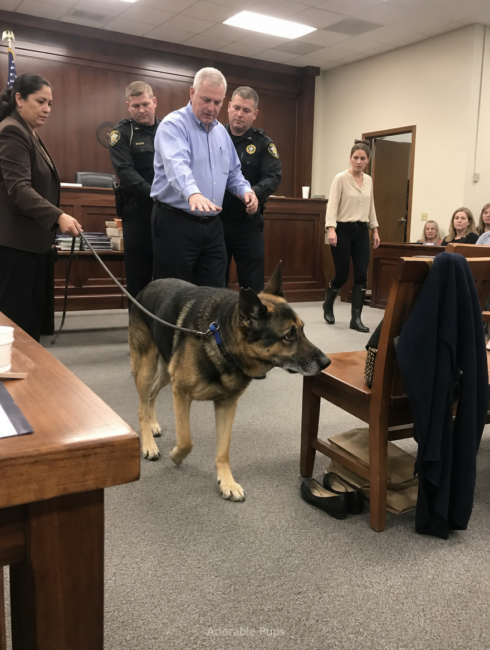
She reviewed the veterinary photographs, Claire’s notes, and Owen’s recorded statement. Then she allowed Ranger to enter under my control.
Wade called him.
Ranger moved close enough to identify the voice and scent.
He did not approach the hand.
He passed Wade and chose Claire’s chair.
The defense called it food conditioning.
Judge Shaw asked for the brown-bag records.
Claire described the deliveries without embellishment. She did not say Ranger loved her. She did not claim he understood her intentions.
She testified to actions.
“I placed food beneath the fence.”
“The dog carried part of it to the child.”
“The dog returned the bag.”
“The dog waited at the same location during later visits.”
Wade interrupted.
“She made him disloyal.”
Ranger rose.
He stood between Wade and Claire.
A deputy placed one hand near Wade’s shoulder.
Claire did not move.
Judge Shaw asked Wade one question.
“When did you last purchase food for the dog before removal?”
Wade said he could not remember.
The prosecutor placed bank records on the screen.
No pet-food purchase appeared for 119 days.
The judge signed the forfeiture order.
Wade was remanded into custody after sentencing on the protective-order charge. Deputies escorted him toward the side door.
He called Ranger’s name twice.
The dog remained across Claire’s feet.
The door closed.
Ranger listened to the lock engage.
Then he reached beneath Claire’s chair, found the empty brown bag, and carried it to her.
The room believed it had witnessed a dog choosing the person who fed him.
That was true.
It was not the whole truth.
Ranger had chosen the person who understood that every bag had two destinations.
Part 5, The German Shepherd Claire Could Not Save
Claire’s first German Shepherd was named Mason.
She met him nine years before Ranger, during her first year as a child-welfare investigator. Mason lived outside a rental house where Claire conducted monthly visits involving two young sisters.
The dog was thin.
Claire reported him.
An officer inspected the property, found food present that day, and closed the complaint.
Claire returned with dog food twice. Then her supervisor told her to stop making unscheduled visits because the family had accused her of harassment.
She stopped.
Six weeks later, Mason disappeared.
The owner said he had been given away. No transfer record, shelter intake, or veterinary file supported that account.
Claire searched neighborhood groups for months.
She never found him.
The brown paper bags began with Mason.
Claire had used them because they looked ordinary. She could carry one through a neighborhood without drawing attention, slide it beneath a fence, and leave without confronting an owner who might punish the dog afterward.
She kept one unused bag in the bottom drawer of her desk.
Not as a memorial.
As a reminder of what delay costs.
When Claire saw Ranger behind Wade’s fence, the scar on his shoulder and the narrowness of his waist brought back every unanswered question about Mason.
That history did not make her careless.
It made her methodical.
She photographed dates.
Saved receipts.
Recorded water levels.
Documented Ranger’s route to Owen’s window.
The food kept two bodies alive. The evidence created the legal path to remove them.
Ranger did not choose Claire because she gave him more than Wade did.
He chose her because she arrived in a repeated sequence.
Double step in the alley.
Brown bag beneath the fence.
Food for Owen.
Food for Ranger.
Quiet departure.
Safety without demand.
She never commanded him to sit. She never reached over his head. She never required affection in exchange for food.
Ranger learned the function of her arrival.
When that sound came, hunger stopped for one night.
Owen ate.
Nobody shouted.
The German Shepherd had not been bribed.
He had recognized a pattern of safety.
Part 6, The Home Claire Believed She Could Not Offer
After the hearing, Claire refused to take Ranger home.
The decision surprised everyone except her.
“My job keeps me away ten hours some days,” she said. “My apartment has no yard. He needs someone who knows what they’re doing.”
Ranger remained beneath her chair.
Helen, his foster caretaker, offered to take him back that afternoon.
I attached the lead and asked Ranger to stand. He followed me to the courtroom aisle, stopped, and looked at Claire.
She picked up her cardigan.
Ranger walked three steps toward the exit.
Claire collected the yellow legal pad.
He walked two more.
She left the brown bag beneath the chair.
Ranger stopped.
Claire stared at it.
The paper had become the object through which both of them kept speaking about fear without naming it.
She returned for the bag.
Ranger followed her into the hallway.
We agreed on a temporary arrangement. Claire would ride with us to Helen’s home so Ranger could see her enter and leave safely. Nobody mentioned adoption.
At Helen’s house, Ranger drank water, inspected each door, and lay beside the front window.
Claire sat on the porch steps.
“He’s going to think I’m leaving him,” she said.
“He has watched people leave before.”
“That isn’t an answer.”
“No.”
Claire folded the paper bag into a narrow rectangle.
Ranger watched through the glass.
“I told myself Mason had found another home,” she said. “I needed that to be true.”
“You don’t know that it wasn’t.”
“I know I stopped going.”
A person can obey procedure and still carry the result like a private failure.
Claire had built nine years of work around not repeating that failure. She had become the employee who saved receipts, photographed bowls, returned after dark, and noticed when a child’s food traveled through a dog.
Taking Ranger home felt different.
Professional action had rules.
Love created the possibility of failing again.
Helen opened the screen door.
Ranger stepped onto the porch. He approached Claire without touching her and placed one paw on the folded bag.
She covered his paw with her hand.
“I don’t know if I can do this right.”
Ranger waited.
Helen offered a thirty-day foster trial.
Claire accepted seven.
The first night, Ranger did not enter her bedroom. He slept across the apartment’s front door.
At 2:18 a.m., Claire found him awake with his head raised toward the hallway.
She sat on the floor five feet away.
No brown bag.
No food.
No fence between them.
Ranger remained where he was.
Claire removed one black flat and placed it beside him. The worn right heel had produced the sound he recognized for months.
He smelled the shoe.
Then he lowered his head across it.
On the second day, Claire bought an orthopedic bed. Ranger ignored it.
On the third, she worked late. A neighbor reported that Ranger sat beside the door beginning at 7:15, the same time Claire once entered the alley.
On the fourth evening, Claire carried groceries upstairs in brown paper bags.
Ranger took the first one from her hand and walked toward the guest room.
He placed it beneath the window.
The room was empty.
He looked at Claire.
She understood.
Ranger was searching for Owen.
Claire called the boy’s aunt. With approval from his therapist and case manager, they arranged a video call.
Owen appeared on the screen.
Ranger heard his voice and searched behind the laptop. He checked the hall, kitchen, and front door.
Owen laughed.
“I’m not there, Ranger.”
The dog returned to the screen.
Owen held up a brown paper bag.
Ranger sat.
“I have food now,” the boy said. “You can eat yours.”
Claire turned her face toward the window.
Ranger walked to his bowl.
He ate.
The seven-day placement became thirty days.
The adoption review took another six weeks because Claire had participated in the original welfare case. An independent committee examined potential conflicts, Ranger’s behavior, alternative placements, and ongoing contact with Owen.
Claire did not receive special treatment.
She passed the same home inspection, veterinary-reference check, landlord approval, and behavioral interview required of other adopters.
Ranger’s final choice was not made in a courtroom.
It happened during a neutral adoption meeting at Helen’s house.
Three approved families arrived separately. Each offered experience, space, and stable care. Ranger greeted them politely. He accepted treats from two and allowed one man to brush his back.
Claire waited outside until the evaluations ended.
When she entered, she carried nothing.
No food.
No paper bag.
Ranger rose from beside Helen.
He crossed the room and placed his head beneath Claire’s empty hand.
The committee approved the adoption on December 1.
Owen visited during winter break.
He had grown nearly three inches. His hair was longer, and he no longer lowered his eyes whenever an adult entered the room.
Ranger heard him on the stairs.
The German Shepherd reached the apartment door before Owen knocked. He did not bark. His body began shaking from shoulders to tail.
Claire opened the door.
Owen knelt.
Ranger pressed his chest against him so carefully that the boy remained balanced.
Owen buried both hands in the silvering fur around the dog’s neck.
“You stayed,” he said.
Ranger turned and looked at Claire.
The boy followed his gaze.
“She stayed too,” Owen said.
They ate lunch at Claire’s small kitchen table. Owen finished everything on his plate. Ranger lay beneath his chair but did not search the floor for dropped food.
Before leaving, Owen placed an empty brown bag beside Ranger’s bed.
Inside, he had written one sentence:
You don’t have to carry mine anymore.
Ranger could not read it.
Claire could.
She sat on the floor until the winter light disappeared from the window.
Ranger placed one paw over the bag.
Part 7, The First Monday of Every Month
On the first Monday of every month, Claire takes Ranger to Owen’s aunt’s house near Augusta.
They leave Savannah at 7:40 a.m. Ranger rides behind the passenger seat with his head beside Claire’s shoulder. A folded brown paper bag rests in the cup holder.
Owen waits at the driveway.
He is thirteen now.
Ranger checks him in the same order each time: shoes, hands, sleeves, face. Then he walks through the house and inspects every doorway before settling beside the kitchen table.
Claire brings lunch in the paper bag.
One sandwich for Owen.
One container of chicken and rice for Ranger.
The food no longer needs to pass beneath a fence.
Before they eat, Owen folds the top twice and places the bag between them. Ranger touches it with one paw.
Only then does Claire open it.
Wade is no longer part of Ranger’s life. His ownership rights were permanently terminated, and the court prohibited future possession of animals during probation.
Ranger does not wait at courthouse doors.
He returned to the building once, eighteen months after the hearing, as part of a training session for social workers and animal-control officers handling cases where harm to children and animals overlaps.
The session took place in the same courtroom.
Claire sat in the third row.
Ranger entered with me, inspected both doors, and walked directly to her chair.
A new social worker asked whether the dog remembered the food.
Claire looked down at him.
“He remembered what happened after it arrived.”
That answer became part of the training.
A bowl filled for one day is not a complete rescue. Neither is a report, photograph, court order, foster bed, or adoption signature by itself.
Ranger’s safety came from a sequence of small acts performed by people who kept returning.
Last month, Claire replaced her worn black flats.
She planned to throw the old pair away, but Ranger carried the right shoe to his bed.
The uneven heel no longer makes its double tap through an alley.
It does not need to.
Claire placed the shoe beside Owen’s folded paper bag.
Ranger rested his chin across both.
For months, he had listened for the woman who came quietly and left before anyone could thank her.
Now, when her footsteps cross the apartment, he does not rise to check whether she will disappear.
He already knows where she sits.
Follow this page for more gripping dog stories about quiet loyalty, second chances, and the people animals remember long after everyone else stops looking.