Part 2: A Pit Bull Saved My Father’s Life Twice — The First Time He Barked Through A Locked Door, The Second Time He Walked Four Miles In The Dark To Reach A House He Had Never Lived In
My father came home from the hospital ten days later, on a cold morning in late October, with a titanium pin in his right hip and the same stubborn look on his face he had worn at my wedding in 1992.
He still would not move to Cleveland.
I drove down to Pittsburgh every weekend for six weeks. I cooked. I cleaned. I helped him to the bathroom in the daytime when he could not yet manage stairs. I hated the look on his face when I had to do that. He hated it more.
Bruno did not leave his side.
He slept under my father’s hospital bed during the day — we had moved a rented hospital bed into the dining room downstairs because my father could not get up to his bedroom anymore for the first month — and on the foot of the bed at night. He was a different dog after the fall. He had been a calm, social Pit Bull before. After the fall, he was on duty. He watched my father walk. He watched him sit down. He watched him stand up. If my father stumbled, even slightly, Bruno was already moving toward him.
Renee from next door came over every day on her way home from her ER shifts. She would bring soup. She would change a bandage. She would sit at the kitchen table with my father and Bruno and talk about nothing for half an hour and then go home.
My father had not had a friend like that in twenty years.
He recovered slowly. He walked again with a cane by Christmas. He started cooking for himself again by February. By the spring of 2022 he was almost back to himself.
He stayed in the house on the south side of Pittsburgh for another year and a half.
In the summer of 2023, when my father was eighty-two, he had a small stroke — a transient ischemic attack, the doctors called it, a kind of stroke that resolves on its own — that scared all of us, including him. He had been making coffee in the kitchen on a Saturday morning. The pot had slipped from his right hand. He had stood there for thirty seconds not knowing what year it was.
It had passed.
But the doctors at UPMC sat us down in a small conference room three days later and told us, very gently, that this was a warning. That my father needed to be living with someone. That at eighty-two years old, with a previous broken hip and a TIA, he could not be alone in a row house on the south side of Pittsburgh anymore.
I asked my father, in front of the doctor, if he would come to Cleveland.
He did not argue this time. He looked at me. He looked at the doctor. He looked at his hands.
He said, “Margie. I’ll come.”
That was the day I started to cry without being able to stop. Not because I had won the argument. Because my father had just told me that he was, for the first time in his eighty-two years of life, ready to ask for help.
We moved him to Cleveland in October of 2023.
There was one problem.
Frank, my husband, had developed a serious dog allergy in his fifties — a thing that neither of us had seen coming, since we had owned a Beagle named Petey for the first eighteen years of our marriage with no problem. By the time of my father’s TIA, Frank could not be in the same room as a Pit Bull without his eyes swelling shut.
We could not bring Bruno.
I want you to understand what this meant.
My father, who had buried his wife and built his own house and broken his hip and survived a stroke and finally agreed at eighty-two to leave the home he had built with his own two hands — was being asked, in the same conversation, to give up the dog who had saved his life two years earlier.
He sat at his kitchen table on the south side of Pittsburgh on a Saturday afternoon and he did not speak for almost an hour. Bruno was lying on the linoleum with his chin on my father’s left foot.
Finally my father said, “Margie. Where will he go?”
I did not have an answer ready.
That is when Renee Calloway, who had come over to help us pack and was sitting at the table with us, said quietly, “Henry. I’ll take him. If you want me to. I love that dog. I’ll keep him here. He’ll be okay.”
My father looked at her for a long time.
Then he reached across the table and he put his hand on hers. He said, “Renee. Your mother raised you right.”
She started crying. He did not.
We moved my father to Cleveland a week later. Bruno stayed in the row house attached to my father’s old one, with Renee, three doors down from the home he had lived in for four and a half years.
My father called Renee every Sunday afternoon to ask about Bruno. Renee would put the phone on speaker and let my father talk to him. Bruno would lie on her kitchen floor with his ears up listening to my father’s voice coming out of a small black speaker, and he would thump his tail twice every time my father said his name.
Eight months passed.
The second thing happened on a Tuesday night in June of 2024.
My father had been living in our spare bedroom in our house in Cleveland Heights for eight months. He was doing reasonably well — a little slower, a little more confused on bad days, but eating, walking, watching the Pirates games on TV in the evenings, calling Renee on Sundays, missing his dog.
That Tuesday night, he had gone to bed at his usual time, around nine-thirty.
At about midnight-thirty, my father had a stroke in his bed.
It was not a TIA this time. It was the real thing. He could not move the left side of his body. He could not speak. He was alone in the spare bedroom with the door closed, on the second floor of a house in Cleveland Heights, and Frank and I were asleep two doors down with our own bedroom door also closed.
He did not have a way to call for us. He had a small medical-alert pendant on his nightstand — the same one I had been trying to get him to wear for years — but it was on the nightstand, not on his neck. He could not reach it. He could not press it. He could not yell. He was lying in the dark with one functioning side of his body, and he was — by his own account, written down later in a slow shaky hand — beginning to accept that this was the end.
At 1:14 a.m., something started barking at our front door.
I want to tell you what I thought when I heard it, because the thinking matters.
I thought it was a stray. We live on a busy street in Cleveland Heights. We get raccoons sometimes. We get the occasional lost dog. The bark was loud and steady and weird-sounding for a stray — too persistent, too directional — and I lay in bed for about two minutes telling myself it was nothing.
Frank rolled over next to me. He said, “Margie. That dog is not going to stop.”
I got up. I put on a robe. I went down the stairs. I turned on the porch light. I opened the front door.
There was a brindle Pit Bull on my porch.
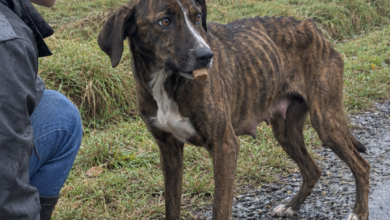
Sixty-three pounds. White chest. Black freckle on his bottom lip. One ear up, one ear flopped halfway. A red leather collar I recognized.
Bruno.
I thought I was hallucinating for a full ten seconds. Bruno was supposed to be in Pittsburgh. Bruno was supposed to be three doors down from my father’s old house, in the kitchen of a thirty-eight-year-old ER nurse named Renee Calloway, four hours and one state line away from my front porch in Cleveland Heights.
Bruno was on my porch. Panting. Tail wagging. Looking up at me with the same brown eyes he had been looking at my father with for four and a half years.
He did not jump on me. He did not bark. He stopped barking the second I opened the door. He looked past me — into the house, up the stairs.
He let out one small huff through his nose.
I stood in the doorway with my hand on the door and I started to understand that something was wrong with my father.
I took the stairs two at a time. I did not even close the front door. I burst into the spare bedroom. I turned on the light. My father was on his back. His left arm was hanging off the bed. The left side of his face was slack. His eyes were open and they tracked me as I crossed the room.
I called 911 from his nightstand phone with one hand and I held his good hand with my other. He squeezed my hand once.
The paramedics arrived in eleven minutes. They got him to University Hospitals Cleveland Medical Center within the window for clot-buster medication. He survived the stroke. He recovered most of the function on his left side over the next four months. The neurologist told us, two days later in the hospital, that the timing of our 911 call had been the only reason my father was going to walk out of that hospital instead of being moved to long-term care.
I asked the neurologist what would have happened if I had not heard him at 1:14 a.m.
The neurologist looked at me and said, very gently, “Mrs. — Mrs. Walsh. He would not have survived to morning.”
Bruno was in our living room.
I had remembered to close the front door at some point during the chaos of the paramedics. He had walked into the house behind them. He had gone up the stairs. He had stood in the doorway of my father’s bedroom while the paramedics worked. He had not gotten in their way. He had watched.
He had ridden in the back of my car to the hospital, because I had not been able to leave him alone in the house and I had not been able to leave my father, and so I had taken him with me and the security guard in the lobby — a kindly man named Marcus — had let me bring him in because I was crying too hard to argue.
I called Renee from the hospital waiting room at three in the morning.
I said, “Renee. Bruno is here.”
She said, “What?”
I said, “Renee. Bruno just walked four miles to my house in Cleveland and barked at my front door and we found my dad having a stroke. Bruno is here. In Cleveland. With me. Right now.”
She was quiet on the phone for a long time.
She said, “Margie. He got out of my back yard sometime last night. I noticed at midnight. I have been driving around Pittsburgh for three hours looking for him.”
We did the math together on the phone, both of us crying.
Bruno had jumped Renee’s six-foot back fence sometime between eleven and midnight. Pittsburgh to Cleveland Heights, the way a dog would walk it, is not four miles — it is a hundred and thirty-six miles. He cannot have walked from Pittsburgh.
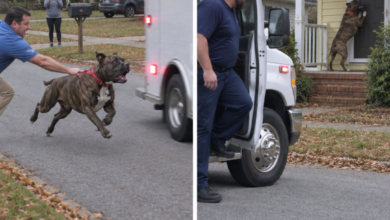
What we figured out, eventually, by tracing the timeline backwards with Renee and a couple of Pittsburgh neighbors, is that Bruno had jumped the fence in Pittsburgh, walked to a Greyhound bus station in downtown Pittsburgh — which Renee confirmed was a route my father had walked him on Sunday afternoons for two years before they moved away — and somehow, miraculously, climbed onto an idling tour bus that was being prepared for a 5:30 a.m. departure to Cleveland. The bus driver, a man named Patrick Kelleher, told the story to a Pittsburgh local-news reporter two weeks later: he had finished his pre-trip inspection, walked into the terminal for a coffee, come back to find a 63-pound brindle Pit Bull asleep on a passenger seat in row twelve. He had called animal control. Animal control had been forty-five minutes out. He had decided to drive the route with the dog and call the Cleveland shelter on arrival.
Bruno had ridden the bus to Cleveland in row twelve with no human.
Patrick had let him off in downtown Cleveland at 9:45 a.m. on Tuesday morning with a bowl of water from the bus station and a phone call to Cleveland animal control that, by Tuesday afternoon, had still not produced a pickup.
Bruno had wandered out of downtown Cleveland sometime that afternoon.
He had walked the four miles from downtown Cleveland to my front porch in Cleveland Heights over the next twelve hours.
We have no idea how he found my house.
Patrick Kelleher told the reporter, “Ma’am. I have been driving Greyhound for twenty-eight years. I have seen things. I have not seen this. I do not have an explanation.”
I do not have one either.
I am not going to give you one.
We brought Bruno home with us that day. We brought him home with us forever.
Frank’s allergies were not as bad as we thought, it turned out, with a high-quality air filter and weekly baths and a new prescription Frank had been meaning to ask his doctor about for three years. Frank told me, four months into having Bruno in the house, that watching that dog with my father had been worth every antihistamine he had taken in his life.
My father lived another four years with Bruno at his side.
He recovered most of the function on his left side. He walked with a cane. He ate scrambled eggs every morning. He went to my granddaughter Lila’s elementary school graduation in May of 2025 in a wheelchair we rented for the day, and Bruno sat at his feet during the ceremony, on the gym floor of a Cleveland public school, with the kind of patience only a sixty-three-pound Pit Bull can have for an entire fifth-grade ceremony.
My father called Renee every Sunday afternoon for the rest of his life. He thanked her for taking care of Bruno when he could not. She told him every time, the same way every time, “Henry. I think Bruno took care of me. Not the other way around.”
He had two more good years.
By the fall of 2025, he was slowing down. By Christmas, he was in a hospital bed downstairs again, in our living room this time, because the stairs had become too much. By February of 2026 — two months ago, as I am writing this — he was sleeping more than waking.
Bruno had moved his bed from the hallway to the floor next to my father’s hospital bed in November. He did not leave the room except to go outside. He ate in the room. He slept in the room. He laid his big square head on the corner of the mattress and watched my father breathe.
We knew it was coming. The hospice nurse had told us.
On the night of February 22nd of this year, at about eleven o’clock at night, I went into the living room to check on my father one last time before I went to bed.
The lights were off except for a small lamp on the side table. My father was asleep. His breathing was slow but steady. Bruno was on the floor next to the bed.
I bent down and kissed my father on the forehead. I told him I loved him. I went upstairs to bed.
At 3:12 a.m. — I know the time because I looked at the clock — I came out of sleep with the feeling that something had changed in the house. I do not know how to describe it better than that. The house was completely silent. There was no bark. There was no alarm. There was nothing.
I put on my robe. I went down the stairs.
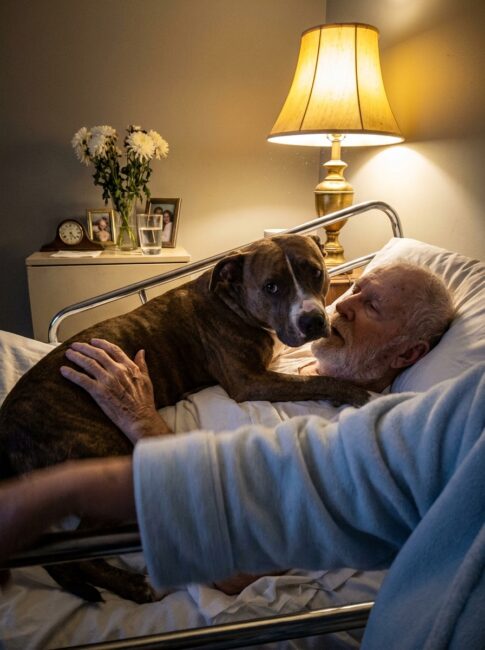
Bruno was on the bed. He had climbed up onto the hospital bed at some point in the night. He was lying across my father’s chest the way a child sleeps on a parent’s chest — head on the shoulder, body draped along the ribs, one paw curled under my father’s chin.
He was not barking.
He was not whining.
He was breathing very slowly, the way a dog breathes when he is keeping watch.
My father was not breathing.
I do not know exactly when my father went. I do not know if he went at one a.m. or at two-thirty or at three. I know that whenever he went, Bruno was already on him. Bruno had not left him. Bruno had not called for me.
He had gotten up. He had climbed up. He had laid himself down on the chest of the man who had adopted him from a city shelter on a Tuesday afternoon in April of 2019, and he had stayed.
He had not barked.
Because this time, there was nobody to call.
This time, Bruno was the only one who needed to be there.
I sat down on the floor next to the hospital bed and I put my hand on Bruno’s back. He did not look at me. He did not move. He kept his head exactly where it was on my father’s shoulder. He kept breathing slow.
I cried as quietly as I could because I did not want to disturb him.
After a while — I do not know how long — Bruno turned his head and licked the side of my father’s face once. Just once. Then he laid his head back down.
I stayed on the floor for almost an hour. Bruno stayed on my father’s chest the whole time.
When I finally stood up to call hospice, Bruno did not move. The hospice nurse, a kind woman named Isabel who had been coming to our house for six weeks, came in at four-thirty in the morning. She did her work gently. She talked to Bruno the entire time as she worked. She said things like, “You did good, baby. You were here. You were here the whole time.”
When the time came to take my father out of the house, Bruno finally got off the bed.
He walked, slow, behind the gurney. He went down the front steps with them. He stood on the sidewalk and watched the hearse drive away.
He did not bark.
He did not need to. There was nobody to call.
Bruno is ten years old now.
He sleeps on the foot of my bed. He still eats scrambled eggs every morning the way my father fed him for years. He goes for slow walks with me twice a day around the block in Cleveland Heights. He has gray on his muzzle now and a small limp in his back leg from a tear he got in 2024, but he is okay. The vet says he has another two or three good years if we are lucky.
I think about the four miles a lot. I do not understand them. Patrick Kelleher does not understand them. Renee Calloway does not understand them. The vet does not understand them. The neurologist who saved my father in June of 2024 does not understand them.
I have stopped trying to understand them. I have made my peace with the fact that there is something inside that animal that knew where my father was, and knew when he was needed, and knew, in the end, when he was not.
He saved my father’s life twice.
He sat with him while he died once.
The math of his entire purpose adds up to three nights in eighty-six years of my father’s life — and on each of those three nights, Bruno did exactly the right thing. The first time he barked because help could come. The second time he barked because help could come. The third time he did not bark, because help could not come, and the only thing left for him to do was to lie down on the chest of a man he loved and stay there until it was over.
That is a kind of intelligence I cannot find a name for. I do not need to find a name for it. I just have to remember it. And I will, for the rest of my life.
There are two photographs in a small frame on my mantel.
One is of my father in 1971, twenty-six years old, standing in front of the brick row house he had just finished building, holding the keys in his hand and grinning at my mother who was taking the picture.
The other is of Bruno on the hospital bed with my father, asleep, the night before my father died. I took it on my phone at about ten p.m. when I had come downstairs to check on them and seen the way Bruno was draped along his side. My father is asleep with a small soft smile on his face. Bruno’s eyes are open, looking past the camera, on duty.
It is the last photograph of my father alive.
It is one of the best photographs I have ever taken.
Bruno is in it.
My father is not alone.
That is everything I have to say.
If this story moved you, follow the page — there are more like Henry and Bruno I haven’t told yet.