Part 2: I Adopted the Golden Puppy Everyone Wanted — Her First Night Revealed Who Had Raised Her
Part 2, The Puppy in Kennel Eighteen
My name is Hannah Mercer. I was forty-one and managed billing for a small physical therapy group near Donelson, Tennessee. I lived alone in a narrow brick house twelve minutes from the Nashville airport, where low planes rattled the kitchen windows on humid evenings.
I had wanted a dog for eleven months.
My husband, Caleb, died in a highway accident three years earlier. For the first year, I kept his boots beside the back door because moving them felt too much like admitting he would not need them. During the second year, I boxed his clothes but left his coffee mug in the cabinet.
By the third year, the house no longer felt paused.
It felt unused.
My sister suggested an adult dog. My neighbor recommended a cat. I chose a puppy because I wanted something whose needs would force me to stop measuring every day by what had been there before.
Riverbend County Animal Center opened at ten on Saturday, February 17. I arrived at 10:14 and found nine people waiting outside the puppy wing.
Poppy had come to Riverbend from a rural shelter near Cookeville. Her intake sheet listed her as an orphaned Golden Retriever, eight weeks and six days old, 9.4 pounds, medically cleared after treatment for aspiration pneumonia.
A narrow patch of fur beneath her chin had been shaved for an IV. Her left ear was one shade darker than her body, and three black hairs grew together beside her right nostril. When she ran, her rear paws turned outward as if they belonged to a larger puppy following close behind.
She was the dog everyone wanted.
A young couple asked whether they could reserve her before the kennels opened. A father photographed her for his two sons. An older woman pressed both palms to the gate and told Poppy she had already bought a pink bed.
Poppy greeted each person.
Then she returned to the wall.
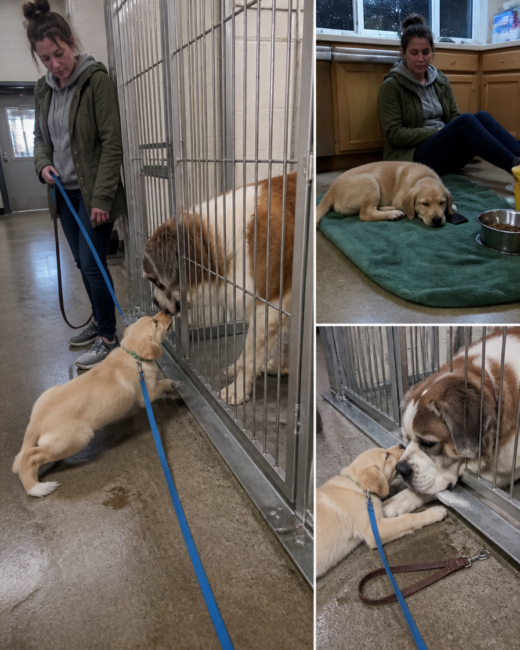
Kennel nineteen held the Saint Bernard. Mabel lay with her broad spine pressed against the divider, breathing through her nose. Her coat had once been deep rust and white, but age had softened both colors. A gray crescent circled her left eye, and the skin across her elbows was dark and bare from years of lying on hard floors.
Every few minutes, Mabel touched her food bowl with one paw.
Three metal taps.
Poppy would stop playing, walk to the wall, and lie down.
Teresa Wynn, the adoption counselor, noticed me watching.
“They’ve been neighbors since Wednesday,” she said.
“Does the puppy bother her?”
“Mabel barely reacts to anything.”
That answer stayed with me because it was wrong in a precise way. Mabel reacted to every movement Poppy made. She simply did it without raising her head.
When Poppy stumbled over her water dish, Mabel’s ear turned toward the sound. When another dog barked close to the puppy’s gate, Mabel shifted her body nearer the divider. When Poppy fell asleep, the Saint Bernard released one long exhale and closed her cloudy eye.
Mabel also refused to eat until Poppy finished.
I watched a volunteer place bowls in both kennels. Poppy scattered half her food across the floor, ate several pieces, then walked away. Mabel waited. The moment Poppy returned and swallowed the final piece, the old dog bent over her own bowl.
I thought the timing was chance.
Poppy’s adoption interview lasted forty-eight minutes. Teresa asked about my yard, work schedule, income, veterinarian, fencing, travel plans, and experience with large breeds. I signed a training agreement and bought a collar from the shelter supply shelf.
Before we left, Poppy pulled toward the divider.
Mabel tapped the bowl.
Once.
Poppy pressed her nose against the concrete gap.
Mabel lowered her muzzle to the same place.
The gate blocked their faces, but their breathing met beneath it.
Poppy followed me only after Mabel stepped away.
That was the first detail I misunderstood.
The second was the blue blanket folded inside Poppy’s travel bag. It smelled faintly of cedar shampoo and carried several strands of long white fur. I assumed the shelter had washed it with another dog’s bedding.
The third was the yellow rubber duck. Poppy did not chew it, shake it, or carry it.
She placed it against my baseboard and waited beside it.
At the shelter, Mabel had slept with an identical duck beneath her chin.
I saw all three clues before I drove away.
I understood none of them.
Part 3, Six Hours Without the Breathing
Poppy rode home in a plastic travel crate secured across the back seat. For the first two miles, she watched me through the vent holes. At the traffic light near Lebanon Pike, she began to cry.
I spoke to her at every red light.
“We’re going home.”
Poppy turned toward the rear window.
At the house, she explored the living room, kitchen, laundry room, and fenced yard. She smelled the legs of the dining table, found one of Caleb’s old tennis balls beneath the couch, and carried it three feet before dropping it.
Then she returned to the front door.
The adoption booklet recommended a quiet first day. I dimmed the lights, turned off the television, and sat beside her crate with a paperback. Poppy entered twice for treats but came out the moment I closed the door.
At 3:26, she ate seven pieces of kibble.
At 3:31, she vomited them onto the blue blanket.
I called the shelter. A receptionist told me stress was common during the first twenty-four hours and advised small portions of food, water, and a calm room. She asked whether Poppy appeared weak or had trouble breathing.
“No. She just won’t stop looking for something.”
“Probably the other puppies.”
The transfer record said Poppy’s littermates had gone to separate foster homes five weeks earlier. I accepted the explanation because it was the only one I had.
At 4:10, Poppy carried the yellow duck to the kitchen wall. She placed it against the baseboard and tapped it with one paw.
Three times.
The sound was soft on the vinyl floor.
She waited.
No metal bowl answered.
Poppy tried again.
At 5:02, I warmed a towel in the dryer and wrapped it around her. She tolerated it for nineteen seconds, then wriggled free and ran to the hallway.
At 5:47, she drank water only after I held the bowl near the front door.
At 6:15, I called my sister.
“She hates me.”
“She met you this morning.”
“She doesn’t hate strangers. She keeps waiting for one.”
My sister suggested placing a ticking clock beneath Poppy’s blanket. I found Caleb’s old travel clock in a drawer, wrapped it in a pillowcase, and put it inside the crate.
Poppy listened.
Then she backed away.
The clock had a beat, but it did not breathe.
By 7:00, her cries had settled into a repeated pattern. Three short sounds. A pause of four or five seconds. One long call.
I sat on the kitchen floor and counted them.
Three.
Pause.
One.
Each set ended with Poppy looking toward a door, wall, or heating vent. She was not calling into the room. She was waiting for a response to travel back through something solid.
At 8:16, I carried her upstairs. Poppy smelled the bedroom, bathroom, and closet. She found a pair of Caleb’s shoes beneath a garment bag and crawled halfway inside one.
For a moment, she rested.
Then a plane passed over the house. The floor trembled, and Poppy ran into the hall.
She pressed her body against the wall.
I brought her downstairs again.
At 9:03, she pulled the blue blanket from her crate. The blanket was nearly twice her size, but she dragged it across the living room, stopping whenever one corner caught beneath her paw.
She left it beside the front door.
White Saint Bernard fur clung to its edge.
I noticed that.
I still did not understand.
At 10:27, Poppy scratched the wood. Her nails made thin white marks above the threshold. When I lifted her, she turned her head toward the door and pushed against my shoulder.
“You can’t go back tonight.”
Her body became still when I said back.
The word meant nothing to her. My voice did.
I lowered myself against the kitchen cabinet and held her across my legs. Poppy’s ribs moved fast beneath my palm. She smelled like shelter soap, puppy breath, and the food she had not kept down.
I tried humming.
Caleb used to hum when he repaired things, usually without knowing he was doing it. The tune had no clear beginning. I had not heard it in three years.
Poppy cried over me.
At 11:34, I opened my phone and searched the photographs from the shelter. Most were blurred because Poppy had moved. One showed her nose filling the frame. Another caught Mabel’s white paw beneath the divider.
Then the short video played.
Poppy’s rubber ring squeaked. A gate struck metal. Near the end, Mabel inhaled slowly and released one rough, rolling breath.
Poppy’s head turned.
I stopped the recording.
She cried once.
I played it again.
Poppy crossed the kitchen and put her right ear against the speaker. Her eyes remained open through the first exhale. During the second, her front legs folded. During the third, she tucked her head against my phone.
Her breathing slowed from fifty-six breaths per minute to thirty-four.
I counted because I needed proof that I had not imagined the change.
The recording ended.
Poppy lifted her head.
I played it again.
She slept.
I lowered the phone onto the blue blanket, set the video to repeat, and watched the same six seconds cycle through the dark kitchen. Mabel breathed. Poppy settled. A rubber toy squeaked. Mabel breathed again.
At 12:18, I called Riverbend. The voicemail gave emergency instructions, then repeated the adoption-wing hours.
I left a message.
“This is Hannah Mercer. I adopted puppy 4817 today. I need to know about the Saint Bernard in kennel nineteen. The puppy recognizes her breathing.”
I hesitated.
“I think I took her away from someone.”
Poppy slept for thirty-two minutes. When my phone battery warning interrupted the video, she woke and cried.
I connected the charger and replayed it.
At 1:06, I carried the phone and blanket into the living room. Poppy followed the sound. She curled beside the speaker instead of climbing onto the couch with me.
I stretched out on the rug.
Every six seconds, the old dog breathed between us.
At 5:42, Poppy woke, walked to the front door, and sat.
I did not offer breakfast.
I put on my coat.
Poppy wore the narrow green leash I had bought the previous day. A second leash hung beside it—a wide brown lead Caleb once used when he walked our neighbor’s Labrador.
I took both.
The shelter parking lot was empty when we arrived at 6:48. Dawn had not cleared the low clouds. A delivery truck idled behind the building, and cold air carried the smell of rain and diesel across the pavement.
Poppy pulled toward the front doors.
Luis, the custodian, recognized her through the glass and let us wait inside the lobby. The adoption wing remained dark except for a row of safety lights near the floor.
At 7:06, Luis unlocked the kennel aisle.
Poppy ran as far as her leash allowed.
Mabel slept behind number nineteen, her back against the dividing wall even though the kennel beside her was empty.
Poppy cried three times.
The old Saint Bernard opened her cloudy eye.
Then Poppy gave the long call.
Mabel stood.
Her rear legs slid apart on the concrete. She caught herself against the gate, lowered her head, and released one deep breath.
Poppy collapsed against the bars.
The crying stopped.
Part 4, The Woman Who Returned With Two Leashes
Marcy arrived six minutes later and found me sitting on the kennel floor.
Poppy had pushed both front legs through the lower gap in Mabel’s gate. Mabel lay on the other side with her muzzle across them. The old dog’s breath lifted the puppy’s darker ear each time she exhaled.
Marcy stared at the brown leash beside my knee.
“Are you here to surrender Poppy?”
“No.”
“Then why did you bring that?”
“I don’t know yet.”
Marcy unlocked Mabel’s kennel.
The Saint Bernard did not come to me. She walked directly to Poppy, smelled her mouth, ears, belly, and paws, then nudged the puppy toward the water bowl.
Poppy drank.
Mabel waited until she finished.
Only then did the old dog drink.
Teresa arrived at 7:34 after hearing my voicemail. She listened to the recording in the staff room, returned to Mabel’s kennel, and watched the dogs for nearly a minute.
“I owe you an explanation,” she said.
The public adoption files showed that Mabel and Poppy were unrelated. Mabel had entered the shelter on January 29 after her owner, sixty-eight-year-old foster volunteer June Whitaker, died following a stroke.
Poppy arrived from Cookeville on February 2.
Different dates.
Different counties.
Different intake numbers.
The computer never connected them.
But the overnight binder did.
Teresa asked Marcy to bring it from the cabinet. The first page carried Poppy’s number and a warning written in blue ink.
If separated, play Mabel’s breathing. Do not use ticking clock.
Below it, another entry read:
Puppy calls 3-short/1-long. Mabel answers with bowl or breath.
I looked toward the kennel window.
Poppy had placed the yellow duck beneath Mabel’s chin. Mabel held it between both front paws.
“Who wrote this?”
“A night technician named Erin,” Marcy said. “She left for maternity leave on Friday. Some of her notes were never transferred into the main file.”
“Why were they separated?”
Poppy had been medically cleared and moved into the public adoption wing. Mabel remained on senior evaluation because the shelter veterinarian had found a lump near her right shoulder and wanted imaging before approving her placement.
The kennels happened to be next to each other.
At least, that was what the day staff believed.
The night staff knew Poppy could not sleep unless Mabel was close.
For eleven nights, Erin opened the divider after the building closed. Mabel entered Poppy’s kennel, circled once, and lay around her. At 5:30 each morning, Erin separated them before cleaning began.
“They were together every night?” I asked.
Marcy nodded.
“Then you let me adopt one?”
Teresa’s jaw tightened. “The bond was not entered into the adoption record. I saw a social puppy beside a quiet adult dog. I should have asked why she kept returning to the wall.”
The shelter could not simply hand Mabel to me. The old dog still needed imaging, a full senior blood panel, and an adoption evaluation. I also needed to consider her weight, arthritis, medical expenses, and the fact that I had never owned a giant breed.
A Saint Bernard could cost more to feed in a month than Poppy would in three. Mabel needed a ramp, wide sleeping space, joint care, and help on slick floors. Her adoption form listed an estimated age of ten years and three months.
I listened.
The second leash stayed in my hand.
Mabel rose and walked toward me. Her cloudy eye gave her face an uneven expression. She smelled my coat, then leaned the side of her head against my ribs.
She did not ask for attention.
She watched Poppy behind me.
“Can I foster her during the evaluation?”
Teresa looked at the leash.
“You came prepared.”
“No. I came afraid I had made one dog sleep alone.”
Mabel’s radiographs were scheduled for Monday. The shelter veterinarian examined her hips, heart, lungs, eyes, teeth, and shoulder. The lump moved freely beneath the skin and appeared consistent with a lipoma, but a needle sample was sent to a laboratory.
Her heart sounded strong. Her bloodwork showed mild anemia and early kidney changes that could be managed with diet and monitoring.
At 10:52, Teresa approved a medical foster placement.
Luis found a folding ramp in the shelter supply shed. Marcy packed Mabel’s green blanket, joint medication, bowls, records, and a bag containing two more yellow ducks.
Mabel wore the brown leash.
Poppy walked beside her through the lobby.
The old dog’s gait was slow, and one rear foot dragged every sixth or seventh step. Poppy adjusted without being guided. She stopped when Mabel stopped and moved when Mabel moved.
Families waiting outside turned toward them.
The puppy everyone had wanted walked past without looking at anyone.
Getting Mabel into my car took three people and a ramp. Poppy climbed in after her and pushed beneath the old dog’s chest before I closed the door.
During the twelve-minute drive home, Poppy made no sound.
At my house, Mabel inspected the front room, kitchen, yard, and hallway. She found Poppy’s blue blanket beside the door and smelled the white hairs along its edge.
Then she walked to the kitchen.
Poppy followed.
Mabel lowered herself beside the refrigerator. Poppy circled once, placed her head beneath the old dog’s jaw, and slept.
The house became quiet.
This time, it sounded occupied.
Part 5, What Happened Before Poppy Learned Her Name
The laboratory called Tuesday morning.
Mabel’s lump was a benign fatty growth. Her arthritis needed treatment, and the veterinarian wanted kidney tests every six months, but no medical result prevented adoption.
I expected that to be the final answer.
It was not.
Erin, the night technician, heard that I had returned. She called from home while her newborn daughter slept against her shoulder and asked whether I still had the six-second video.
“You recorded the breathing?” she said.
“Yes.”
“June used to do that.”
June Whitaker had owned Mabel for seven years. She had also fostered orphaned and medically fragile puppies for Riverbend’s rescue network.
After her husband died, June converted her laundry room into a nursery. She kept warming boxes along one wall, formula in a small refrigerator, and an old baby monitor beside her chair.
Mabel arrived as a three-year-old Saint Bernard whose previous family could no longer manage her size. June planned to foster her for two weeks.
Mabel remained for seven years.
The first orphaned litter came eleven months later. Their mother had died after an emergency delivery, leaving six hound-mix puppies less than two days old.
June fed them with bottles.
Mabel did everything the bottles could not.
She cleaned their faces, stimulated them after meals, warmed them against her abdomen, responded when one crawled away, and slept beside their box with her head across the opening. She had been spayed years earlier and could not provide milk, but she supplied nearly everything that happened between feedings.
When the puppies cried, Mabel tapped the side of the warming box.
Three times.
They learned to move toward the sound.
During Mabel’s fourth year with June, an orphaned puppy developed pneumonia and spent nine days at the veterinary clinic. The puppy refused to settle in an oxygen kennel, so June recorded Mabel breathing on her phone.
The clinic played it through a small speaker.
The puppy slept.
After that, June created a one-minute recording for every orphaned litter Mabel helped raise. Foster families played it during car rides, veterinary stays, and the first nights after separation.
Mabel’s breath had become part of the rescue protocol, though it existed only in June’s handwritten notes and the memories of a few volunteers.
Poppy entered that history on February 2.
Her mother, a four-year-old Golden Retriever named Daisy, had been surrendered to the Cookeville shelter while heavily pregnant. Daisy delivered five puppies during the night, then developed severe complications. Despite emergency surgery, she died before sunrise.
Four puppies were strong enough to enter bottle foster together.
Poppy was not.
She aspirated formula during her second feeding. Her temperature dropped, her breathing became wet, and she was transferred to Riverbend because its clinic had an oxygen unit.
Poppy spent the next three days alone behind clear plastic walls.
She survived the pneumonia.
Then she stopped sleeping.
Erin tried a warming toy with a mechanical heartbeat. Poppy crawled away from it. She tried a ticking clock, but the sharp rhythm made the puppy cry harder.
At 2:13 on Poppy’s fourth night, Mabel began scratching the door of the senior room.
June had died five days earlier. Mabel had been brought to Riverbend with her bed, bowls, medicine, and three boxes of June’s foster supplies. Staff believed the Saint Bernard was restless because she had lost her owner.
Erin led her into the clinic hallway.
Mabel walked past four kennels and stopped outside Poppy’s oxygen unit.
The puppy cried three times.
Mabel tapped the plastic wall.
Poppy crawled toward her.
The veterinarian would not allow direct contact until the infection risk passed, so Mabel slept outside the oxygen kennel. She remained there through the rest of the night, breathing against the plastic while Poppy pressed her face to the opposite side.
Poppy’s respiratory rate slowed.
Her oxygen level remained stable.
The next morning, she ate a full feeding.
Once Poppy completed antibiotics, staff placed them together under supervision. Mabel inspected her in the same order I later saw at the shelter—mouth, ears, belly, paws. Poppy climbed beneath her chest.
For five weeks, Mabel raised her.
Staff bottle-fed the puppy. Mabel woke her for meals, kept her warm, cleaned spilled formula from her face, blocked her from crawling beneath shelves, and taught her to follow the three taps of a bowl.
Poppy’s littermates lived with one another.
Poppy had Mabel.
“What about the recording?” I asked.
Erin became quiet.
“We made it the night before they entered the adoption wing. We knew they would have to spend part of the day apart.”
“Why wasn’t it sent home with her?”
“It was stored on June’s old phone. The phone disappeared when her family collected the boxes.”
The note remained in the overnight binder, but the audio file did not.
My accidental six-second video had recreated something Poppy had heard through her illness, every feeding, and every night she had spent without her biological mother.
Poppy had not calmed because the noise was pleasant.
She had learned a sequence.
That breath meant warmth arrived next.
That breath meant food would come.
That breath meant a large body stood between her and an empty room.
I looked at Mabel sleeping across my kitchen doorway. Poppy lay against the rise and fall of her ribs.
The first night in my house, I had offered the puppy every object experts said might resemble a mother.
She had not wanted something that resembled safety.
She wanted the dog who had already provided it.
Part 6, Everything the Old Dog Had Been Teaching
Erin sent me photographs from Poppy’s five weeks in the clinic.
In the first, Mabel lay outside the oxygen kennel with her nose touching the clear wall. Poppy was barely visible beneath a towel.
In the second, taken nine days later, the puppy slept between Mabel’s front legs. A feeding bottle stood upside down in a metal cup, and one yellow duck rested beneath Mabel’s jaw.
The third photograph explained the blue blanket.
June had used cedar-scented shampoo on Mabel. After her death, the shelter packed the old dog’s belongings into boxes. Erin cut Mabel’s largest blanket into smaller pieces and placed one beneath each puppy Mabel had helped settle.
Poppy’s piece came home with me.
The white hairs were not accidental.
The yellow duck had a history too. June bought the toys in packages of three because their long necks fit beneath Mabel’s chin. She placed one in every warming box. The puppies learned that the toy appeared wherever Mabel slept.
Poppy had carried hers to my kitchen wall because toys had always been placed beside the Saint Bernard.
The three taps against the floor were not random play.
Mabel used that signal whenever Poppy crawled beyond the edge of her blanket. The sound traveled through warming-box walls and kennel dividers. Poppy had learned that three taps meant come closer.
The puppy’s three short cries and one long call had formed the other half of the exchange. Mabel answered with her paw when she was awake and with a deep exhale when she was already lying beside the wall.
Poppy had spent six hours calling into my house.
Nothing answered until my phone breathed.
Mabel’s quiet behavior at the shelter also changed meaning. Teresa said the Saint Bernard barely reacted, but she had been watching Poppy through sound, scent, and vibration.
She waited to eat because June’s feeding routine always served puppies first.
She slept against the divider because that was where Poppy’s warmth and breathing could reach her.
She tapped the bowl because the puppy wandered toward visitors and needed to know how to return.
Even Mabel’s refusal to greet families made sense. For five weeks, people had entered her space to examine, feed, or carry Poppy. Mabel learned to watch their hands before offering her body.
She was not detached.
She was on duty.
Mabel’s foster period became an adoption on March 8. I signed her paperwork in the same office where I had signed Poppy’s nineteen days earlier.
The shelter waived the senior adoption fee. I used the money to buy two rubber-backed runners for the hallway and a ramp for the back steps.
Mabel ignored the orthopedic bed I ordered.
She slept beside Poppy’s crate.
Poppy’s first months became a series of small lessons delivered without commands. Mabel stood beside the back door until Poppy followed her into the yard. She blocked the stairs with one shoulder when the puppy tried to climb them too fast. She placed her body between Poppy and the vacuum cleaner but moved aside once the puppy stopped trembling.
Mabel never corrected her with force.
One look was enough.
At fourteen weeks, Poppy learned to ring a bell beside the back door. I believed I had taught her. Then I saw Mabel touch the bell with her nose while Poppy watched.
At five months, Poppy began bringing her food bowl to the kitchen when it was empty. Mabel had done that for years in June’s foster room.
At seven months, Poppy stopped sleeping beneath Mabel’s chest because she no longer fit. She placed her head across the old dog’s front paws instead.
Mabel’s arthritis worsened during the summer. She needed help entering the car, and her rear foot dragged on long walks. Poppy adjusted her pace.
She had once followed Mabel because she needed protection.
Now she walked slowly because Mabel needed time.
Riverbend invited us to visit a foster class in October. Mabel lay on a rubber mat while eight volunteers learned to bottle-feed orphaned puppies. Poppy sat beside her, restless at first.
A three-day-old Beagle mix began crying inside a warming box.
Mabel lifted her head.
She tapped the mat three times.
Poppy turned toward the box.
The puppy cried again. Mabel tried to stand, but her rear legs failed beneath her. Before I could help, Poppy crossed the room and lay outside the warming box.
She did not know what to do.
She looked back at Mabel.
The old dog released one long breath.
Poppy lowered her face against the clear wall.
The crying stopped.
Nobody in the room spoke.
Erin reached for her phone and began recording.
Not Mabel this time.
Poppy.
Part 7, The Breathing We Keep
Mabel lived with us for two years and four months.
Her days became slower, but she kept the same evening routine. At 9:00, she checked Poppy’s bowl. At 9:15, she walked through the kitchen and touched the back door. At 9:30, she lowered herself onto the blue blanket.
Poppy always waited for the first deep breath before lying down.
I began recording one minute every Sunday evening. The files contained little worth watching: a dark kitchen, the refrigerator motor, Poppy shifting her paws, and Mabel breathing.
I saved each recording by date.
When Mabel could no longer climb the back step, Poppy stood inside while I guided the old dog up the ramp. When Mabel stopped finishing her meals, Poppy waited beside the bowl but did not touch the food.
On June 26, Mabel refused breakfast and rested with her head beneath the kitchen window. Our veterinarian came to the house that afternoon.
Poppy lay against Mabel’s chest.
The old dog took one final deep breath, released it slowly, and did not draw another.
Poppy waited.
Then she tapped the floor three times.
I placed my hand over hers.
Seven months later, Riverbend called about two orphaned Golden Retriever puppies whose mother could not care for them. The shelter needed a calm adult dog to remain beside their warming box between feedings.
Poppy was two years old.
She had never raised a litter.
We brought her to the foster room with Mabel’s blue blanket and one yellow duck. Poppy circled the box twice, smelled both puppies, and looked at me.
One puppy cried three times.
Poppy lay down.
Her first breath came fast. The next was slower. By the fourth, both puppies had crawled toward the sound.
I sat beside her and opened the oldest recording on my phone.
Mabel breathed from six years earlier.
Poppy breathed beside me.
The two sounds overlapped until I could no longer tell where one ended and the other began.
Every Sunday, I still record one minute.
Some habits should be carried forward.
Follow this page for more gripping dog stories about second chances, quiet devotion, and the animals whose hidden histories change the families who choose them.