Part 2: I Yelled at a Biker to Get Out of My Neighborhood. Two Weeks Later, He Showed Up at My Door With My Dog in His Saddlebag.
I want to tell you what I saw on his face when he looked at me.
He did not look angry.
He did not look hurt.
He looked at me the way a man looks at a child throwing a tantrum in a grocery store. With a kind of patient, tired sadness. Like he had seen this a hundred times before and he was not surprised, just disappointed in some small adult way I did not understand at the time.
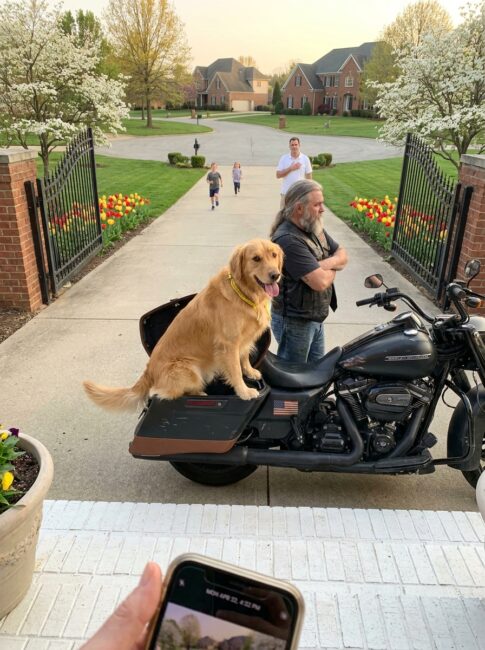
He nodded, once, at me. The way you nod at somebody you are not going to argue with.
He picked up his helmet. He swung a leg over the bike. He started the engine. He rolled out of the cul-de-sac without looking back.
Bowie watched him go. He stood in the middle of the street. He whined — low, in his chest. I had never heard Bowie whine.
Hannah ran out and grabbed his collar. She walked him back to the lawn. She did not say anything to me. She would not look at me.
My ten-year-old, Lily, said, “Mom. He didn’t do anything. Why did you yell?”
I said, “Sweetheart. Sometimes people who look like that — you don’t know who they are. We have to be careful. We have to protect ourselves.”
She looked at me.
She said, “Bowie didn’t think he was bad.”
I told her dogs don’t know.
I told her dogs love everybody.
I went inside and made coffee.
My husband was in the kitchen. I told him what had happened. I told him the version where I had been protective. The version where the biker had been “circling our street.” The version where Bowie had “gotten out” and the biker had “approached him.”
My husband looked up from his laptop.
He said, “Marg. Did the guy do anything?”
I said, “He could have.”
He looked at me for a long second.
He said, “Okay.”
He went back to his laptop.
I knew, even then, the way you know things you do not want to know, that I had not told the story the way it had happened.
I forgot about it for a while.
For about thirteen days.
Bowie went missing on a Friday night.
We do not know exactly when. He was in the backyard at 6 p.m. — I let him out before dinner. He was not there at 9 p.m. when I went to bring him in. The side gate was open. The latch is one of those old metal ones that you have to lift up and over. Bowie is — was — six years old. He had never opened the gate himself in his life.
I asked the kids if any of them had been in the side yard.
None of them had.
We searched the neighborhood. The girls and I walked the cul-de-sac. My husband drove the surrounding streets. I called the non-emergency police line. I called the local shelter. I called the breeder. I posted on Nextdoor and on the Facebook group for our subdivision and on Instagram. I cried in front of the kids twice.
By the next morning we had flyers up. We had offered five thousand dollars. We had a pinned post in three different lost-pet groups for the Charlotte area.
There was no sign of him.
For three days, nothing.
I want to tell you what those three days were like for me. I am ashamed of it now, in a way I will spend a long time being ashamed of, but I want to tell you the truth.
I did not think about the biker.
Not once.
I thought about every other possibility. I thought he had been hit by a car. I thought he had been picked up by some teenager joyriding through the development. I thought, in my worst moments at three in the morning, that someone had taken him to sell him — Goldens are expensive, especially registered ones, especially friendly males.
I called the police a second time. They told me they couldn’t actively search for a missing dog. They told me to keep posting.
My son Caleb — seven years old — asked me on Sunday night if Bowie was in heaven.
I told him no, baby. We’re going to find him.
He said, “How do you know?”
I did not have a good answer for that.
On the third day — Monday afternoon, three days and seventeen hours after Bowie went missing — I was in the kitchen on the phone with my mother in Florida, crying about it, when my husband came in from the front and said, very strange, very quiet, “Marg. There’s a guy in our driveway. With a motorcycle. And — Marg. I think he has Bowie.”
I dropped the phone.
I ran to the front door.
The motorcycle was parked at the end of our driveway.
The biker — the same biker, the same gray beard, the same tattoos, the same tank top — was standing next to it. He was not on our property. He was on the driveway just inside the gate, where he could be seen but where he had not crossed the threshold.
There was a custom soft-sided saddlebag mounted on the back of his bike. The top of it was open.
Sitting inside the saddlebag, head out, ears up, eyes bright, looking around like he was on a parade float, was Bowie.
I started to cry.
I have not cried like that in a long time. I cried the way you cry when something you had given up on comes back to you, and the relief is so big that the shame underneath it has to come too, all at once, in the same breath.
Hannah and Lily and Caleb were behind me.
Hannah pushed past me first. She ran.
Bowie saw her. He scrambled up out of the saddlebag — the biker held the side of it steady so he wouldn’t fall — and Bowie jumped down and he ran across the driveway and the kids met him in the middle and all four of them went down on the concrete in a pile.
Hannah was sobbing. Lily was sobbing. Caleb was repeating, Bowie, Bowie, Bowie, into Bowie’s neck like a prayer.
The biker stood next to his motorcycle and watched.
He did not smile.
He did not say anything.
He just watched.
After a long minute, my husband walked over to him. He stuck out his hand. He said, “Sir. Thank you. Thank you so much. I — we don’t know how to thank you. We had a reward — five thousand —”
The biker shook his head.
He said, “I don’t want the reward.”
His voice was deep and quiet and tired.
He said, “I’m not here for that.”
My husband stopped talking.
The biker looked at me.
He had recognized me from the moment he rolled up. I knew it. He had not given any sign of it. He had not been smug. He had not been triumphant. He had just stood there with my dog in his saddlebag, waiting for me to come out of my house and see him.
I walked down the driveway.
I felt the way you feel when you are about to be told something you cannot un-hear.
I stopped about six feet from him.
I said, “Where did you find him?”
He said, “He found me, ma’am.”
I said, “What?”
He said, “I run a small custom motorcycle shop about fifteen miles from here. Off Highway 73. Out past the lake. Friday night, about ten o’clock, I was closing up. Your dog walked into my open garage bay. He came in by himself. Sat down on the floor. Looked at me.”
He paused.
He said, “I didn’t recognize him at first. He had no collar — he must have slipped it somewhere — and I’d only seen him once before.”
I felt my face go hot.
I said, “How did you know he was ours?”
He said, “I didn’t. Not for two days. I took him in. Fed him. Gave him a bed in the garage. He wouldn’t leave my side. Slept at my feet on the couch the first night. I asked around the next day — nobody in my area was missing a Golden. I was about to take him to the county shelter to scan for a chip when my buddy who fixes my plumbing came by. He saw the dog. He said, ‘That looks like the dog those people have flyers up about. The reward.’ He pulled up a Facebook post on his phone.”
He looked at me steady.
He said, “I recognized you in the post, ma’am.”
He said, “I figured I’d bring him back myself.”
I could not look at him.
He said, very quiet, “He walked fifteen miles.”
He said, “I don’t know how he found my place.”
He said, “I have been thinking about it for three days.”
He looked at Bowie, who was now in Hannah’s arms, getting his ears scratched, his whole body wagging.
He said, “Ma’am. I’m not telling you this to make you feel bad. I’m telling you because I don’t think you should ignore it.”
He paused.
He said, “Your dog passed seven other houses with people inside. He passed two gas stations with people who would have helped him. He could have stopped at any of them. He walked fifteen miles, in the dark, on a Friday night, to find a man he met for thirty seconds, two weeks ago.”
He looked at me.
He said, “You don’t have to apologize to me. I don’t need it.”
He said, “But you might want to ask your dog why he ran fifteen miles to my house instead of staying at yours.”
He nodded at my husband. He nodded at the kids. He swung his leg over his bike.
He started the engine.
He rolled out of our driveway.
I stood at the foot of it and watched him go.
My children stood with their dog on the lawn.
Bowie watched the bike too.
Until it was gone.
I want to tell you what I have figured out in the fourteen days since.
I bought Bowie because I wanted a Golden Retriever for the family Christmas card. I am being more honest with myself now than I have been in a long time, and that is the truth. I picked the breeder for the pedigree. I picked the puppy for the markings. I named him Bowie because I thought it would be charming at parties.
I did not raise him.
The kids raised him. Or — the kids loved him, anyway. They fed him. They walked him. They cried into his fur on bad days at school. They slept with him when they got the flu. They told him secrets I will never know.
I bought the food. I paid the vet. I scheduled the grooming appointments.
I did not let him on the couch. I did not let him in our bedroom. I corrected him sharply when he barked. I yelled at him the few times he shook water on me after a bath. I had a nice rug in the living room, and I did not let him lie on it.
I had told myself, the whole time, that I was the responsible one. That I was the parent. That my husband and the kids were soft, and I was the one keeping the household running.
I have, in the last fourteen days, been thinking about a different version of that story.
Bowie did not run to a stranger in our driveway because the stranger had food in his pocket. He ran to him because, in the thirty seconds the man stood by his bike, the man had crouched down. The man had looked at Bowie like he was a creature with a soul. The man had scratched behind his ears the way a person who has loved a dog before scratches behind the ears.
I had not done that for Bowie in months.
I had a Golden Retriever for six years and I do not know if I had ever, in his whole life, gotten down on the floor and looked at him at his level.
Bowie ran fifteen miles to a man who looked at him for thirty seconds because thirty seconds of being seen was more than he had been getting at home.
I do not know how to write this without it sounding melodramatic. I know how it sounds.
It is also true.
The biker did not say any of this to me. He said one sentence. Ask your dog why he ran fifteen miles to my house instead of staying at yours.
I have been asking the dog. I have been asking myself.
I have been asking why I yelled at a stranger in front of my children, on a Saturday morning, for crouching down to scratch a dog’s ears.
I think I know the answer. I do not love the answer.
The answer is that the biker was not afraid of being soft. He had a body that the world looks at and assumes is dangerous, and he stopped his bike on a strange street and crouched down on the asphalt to be tender with somebody else’s animal, and he did it without thinking, because that is who he is.
I have a body the world looks at and assumes is safe — a forty-eight-year-old woman in a gated subdivision with a Golden Retriever — and I have been hard for a long time. I have been hard with my husband. I have been hard with my children. I have been hard with the dog.
I yelled at that man because, in some part of myself I had not let myself look at, I knew the difference between us.
I knew, in the second I saw him crouch down, which one of us my dog would have run to.
Bowie sleeps in our bedroom now.
On the floor on a real dog bed at the foot of my side. He wakes me up at 6 a.m. by putting his chin on the edge of the mattress. I get up. I go downstairs. I make him breakfast. I sit on the kitchen floor while he eats, and when he’s done, he comes over and puts his head in my lap.
I let him.
I am trying to learn how to let him.
I went back to the biker’s shop ten days after he came to our house. I did not take Bowie. I went alone. I drove up in my Range Rover, which I felt embarrassed about, and I parked at the end of his lot, and I walked up to his open garage bay.
He was working on a transmission.
He looked up.
He recognized me. He did not smile. He nodded.
I said, “I came to apologize to you, even though you said I didn’t have to.”
He set down his wrench.
He said, “Ma’am. You didn’t drive out here to apologize to me. You drove out here because you needed to see what kind of place a dog walks fifteen miles to.”
I started crying.
He let me cry for a minute. He did not move toward me. He did not hand me anything. He just stood there.
When I was done, he said, “Take care of your dog, ma’am. Take care of your kids. You got my number from the post you called my buddy from. If your dog ever runs again, you call me. I’ll come help you find him.”
I nodded.
I drove home.
I have not gone back. I do not need to. The way he looked at me at the end of that conversation was a thing I am going to carry for the rest of my life.
Last night Caleb asked me at bedtime if Bowie was happy.
I said, “Yeah, baby. I think he is now.”
Caleb said, “Was he sad before?”
I thought for a long time.
I said, “I think he was a little sad before. I’m sorry, buddy.”
Caleb said, “It’s okay, Mom. You’re better now.”
I said, “I’m trying.”
Bowie was on the floor at the foot of Caleb’s bed.
He thumped his tail.
Once.
That was enough.
Tag someone who needs the reminder that being seen costs nothing.