Part 2: A Biker With a Prosthetic Leg Found a Three-Legged Dog Dragging Through a Dump — Then Gave Him Wheels, a Home, and Someone Who Finally Understood
Part 2 — The Name on the Old Collar
Mara arrived forty minutes later in a dusty blue van with rescue stickers on the back window, two slip leads, a collapsible crate, and the expression of a woman who had seen too much cruelty to waste time being surprised by it.
She did not walk straight toward Buddy.
That was why I trusted her.
She stopped beside my Harley, lowered herself slowly onto the edge of the road, and looked at the dog from the side instead of head-on. Buddy had retreated beneath the shadow of the old washing machine again, the torn plastic bag lying beside him like evidence. He watched us through a gap between rusted metal and weeds.
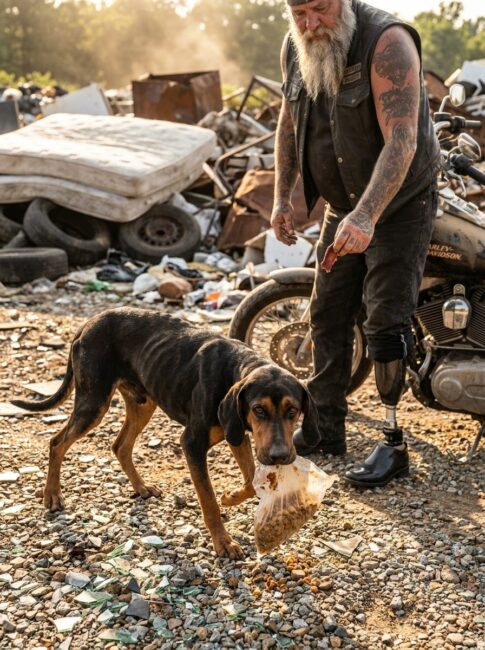
“How long has he been coming out?” Mara asked.
“I don’t know. I just found him.”
“Does he seem injured beyond the missing leg?”
“Underfed. Tired. Scared. Stump looks healed but rough. Moves like his hips hurt.”
Mara nodded. “Tripods can do well, but not when they’re starving and living on glass.”
Tripod.
People used that word casually sometimes. I had heard it used for dogs, for camera stands, for jokes. I did not like it at first, maybe because I had heard too many nicknames for men with missing limbs spoken by people who wanted to sound comfortable with discomfort. But when Mara said it, she did not mean less. She meant adapted.
Buddy’s adaptation had limits.
Each time he moved, his front shoulders absorbed too much weight. His remaining rear leg shook when he stood too long. The missing leg was not the whole problem. Hunger, exposure, rough terrain, and whatever grief dogs carry when left behind had weakened him.
Mara opened a can of soft food and set it near the front of the van.
The smell traveled faster than trust.
Buddy came out slowly. His body leaned away from us even as hunger pulled him forward. He moved in a hop-drag pattern that made my own residual limb ache in sympathy. I knew the arithmetic of uneven movement. How one good side works too hard. How the back tightens. How the body begins charging interest for every step.
I looked away before pity became disrespect.
Buddy reached the food. Ate. Paused. Looked up. Ate again.
Mara waited until the can was empty before sliding the slip lead across the ground toward him. He sniffed it, backed away, came forward, backed away again. Twenty more minutes passed before he allowed the loop to settle over his head.
When it did, Mara did not pull.
“Good choice,” she whispered.
Buddy stood very still.
I saw the moment he realized the loop was not tightening.
His body did not relax exactly, but something in his eyes shifted.
Choice, when returned, often looks small from the outside.
We lifted him into the van together. He flinched when my hands went beneath his chest, and I froze immediately.
“Sorry,” I said.
Mara looked at me sharply, then softened.
“He’ll learn. So will you.”
At Cedar Hollow Veterinary Clinic, Dr. Lena Whitaker scanned him for a microchip. The beep surprised all of us.
His registered name was Buddy.
The chip led to an address thirty miles away and a disconnected number. The alternate contact belonged to a woman named Diane Kessler, who answered on the second try and went quiet when Lena described the dog.
“Oh God,” Diane said. “That sounds like Evan’s dog.”
Evan was her brother.
Buddy had been hit by a pickup nearly a year earlier. The accident shattered his left rear leg beyond repair. Diane said the veterinarian had recommended amputation, and Evan agreed at first because Buddy had been “his shadow” for years. But after surgery, things changed.
Buddy needed medication.
Help outside.
Extra patience.
A few rugs on slippery floors.
Evan complained that the dog was “ruined” and “too hard to deal with.” Diane offered to take him, but Evan said he would manage. A month later, he claimed Buddy had run off.
Diane had searched.
Called shelters.
Posted online.
Nothing.
Until that day.
Lena asked if Diane wanted to reclaim him.
Diane cried.
She lived in assisted housing with a strict pet limit and two elderly cats. She could not take Buddy, but she wanted him safe. She gave a statement. She gave Evan’s new address. She gave us the name of the clinic that performed the amputation.
When Lena hung up, Buddy was asleep on a blanket with an IV line running and one ear twitching.
Mara looked at me.
“You okay?”
I stared at Buddy’s missing leg.
Then at my own.
I had lost mine in a motorcycle crash twelve years earlier, a drunk driver crossing the center line outside Memphis. People told me I was lucky to be alive, which was true and also not always helpful. For months after the amputation, some friends visited less. Some spoke too loudly. Some tried to inspire me into convenience. A woman I had loved left because, in her words, she “could not watch me struggle forever.”
Too much trouble.
Ruined.
Hard to deal with.
Different species.
Same wound.
“No,” I said. “I’m not okay.”
Mara placed a hand on my shoulder.
On the table, Buddy slept through it all, finally full enough to stop searching for food in garbage.
Part 3 — The First Night He Did Not Hide
The legal side moved slowly.
Evan denied abandoning Buddy at first. Said the dog must have wandered. Said he had looked “for days.” Said maybe someone stole him. People will build entire houses out of lies if the truth asks them to look at themselves too closely.
The location of the dump, Diane’s statement, Buddy’s condition, and veterinary records told a different story. Animal control opened a neglect investigation. The county prosecutor later added abandonment. I gave a statement because I found him. Mara gave one because she contained him. Dr. Lena documented every part of Buddy’s condition: malnutrition, skin irritation, overgrown nails, muscle strain, early shoulder stress, and a poorly maintained amputation site that needed monitoring.
But while the paperwork moved through offices, Buddy had to decide whether the world was worth trusting again.
Mara asked if I could foster him.
I almost laughed.
“I live over a garage.”
“You have a fenced yard.”
“My stairs are bad.”
“We can build a ramp.”
“I ride.”
“Not constantly.”
“I have a prosthetic leg.”
Mara raised one eyebrow. “I noticed.”
“I’m not exactly an ideal caregiver for a disabled dog.”
“Maybe ideal isn’t what he needs.”
I did not answer because the thought hit harder than I expected.
Maybe ideal was overrated.
Maybe familiar mattered more.
The rescue provided a low ramp, harness, orthopedic bed, anti-slip runners, joint supplements, and a medication schedule. Dr. Lena recommended rest first, then evaluation for mobility support. Buddy could move on three legs, but the strain on his front shoulders and remaining rear leg was obvious. A properly fitted cart might help on longer walks, prevent overuse, and give him freedom without forcing his body to pay for every inch.
The word cart sounded practical.
Wheelchair sounded emotional.
I used both.
Buddy came home with me on a rainy Thursday evening.
My place sat behind Mercer Custom Cycles, the small repair garage I owned with two other riders. The apartment above it had creaky floors, old windows, a narrow kitchen, and the smell of leather, coffee, and engine grease. It was not fancy, but it was quiet. The yard behind the shop had a wooden fence and a pecan tree that dropped leaves into everything.
Buddy entered the apartment, saw the open space, and immediately wedged himself behind the couch.
I sat on the floor fifteen feet away.
“Fair,” I said. “Behind the couch is a respectable first choice.”
He stayed there for three hours.
I ate dinner on the floor so he could see me. Not near him. Not reaching. Just existing. At ten, I placed a bowl of food halfway between us and went to the kitchen. He waited until I turned my back before eating.
At midnight, I woke on the couch to the sound of nails clicking.
Buddy stood near the hallway, watching my prosthetic leg where it leaned beside the coffee table.
That was the first time I wondered what he made of it.
To most dogs, a prosthetic limb is simply another strange human object. To Buddy, maybe it smelled like sweat, carbon fiber, metal, and use. Maybe it meant nothing. Maybe I was giving the moment more meaning because humans are always hungry for mirrors.
Then he limped forward and sniffed the socket.
Carefully.
I did not move.
He sniffed my residual limb next, wrapped in its liner, then looked up at me.
No fear.
No confusion.
Just recognition of a body that had also been altered.
“Yeah,” I whispered. “That part comes off.”
Buddy sat down.
Awkwardly, because sitting with one missing rear leg requires negotiation.
I lowered my hand to the side of the couch, not reaching.
He leaned forward and touched my fingers with his nose.
Once.
Then he went back behind the couch.
It was not affection.
Not yet.
It was a question.
The first honest question between us.
Are you like me?
I did not know how to answer in dog language.
So I slept on the couch without putting my leg back on, letting him see the truth of me in the dark.
Part 4 — Two Missing Legs and One Small Wheelchair
The wheelchair fitting happened three weeks later in a rehabilitation clinic that smelled like rubber mats, peanut butter, and nervous hope.
Buddy had gained four pounds by then. His coat had started to shine in patches. His eyes no longer stayed fixed on exits every second. He still hid when strangers came too close, but he had begun following me from room to room in the apartment, never touching, always near.
Dr. Lena referred us to Paws Forward Mobility, a small canine rehab program run by a specialist named Tessa Monroe. Tessa was in her sixties, with cropped white hair, bright orange glasses, and the brisk gentleness of a woman who could measure a dog’s hips while convincing him it was his own idea.
She examined Buddy carefully.
“He can function on three legs,” she said. “But he’s compensating hard. Front shoulders are tight. Remaining rear leg is overworked. A cart for longer walks could help him move without exhausting himself. It should not replace strengthening. Think of it as support, not surrender.”
Support, not surrender.
I liked that.
I had spent months after my crash resisting my prosthetic because I thought needing it meant admitting defeat. Then a rehab therapist named Cal Nolan told me, “A tool that gives you life back is not an insult.” I hated him for saying it. Then I used the leg. Then I understood.
Buddy was less philosophical.
He thought the measuring tape was suspicious and the sample wheels were offensive.
The first fitting looked ridiculous.
Two small rear wheels, a lightweight frame, padded support, straps, and Buddy standing there with the expression of a dog betrayed by engineering.
I laughed before I could stop myself.
Buddy glared.
“I’m sorry,” I said, trying to compose myself. “It’s just… buddy, we match.”
Tessa looked at my prosthetic leg, then at Buddy’s cart.
“You do, actually.”
Buddy refused to move for eleven minutes.
Tessa placed a small piece of chicken two feet ahead.
He stared at it.
Then at the wheels.
Then at me.
I tapped my prosthetic foot against the mat.
Click.
“One step,” I said.
He took one.
The wheels rolled.
Buddy startled and froze.
Nothing bad happened.
He took another.
Then another.
By the end of the session, he had crossed the mat three times, each pass less awkward than the last. His ears lifted. His tail, which had mostly stayed low since the dump, moved once.
Small.
Fast.
But real.
I felt the room tilt around that tail movement.
Tessa pretended not to notice my eyes.
Professionals in rehabilitation are kind that way.
The cart took two weeks to customize. During that time, we practiced harness work, strengthening exercises, and short walks without overdoing his body. I learned how to inspect his remaining paw pads, massage tight shoulders, and watch for fatigue signs. Buddy learned that help did not always mean helplessness.
When the finished wheelchair arrived, it was blue.
I did not choose the color.
Mara claimed she did.
I accused her of sentimentality.
She said, “You named your Harley after your grandmother. Don’t start.”
Fair enough.
The first real walk with the cart happened at dawn on a quiet sidewalk near the shop. I clipped Buddy’s leash, checked the straps, adjusted the support, and stepped beside him with my own prosthetic leg locked into place.
He hesitated at the door.
So did I.
Outside, the morning air smelled like wet pavement and coffee from the diner across the street. A delivery truck rumbled by. Somewhere, a train horn sounded. Buddy leaned against my leg for one second.
Then we went.
Click.
Roll.
Click.
Roll.
My prosthetic foot.
His little wheels.
The rhythm sounded strange at first.
Then it became music.
At the end of the block, Buddy lifted his head and looked forward instead of down.
That was when he began to move faster.
Not running.
Not yet.
But choosing speed.
An old woman outside the bakery stopped sweeping and put one hand over her mouth.
“Well, look at you two,” she said.
Buddy ignored her because a sparrow had offended him.
I laughed.
For the first time in years, I did not hear my prosthetic leg as something marking what I lacked.
I heard it keeping time with him.
Part 5 — The Man Who Called Him Broken
Evan appeared at the garage two months after the adoption became legal.
I had been warned he might try. Animal control had completed the neglect case, and Evan had accepted a plea agreement involving fines, restitution, and a ban on owning animals for a period of time. He did not serve jail time, which made me angry until Mara reminded me that Buddy was alive, safe, and legally mine.
Still, when a silver pickup pulled into the shop lot and a man in his forties stepped out wearing mirrored sunglasses and a defensive scowl, I knew before he spoke.
“That the dog?” he asked.
Buddy was lying on a mat inside the open garage door, his cart parked nearby, one chew toy between his paws.
I wiped grease from my hands with a rag. “Depends who’s asking.”
“Evan Kessler.”
Buddy lifted his head at the sound of the voice.
Not excited.
Not happy.
Still.
Too still.
I stepped between them.
Evan looked at the cart and snorted. “You bought him wheels?”
“Yes.”
“Waste of money. Dog’s half useless.”
The words did not surprise me.
That was the worst part.
They fit too neatly with everything Diane had said, with Buddy’s condition, with the way he had eaten trash like he expected no one to care.
I took one step closer.
My prosthetic leg clicked against the concrete.
Evan glanced down.
His face changed, just slightly, when he understood the parallel.
“Don’t,” I said.
“I didn’t say anything.”
“You were about to.”
He shifted. “Look, I didn’t come here for trouble.”
“Then why come?”
“I heard people online were making me out like some monster. I had that dog for years. Paid for his surgery. You know how expensive that was?”
I looked back at Buddy.
He had lowered his head but kept his eyes on us.
“You paid to save him,” I said. “Then punished him for surviving different.”
Evan’s jaw tightened. “You don’t know what it was like.”
That sentence nearly worked.
Because I did know difficulty. I knew the exhaustion of recovery, the resentment that sneaks in when life rearranges itself around injury, the shame of needing help, the way people look at you when they are trying not to look at what is missing.
But difficulty explains strain.
It does not excuse abandonment.
“You’re right,” I said. “I don’t know what it was like for you. But I know what it was like for him. I found him eating garbage.”
Evan looked away.
For one second, something like guilt crossed his face.
Then pride covered it.
“He was never going to be normal again.”
“No,” I said. “Neither was I.”
The garage went quiet.
Behind me, Buddy shifted. His cart wheels rattled softly because he nudged them with his nose.
I turned.
He stood, awkwardly but determined, and moved toward me without the cart. Three-legged, uneven, scarred by neglect, but moving. He pressed his body against my right leg—the living one—and looked at Evan.
Not fearful.
Not pleading.
Just finished.
Evan saw it too.
Whatever he had come to say, it died there.
He got back in his truck and left.
Buddy watched until the pickup disappeared.
Then he leaned harder against me.
I lowered myself onto the garage floor beside him, which took some effort because knees, prosthetics, and pride all complicate sitting.
“You’re not useless,” I told him.
He sighed.
“I’m not either,” I added.
That night, I took the blue cart apart and cleaned every piece. Buddy watched from his bed. When I reassembled it, he crawled forward, sniffed the frame, and placed one paw on the wheel.
Maybe by accident.
Maybe not.
The next morning, he waited by the door before I had my boot on.
Ready.
That was the first day we walked two full blocks.
Part 6 — The Walks That Changed the Neighborhood
Our walks became a neighborhood event without my permission.
At first, people stared.
I cannot blame them entirely.
A large tattooed biker with a gray beard, black vest, prosthetic leg, and a three-legged dog rolling beside him in a blue wheelchair cart creates a certain image. Some people smiled too quickly. Some looked sad in a way that made me want to tell them to knock it off. Some asked questions that were too personal. Children, as usual, did better than adults.
A little boy named Nolan was the first to ask properly.
“Does your dog have wheels because he got hurt?”
“Yes.”
“Do you have that leg because you got hurt?”
“Yes.”
“Can you both still race?”
Buddy looked at me.
I looked at Buddy.
“We’re retired from racing,” I said.
Nolan considered this. “But maybe fast walking?”
That became the category.
Fast walking.
Buddy loved it.
Once he trusted the cart, his personality came out like sunlight through a torn curtain. He chased leaves. He barked at mailboxes. He developed a vendetta against one particular squirrel. He learned which shops kept treats. He knew the bakery lady, Mrs. Alvarez, would always have a piece of plain biscuit if he sat politely, which he did with theatrical virtue.
People began expecting us.
The diner owner put a water bowl outside.
The barber waved with clippers in hand.
The high school track coach once timed us as a joke and declared Buddy “the most determined athlete on this street.”
I pretended not to enjoy it.
Buddy did not pretend. He loved applause.
But the walks did more than entertain the neighborhood.
They changed how people looked.
At first, they saw what was missing.
One leg.
One dog leg.
A cart.
A limp.
A biker moving slower than the image of bikers usually allows.
Then, gradually, they saw motion instead of absence.
They saw Buddy pulling forward with bright eyes. Saw me adjusting my pace to his and him adjusting his to mine. Saw that adaptation was not tragedy dressed up nicely but ordinary life continuing with better equipment.
A woman stopped me one morning outside the pharmacy. She used a cane and wore a brace on her right knee.
“I’ve been putting off getting a walker,” she said.
I had no idea what to say.
She nodded toward Buddy’s cart. “He doesn’t look ashamed.”
“He was, at first.”
“Were you?”
I looked down at my prosthetic foot.
“Yes.”
She sighed. “Me too.”
The next week, she came out of the pharmacy with a bright red walker and dared anyone to comment. Buddy sniffed it, approved, and walked beside her for half a block.
That became another kind of rescue I had not expected.
Not dramatic.
Not headline-worthy.
But real.
People began telling me their stories. Motorcycle crashes. Strokes. Surgeries. Bad knees. Lost spouses. Disabled children. Old dogs. Shame. Fear. Equipment they did not want. Help they were afraid to need.
Buddy listened better than I did.
He had the gift of not trying to fix what someone confessed.
He would stand beside a wheelchair, walker, cane, stroller, or hospital discharge boot as if all mobility tools belonged to one large, sensible family. Children touched his wheels with permission. Adults asked about adoption. Some donated to Mara’s rescue for disabled pets. One mechanic from the shop built a ramp for a woman’s senior Labrador after watching Buddy use his.
At home, Buddy became fully himself.
He stole socks.
He slept upside down.
He barked in his dreams.
He learned to climb onto the couch using a ramp and immediately claimed the center cushion. He hated baths but loved towel drying. He tolerated my motorcycle only when it was parked, then discovered the sidecar and decided sitting in it made him look important.
I did not ride with him often, and never in unsafe heat or traffic. But on quiet Sunday mornings, we took slow rides to the river road, where the path was flat and the shade was good. I would unload his cart, attach the frame, and we would walk beside the water.
Click.
Roll.
Click.
Roll.
By then, that sound no longer felt like loss.
It felt like proof.
Two bodies moving forward with what remained.
And what remained was enough.
Part 7 — The Day He Ran Without Apology
Buddy lived with me for seven more years.
Long enough for his muzzle to turn white.
Long enough for the blue cart to be replaced twice because he wore down the wheels with what Tessa called “recreational stubbornness.”
Long enough for the neighborhood children to grow tall and still call him “Mr. Wheels.”
Long enough for me to stop flinching when people glanced at my prosthetic leg.
Long enough for both of us to become local fixtures on the sidewalk at 7:10 every morning.
He slowed with age, as all dogs do. His shoulders stiffened. His remaining rear leg needed more support. Some days we walked only to the bakery and back. Some days we made it to the river. Some days he looked at rain from the doorway and decided dignity required staying inside.
I respected his professional judgment.
When he was estimated to be eleven, Mara organized a small fundraiser called Wheels for the Forgotten, helping disabled rescue dogs receive carts, ramps, harnesses, and rehabilitation support. She asked me to speak.
I said no.
She asked again.
I said no more aggressively.
Then she said, “Buddy will be there.”
That was unfair.
The fundraiser took place in the park behind the community center. There were rescue booths, food trucks, children drawing pictures of dogs, and several animals using carts or braces. Buddy arrived in his blue wheelchair with a fresh bandana and immediately behaved like a celebrity who had fired his publicist.
When my turn came, I stood near the small stage and looked at the crowd.
I had prepared notes.
I did not use them.
“I found Buddy eating garbage,” I said. “He had three legs, a loose collar, and no reason to believe anyone was coming back for him.”
The park quieted.
“I lost my leg in a crash twelve years ago. After that, I spent a long time thinking life had become smaller. I thought people saw the missing part first. Maybe they did. Maybe I did too.”
Buddy leaned against my prosthetic side.
I placed one hand on his head.
“This dog taught me something I should’ve learned earlier. A missing part is not the same thing as a missing life.”
People cried.
I pretended not to notice because generosity includes allowing a man his pride.
That day raised enough money for nine mobility carts.
Nine dogs got wheels because Buddy had once dragged himself through trash and survived long enough for someone to see him.
In his final year, our walks became very slow.
Click.
Roll.
Pause.
Click.
Roll.
Pause.
The rhythm changed, but the meaning did not.
One autumn morning, Buddy stopped at the end of our block and looked toward the landfill road. We had not been back since the investigation ended. The dumping area had been cleaned up and fenced off after community pressure, partly because Buddy’s story had embarrassed enough officials into action.
I drove us there that afternoon.
Not to revisit pain.
To close a loop.
The trash piles were gone. The ground had been graded. A sign warned against illegal dumping. Young grass had begun to grow where broken glass and plastic bags once lay.
Buddy stood in his cart at the edge of the field.
He sniffed the air.
Then he rolled forward.
Not far.
Just enough.
The wheels crossed the dirt where he had once searched for food.
He lifted his head.
For one beautiful second, he pulled hard enough that I had to quicken my pace.
An old three-legged dog in a blue wheelchair, running over the place where someone had decided he was no longer worth keeping.
I laughed so hard my chest hurt.
Buddy barked once.
Loud.
Indignant.
Alive.
He died months later at home, on the center couch cushion he had stolen years before and never returned. Mara came. Dr. Lena came. Tessa came. Mrs. Alvarez from the bakery brought a plain biscuit and cried into a napkin. Nolan, no longer little, left a drawing of Buddy with wings and wheels.
I kept one hand on his chest until it stilled.
My prosthetic leg rested against the coffee table.
His blue cart stood near the door.
Two tools that had helped two broken bodies refuse to stop moving.
Afterward, I hung one of Buddy’s worn wheels above the workbench in my garage. Beneath it, I placed a small metal sign:
BUDDY
THREE LEGS. FOUR WHEELS.
NO APOLOGIES.
People still ask me whether I saved him.
I always say yes, because that is partly true.
I stopped.
I fed him.
I brought him to care.
I adopted him.
I bought the cart.
But Buddy did something harder to explain.
He saved the part of me that had been hiding behind jokes, leather, engines, and the sound of my own prosthetic clicking on concrete. He made me stop treating adaptation like evidence of defeat. He made me walk every morning where people could see us. He made me answer children honestly. He made me understand that pride is not pretending you need nothing.
Sometimes pride is letting the wheels roll.
Sometimes courage is using the ramp.
Sometimes healing is a biker and a three-legged dog moving slowly down a sidewalk while the whole neighborhood learns to look at what is possible before what is missing.
We were both short one leg.
But together, somehow, we never felt incomplete.
Follow this page for more unforgettable dog stories about rescue, healing, and the animals who prove that being different never means being less worthy of love.