Part 2: My Dog Stole My Blanket Every Night—What I Found Beneath the Maple Tree Changed My Eightieth Winter
Part 2 — The Animal Beneath My Blanket
I want to explain why the gray cat’s face stopped me beneath that maple tree, because Jasper’s decision means little unless you know what had happened between them.
I adopted Jasper on October 17, three years after Walter died. By then, my house had become so quiet that I could hear the kitchen clock from the upstairs bathroom. I was seventy-seven, recently retired after forty-one years as a school librarian, and still setting two coffee cups beside the machine each morning.
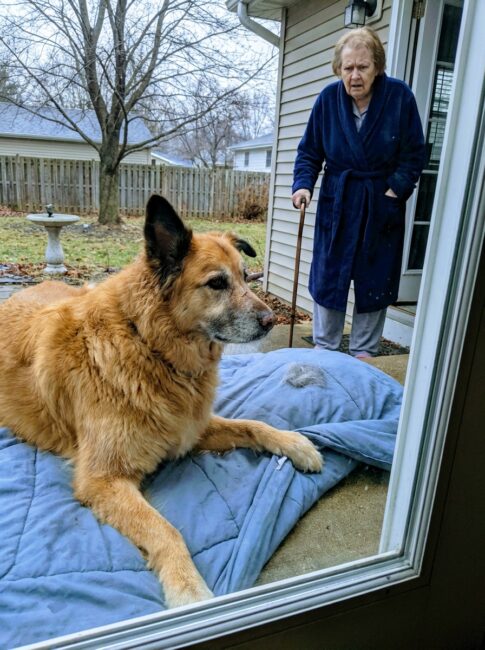
Ellen found Jasper’s photograph on the Dane County shelter website. He had been surrendered after his owner entered assisted living, and the intake note described him as “calm, cautious, house-trained, uncertain around cats.”
I almost stopped reading at the last phrase.
A gray stray had lived near my property for several years. I never fed it, but I sometimes saw it crossing the back fence with its belly low to the ground. Its left eye was cloudy, its right ear had a V-shaped notch, and it disliked every dog on our block.
The shelter volunteer introduced Jasper in a fenced yard. He did not jump. He placed his chin on my knee and held it there while I ran one finger along his black ear.
I brought him home that afternoon.
We had been in the backyard for eleven minutes when the gray cat came out from beneath the hydrangeas.
Jasper saw it before I did. He stepped forward, curious rather than aggressive, but the cat had nowhere to retreat because the fence corner stood behind it. The animal arched, spat, and struck his face four times before Jasper could turn away.
Blood ran from the bridge of his nose.
The cat escaped over the fence. Jasper remained beside me, blinking red drops from one eye, while I pressed Walter’s old handkerchief against the wound.
Seven stitches left a pale diagonal scar.
After that, the gray cat and Jasper treated the yard as disputed land. When the cat crossed the fence, Jasper followed it to the maple tree. When Jasper approached the hydrangeas, the cat hissed from beneath the leaves. They never fought again, but neither one forgot.
I privately named the cat Thistle because it was gray, stubborn, and painful to touch.
Jasper became the opposite of everything I had expected from a large rescue dog. He carried my newspaper from the porch without tearing it. He waited outside the bathroom when my knees hurt. Each evening at 8:30, he brought Walter’s old wool slipper from beneath the bed and placed it beside my chair.
He never chewed it.
He simply kept it near us.
The first winter, Jasper began nudging my blankets into a mound before lying down. He circled each bed twice, pulled one edge over his paws, then pushed the extra fabric outward with his nose.
I thought he disliked drafts.
Only later did I remember what the shelter volunteer had told me: before Jasper’s former owner entered assisted living, the man had slept beneath several quilts because his circulation was poor. Jasper had learned that a blanket was not only a place to lie.
A blanket was something you placed over a body that could not stay warm.
Under the maple tree, Thistle tried to rise. Her back legs buckled. Jasper immediately pressed his shoulder against her side, holding her upright until she lowered herself again.
I crouched as far as my knees allowed.
Thistle’s coat had lost its shine. Burrs clung beneath her chest. A sore the size of a quarter showed near her hip, and her breathing made a faint clicking sound.
“You need help,” I said.
She opened her mouth, but no hiss came.
Jasper looked at me, then at the sunroom.
I brought out a cardboard box lined with towels. Thistle pulled herself deeper beneath the quilt when I set it nearby. Jasper sniffed the box and placed one paw inside, but she would not follow him.
I called the emergency veterinary clinic. The receptionist told me not to chase a frightened stray unless it faced immediate danger. She suggested food, water, shelter, and a humane trap.
The temperature was falling.
Immediate danger had already arrived.
I placed warmed chicken and water beside the tree, then sat on a patio chair ten feet away. Thistle ignored both dishes. Jasper touched his nose to the chicken, carried one piece to the quilt, and dropped it beside her mouth.
She ate only after he stepped back.
That was the first time I saw him feed her.
It was not the first time he had tried.
Part 3 — Twenty-One Nights No One Saw
The camera on my sunroom had been installed after Walter fell on the back steps seven years earlier. It faced the porch rather than the yard, but its corner caught a narrow strip of lawn leading toward the maple tree.
Ellen helped me download the recordings.
We began with the previous night. At 1:46 a.m., Jasper emerged through the sunroom door, walking backward with the quilt between his teeth. Thistle waited beyond the camera’s view. Jasper returned at 6:03, dragging the wet blanket toward the house before stopping when he heard me in the kitchen.
The next recording showed the same thing.
So did the one before that.
We went back through the saved clips until October 29. At 3:08 that morning, Jasper left the house without a blanket. He returned nine minutes later, pushed open the linen closet, and came out with a small fleece throw.
That was the first night.
For twenty-one nights, my dog had carried fabric into the yard while I slept.
The early recordings explained why I had not noticed. Jasper initially returned the blanket before dawn. He dragged it through the sunroom, pushed it beside the washing machine, and licked moisture from the floorboards.
On the fourth morning, rain made the fleece too heavy. He abandoned it beneath the maple tree. I found it later and assumed I had left it on the porch.
When the weather became colder, he stopped using the thin throw and chose the blue quilt.
Jasper was not stealing the same object from habit. He was selecting the warmest thing he could carry.
A second mystery appeared at the bottom of the screen. On five nights, Jasper went outside carrying something smaller in his mouth. Ellen enlarged the frame until the pixels blurred.
Food.
He had been saving pieces from his dinner.
I checked beneath his bed and found three dry pieces of kibble pushed against the wall. Jasper had never hidden food before. During the weeks Thistle slept outside, however, he ate more slowly and sometimes left the kitchen with his mouth closed around part of his meal.
I had scolded him twice for dropping crumbs on the carpet.
The shame of those words sat behind my ribs.
The recordings also showed that Jasper did not sleep comfortably beneath the tree. He remained on the outside edge of the quilt, facing the fence. Raccoons crossed the alley behind our property. A fox had taken one of my neighbor’s hens the previous spring.
Whenever a sound came from the dark, Jasper stood.
Thistle remained covered.
At 4:17 one morning, a raccoon climbed onto the fence. Jasper moved beneath it and barked once. The raccoon retreated. Jasper waited six minutes before returning to the quilt.
At 5:02 on another night, rain began falling. Jasper caught the quilt by one corner, pulled more of it over Thistle, then lay with his own back exposed to the weather.
He guarded her until sunrise.
Ellen watched with both hands around her coffee mug.
“Mom,” she said, “he knew she was sick.”
“He knew she was cold.”
“He knew more than we did.”
The recordings could not tell us when Thistle became ill or why she chose my yard. A neighbor two houses down had seen her near the storm drain in September. Another had photographed her sleeping beneath a parked truck in early October. No one claimed her.
A woman named Marcy, who had lived across the alley for thirty-two years, told me the cat was older than we thought.
“She was grown when the Petersons still owned the yellow house,” Marcy said. “That was at least twelve years ago.”
Thistle might have been fifteen or sixteen.
Marcy had tried feeding her once. The cat waited until she went inside, then approached the bowl. She trusted distance more than hands.
That explained why my efforts failed.
It did not explain Jasper.
The two animals had never shared food, slept together, or played. Jasper still stopped whenever Thistle crossed the fence. Thistle still watched him with the one clear eye she had left.
Their old boundary remained.
Yet sometime during late October, Jasper saw her shaking beneath the maple tree and crossed it.
I built a shelter from a plastic storage bin, insulation board, and straw. Ellen cut an entrance while I taped the rough edges. We placed it beneath the branches with food inside.
Thistle refused to enter.
Jasper inspected the shelter, carried the food out, and put it beside her.
The next night, he brought the quilt again.
“He doesn’t think the box is enough,” Ellen said.
The forecast called for freezing rain by Friday. Thistle had eaten half a cup of chicken in two days, but her legs weakened. She could no longer climb the fence. A shallow opening beneath the gate had become her only way in or out.
I borrowed a humane trap from a rescue group. We lined it with newspaper, covered the top with towels, and placed tuna at the far end.
Thistle smelled the metal and retreated.
Jasper walked inside the trap, ate the tuna, and backed out.
For the first time in three days, I laughed. Jasper looked pleased with himself. Thistle watched from the quilt with an expression that seemed close to contempt.
The rescue volunteer suggested that I stop trying for one night. Hunger might lead Thistle into the trap after the yard became quiet.
At 11:30, I turned off the porch light and watched from the kitchen.
Thistle approached the trap twice. Each time, her front paws reached the metal plate, then withdrew. Jasper lay nearby without interfering.
At 2:13 a.m., sleet struck the window.
Thistle attempted to stand. Her front legs worked, but her back half dragged across the grass. She made it three feet before collapsing against the trap.
Jasper rose.
He did not try to push her toward the food. He caught the quilt, dragged it over her body, then looked directly at the kitchen window where I stood.
He could not see my face through the dark glass.
Still, he stared at the exact place.
I put on Walter’s winter coat and walked into the yard.
“We are not waiting anymore,” I told him.
Jasper lowered his head beside Thistle.
This time, when I reached for the blanket, he did not block me.
Part 4 — The Night We Brought Winter Inside
Freezing rain coated my glasses before I reached the maple tree. Thistle’s gray fur had darkened along her spine, and her breathing came through an open mouth.
Cats do not usually breathe that way.
The emergency receptionist had told me that much.
I opened a large dog crate on the grass, removed its door, and placed the bottom half beside Thistle. Ellen was driving across town, but the roads had begun freezing. I could not wait.
Jasper stood on Thistle’s other side.
“Help me,” I told him, though I had no reason to believe he understood.
I slid the quilt beneath the cat inch by inch. Thistle lifted her head and produced a thin warning sound. Jasper lowered his nose until it almost touched her forehead.
She stopped.
I pulled the quilt’s corners together and created a sling. Thistle weighed less than nine pounds, but my hands shook from the cold and arthritis. Jasper caught one loose edge between his teeth.
Together, we moved her.
I lifted. He pulled.
Thistle entered the crate without scratching either of us.
Jasper followed before I could replace the door. He folded his seventy-four-pound body along the side, leaving Thistle the dry center of the quilt.
I carried the crate only three feet before my back refused. Jasper stepped out, and I dragged the plastic base over the wet grass like a sled. He walked beside it with his shoulder against the rim.
Inside the sunroom, Thistle tried to climb out. Her back legs folded beneath her, and she fell against Jasper’s chest.
He did not move.
I brought a heating pad from the bathroom, wrapped it in a towel, and placed it beneath half the crate so Thistle could move away if she became too warm. Jasper lay outside the open door with his scarred nose resting between his paws.
Thistle faced him.
They remained that way until Ellen arrived.
The emergency clinic was eight miles away. Ellen drove while I held the crate in the back seat. Jasper sat beside me with one paw pushed through the wire door.
Thistle pressed her cheek against it.
The gesture lasted only four seconds.
Ellen saw it in the mirror.
“Did she just—”
“Yes.”
At 3:06 a.m., Dr. Priya Nandakumar examined Thistle beneath a warming blanket. Her temperature was 94.1 degrees. A healthy cat’s temperature should have been near 101 or 102.
Dehydration had tightened the skin along her shoulders. She had an upper respiratory infection, infected teeth, severe arthritis, and a wound near her hip where damp fur had rubbed against bone. Blood tests showed early kidney disease and anemia.
None of those problems alone explained why she had collapsed.
Together, they did.
“She has probably been losing strength for months,” Dr. Nandakumar said. “Cold took the last reserve she had.”
The clinic estimated Thistle’s age at sixteen.
A technician scanned her for a microchip. The device remained silent.
“No owner,” Ellen said.
“No registered owner,” the doctor corrected. “That isn’t always the same thing.”
Thistle required warmed fluids, antibiotics, pain medicine, and observation. The estimate came to $1,146.
I had spent decades teaching children not to judge a book before reading it. Still, I looked at a sick stray cat and thought about the roof repair I had postponed.
Ellen reached for her credit card.
I stopped her.
“Use mine.”
Jasper remained in the waiting room. Each time a clinic door opened, he stood. When a technician carried Thistle past us in a clear oxygen kennel, he walked beside her until the hallway door closed.
He refused to leave.
The clinic allowed us to sit in an empty exam room. Jasper paced from the door to the window and back. At 4:22, he pushed his nose against my coat pocket.
I found three pieces of kibble inside.
He must have placed them there while I was dressing.
I held one in my palm.
“Were these for her?”
Jasper picked up the kibble, carried it to the exam-room door, and dropped it beside the threshold.
At 6:40, Dr. Nandakumar returned. Thistle’s temperature had risen to 97.8. She had eaten two teaspoons of recovery food and kept them down. The clicking in her chest had softened after oxygen and medication.
“She may recover enough to go home,” the doctor said. “But she cannot live outside again.”
Home.
The word made Jasper’s ears rise.
I had never owned a cat. I had never planned to own one. Thistle disliked hands, doors, crates, and probably me. She had wounded my dog the first day he entered my yard.
I looked at Jasper.
He had already made room.
Thistle spent three nights at the clinic. Jasper waited beside the sunroom door at 1:43 each morning, the time he had once carried the quilt outside. He walked to the maple tree, smelled the empty grass, and returned without lying down.
On the fourth afternoon, I brought Thistle home.
I prepared Walter’s old study for her with a low litter box, water, food, and three covered beds. Jasper waited behind a baby gate in the hall.
When I opened the carrier, Thistle remained inside for twelve minutes. Then one gray paw emerged.
Jasper lowered himself to the floor.
Thistle stepped out, crossed the room, and stopped on the opposite side of the gate.
The scar on Jasper’s nose lined up with the gap in her ear.
They looked at each other.
Thistle raised one paw.
I held my breath.
She pushed it between the bars and rested it against Jasper’s muzzle.
Then she withdrew into the room.
I thought that was the end of the story: an old stray had been rescued from the cold, and a dog had helped save the animal no one else had noticed.
Five days later, I found the photograph that changed what I thought I had seen.
Part 5 — The Scar I Had Blamed on Her
The photograph was in Walter’s desk, inside an envelope marked “Garden, 2019.” I had opened the drawer while looking for batteries and found sixty printed pictures from the last summer of his life.
One showed the maple tree before a storm split its upper branch. Another showed Walter kneeling beside the hydrangeas.
A gray cat stood behind him.
Thistle looked younger, but the cloudy left eye and notched ear were already there. Beneath her belly, three kittens crowded around a paper plate.
I turned the photograph over.
Walter’s handwriting covered the back.
Gray mother came again. Three kittens. She lets me leave food if I don’t watch. One is weak.
The date was June 8, 2019.
Walter had been feeding Thistle.
I took the photograph across the alley to Marcy. She adjusted her glasses and studied the kittens.
“I remember those,” she said. “A rescue group caught two. The little one died before they could get it.”
“Did Walter know?”
“He buried it under the hydrangeas.”
Marcy pointed toward Thistle.
“She stayed near that spot for weeks.”
The first day I brought Jasper home, he had approached the hydrangeas. I had believed Thistle attacked because she hated dogs.
She had been guarding the place where her kitten lay.
That knowledge softened the old scene, but it did not erase it. Jasper could not read Walter’s note. He did not know why her claws cut him.
He only knew she had.
Ellen found a clearer photograph on my old phone from Jasper’s first afternoon. Thistle’s front paw remained extended. Jasper turned his face away. The cut across his nose opened beneath the claw.
Behind Thistle, dry leaves formed a small mound beneath the hydrangeas.
Jasper had returned to that spot many times during his first month. He smelled the soil and sat several feet away. I assumed he was searching for the cat.
Now I wondered whether he had smelled what she had protected.
Dr. Nandakumar offered no grand theory when I told her.
“Dogs remember conflict,” she said. “They also respond to what is happening now. Jasper may have recognized that the cat was weak, cold, or unable to defend herself.”
“Even after she hurt him?”
“The scar mattered to you. Her condition mattered to him.”
That sentence stayed with me.
The following evening, Thistle left Walter’s study for the first time. She crossed the hall in slow steps while Jasper watched from the living-room rug.
He did not approach.
Thistle stopped beside his water bowl, drank, and turned toward the sunroom. Jasper followed from six feet behind.
At the glass door, she looked toward the maple tree.
Jasper brought the blue quilt from the bedroom.
He dragged it into the sunroom and spread it clumsily across the floor. Then he lay on one end, leaving the warmer center open.
Thistle circled once and lowered herself beside him.
Her paw came to rest near the scar she had made.
Jasper closed his eyes.
The old enemies had not forgotten.
One of them had simply decided the wound would not receive the final word.
Part 6 — Two Years Beneath the Same Quilt
Thistle’s recovery did not happen in a single warm scene. She remained an old feral cat with sixteen years of habits built around distance.
For the first month, she allowed me to touch only the top of her head. If my hand moved toward her side, she flattened her ears and withdrew. Her teeth required two procedures. Her kidney disease required wet food, added water, and blood tests every eight weeks.
Jasper made the routine possible.
Every morning at 7:10, I crushed Thistle’s medicine into a spoonful of food. She refused it when I placed the dish in Walter’s study. Jasper solved the problem by sitting outside the doorway and eating from his own bowl.
Thistle watched him chew.
Then she ate.
At night, Jasper carried the blue quilt into the sunroom. I bought a thick brown dog blanket so I could reclaim my bedding, but he ignored it. He wanted the quilt that had covered Thistle beneath the maple tree.
I finally bought a new quilt for myself.
The old one became theirs.
Thistle slept near Jasper’s chest, though she never curled against his stomach like a house cat. Six inches of fabric usually remained between them. If Jasper moved too close, she tapped his nose without extending her claws.
He always backed away.
The first time she purred, I mistook the sound for the heating vent. Jasper lifted his head and listened. Thistle’s body remained still, but a low vibration traveled through the quilt.
Jasper’s tail moved twice.
Spring arrived. Thistle began sitting inside the open sunroom door while Jasper rested on the step. She would not cross the lawn, but she watched birds from the threshold and followed the sunlight as it moved across the floor.
Jasper watched the fence.
On April 9, a raccoon appeared near the trash cans before dusk. Jasper stepped between it and the sunroom. Thistle retreated behind him, then stopped instead of running upstairs.
She trusted his back.
That summer, Ellen gave me a small camera for the sunroom. “So we can see what they do when you’re not watching,” she said.
Most of the recordings contained nothing dramatic. Jasper slept. Thistle changed positions. Sunlight moved across the quilt.
The ordinary images mattered most.
At 2:04 one afternoon, Jasper began dreaming. His paws twitched, and a faint sound escaped his throat. Thistle stood, walked to his face, and pressed her forehead against the scar she had made.
Jasper woke.
She returned to her place without looking at him.
In October, Thistle’s kidney values worsened. Dr. Nandakumar adjusted her food and taught me how to give fluids beneath the skin twice a week. My hands resisted the needle the first time.
Jasper stood beside the table.
Thistle looked at him instead of me.
She did not struggle.
The next winter arrived hard. Madison received eleven inches of snow in one night, and the temperature fell below zero. Thistle sat near the sunroom glass while wind pushed snow against the tree where she had once slept.
Jasper brought the quilt.
He pulled one side over her back.
That was when Ellen took the photograph I keep beside Walter’s garden picture. Jasper lies along the edge of the faded fabric. Thistle’s gray head rests against his front leg. Outside, the maple tree disappears behind snow.
Neither animal looks at the camera.
Thistle lived for two years and eleven days after we carried her inside.
She gained three pounds. Her coat softened. She learned the sound of the refrigerator door and appeared whenever I opened canned salmon. She never sat in my lap, but each morning she waited beside my chair until I touched the top of her head.
Jasper remained her clock.
When he rose at 6:30, she followed him to the kitchen. When he brought the quilt at 8:45, she walked to the sunroom. When he stood beside the back door, she waited on the warm side of the glass.
She never went outside again.
During her last month, Thistle slept more. She stopped climbing the stairs and began missing the litter box. Dr. Nandakumar said her kidneys were failing despite the medicine.
Jasper changed before I did.
He stopped bringing the quilt to the sunroom and carried it instead to the rug beside Walter’s study. Thistle no longer had the strength to walk farther.
He shortened the distance for her.
On her final morning, rain tapped against the windows. Thistle refused food and water. She lay beneath the blue quilt with her cloudy eye closed and one paw resting on Jasper’s leg.
Dr. Nandakumar came to the house.
Ellen sat on the floor beside me. I kept one hand on Thistle’s head. Jasper remained against her back, giving her the warmth he had first carried through the yard.
When the doctor finished, Jasper did not stand.
He smelled Thistle’s face, her shoulder, and the small white patch beneath her chin. Then he pulled the quilt farther over her body and lay down beside it.
We gave him time.
That afternoon, Ellen and I buried Thistle beneath the hydrangeas, near the kitten Walter had buried years earlier. Jasper watched from the patio.
He did not approach the soil until we had gone inside.
The camera recorded him walking out at 1:43 the next morning.
He carried no blanket.
Jasper lay between the hydrangeas and the maple tree until sunrise.
Part 7 — The Blanket We Leave Open
Two winters have passed since Thistle died.
Jasper is eleven now. Silver has spread across his muzzle, nearly hiding the pale scar. His back legs stiffen in cold weather, so Ellen built him a small ramp beside the sunroom step.
The blue quilt remains his.
Every night at 8:45, he carries it from the basket near my bedroom to the sunroom. He pulls one edge across the floor, circles twice, and lies along the outside.
He always leaves the center open.
For several months after Thistle died, I tried folding the unused half beneath him. Jasper stood, pulled it flat, and created the empty space again.
I stopped correcting it.
Each October 29, the night he first carried warmth into the yard, I wash the quilt with unscented soap and dry it on the line beneath the maple tree. Jasper waits below it until the fabric is ready.
Then I place a small dish of cat food near the opening under the fence.
Some nights, a stray eats it. Some nights, raccoons do. Jasper watches through the sunroom glass without barking.
I am eighty-two now. My hands shake when I button a coat, and I write appointments in three places so I will not forget them. People sometimes speak about old age as if it delivers wisdom with the years.
It does not.
Age gives us time. What we do with the time remains uncertain.
I spent three weeks calling Jasper stubborn, disobedient, and sneaky because he kept taking something that belonged to me. He was carrying it to a creature with no warm room, no human hand, and not enough strength to survive another cold night.
Thistle had once cut his nose open.
Jasper remembered her scent. He remembered her claw. He remembered the boundary beneath the maple tree.
Then he saw that she was shaking.
That fact became larger than the old wound.
People have asked whether Jasper forgave Thistle. I cannot place a human word inside a dog’s mind. I can only describe what he did.
He found the animal that had hurt him.
He carried her his food.
He covered her with my warmest quilt.
He placed his body between her and the dark for twenty-one nights.
When she became too weak to walk, he helped me pull her inside. When she became too weak to reach the sunroom, he moved the quilt closer. When her body could no longer hold warmth, he gave her his.
The lesson did not arrive in a speech.
It lay outside in the frost every morning, wet with dew, while I complained about laundry.
The cat had torn Jasper’s nose.
He still chose to keep her warm.
Follow this page for more unforgettable dog stories about quiet courage, second chances, and the small acts of mercy that change ordinary lives.