Part 2: An Old Man in Hospice Asked to Adopt a Dying Senior Dog, and Their Final Nights Taught His Family Nobody Should Leave Alone
Part 2 – Bringing Blue to Room 214
The shelter had rules, but it also had people who understood mercy.
Rachel did not hand Blue over that afternoon. She made phone calls. She contacted the shelter veterinarian, Dr. Miguel Alvarez, a Latino American man in his forties who had cared for Blue since he arrived. She spoke with Willow Creek Hospice House and asked for their pet visitation policy, then asked if an exception could be made for a formal adoption where the family accepted responsibility. She made sure Blue’s comfort would come first, not our grief, not Grandpa’s wish, not a story that sounded beautiful only because someone else would carry the consequences.
I respected her for that.
That evening, I went back to hospice without Blue. Grandpa was awake when I entered, and for a second I felt like a child coming home without the thing she had promised.
“Well?” he asked.
“There is a dog,” I said.
His eyes sharpened.
“Old?”
“Thirteen.”
“Good.”
“Black Lab mix. White muzzle. His name is Blue.”
Grandpa smiled for the first time in days. Not a wide smile. Not the kind people take pictures of. Just a small lift at the corner of his mouth, but it changed the whole room.
“Blue,” he repeated. “That is a good old name.”
My mother asked questions because mothers are made partly of love and partly of practical fear. What about infection control? What if Blue panicked? What if Grandpa became too weak? What if the dog died first? What if Grandpa died first? What if this made everything harder?
Grandpa listened patiently, then said, “Harder is not always worse.”
That stopped her.
The next morning, Willow Creek approved a trial visit. Blue would come bathed, brushed, checked by the shelter vet, and brought in through the side entrance by Rachel. He would stay only if calm. He would have his own bed in the corner, bowls, medication, and a leash. Our family would sign paperwork agreeing that if Grandpa passed, Blue would come home with me or return to hospice care through the shelter program if medically needed.
I signed before my hand could shake too badly.
At two in the afternoon, Blue arrived.
I will never forget the sight of him in the hallway.
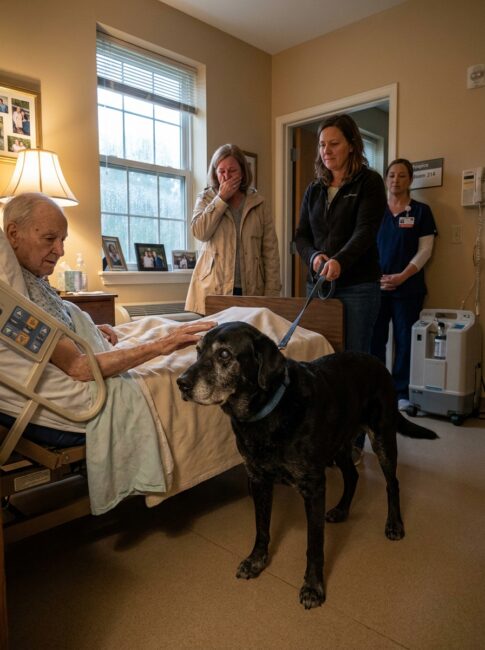
He walked slowly beside Rachel, a black dog gone gray around the face, with cloudy eyes, a blue collar, and legs that moved carefully, as if every step had to be negotiated with age. He smelled faintly of oatmeal shampoo. His nails clicked against the hospice floor. Nurses stepped out from the desk to watch, and even people who did not know the story seemed to grow quieter when he passed.
Grandpa was awake, propped against pillows, wearing the blue flannel shirt my mother had brought from home because hospital gowns made him angry. He had been a tall man once, broad-shouldered and solid, but illness had folded him inward. Still, when Blue entered the room, Grandpa lifted his head.
Blue stopped at the doorway.
For several seconds, no one moved.
Then Grandpa whispered, “Come on, old man.”
Blue looked at him.
The dog’s tail gave one slow sweep.
Rachel loosened the leash, and Blue crossed the room with the soft, careful dignity of an old soul approaching another. He did not jump. He did not rush. He walked to the bed, sniffed Grandpa’s hand, then rested his white muzzle against the blanket near Grandpa’s fingers.
Grandpa closed his eyes.
His hand moved, trembling, until it settled on Blue’s head.
“Oh,” my mother said, and then turned away.
I understood. The sound had come out of her before she could stop it. It was not sadness exactly. It was recognition. Two creatures at the edge of everything had found one another without needing an explanation from the rest of us.
Grandpa stroked Blue’s head slowly.
Blue sighed.
Then, with help from Rachel and one of the hospice nurses, Nurse Ruth Parker, a Black American woman in her late fifties with gentle strength and no patience for unnecessary drama, we placed Blue’s dog bed beside Grandpa’s bed. Blue lowered himself onto it with a tired grunt. Grandpa watched the whole process as if we were arranging the furniture of a small kingdom.
“Closer,” he said.
“Dad,” my mother said, “he’s right beside you.”
“Closer.”
So we moved the bed until Blue’s head could rest near Grandpa’s dangling hand.
That was where Blue stayed.
The first visit lasted two hours. Then three. Then Rachel looked at the dog, looked at Grandpa, and said she would return in the morning with the adoption papers if the night went well. Blue did not want to leave. When Rachel picked up the leash, he lifted his head, then placed it back beside Grandpa’s hand.
Grandpa smiled without opening his eyes.
“He knows,” he whispered.
“What does he know?” I asked.
“That I asked for him.”
By evening, the paperwork was already on its way.
By morning, Blue was no longer a shelter dog.
He was Blue Cole.
My grandfather signed with a shaking hand, and the hospice chaplain, who happened to be passing by, said it was the first adoption ceremony he had ever witnessed in Room 214. Rachel cried. My mother cried. I cried into the collar of my coat because I had promised myself I would be useful, not emotional.
Grandpa did not cry.
He looked at Blue and said, “Well, boy, I guess we belong to each other now.”
Blue blinked slowly.
Then he moved his paw until it touched the wheel of the bed.
It looked like agreement.
Part 3 – Two Old Bodies, One Quiet Room
After Blue came, the room changed.
Not in a dramatic way. No miracle cure, no sudden strength, no scene where Grandpa sat up laughing and demanded soup. Hospice does not work like that, and neither does old age. Grandpa was still dying. Blue was still frail. The oxygen machine still hummed. The medication schedule still mattered. The nurses still came in softly, checking vitals, adjusting pillows, speaking in the low voices people use around the edge of life.
But the room was no longer only waiting.
It was living in a smaller form.
Blue brought routine. He needed water refreshed, soft food warmed, pills tucked into peanut butter, slow walks to the small enclosed garden if his legs allowed. Grandpa could not do those things himself, but he watched every detail with serious attention. When I mixed Blue’s dinner too dry, Grandpa opened one eye and said, “More water.” When Blue refused a pill, Grandpa told me to hide it in cheese because “dogs respect cheese more than medicine.” When Blue’s blanket slipped, Grandpa noticed before anyone else.
That mattered.
Illness had taken almost every job from him. He no longer drove, cooked, repaired, lifted, carried, or decided what time he would leave a room. People asked him if he was comfortable, if he needed pain medicine, if he wanted visitors, if he wanted the curtains open. They meant well, but care can make a proud man feel like a house everyone keeps entering without knocking.
Blue gave him a role again.
Grandpa became the person who watched over the old dog.
Even from bed, he had purpose.
“His bowl is empty.”
“His hip is stiff today.”
“He likes the left ear better.”
“Tell Ruth not to call him sweetheart. He’s too old for that.”
Nurse Ruth, who absolutely called everyone sweetheart, said, “Mr. Cole, if I can call you sweetheart, I can call that dog sweetheart too.”
Grandpa replied, “He has more dignity than I do.”
Blue raised his head at that, and Ruth laughed so hard she had to wipe her eyes.
The staff began stopping by even when they did not need to. Not to bother Grandpa, just to stand in the doorway for a moment and see the old man and the old dog breathing near each other. Rachel from the shelter visited every other day and brought soft treats. Dr. Alvarez came once to check Blue’s comfort and sat on the floor instead of using the chair.
“He is calmer here,” Dr. Alvarez said.
“He knows he was chosen,” Grandpa answered.
That sentence stayed with me.
Chosen.
Blue had spent four months watching families pass his kennel. Children wanted puppies. Parents wanted younger dogs. Some people paused, smiled sadly at him, then moved on because adopting a dog at the end of life feels like signing up for grief. I understood that. I also understood, after watching him in Room 214, that avoiding grief is not the same as avoiding love.
Sometimes it is refusing the most honest kind.
Blue did not ask for much. He slept near Grandpa’s bed, lifted his head when Grandpa shifted, accepted tiny bites of scrambled egg when allowed, and thumped his tail when my mother sang old hymns under her breath. At night, when Grandpa grew restless, Blue seemed to know before the monitor did. He would lift his muzzle, sniff the air, and give one low sound, not a bark, more like a reminder.
Someone would come.
Someone always came.
One evening, I arrived to find Grandpa asleep with his hand hanging over the mattress, fingers resting in the fur behind Blue’s ears. Blue was asleep too, his cloudy eyes closed, his breathing slow. The late sun came through the window and turned everything gold. For a few minutes I stood in the doorway, unwilling to break the scene.
My mother came up behind me.
“I was wrong,” she whispered.
I knew what she meant.
She had feared Blue would make losing Grandpa harder. Instead, Blue made the room gentler. Grief still waited outside every conversation, but it no longer stood alone. There was a dog bed beside the hospital bed. There were chew marks on a soft toy someone had brought. There was a water bowl on the floor. There was the small, ordinary mess of care, and that mess held us together.
Grandpa woke while we were standing there.
“Don’t hover,” he said, eyes still closed.
“We’re not hovering,” my mother lied.
“You hover like your mother.”
That made her cry, which made him open his eyes, which made Blue lift his head.
Grandpa looked at the dog and said, “See what you started?”
Blue wagged once.
My mother laughed through tears.
For the first time in many days, the room sounded like family instead of farewell.
Part 4 – What the Old Dog Remembered
Blue had a past none of us fully knew.
Rachel told us what the shelter records showed. His previous owner had been a man named Walter Grimes, a retired mail carrier who lived alone in a small brick house near Quarryville. Walter had adopted Blue as a young dog after finding him wandering along a country road. For twelve years, they had been together. Neighbors remembered seeing them every morning, Walter with a canvas mailbag repurposed for dog treats, Blue trotting beside him like an assistant inspector of sidewalks.
When Walter died suddenly, relatives came to clear the house. None could take Blue. They brought him to Red Barn Animal Rescue with his blue collar, a bag of senior food, and a handwritten note that said, “He is gentle. He likes toast crusts. Please tell him he was loved.”
Rachel kept that note in Blue’s file.
When she read it aloud beside Grandpa’s bed, Grandpa asked her to read the last line twice.
Please tell him he was loved.
Blue was asleep at the time, but Grandpa reached down and touched his head.
“He knows,” Grandpa said. “But tell him anyway.”
So we did.
We told Blue every day.
You were loved.
You are loved.
You are safe.
You are wanted.
At first, I felt foolish saying those things aloud to a dog who mostly slept. Then I watched what happened when Grandpa heard us. His face softened every time. I realized the words were not only for Blue. In that room, everyone needed to hear that love did not disappear just because bodies failed.
Grandpa had his own past, and Blue seemed to pull stories from him that we thought illness had sealed away.
He told us about meeting my grandmother, Eleanor, at a church picnic when she beat him at horseshoes and refused to apologize. He told us about building their first kitchen table because they could not afford one. He told us how my mother once hid a frog in her Sunday purse. He told us about Scout the beagle stealing an entire ham slice from a Christmas plate and then hiding behind the piano with “the confidence of a criminal lawyer.”
Blue slept through most of these stories, but Grandpa told them to him anyway.
“Dogs keep secrets,” he said.
One afternoon, Grandpa asked to see the photo album from home. My mother brought it in a canvas tote, and we spread old photographs across his blanket. Wedding pictures. Baby pictures. Grandpa standing beside a half-built porch. Grandma in a yellow dress. Scout with one ear flipped inside out. Pictures of me as a child missing my two front teeth, holding a dandelion bouquet like an Olympic torch.
Blue lifted his head when we laughed.
Grandpa placed one old photograph beside Blue’s paw. It showed him at forty, strong and tan, crouching beside Scout in the backyard.
“Look at that,” he said to Blue. “We were young fools once.”
Blue sniffed the picture, then sneezed.
Grandpa said, “Fair review.”
That became one of the few days I remember without the sharp edge of fear. We did not pretend the ending was not coming. We simply allowed the present to hold more than dread. There was memory. There was fur. There was laughter. There was a dog who had lost one old man and found another. There was an old man who had lost almost everything except the ability to offer comfort.
As Blue grew weaker, we adjusted.
His bed became thicker.
His walks became shorter.
His food became softer.
Grandpa’s hand became less steady, so we guided it to Blue’s head when he asked. Some days, both of them slept more than they woke. When visitors came, Blue opened one eye, judged them politely, then went back to guarding the bed. If anyone cried too loudly, Blue sighed as if disappointed in our lack of composure.
The hospice chaplain, Pastor Helen Reeves, a white American woman in her sixties with silver hair and gentle humor, visited often. She once looked at Blue and said, “I believe this dog has a ministry.”
Grandpa replied, “Better attendance than mine.”
Pastor Helen laughed, then sat beside him for a long time.
Later, she told me something I wrote down because I did not want to forget it.
“Some people are afraid that loving at the end is wasted,” she said. “But love near the end may be the purest kind, because it stops pretending it can own time.”
That night, Grandpa was awake after everyone left. I sat beside him while Blue slept.
“Annie,” he said, “is he comfortable?”
“Yes.”
“Tell me the truth.”
“He is tired. But he is not afraid.”
Grandpa looked at the ceiling.
“Good.”
Then after a long pause, he whispered, “I am tired too.”
I took his hand.
“Are you afraid?”
He did not answer right away.
Then Blue shifted in his sleep and pressed his muzzle against the bed frame.
Grandpa smiled faintly.
“Less,” he said.
Part 5 – The Last Good Day
The last good day came on a Sunday.
We did not know it was the last good day, which is probably mercy. If we had known, we might have ruined it by trying too hard. Instead, it arrived quietly, with morning sun after three days of rain and Blue waking up hungry enough to finish half a bowl of chicken and rice.
Grandpa woke clearer too.
His voice was weak, but his eyes were bright. He asked my mother to open the curtains. He asked me if Blue had eaten. He asked where his blue flannel shirt was, the one with the missing button, because “a man should not look like laundry in front of company.” We helped him into it, and he seemed pleased.
Blue’s bed had been moved so close to Grandpa’s bed that the two nearly touched. Blue lay with his head on the edge of Grandpa’s blanket. Grandpa kept his hand there most of the morning, fingers resting lightly on the white fur of Blue’s muzzle.
Around noon, Rachel came from the shelter with a small envelope. Inside was Blue’s adoption certificate, officially printed, with his name listed as Blue Cole. She had already emailed a copy, but she said she thought Grandpa might like to hold the paper.
He did.
He studied it for a long time, though I am not sure how much he could read.
“Looks legal,” he said.
Rachel smiled. “Very legal.”
“Then nobody can unchoose him.”
Her face changed.
“No,” she said softly. “Nobody can unchoose him.”
We taped the certificate to the wall where Grandpa could see it. Under it, my mother placed a photograph I had taken two days earlier of Grandpa’s hand resting on Blue’s head. Not a perfect picture. The light was dim, and the angle was crooked, but it told the truth.
A nurse brought an extra chair. Pastor Helen stopped by after chapel. Dr. Alvarez came too, not because Blue had an appointment, but because he said he was in the neighborhood and lied badly. Even Nurse Ruth came in on her break with a biscuit she insisted was for Blue, though she made Grandpa promise not to tell administration.
The room filled slowly, but it did not feel crowded.
It felt gathered.
Grandpa told one more Scout story. Blue accepted three tiny pieces of biscuit. My mother sang “Abide with Me” so softly that at first I thought she was only breathing the tune. Grandpa closed his eyes and mouthed some of the words. Blue’s tail moved once when she reached the second verse.
Then Grandpa asked if the window could open.
It was April, warm for Pennsylvania, with the smell of wet grass and flowering trees outside. The nurse checked, then opened it a few inches. A breeze entered the room, carrying birdsong and the far-off sound of someone mowing grass beyond the hospice garden.
Blue lifted his head.
Grandpa turned his face toward the air.
For a moment, both of them seemed to be listening to the same distance.
“Smells like spring,” Grandpa whispered.
“It is spring,” I said.
He nodded.
“Good.”
Later that afternoon, he asked everyone to leave except me and my mother. Rachel hesitated, then bent to kiss Blue’s head. Blue licked her wrist once, and she pressed her hand to her mouth before walking out.
When the room was quiet, Grandpa said, “Linda.”
My mother stepped close.
“I need you not to be mad at me for leaving.”
She made a sound like the sentence had struck her physically.
“Dad.”
“I mean it.”
She sat on the bed carefully, avoiding tubes and blankets, and took his hand. “I am not mad.”
“You will be.”
She shook her head, crying now.
“You were a good daughter,” he said.
She bent over his hand.
Then he turned his eyes toward me.
“Annie, you brought him.”
“I did.”
“You did good.”
I could not answer.
He looked at Blue, who was awake but still, his old eyes cloudy and calm.
“I did not want him to be alone,” Grandpa said.
“I know.”
“And I did not want to be either.”
My mother reached down and touched Blue’s side.
“You are not,” she said.
That evening, Grandpa slept deeply. Blue did not leave the bed. He refused dinner, took only water, then rested his head as close to Grandpa’s hand as he could get. Nurse Ruth checked on both of them and said nothing, which was how I knew she understood.
Before I went home to shower and change, I leaned over Grandpa.
“I’ll be back in the morning,” I whispered.
His eyes opened slightly.
“If I’m sleeping, don’t wake me.”
I tried to smile. “Okay.”
Then he added, so softly I almost missed it, “Make sure Blue knows I stayed.”
I looked at the old dog beside him.
Blue’s eyes were open.
“He knows,” I said.
And I believe he did.
Part 6 – The Night They Did Not Go Alone
The call came at 2:17 in the morning.
Hospice calls at night have a sound before anyone speaks. The phone lights up, and something in your body knows. I answered before the second ring.
It was Nurse Ruth.
“Anna,” she said gently, “you may want to come now.”
My apartment was twelve minutes from Willow Creek. I got there in eight, wearing yesterday’s sweater and shoes without socks. My mother was already there, her hair unbrushed, her coat pulled over pajamas. Pastor Helen stood in the hallway. No one was rushing. That frightened me more than rushing would have.
Grandpa was still alive when I entered.
His breathing had changed. Slower. Farther apart. His face looked peaceful, but not empty. Blue was lying partly on his own bed, partly against the side of Grandpa’s bed, his muzzle resting near Grandpa’s hand. Someone had lowered the rail so Grandpa’s fingers could touch Blue’s head.
Nurse Ruth whispered, “He asked for that earlier.”
“He was awake?”
“A little. Around midnight.”
“What did he say?”
Ruth looked at Blue.
“He said, ‘Closer.’”
Of course he did.
We sat around the bed. My mother held one hand. I held the other. Blue lay beneath the hand that had chosen him. The room was dim except for the small lamp near the chair. Outside, the hospice garden was dark. The oxygen machine had been quieted. There was only breathing, ours and his and Blue’s.
No one said much.
Words become clumsy at the end.
My mother told him she loved him. I told him I loved him. Pastor Helen prayed softly, not long, not dramatic, just enough to bless the room without filling it. Nurse Ruth stood near the foot of the bed with her arms folded tightly, professional and heartbroken in the way good nurses often are.
At 3:04, Blue lifted his head.
He seemed to gather strength from somewhere deep and old. Slowly, painfully, he pushed himself up, placed his front paws on the low edge of the mattress, and laid his muzzle against Grandpa’s wrist.
Grandpa’s fingers moved.
Not much.
Enough to brush Blue’s fur.
My mother covered her mouth.
Grandpa breathed in.
Then out.
Then, after a long silence, out again.
And then no more.
No thunder rolled. No music swelled. The world did not stop in a way anyone outside that room could measure. But inside Room 214, everything changed.
Nurse Ruth checked gently. Pastor Helen bowed her head. My mother leaned over Grandpa and cried against his shoulder. I stood frozen, one hand still holding his, unable to understand how a person can be there and then, in the most silent way, not.
Blue did not move.
His muzzle remained against Grandpa’s wrist.
For twenty minutes, no one tried to move him.
Then he let out one breath, long and low, and sank back onto his bed.
Rachel arrived at dawn. Ruth had called her after we called the funeral home because Blue had begun breathing harder, and we all knew what that might mean. Dr. Alvarez came too, carrying his medical bag though there was very little to do except make sure Blue was comfortable.
Blue was not in distress.
That is what Dr. Alvarez told us. He was weak, deeply tired, and fading. His heart, already fragile, had slowed. He seemed calm. He accepted a little water from Rachel’s hand, then turned his head toward Grandpa’s empty bed.
The funeral home staff had come and gone by then.
The bed had been remade, but Blue knew.
Dogs know absence by scent first.
He looked at the place where Grandpa had been and gave one soft sound, not a whine, not a bark, something smaller and older than both. Rachel sat on the floor beside him and cried openly.
“I brought him here so Mr. Cole would not be lonely,” she said. “I did not think Blue would choose him this completely.”
My mother sat beside her.
“I think they chose each other.”
Blue rested his head on my mother’s foot for a while. Then on Rachel’s knee. Then he looked toward me. I sat on the floor in the place where Grandpa’s bed had been closest to his.
Blue came to me slowly.
I do not know how he found the strength.
He lowered himself with his head in my lap, just as he had placed it on Grandpa’s blanket that first day. I stroked the white fur between his eyes and told him the things we had told him all week.
“You were loved.”
“You are loved.”
“You are safe.”
“You can rest.”
At 6:41 in the morning, Blue took one last breath in my lap.
Grandpa and Blue died three hours and thirty-seven minutes apart.
In the same room.
In the same peace.
Neither one alone.
Part 7 – Side by Side
The funeral was small because Grandpa had asked for small.
He had written most of his wishes years earlier, in the tidy block handwriting he used on grocery lists and workshop labels. No long sermon. No expensive casket. No carnations because he considered them “funeral celery.” He wanted to be buried beside my grandmother, Eleanor, in the old cemetery behind St. Mark’s Lutheran Church, where he had repaired pews, built bookshelves, and once fallen asleep during a committee meeting he claimed was “designed for that purpose.”
But Blue had not been in the plan.
That was the first decision we had to make without Grandpa.
Rachel offered to arrange cremation through the shelter’s veterinary partner. Dr. Alvarez said the same. Everyone was gentle. Everyone said there was no wrong choice. My mother listened, then looked at me with red eyes.
“He should stay with Dad,” she said.
The church cemetery had rules, as cemeteries do, and animals could not be buried in the family plot. Pastor Helen knew that before we asked. But she also knew the caretaker, an older white American man named George Miller, who had been friends with Grandpa for forty years. Behind the cemetery fence, near an old oak tree, there was a small strip of church land where people had scattered ashes of beloved animals over the years, unofficially, quietly, with the kind of mercy no committee ever needs to advertise.
Blue was cremated.
On the morning after Grandpa’s burial, our family gathered beneath the oak tree with Rachel, Dr. Alvarez, Nurse Ruth, and Pastor Helen. The ground was soft from spring rain. Birds moved in the branches above us. My mother held the small wooden box containing Blue’s ashes. I held his blue collar.
Pastor Helen said a few words.
Not too many.
She said Blue had been unwanted by the world at the very moment Edward had wanted him. She said Edward had been afraid of leaving alone, and Blue had answered that fear not with words, but with presence. She said companionship at the end of life was not small just because it was brief.
Then she said, “They gave each other what every living creature deserves, a witness, a comfort, and a safe place to rest.”
We buried Blue’s ashes under the oak tree, just beyond the fence from Grandpa and Grandma’s graves. Close enough that if love has any sense of direction after death, they could find one another easily.
George made a small marker from leftover cedar.
It read:
BLUE
Beloved Dog of Edward Cole
He stayed
My mother touched the words and cried.
Rachel stood beside me, arms wrapped around herself against the morning chill. She looked exhausted, but peaceful in a broken kind of way.
“I keep thinking I brought Blue there for your grandfather,” she said.
“You did.”
“And then they left together.”
“Not exactly together,” I said. “But close enough.”
She nodded.
“Close enough that neither one had to wonder where the other went.”
That sentence stayed with me as much as anything.
In the weeks after, people wanted to tell the story. The shelter asked permission to share it, partly because senior dogs still waited in kennels, and Blue’s story might help someone choose one. My mother hesitated at first. Grief felt too private. But then she looked at the photograph of Grandpa’s hand on Blue’s head and said, “Maybe it will help another old dog.”
So Rachel wrote the post.
She did not make it cheap. She did not call it a miracle in capital letters. She simply told the truth. An old man in hospice asked for an old dog. A senior shelter dog became his companion. They spent their final days side by side. They died the same night, a few hours apart, in peace.
The post spread farther than any of us expected.
People wrote messages about their fathers, mothers, grandparents, old dogs, hospice rooms, shelter adoptions, and goodbyes they had not known how to carry. Some said they went to shelters afterward and asked to meet the oldest dog. One woman adopted a twelve-year-old terrier named Mabel. A retired man adopted a blind senior spaniel. A hospice volunteer wrote that they were starting a comfort dog program for patients who missed their pets.
Blue’s life, which had seemed nearly over in a shelter kennel, kept opening doors after he was gone.
Grandpa would have liked that.
He always believed useful things should keep being useful.
For a while, I could not go back to Room 214. I drove past Willow Creek once and had to pull over because my hands shook. Grief is strange after hospice. You think you have been preparing, but preparation is not protection. It is only a lantern. It helps you see the road, but you still have to walk it.
When I finally returned, it was to bring thank-you cards. Nurse Ruth hugged me in the hallway. Rachel had brought a framed copy of Blue’s adoption certificate for the hospice family room. Under it, they placed the photo of Grandpa and Blue.
Visitors still stop there.
I know because Ruth tells me.
Sometimes families who are afraid of the end stand in front of that picture and ask about the old man with the dog. Ruth tells them, gently, that love is allowed in the room even when time is short. Especially then.
My mother keeps Blue’s collar in Grandpa’s workshop, hanging from a nail beside his old measuring tape. At first, that seemed too painful. Now it feels right. The workshop smells of cedar, dust, machine oil, and memory. Grandpa built things there for decades. Chairs, shelves, birdhouses, toy boxes, repairs nobody else noticed. Blue’s collar hangs among those useful things, a reminder that in his last week, Grandpa built something too.
Not from wood.
From mercy.
From choosing.
From refusing to let an old dog spend his last days unwanted.
Every April, we visit the cemetery. We bring flowers for Grandma, a small stone for Grandpa because he liked river stones, and a soft dog biscuit for Blue’s marker under the oak. My little nephew once asked if dogs eat biscuits in heaven. My mother said she certainly hoped so. I said if they do, Blue probably shares his with Grandpa, who always pretended not to like dog biscuits but believed firmly in snacks.
We laughed.
That felt like healing.
Not the absence of sadness.
Just sadness with room for warmth.
I think often about what Grandpa said before any of this began.
A puppy has years. Bring me one that does not.
At the time, it sounded like a dying man’s strange request. Now I understand it as one of the clearest acts of love I have ever witnessed. He did not want to take from the future. He wanted to meet another creature in the same honest place, near the end, where nobody had to pretend they were beginning something long. They began something brief instead.
Brief does not mean small.
A candle is brief.
A song is brief.
A final hand resting on an old dog’s head is brief.
Some things only need a little time to become forever.
I was the one who drove to the shelter in the rain. Rachel was the one who brought Blue through the hospice door. My mother was the one who made space beside the bed. Nurse Ruth was the one who lowered the rail so Grandpa’s hand could reach him. Dr. Alvarez was the one who made sure Blue was comfortable. Pastor Helen was the one who blessed what none of us had words for.
But Grandpa and Blue were the ones who taught us.
They taught us that the end of life can still hold new love.
They taught us that old dogs are not leftovers.
They taught us that comfort does not need years to be real.
They taught us that dying is still living until the final breath.
And most of all, they taught us that nobody, human or animal, should have to go alone if love can possibly find its way into the room.
I brought the dog there so Grandpa would not be lonely.
Blue came because he was lonely too.
They left within the same morning, a few hours apart, peaceful, chosen, and close enough that I will never again believe short love is wasted.
If this story stayed with you, follow this page for more unforgettable dog stories about rescue, loyalty, healing, and the quiet moments when love arrives just in time to make sure no one has to walk the final road alone.