Part 2: A Biker Saw a Dog Tied to the Train Tracks Outside Amarillo — He Had No Knife, Only His Hands, and Seconds Left
Part 2 — Rising Action
Before I found that dog, I was not looking to save anything.
That is the truth, and it is not a pretty one.
My name is Caleb “Graveyard” Mercer, though most people just call me Mercer. I got the nickname from working overnight security at a salvage yard for fifteen years, not from anything darker, but strangers never asked. They just saw the leather cut, the beard, the old prison-looking tattoos that were not prison tattoos at all, and decided I was the kind of man best avoided.
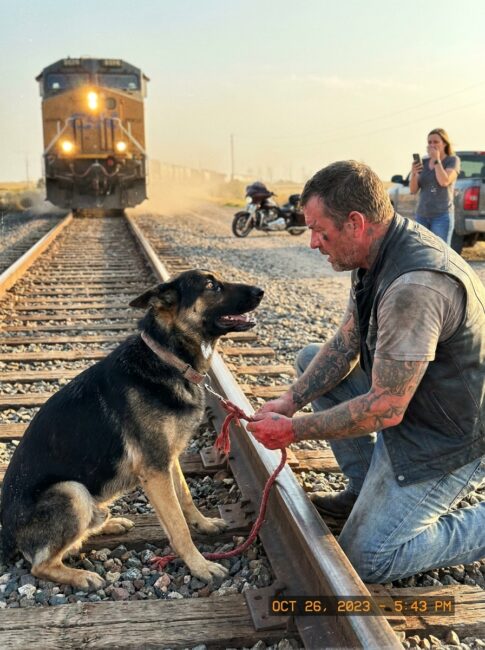
I did not correct them much.
Avoided men do not have to explain why they live alone.
My little house sat on the north side of Amarillo, near a truck wash and a tire shop that stayed open too late. I had a refrigerator full of microwave dinners, a coffee maker that leaked, and a spare bedroom I had not entered in almost four years.
That room used to belong to my son, Jamie.
Jamie loved trains.
That is one of those details that sounds too neat for a story, but life can be cruel with its symbols. He had model engines lined across his shelves, tiny freight cars arranged by color, and a map of the Santa Fe line taped above his bed. When he was seven, I took him out to the same service road where I found the dog, and we sat in the bed of my old pickup counting cars until sunset.
He would raise both arms when the horn blew.
Like the whole world was announcing him.
Jamie died at nineteen in a motorcycle accident I still do not talk about well. A distracted driver turned left across his lane. The police report was clean. The funeral was not. His mother, my ex-wife, stopped speaking to me after that because grief needs somewhere to put its teeth, and I was close enough to bite.
So I rode.
I rode when I could not sleep. I rode when I could not pray. I rode when my house felt too full of a person who was gone. Most evenings, I took the long loop outside town, past the rail yard, the old elevators, the open land where the sky did not ask questions.
That was why I was on that service road.
Not because I was heroic.
Because I was trying not to go home.
Three weeks before I found the dog, my club had done a charity ride for a children’s hospital in Lubbock. We were the kind of motorcycle group people photographed from a distance and thanked with nervous smiles. Big men. Loud pipes. Leather vests. Gray beards. Tattoos. A few veterans, two mechanics, one retired nurse, one school janitor, and me.
We called ourselves the High Plains Riders.
Not an outlaw club.
Not saints either.
Just men and women who had lived enough life to know that being judged from the outside can make you kinder if you let it.
At the hospital, a little boy asked if my tattoos hurt.
I told him, “Only the dumb ones.”
He laughed so hard his oxygen tube slipped sideways.
That laugh followed me for days.
So did the silence afterward.
When I got back to Amarillo, I found myself standing in Jamie’s doorway for the first time in months. The room smelled like dust and old cardboard. His train map still hung on the wall, curling at one corner. His toy engine, a blue one with chipped paint, sat on the desk where he had left it when he became too old to admit he still liked it.
I picked it up.
Then put it down.
That was the kind of man I was then.
Able to pull a stranger’s truck from a ditch.
Unable to touch my own son’s toy for more than ten seconds.
The day of the tracks, I had left work early after my boss told me I looked like hammered hell. I bought gas, rode west, and stopped at a diner where the waitress still called me “honey” even though I tipped badly when sad. Then I took the service road with no destination in mind.
There were small signs I missed.
A pickup parked near the abandoned grain sheds with no one inside.
Fresh tire marks crossing the gravel.
A length of red rope lying in the ditch farther back, like someone had cut off extra and thrown it away.
At the time, it was all just background.
Dust.
Noise.
Trash.
Then I saw the movement between the rails.
And the world narrowed to a dog nobody had meant to survive.
Part 3 — False Climax
After the train passed, the silence felt wrong.
Not peaceful.
Wrong.
The kind of silence that comes after something too large has moved through your life and left you checking whether your body is still there.
I could not hear right away. My ears rang from the horn and the rush of steel. Gravel had torn the side of my face. My right shoulder throbbed deep where I had landed on it. One of my gloves was gone, and the palm underneath was striped red from the rope.
The dog lay across my ribs, shaking.
I did not move him at first.
Maybe I was afraid he would fall apart if I did. Maybe I was afraid I would.
His breath came fast against my neck. His fur smelled of dust, fear, hot rail, and something sour from old rope. He was thin under that Shepherd coat, not starving but neglected, the bones of his hips too easy to feel beneath my hand.
“You’re all right,” I said, though neither of us knew that yet.
He pressed closer.
The passing pickup finally stopped farther down the road. A woman in a blue work shirt ran toward us with her phone in her hand, crying so hard she could barely speak. Her name was Angela Ruiz. She had seen the last few seconds: a biker on the track, a dog tied down, the train coming, both of us vanishing into dust.
“I called 911,” she kept saying. “I called, I called.”
I nodded because talking hurt.
The dog lifted his head when he heard her. His ears flattened, and a growl rumbled low in his chest.
Not at me.
At the road.
At every vehicle.
At every human shape that was not yet sorted into safe or unsafe.
I put my hand on his neck.
“Easy.”
He stopped.
Again.
That trust nearly broke me.
When the sheriff’s deputy arrived, he looked at me first, then the dog, then the snapped rope in my hand.
“What happened?”
I wanted to give him a full sentence. I wanted to explain that some kind of evil had been there before us, that a dog had been tied to a live track with a freight train due, that I had no knife, no tool, no time, only hands.
What came out was, “Train was close. I pulled.”
The deputy looked at the tracks.
Looked at the dog.
Then looked back at me in a different way.
Animal control came next, then paramedics I insisted I did not need until one of them pointed out that my left hand was bleeding through the towel Angela had wrapped around it. The dog refused to let animal control touch him. He tucked himself behind my legs, trembling, eyes fixed on the catch pole like he knew exactly what tools could do.
“No pole,” I said.
“Sir, he may be injured.”
“Then bring a blanket.”
They brought one.
I crouched slowly, every joint complaining, and laid the blanket on the gravel. The dog sniffed it, then looked at me.
“Come on,” I said. “You rode out of hell with me. You can ride in a truck.”
He stepped onto the blanket.
The animal control officer, a younger man named Price, whispered, “I’ve never seen anything like that.”
I had, but not with a dog.
I had seen that look on soldiers at roadside diners, on crash survivors, on old men at funerals who kept patting pockets for cigarettes they had quit forty years earlier. The body leaves danger before the mind does.
The vet clinic in Amarillo took him in through the side entrance because he panicked near the front lobby. I followed even after the nurse told me I could wait outside.
The dog looked back once.
That was all it took.
“I’m staying,” I said.
They checked him for broken ribs, paw injuries, rope burns around the collar area, dehydration, and stress. He had no microchip. No tags. No name. His red rope had cut into the fur at his neck, but not deeply enough to scar if treated fast.
The vet said, “He’s lucky.”
I looked at my hands.
“No,” I said. “He was tied to a train track.”
She did not argue.
That night, after they cleaned him up and gave him fluids, he slept on a towel in the exam room with his nose tucked into the corner of my leather vest. I had taken it off because it was covered in dust and gravel, and he had dragged it down from the chair with his teeth.
The vet smiled sadly.
“Looks like he picked you.”
I said nothing.
But inside, I thought the story had ended there.
A cruel person tied up a dog.
A biker cut it close.
The dog lived.
That should have been the whole thing.
It was not.
Part 4 — The Twist
The first twist came from a missing person flyer taped inside the vet clinic’s back office.
I noticed it because I was standing there at 2:13 in the morning, drinking coffee from a paper cup and trying to pretend my shoulder did not feel like someone had packed it with broken glass. The flyer had curled at the corners. A dog’s face stared out from the page, younger, heavier, cleaner, but with the same torn ear and the same white scar under the chin.
MISSING SERVICE DOG — ANSWERS TO DIESEL
My stomach tightened before my mind caught up.
I pulled the flyer from the corkboard.
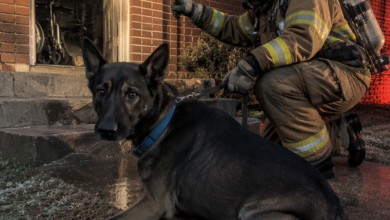
The dog in the photo wore a blue vest. Not a fake one. Not one of those cheap online patches people buy to take pets into stores. This was a real service vest, fitted and worn. The caption said he belonged to a twelve-year-old boy named Owen Miller from Canyon, Texas, who had epilepsy and autism.
Missing for eleven days.
Last seen near a rest stop south of Amarillo.
Reward offered.
I took the flyer to the front desk.
The vet tech went pale.
“That’s him?”
I looked through the small window into the exam room, where the dog slept with his nose on my vest.
“Yes.”
I had not saved a stray.
I had saved somebody’s lifeline.
The clinic called the number on the flyer. A woman answered on the first ring, like she had been living beside the phone. Her name was Rebecca Miller. I could hear the sleep leave her voice as soon as the tech said German Shepherd.
Then I heard a sound in the background.
A boy crying.
Not loud.
Not dramatic.
Just a broken little sound, like hope hurt too much to touch.
They arrived before sunrise.
Rebecca was in her late thirties, thin from worry, with dark circles under her eyes and a sweater on inside out. Her husband, Tom, had one arm around a boy with sandy hair and noise-canceling headphones pressed over his ears. Owen held a small blue leash in both hands.
Diesel woke before they entered the room.
His head lifted.
His whole body changed.
Not excited exactly.
More like a missing note had returned to a song.
The door opened, and Owen whispered, “Diesel?”
The dog stood too fast and almost slipped.
I reached for him, but he was already moving, limping across the floor, tail low, ears back, making a sound so soft I would have missed it if the room had not gone still.
Owen dropped to his knees.
Diesel put his head against the boy’s chest.
The boy wrapped both arms around his neck and rocked once, then twice.
Nobody spoke for a while.
Rebecca covered her mouth with both hands. Tom turned toward the wall. The vet tech cried openly because some people are honest like that.
I should have felt good.
Instead, I felt something twist under my ribs.
Because Diesel was going home.
Of course he was.
That was right.
That was what should happen.
But when Owen’s seizure-alert dog was finally back in his arms, Diesel lifted his head and looked at me.
Then he pulled away from the boy.
Not far.
Just enough to come to where I stood by the counter and press his burned nose into my palm.
Owen watched us.
His face changed in a way I could not read.
Rebecca saw it too.
“Oh,” she said quietly.
That was when they told me the second twist.
Diesel had not been stolen at random.
Someone had taken him during a family stop on the way to Lubbock, likely after seeing the service vest and assuming a trained dog could be sold for money. Rebecca had turned away for less than a minute to help Owen inside the restroom. When she came back, Diesel was gone, vest and all.
For eleven days, Owen barely slept.
His seizures increased.
He stopped speaking in full sentences.
And every morning, he put Diesel’s leash by the door.
Waiting.
The third twist came from the deputy who returned to the clinic at sunrise. He had reviewed traffic camera footage near the abandoned grain sheds. A pickup matching the one I had noticed earlier had been seen entering the service road twenty minutes before I arrived.
The owner had prior charges.
Animal theft.
Illegal dog fighting.
Cruelty complaints that never stuck.
The deputy believed Diesel had been dumped on the tracks because he was too recognizable to sell and too trained to break.
Rebecca’s knees buckled.
Tom caught her.
Owen did not react at first.
Then he reached for Diesel’s collar and whispered, “Bad men put you there.”
Diesel leaned into him.
But his eyes came back to me.
That look held the room in a place none of us knew how to leave.
Because I had not just pulled a dog off the tracks.
I had pulled him out of the last stop in a chain of cruelty someone thought no one would see.
And somehow, Diesel had carried trust across the rails with him.
Part 5 — Revelation
The Millers took Diesel home that morning, but the story did not leave with them.
It followed me back to my house, into my garage, down the hall, and stopped outside Jamie’s bedroom like it had a key.
I tried to sleep.
I could not.
Every time I closed my eyes, I saw Diesel’s paws braced against the wooden tie. I saw the red rope, wet and tight. I saw the engine shadow crossing the gravel. Then I saw his face in the flyer, wearing the blue vest, standing beside a boy who needed him for more than comfort.
I had spent years thinking the world had taken my son from me because I was not close enough to stop it.
Then I found a dog tied to the thing my son had loved most as a child.
Tracks.
Steel.
Horns.
Movement.
For the first time in a long time, I did not feel like running from that thought.
I went into Jamie’s room.
The air smelled stale, but not haunted like I had imagined. Just stale. A room waiting for someone to open a window.
His train map was still on the wall. Amarillo. Canyon. Lubbock. Lines crossing the Panhandle like veins. His blue toy engine sat on the desk, dusty enough that my fingerprint made a clean mark when I picked it up.
I held it longer than ten seconds.
Then I sat on his bed and let the morning pass.
At noon, my phone rang.
It was Rebecca Miller.
Her voice sounded careful. “Mr. Mercer, I’m sorry to bother you.”
“You’re not.”
She hesitated. “Diesel won’t settle.”
My hand tightened around the phone.
“Is he hurt?”
“No, the vet checked again. He’s home. He’s with Owen. He alerts. He responds. But he keeps going to the front door with your vest.”
“My vest?”
“You left it at the clinic. The tech gave it to us by mistake because Diesel was lying on it.”
I closed my eyes.
Rebecca kept talking. “Owen says Diesel wants to check on you.”
That sentence should have sounded childish.
It did not.
I rode to Canyon that afternoon.
Their house was small, clean, and full of signs of a family that had been living under emergency for nearly two weeks. Prescription bottles on the counter. Printed seizure logs. Half-eaten crackers. A blanket on the couch where someone had been sleeping instead of going to bed.
Owen met me at the door with Diesel beside him.
The dog was wearing his blue service vest again. His fur had been cleaned. The rope marks were visible under the collar, but healing. When he saw me, he gave one sharp sound and pushed his head into my stomach hard enough to knock me back half a step.
Owen watched closely.
“He says thank you,” the boy said.
I swallowed.
“Tell him he saved me too.”
Owen tilted his head.
Kids like Owen do not always let polite lies pass through the room unnoticed.
“How?”
I looked at Diesel.
Then at the boy’s small hands on the blue leash.
“I was stuck,” I said finally. “Not on tracks. But stuck.”
Owen nodded like that made sense.
For the next month, I visited every Saturday.
At first, I told myself it was because the deputy needed statements, because Diesel knew me, because Owen asked questions about motorcycles, because Rebecca kept offering coffee and Tom needed help fixing a fence.
All true.
None the whole truth.
The whole truth was that Diesel had torn open a door I had nailed shut.
I started cleaning Jamie’s room.
Not emptying it.
Cleaning it.
There is a difference.
I dusted the train map. Washed the sheets. Packed some clothes for donation and kept the jacket that still smelled faintly of his old cologne. I found a photo of him at eight years old, sitting on my Harley before his feet could reach anything, grinning like he had already outrun sorrow.
I placed that photo on the desk.
Beside the blue toy engine.
The deputy later called to say they had arrested the man from the pickup. His truck had rope fibers in the bed, two stolen collars, and Diesel’s cut service vest patch stuffed behind the seat. He denied everything until traffic footage showed him near the tracks.
I wish I could say justice fixed something.
It did not.
It helped.
But fixing is a word people use when they want pain to behave.
The real healing came in smaller pieces.
Diesel lying between Owen and the front door, still on duty despite what had been done to him.
Owen learning to say “train” again without covering his ears.
Rebecca sending me a photo of Diesel asleep with one paw on the blue leash.
Me riding past the service road without turning away.
And one Saturday in November, when Owen asked if Diesel could visit Jamie’s room.
I almost said no.
Then Diesel stepped into my house, sniffed the hallway, and walked straight to the bedroom like he had been invited by someone I could no longer see.
He stood under the train map and looked up.
His ears lifted.
Then he sat.
Calm.
Owen placed one hand on Diesel’s head and said, “He likes this room.”
I looked at the map.
The toy engine.
The sunlight on the dust I had missed.
And for the first time since the funeral, Jamie’s room felt less like a closed wound and more like a place where love had once lived loudly.
That was the final twist, though it took me months to say it.
I thought I had saved Diesel because I happened to pass the tracks at the right time.
But Diesel had pulled me off a different track entirely.
One I had been tied to for years.
Part 6 — Echo
Diesel stayed with Owen.
That is the part some people did not like when the story spread online.
They wanted the biker to adopt the dog.
They wanted the photograph: rough man, rescued Shepherd, sunset, motorcycle, clean ending.
Life gave us something better and less simple.
Diesel belonged to Owen. His first duty, his trained work, his deepest daily rhythm, was with the boy who needed him before the tracks and after them. No one who saw them together could question that.
But Diesel also became part mine.
Not ownership.
Something quieter.
Every second Saturday, the Millers drove to Amarillo or I rode to Canyon, depending on weather. Diesel would greet me with his whole body, then check Owen, then return to me, as if making sure both parts of his world had stayed in place.
I bought a new knife and clipped it to my belt.
Then another for my saddlebag.
Then a rope cutter for every bike in our club.
The High Plains Riders turned it into a rule after that. Nobody rides without a blade. Nobody passes a roadside animal without slowing down. Nobody assumes trash is trash if it moves.
We started calling it Diesel’s Rule.
At first, it was just us. Then other clubs heard about it. A veterans’ group in Oklahoma asked for the decal. A rescue shelter in New Mexico printed cards. A rail worker in Kansas mailed me a package of orange safety cutters with a note that said, “For the next dog.”
I kept one on Jamie’s desk.
Beside the toy engine.
Every Sunday evening, I rode the service road outside Amarillo. Not always to the spot. Some days I only passed the turn. Some days I stopped and walked down the gravel slope where Diesel and I had rolled away from the train.
The rope scar on my palm faded slower than it should have.
I was glad.
It gave me something to touch when memory got loud.
In December, Owen and Diesel came with me to the tracks for the first time since the rescue. Rebecca worried it would be too much. Maybe it was. But Owen wanted to bring something.
He carried a small blue toy train.
Not Jamie’s.
A new one.
He placed it on a flat stone near the service road, far from the rails. Diesel stood beside him in his blue vest, steady as a guard at a gate.
Owen said, “For the boy you miss.”
I did not answer right away.
Could not.
The wind moved over the empty land. A train horn sounded far off, low and distant, no longer a monster, only a sound crossing miles.
Diesel leaned against my leg.
Owen leaned against Diesel.
And for once, I did not feel like the past was coming to take something from me.
It was just passing through.
Part 7 — Ending
The last time I saw Diesel that winter, he climbed carefully onto my porch before Owen even got out of the car.
He was stronger by then. The fur around his neck had grown back unevenly where the rope had burned it away. His torn ear still gave him a lopsided look, but his eyes were clear.
Owen handed me a folded paper.
Inside was a drawing.
A motorcycle.
A train track.
A German Shepherd standing between them.
And a big man with tattoos holding a broken red rope in both hands.
Above the picture, Owen had written three words.
He pulled back.
I put the drawing in Jamie’s room.
Not in a drawer.
On the wall, beside the train map.
That night, I sat on the edge of my son’s bed with Diesel’s rope cutter in my hand and listened to a freight train call somewhere beyond town.
I did not flinch.
I did not leave.
I just sat there until the sound faded.
Some rescues happen in seconds.
Some take years.
Sometimes the one shaking in your arms is not the only one being saved.
Follow this page for more powerful dog stories about loyalty, rescue, second chances, and the kind of courage that appears when there are only seconds left.