Everyone on the Garbage Crew Thought the Muddy Stray Just Wanted a Place to Sleep When She Leaped Onto the Old Mattress Seconds Before the Truck Took It, Until One Worker Saw the Seam Move
Part 2: Three Heartbeats in the Stuffing
Ray let go of her like her fur had burned him.
The dog stopped crying the instant his hand was gone. She lifted her head, licked the seam once, gently, the way a mother licks a face, and then looked up at him as if to say, Now do you see?
He dropped to one knee on the wet asphalt. His back screamed. He ignored it.
There was an old tear near the corner of the side panel, maybe three inches long, the edges frayed and gray. Someone small had been using it as a door. Ray hooked two gloved fingers inside and pulled the fabric open as carefully as he’d ever done anything in his life.
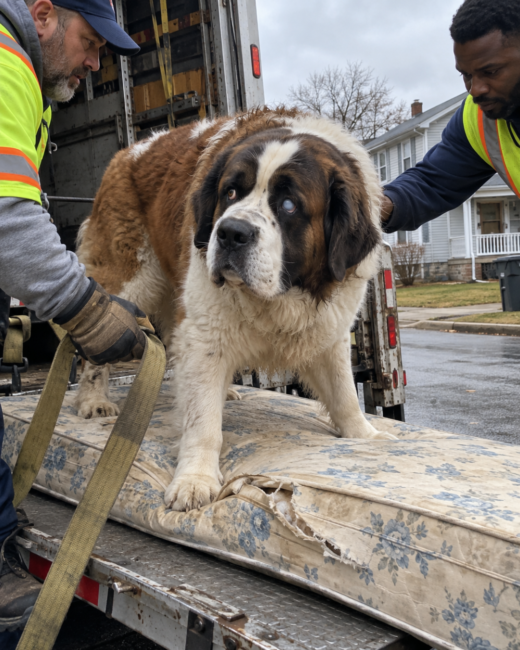
Yellowed foam. Clumps of old cotton batting, packed down and shaped into a hollow. And in the hollow, three kittens.
They couldn’t have been more than two weeks old. Eyes barely open, the cloudy blue of skim milk. One gray tabby. One black with four white socks. And one so small and pale gray it looked like a dust bunny someone had forgotten to sweep.
“No way,” Tyler whispered. “No way. We almost…”
He didn’t finish. He didn’t have to. Ray knew exactly where that mattress had been ten seconds from going. He knew what the blade inside the hopper did. He’d watched it a thousand times.
The black one opened its mouth and let out that squeak. The same thin squeak Ray had blamed on the hydraulics.
His stomach rolled.
Footsteps slapped down the porch steps. The man from 412 came across the yard, still clutching his box. “What’s the holdup? I’ve got a closing Friday and a dumpster coming at noon, and—”
He saw the kittens and stopped walking.
“Oh, God.” The box sagged in his arms. “I dragged that thing down the steps an hour ago. I bounced it off every single step.”
“Mama cat around?” Ray asked.
The man shook his head slowly. “There’s a gray one that hangs around the porch. Skinny thing. Haven’t seen her since…” He frowned. “Tuesday, maybe. My crew was sealing up the crawlspace vents Tuesday. Keeping critters out before the inspection.”
The dog’s head turned toward the house when he said it. Just for a second. Then back to the kittens.
Ray noticed. He didn’t know yet that he’d noticed.
The radio on his shoulder crackled. “Delgado, you’re forty minutes behind on Cedar. What’s going on out there?”
Ray pressed the button. “Found something in a mattress.”
“Is it hazardous?”
He looked at the three tiny bodies, the black one still squeaking, the gray one barely moving at all. “No,” he said. “It’s alive.”
He let go of the button before his supervisor could answer.
Then Ray Delgado, who had not done one unnecessary thing in seven months, unzipped his faded red flannel jacket and pulled it off in the cold. He grabbed an empty box from the curb pile, folded the jacket into the bottom, and lifted the kittens out one at a time. They weighed nothing. They were cold as river stones.
The dog climbed off the mattress the moment the last kitten was out. She didn’t try to take them. She pushed her gray muzzle into the box and breathed on them, warm and slow, then sat down against Ray’s leg like she’d been assigned there.
“Tyler,” Ray said. “Pull that mattress off the lip and lay it on the grass.”
“It’s on the list, Ray. It’s supposed to—”
“Nobody crushes that mattress today.”
Tyler looked at him for a long second, then did it without another word.
That was when a screen door banged on the far side of the street, and a thin, furious voice cut through the idling engine.
“Dolly! Dolly, you get back here this instant!”
The dog’s notched ear went up.
An old woman was coming down her driveway behind an aluminum walker, a plastic rain bonnet tied under her chin. Hooked over one handle of the walker hung a faded red collar.
In her other hand, she was carrying a full bowl of food.
Part 3: The Dog Nobody Lost
June Hadley was seventy-nine years old and did not run anymore, but she crossed Cedar Lane faster than Ray would have believed possible.
“She went right under my fence,” she said, out of breath, shaking the red collar at the dog. “Left this hanging on the chain-link like a flag. Dolly, you scared ten years off me, and I didn’t have ten to spare.”
The dog thumped her tail against Ray’s boot but didn’t leave his side.
“She’s yours?” Tyler asked.
“She’s fed, she’s vaccinated, and she sleeps on a cedar bed by my stove that cost me forty dollars,” June said. “Chicken and rice twice a day, since her back teeth went. And she has never once, not one time, walked away from her breakfast.” She held up the bowl. It was still full, a fork sticking out of the rice. “This morning she heard that mattress go bumping down the steps and she was gone like I’d fired a gun.”
So the round belly wasn’t garbage. And the pale ring around her neck had been a collar an hour ago.
Ray felt the first piece of the morning click into place. It didn’t make him feel any better.
“Ma’am,” he said, “if she’s yours, why was she so desperate about his mattress?”
June looked at the man from 412. Something passed between them. His jaw worked.
“Because it isn’t his mattress,” June said quietly. “It was his daddy’s. And she isn’t really mine. She was Walt’s.”
Ray went very still.
“Walt Ames,” June went on. “Lived in that house forty-one years. His wife Ellen passed nine years ago, and after the funeral, Walt couldn’t make himself sleep in their bed. Couldn’t even sleep in the room. So he dragged that little twin mattress out onto the porch and slept out there, rain or shine, with Dolly beside him. Summer, winter, all of it. Nine years.”
Ray looked at the mattress lying on the grass. At the long hollow pressed into the middle of it.
The shape of a man who couldn’t go back inside.
“Walt passed in April,” June said. “Heart. Went in his sleep, right out there on that porch. Dolly was lying across his feet when the mail carrier found him.”
The man from 412 cleared his throat. “I’m Dale. His son.” His arms were still full of his father’s things. “I live in Nashville. I’ve been driving down weekends to clean the place out. Closing’s Friday.”
“She came to live with me after,” June said, stroking the folded ear. “She eats at my house. She sleeps at my house. But every single morning, the minute her bowl’s empty, she trots over here, climbs up on Walt’s mattress, and lies down right in the hollow where he used to be. Hours. Every day.”
“And the gray cat,” Ray said.
June’s eyebrows lifted. “Smoke. Walt fed her for years. Called her his porch tenant. After he passed, Smoke started lying on the mattress too. The two of them curled up together, keeping each other company on a dead man’s bed.” She pressed her lips tight. “I’d sit at my window and watch them and cry like a fool.”
Tyler looked down at the box. “So Smoke had her babies in there. Inside the mattress. Right where…”
“Right where Walt used to sleep,” June said.
Dale finally set his box on the curb, like his arms had given out. “I didn’t know any of that,” he said, voice rough. “I just couldn’t look at the thing anymore. Every time I came up those steps, it was like he was still lying there. I wanted it gone.”
Nobody spoke. Rain began to tick against the truck’s steel sides.
So that was the truth of it. Dolly hadn’t been fighting for a place to sleep. She’d been fighting for the last warm thing left on Walt’s porch, and for what was hidden inside it.
Ray should have felt relieved. The mystery was solved. The kittens were safe. He could finish his route.
Instead his throat had closed so tight he could barely breathe. Because he knew that porch. He’d known it for ten years. And he’d known Walt Ames.
He just hadn’t known Walt was dead.
June was studying him now, squinting through her glasses at his face, his thick gray mustache, the back brace under his vest. Her mouth fell open a little.
“Wait,” she said. “You’re him. You’re the Thursday man.”
Ray couldn’t answer.
“Ray,” she whispered. “Walt’s Ray.” She gripped her walker with both hands. “Honey, he left something for you. Made me swear to hold onto it. He said you’d come back on a Thursday someday.”
She looked at the dog, then back at him.
“He said Dolly would see to it.”
Part 4: Sweet Tea on Thursdays
For ten years, Thursday had been Ray’s favorite day of the week, and it was because of a man on a mattress.
He’d first noticed Walt Ames the spring he took over the Cedar Lane route: an old man in a flannel shirt sitting cross-legged on a striped mattress on his porch like it was the most normal thing in the world, a brindle puppy with a notched ear chewing his shoelace. That first Thursday, Walt raised a mason jar of sweet tea at him like a toast.
The second Thursday, there were two jars.
After that, there were always two.
Ray never stayed long. Five minutes, maybe seven, standing at the bottom of the porch steps while the truck idled and the other guys gave him grief. Walt talked about Ellen, about his bad knee, about how the Vols were going to break his heart again. Ray talked about Carmen. Her tomato garden. Her laugh, which was too loud for church, and she didn’t care.
Then, two years ago, Ray talked about Carmen’s diagnosis.
Walt didn’t say anything foolish. He didn’t promise she’d beat it. He just came down the steps, which he never did, handed Ray the jar, and stood beside him in the heat while the truck beeped. “You tell me every Thursday how she’s doing,” he said. “Every Thursday. You hear me?”
And Ray did. Treatment by treatment. Good weeks and bad. Walt was the only person on earth Ray told the truth to, because Walt had been through it, and because a man sleeping on a mattress on his own porch can’t pretend to be anything he isn’t.
Carmen died on a Tuesday in March.
That Thursday, Ray called in sick. The Thursday after, he asked to be moved to a different route, any route, the farther from Cedar Lane the better. He told himself he couldn’t stand the questions. The truth was simpler. If he walked up to that porch, Walt would hand him the jar and look at him, and Ray would have to say it out loud.
So he never went back.
He’d slept on his living room couch ever since, the TV murmuring all night, Carmen’s side of the bed made up tight and untouched. He hadn’t told a soul.
Now he sat in the cab of the truck at three in the afternoon, route finished, the box of kittens humming on the floor by the heater vent. Dolly had refused to leave the box, so she’d ridden the rest of the route in the cab like she’d been hired. Her chin rested on his knee. In his hands was an envelope with his name on it in shaky blue ballpoint.
For Ray. Thursdays.
June had made him finish the route first; it had taken her that long to find the envelope among her things. Tyler had run to the Dollar General for kitten formula and tiny bottles, and now sat in the passenger seat watching the smallest kitten with an expression of pure terror.
Ray opened the envelope.
Ray,
You stopped coming. Three Thursdays now. I figure that means the worst thing happened, and I figure you’re doing what I did, which is hiding.
I’ll tell you something I never told you. I didn’t move out onto this porch for the fresh air. I moved out here because I couldn’t stand to look at Ellen’s side of the bed. Told myself it was for a few nights. It’s been nine years. I gave my whole last stretch of life to a porch, son. Don’t you give yours to whatever you’re sleeping on.
My heart’s not good. Doc says so and I believe him. When I go, June will take Dolly, but June’s getting on too. If it comes to it, that dog is going to need somebody stubborn.
And I think you’re going to need somebody who won’t take no for an answer.
She doesn’t lose, Ray. Don’t argue with her.
Your friend,
Walt
P.S. The tea’s in the fridge. Same as always.
Ray read it twice. The second time through, the words blurred and he stopped trying.
Tyler stared out the window and pretended very hard not to notice that his boss was crying. Dolly lifted her head and pressed her white teardrop patch against Ray’s arm, steady and warm, the same way she’d pressed against the mattress seam.
“He wrote that in March,” Ray said finally. His voice came out like gravel. “He knew. He knew before I ever said it.”
“Sounds like he knew you pretty good,” Tyler said softly.
Ray folded the letter along its old creases and slid it into his shirt pocket, over his heart, where it crinkled every time he breathed.
Outside, June was making her way along the curb on her walker. She stopped by his window. Up close, her eyes were red.
“I didn’t give you that only because Walt asked,” she said. “I gave it to you today because I’m out of time.”
Ray rolled the window all the way down.
“My daughter’s moving me to Knoxville on Saturday. Assisted living. No dogs allowed. I’ve asked everybody on this street. Dale’s building won’t take her. Nobody wants a nine-year-old mutt with bad teeth.”
She looked at Dolly, and her chin trembled.
“If nobody takes her, the county picks her up Saturday at eight in the morning.”
Part 5: The Night Before Saturday
Ray said no.
He said it right there in the truck, before June had even finished, before he could let himself think. “I can’t, ma’am. I’m sorry. I can’t.”
June nodded like she’d expected it. Like everyone had already said those exact words to her. She patted his arm through the window and turned her walker around.
Dolly didn’t follow her. Not right away. She stayed by the truck, staring up at Ray, until June called her name three times.
Ray didn’t watch her go. He looked at the dashboard.
He told himself it was practical. He worked ten-hour shifts. He had a bad back and a worse knee. And come Monday, if the paperwork he’d signed on Wednesday went through, he’d be working nights. An old dog needed soft food, vet visits, someone home.
That wasn’t the reason.
The reason was that he’d spent seven months learning how to need nothing. Not the bed. Not his friends. Not the church ladies who’d dropped off casseroles until they gave up. If you didn’t let anything in, nothing could get torn out of you. That was the whole plan.
A dog would wreck the plan.
The kittens, though, he took. Somebody had to. The vet in town, a brisk young woman named Dr. Patel, looked them over that evening and didn’t sugarcoat it. No mother, two days without nursing, chilled for who knew how long. “Bottle every two hours, around the clock. Keep them warm. The two bigger ones have a decent shot.” She touched the smallest with one fingertip. “This little one, I’ll be honest. I wouldn’t get attached.”
Ray took them home to his dark little house on Hiwassee Street and set up a heating pad in a laundry basket beside the couch.
That night he woke every two hours to the alarm on his phone. He warmed formula in a coffee mug of hot water, held each kitten belly-down in his big palm, and fed it with a bottle the size of his thumb. Tyler named them over text. The black one was Socks. The tabby was Biscuit. The smallest, the one that fit in a tablespoon, Tyler called Pip.
Pip would take a few drops and then turn her face away.
Every two hours, Ray coaxed her. Every two hours, a few drops. He talked to her. He didn’t know what about. Around four in the morning he realized it was the most he’d talked in seven months.
Friday the rain came in hard, the kind of October storm that knocks the last leaves down all at once. Ray worked his shift. At lunch he called June. She was packing; her daughter had arrived. Dolly had spent the whole day lying against the front door.
“She keeps looking toward Walt’s,” June said. “Whining. I don’t know what she wants. The mattress is still out in the yard. Dale didn’t have the heart to haul it after all.”
Ray said he was sorry. He was. It didn’t change anything.
He called the county shelter to ask if they could give her a little time. The woman on the phone was kind and tired. They were full. Brindle dogs over seven, she said gently, didn’t move fast.
That night, Pip stopped taking the bottle altogether.
Ray tried at ten. At midnight. At two. Her body had gone soft and cool in his hand, her breathing so shallow he had to hold her to his ear to be sure. He tucked her inside his T-shirt, skin to skin, the way Dr. Patel had shown him, and sat on the couch in the dark while the rain hammered the windows.
At 4:40 in the morning, his phone lit up.
June’s voice was thin and frantic. “She’s gone, Ray. Dolly’s gone. She dug under the fence in the storm. My daughter’s been out with a flashlight for half an hour. She’s not on the street. She’s not anywhere. And the county truck comes at eight.”
Ray sat with the phone against his ear and the tiny, barely-there weight of Pip against his chest.
An old dog lost in a storm. A kitten fading in his shirt. A shelter truck in three hours. And in his jacket pocket, a letter from a dead man who’d asked him for exactly one thing.
He had said no.
He thought about Walt sleeping on that porch for nine years, alone, because he couldn’t walk back into his own bedroom. He thought about this couch. The TV glowing all night. Carmen’s side of the bed, tucked so tight it might as well have been a grave.
He wasn’t grieving. He was doing exactly what Walt had begged him not to do.
Pip’s breath fluttered against his skin.
Then, for one long, terrible second, it didn’t.
Ray grabbed his keys.
Part 6: What She Was Trying to Tell Us
Pip took a breath somewhere on Highway 11, a tiny hitch against his skin, and Ray nearly drove into the ditch.
“Hang on,” he told her. “Just hang on, little one.”
He didn’t know why he was heading to Cedar Lane. June’s daughter had already searched it. But there was nowhere else on earth that dog would go, and he knew it the way he knew his route, in his bones.
His headlights swept across 412 at 5:15. The porch was bare and dark. The striped mattress lay in the yard where Tyler had left it, sagging with rainwater, the long hollow in the middle filled up like a shallow, man-shaped pond.
Dolly wasn’t on it.
Ray almost turned around. Then he heard it under the rain: the frantic scrape of claws on wood.
He found her around the side of the house, belly-deep in mud, digging at a square of new plywood screwed over the crawlspace vent. Her paws were raw. There was blood on the board. She’d chewed one corner of it to splinters.
She looked up when his flashlight hit her and barked once, hoarse, like she’d been barking for hours.
And then Ray remembered. Dale on Thursday morning: My crew was sealing up the crawlspace vents Tuesday. The way the dog’s head had snapped toward the house when he said it. June on the phone: She keeps looking toward Walt’s.
She hadn’t been mourning. She’d been telling them.
Ray didn’t have a drill. He had a tire iron and fifty-six years of bad temper. He jammed the iron under the plywood and heaved until the screws shrieked out of the siding and the board fell into the mud. His flashlight beam went into the dark under the house.
Two green eyes stared back.
The gray cat came out low and slow, so thin her hips showed through her soaked fur, one front paw held up and swollen. She’d been sealed under there since Tuesday, while her kittens lay twenty feet away inside a mattress she couldn’t reach, crying for her through the floorboards. And Dolly had heard them both.
Smoke went straight to Dolly and pressed her face into the dog’s muddy chest. Dolly lay down around her like a wall.
Ray’s hands were shaking when he opened his shirt.
He set Pip in the warm space between the cat’s front legs. For a moment nothing happened. Then Smoke bent her head and licked the kitten, rough and hard, the whole length of her tiny body, again and again. Pip’s mouth opened. She squeaked. Then she rooted blindly forward and latched on, and Ray heard himself make a sound he hadn’t made since March.
He sat down in the mud beside them. He didn’t care about his back.
The rain was easing. Across the street a porch light came on, and June’s silhouette appeared in the window, one hand pressed over her mouth.
Ray looked at the mattress in the yard. At the hollow full of rain.
Walt had slept nine years on that porch because he couldn’t face an empty bed. He’d known exactly what Ray would do when Carmen died, because he’d done it first. And he’d known Ray wouldn’t listen to a letter. So he’d left the one thing he had that never took no for an answer.
On Thursday, Dolly jumped onto that mattress to save three kittens.
That was true.
But she had also stopped a truck on the one Thursday in seven months that Ray Delgado came back to Cedar Lane. She’d climbed into his life and refused to get off. And when he said no, she went out into a storm and found the one thing that could make a stubborn old man run.
The paperwork he’d signed Wednesday was a transfer. Starting Monday, he’d have worked nights at the county landfill. Alone. No route. No porches. No Thursdays. Nobody, ever again, asking how he was.
He’d thought he was protecting himself.
Dolly turned her gray muzzle toward him across the mud and thumped her tail once. Same as Thursday morning. Like she knew him.
Like she’d known him all along.
Ray pulled out his phone. He called the county shelter’s overnight line and left a message: the eight o’clock pickup on Cedar Lane was canceled. The dog had a home.
Then he called his supervisor’s voicemail and withdrew the transfer.
“She doesn’t lose,” he said out loud, to nobody, to Walt. “Okay. I hear you. I’m not arguing.”
Part 7: Bulk Pickup Day
Hiwassee Street had its bulk pickup on the first Thursday of November.
At the curb in front of Ray’s house sat a brown plaid couch with a permanent dent at one end, the shape of a man who’d fallen asleep in front of the TV for seven months straight.
The truck rounded the corner at 9:20. Tyler was riding the back with a new kid beside him. When he saw the couch, he grinned and gave Ray a two-finger salute.
Ray stood on his porch with a mason jar of sweet tea in each hand.
The house was different now. The back porch had become a nursery. Smoke lay in a padded crate by the door, her paw healed, keeping two fat, bossy kittens in line. Biscuit had gone home with Tyler, whose landlord had nothing against cats. Socks and Pip were staying. Pip was still the smallest. She was also, without question, in charge.
June called every Sunday on video from Knoxville. Dolly always pressed her nose to the screen.
And on Thursdays, Ray was back on Cedar Lane. He’d asked for it himself. Dale had sold the house, and the young couple now living at 412 had started waving at the truck. Last week they’d offered him coffee. He’d stayed seven minutes.
Walt’s mattress was gone. Ray had let it go the Thursday after the storm, lifting it into the hopper himself while Dolly sat beside him on the curb. She’d watched the whole thing without moving a muscle. He figured that meant she was finished with it.
Now Tyler and the new kid grabbed the couch by its arms and swung it toward the truck.
Ray glanced down at the dog beside his boots. Brindle. Gray muzzle. One notched ear folded over. A white teardrop on her chest.
She watched the couch rise. Her ears didn’t even twitch. She yawned.
“Not this one, huh?” Ray said.
The hopper took it. The blade came down. The couch was gone.
Tyler hopped off the back, and Ray handed him a jar of tea, and they stood at the bottom of the porch steps for a few minutes the way Ray and Walt used to, saying nothing much, while the truck idled and the new kid waited without complaining.
That night, Ray turned off the TV at ten.
He walked down the hallway he’d been avoiding since March and stood in the bedroom doorway, looking at the bed with Carmen’s quilt on it. His chest hurt. He let it.
Dolly pushed past his legs.
She crossed the room without hesitating, the same way she’d crossed Cedar Lane that first gray morning, jumped up onto the bed, turned around twice, and settled on Carmen’s side with a long, satisfied groan. Then she looked back at him over her shoulder.
Waiting.
Ray laughed, a short, rough, astonished sound, and lay down on his own side of the bed for the first time in eight months.
The mattress gave beneath him. Dolly’s warm back pressed against his.
Outside, the rain started up again, soft on the roof.
That Thursday on Cedar Lane, she had jumped onto a mattress so no one could take it away.
Tonight she’d jumped onto one so he would stay.
And this time, nobody tried to pull her off.
If this story touched your heart, follow our page for more stories that remind us why dogs are the best of us. ❤️