Part 2: Our New Volunteer Had Just Left Prison and Wouldn’t Coax a Frightened Dog Out of the Corner—Then the Dog Walked Past Him and Came Back
Part 2, Somewhere to Go
My name is Nora Bell, and I supervised the morning shift at a small dog rescue outside Pittsburgh. I was forty-seven, usually carried two pens because one always disappeared, and had developed the unfortunate habit of finishing a task in my head before the person doing it had begun.
Cal made that habit difficult.
He checked instructions before acting. During orientation, he asked where dirty towels went, whether the marked scoop belonged to a particular food bin, and who he should tell if a latch looked loose. He wasn’t slow. He wanted to know exactly what counted as finished.
That morning, I had mistaken the same care for hesitation.
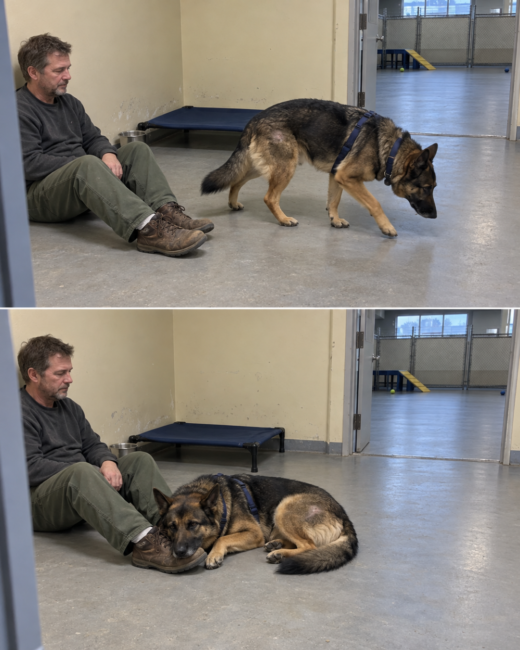
Rook stayed beside his boot for less than three minutes. When Leah moved to collect the cleaning supplies, he lifted his head and returned to his bed. Cal let him leave without reaching after him, then accepted the mop when I handed it over.
“What were you waiting for?” I asked.
“Him to have somewhere to go.”
He said it while wringing out the mop, as if he were explaining why a chair needed moving before a floor could be cleaned. He wasn’t offering a theory about dogs. He had noticed a blocked route.
Leah nodded. She had been working on giving Rook room to approach and retreat, but our crowded morning had undone some of that arrangement. She said so plainly. Nobody needed to become the villain of a story because a bucket had ended up in the wrong place.
Cal cleaned while she stayed with Rook.
I knew about his conviction because he had disclosed it during his application. He had served time for taking part in a warehouse burglary. He didn’t call it a misunderstanding, and I didn’t ask him to perform remorse every time we discussed a volunteer shift. We needed accurate information and reliable conduct.
His background didn’t make him a dog expert. He still needed training, supervision, and correction, exactly as our other new volunteers did. His observation that morning was useful because it was specific, not because suffering had given him some secret language animals understood.
When the room was ready, Leah guided him through the water routine. He rinsed the bowl, filled it, placed it where Rook could reach without passing close to a person, and stepped away.
Rook drank after they left.
Cal watched through the window, then asked where to record it. I showed him the daily sheet. He wrote the time, capped the pen, and returned it to the clip.
He had done one ordinary job correctly.
Before he left, he checked whether we wanted him back for his scheduled Tuesday shift. I said yes, assuming he was confirming the time. He repeated it once, quietly, before putting on his jacket.
Part 3, The Mornings Without a Photograph
On Tuesday, Rook didn’t rest his head on anyone’s boot.
He stayed behind his bed when Cal entered with Leah. A delivery truck had rattled past the rear fence, and another dog had been barking for several minutes. Cal sat near the wall for a short time, then left when Leah decided Rook needed a quieter room.
I watched for disappointment. Cal only asked whether he should finish the laundry first or refill the storage shelf.
He hadn’t arrived expecting a repeat performance.
The photograph had already attracted more attention inside the building than the actual routine. One staff member called him “Rook’s guy.” Cal looked uncomfortable with that, and Leah gently reminded us that one relaxed moment didn’t establish a handling skill or a permanent bond.
Rook needed several familiar people.
Cal became one of them slowly. He worked through the same supervised handling sessions as everyone else, learned how Rook responded to different approaches, and practiced ending a visit before the dog became overwhelmed. Some days they walked in the enclosed yard. Other days, Cal changed bedding while Rook remained with Leah.
There was plenty of work without a reward attached.
One morning, I found Cal beside the care sheet with his pen hovering over the page. He had written that Rook completed his walk, then crossed it out with a single line.
They had reached the yard gate when a bin lid slammed nearby. Rook had stopped, turned, and wanted to return.
“Should I put five minutes?” Cal asked.
“Put what happened.”
He wrote that they returned early after the noise, then asked Leah to check Rook before he tried again later. An honest note was more useful than a successful-looking one.
We didn’t make a speech about it. Leah adjusted the next session, and Cal went to wash the bowl.
That afternoon, he showed me a latch that wasn’t catching cleanly. He had noticed it during the closing check and left the room unused until someone could inspect it. I thanked him and called our maintenance volunteer.
He waited until I finished the call.
“Was I supposed to try fixing it?”
“No. You did the right thing.”
He nodded, but remained beside my desk long enough that I looked up again.
“Anything else?”
“No. Just checking.”
I began noticing how often he asked that. Not because he wanted praise, and not because every question hid a tragic memory. He was learning where his judgment was welcome.
By the end of his third week, he was approved for several routine care tasks within the schedule we agreed on. Leah remained responsible for the behavior plan. I remained responsible for making sure another trained person could cover every shift.
Cal’s name appeared on the board beside Rook’s morning care.
He stood reading it before he took off his coat.
Part 4, The Name Beside the Next Shift
The first morning Cal completed Rook’s routine without Leah beside him, he asked her to check it afterward.
She read the sheet, looked at the room, and told him the work was done. The bowl was clean, the bedding was dry, and his notes described a short walk without making it sound like a breakthrough. Cal waited for another instruction before realizing there wasn’t one.
He could go on to his next task.
I handed him the board for the following week and asked him to confirm the mornings he could reliably manage. He read the bus times on a folded timetable, checked the commitments already in his pocket notebook, and chose two shifts.
I wrote his name into the spaces.
He asked what happened if something went wrong.
“Tell us early. Someone else covers it.”
He nodded, then checked where the backup person’s name belonged. He wasn’t being asked to become indispensable. We needed a routine that worked when anyone was sick, late, or away.
The responsibility wasn’t as satisfying every day as that first photograph made it appear. On one morning, Rook left most of his breakfast. Cal brought the observation to Leah, who checked on him and decided what needed attention. Cal didn’t hover with the bowl, invent a diagnosis, or keep offering food until he could write that the dog had eaten.
He recorded what was left.
Afterward, he asked whether a dog could dislike the person who brought breakfast. I asked what made him think that.
“He eats when Leah comes.”
“Sometimes. She also sees the mornings you don’t.”
He looked through the window at Rook on his bed. I could almost see him reconsidering the few minutes he had treated as a verdict on himself.
He didn’t have to earn a response every time he entered.
Later that week, Rook settled near the wall while Cal changed the water. He didn’t approach, but he didn’t leave either. Cal finished, stepped out, and wrote down that the dog had remained resting.
At the end of his shift, I offered to send him the photograph from that first morning. He asked for a copy, then studied it on his phone.
I thought he was looking at Rook.
Instead, he enlarged the picture until his hands filled most of the screen. They lay open on his knees, nowhere near the collar.
“I thought I looked like I wasn’t doing anything,” he said.
“So did I.”
He smiled a little at that.
The care sheet gave us a less misleading picture: things noticed, things completed, questions passed to the right person. It was less striking than a dog’s head resting on a boot.
Cal checked it once more before leaving.
His name was still beside the next shift.
Part 5, Eighteen Applications
The first time Cal missed a bus, he called twenty minutes before his shift.
He sounded embarrassed. I was already reaching for the coverage sheet when he began explaining the connection he had missed and the next service he could catch. He offered to arrive late and stay longer.
“We’ll cover the morning,” I said. “Come when you can. We can use you on laundry.”
He went quiet. Then he asked, “Am I still on the board?”
I looked toward it. His name remained beside Tuesday and Thursday, written in blue marker.
“Yes.”
One missed connection hadn’t erased the arrangement.
He arrived with rain darkening his sweatshirt and went straight to the laundry room after checking in. When he finished, he found Leah, asked how Rook’s morning had gone, and entered the afternoon observations she gave him.
Later, I asked whether he wanted tea before the bus home.
He sat across from me with a thin plastic folder beneath his mug. A corner had split, and he had repaired it with clear tape. When he moved it away from a drip, several printed application confirmations slid into view.
I didn’t reach for them.
“Looking for work?” I asked.
“Still.”
He counted briefly in his head. Eighteen applications since coming home. Several had produced nothing beyond an automatic message. Two interviews had seemed promising until the background discussion. One manager had simply told him the position was filled, although the advertisement remained online.
He couldn’t know the reason for every rejection. He was careful to say that.
“I can do stock work. Repairs. Clean a place properly,” he said. “Just need somebody to see me do it.”
There was no anger in the way he held the mug. His thumb moved along a chip near the handle.
He told me he was staying with his sister and meeting his release requirements. She had helped him find the volunteer program, but the shelter wasn’t a condition of his release. He had chosen to apply because the days were becoming difficult to fill.
“Rook’s water,” he said, looking toward the hall. “That’s the first regular thing somebody outside my family asked me to be responsible for.”
I thought about the shift board.
To me, it had been a staffing decision.
To him, it meant someone expected him to return, notice what needed doing, and tell the truth when a task wasn’t finished. It didn’t pay his rent or remove a conviction from an application. He knew that.
He wasn’t asking me to pretend otherwise.
“The picture’s nice,” he said. “But I like knowing what I’m coming in to do.”
After he left, I checked the care sheet. Rook had drunk, eaten most of breakfast, and taken a shorter afternoon walk. Cal’s writing was small and easy to read.
Nothing on the page needed an explanation of his past.
Part 6, Someone Else on Thursday
I offered to be a reference after Cal had volunteered consistently for several more weeks. I asked his permission first and explained what I could honestly tell an employer: he arrived when scheduled, called when delayed, followed instructions, reported problems, and accepted correction.
He asked whether I would mention Rook.
“If it’s relevant.”
He thought about it, then nodded.
The photograph stayed out of the conversation. A quiet dog resting on a shoe couldn’t establish whether someone would turn up for work at seven in the morning. The attendance sheet and the people who had worked beside him could speak to that.
Meanwhile, Rook’s days became less confined.
He learned the route to the quiet yard with several handlers. He began taking treats during some introductions and could settle on his bed while a familiar person moved around the room. Sudden noises still unsettled him, and crowded doorways still required attention.
Cal didn’t claim him as his own.
His sister’s lease didn’t allow a large dog, and he wasn’t ready to take responsibility for an animal outside the shelter’s support. He told a visitor that directly when she asked whether he planned to adopt.
Wanting Rook wasn’t the same as having a suitable home.
By then, I had begun asking Cal to help orient new volunteers to routine tasks he knew well. Leah demonstrated handling. Cal showed people where the cleaning supplies belonged, how to read the care board, and why an open doorway wasn’t useful if a person stood in the middle of it.
He was still learning. Once, I corrected how he had stored a freshly washed bowl, and he moved it without defending the choice. Later, he asked whether a label would help the next person avoid the same mistake.
He made the label after I said yes.
An employer eventually offered him a trial shift in a small warehouse that supplied building materials. The manager needed someone for stocking, cleaning, and basic upkeep, and called me after speaking with Cal.
I gave the reference we had discussed.
The trial became a part-time job.
Cal brought the schedule in before accepting his next volunteer shifts. One workday overlapped with Thursday morning, and he wanted to change his shelter hours before anyone relied on him.
We moved him to Saturday.
Rook’s care continued on Thursday, handled by someone else. Cal asked who it would be, then showed the volunteer where the spare bedding was kept. He didn’t leave a private set of tricks or suggest Rook would manage only with him.
When I thanked him for arranging the change early, he looked at the new schedule and smiled.
It was the first time I had seen him read his name on the board without checking whether it might disappear.
Part 7, This Time He Didn’t Turn Back
In early summer, a couple named Helen and Martin began meeting Rook.
They were quiet people with an adult-only home, a secure yard, and realistic questions about the dog they had come to see. Leah managed the introductions. Cal stayed involved only where his presence made the routine easier, then stepped back as they became familiar.
He helped prepare Rook’s care notes.
Favorite walking route. Feeding routine. The sounds that bothered him. The signs that he needed more distance. He wrote observations instead of promises, then asked Leah to review them.
He wanted the next people to have useful information.
On adoption morning, Cal arrived for his normal shift in the same brown boots. He washed bowls, checked the bedding supply, and put Rook’s familiar blanket into the bag Leah had prepared.
I found him standing beside the room after everything was ready.
“You okay?” I asked.
“Yeah.”
He watched Rook investigate the blanket in Martin’s hand.
“Going to miss having him here.”
I said we all would. I didn’t tell him another dog would replace him, because that wasn’t true, and I didn’t suggest that being glad for Rook meant he shouldn’t feel the loss.
He could be pleased and sad in the same morning.
When Helen and Martin were ready, Cal moved away from the doorway. Rook walked past his boots toward Leah, who helped the couple complete the departure.
This time, he didn’t turn back.
Cal kept the route clear until they were through, then picked up the empty water bowl.
He stayed for the rest of his shift.
The following Saturday, there was no familiar Shepherd waiting in that room. Cal read the board, found his assignments, and asked whether the new arrivals needed extra bedding. He had brought a sandwich from home and left it in the staff refrigerator with his name written on the bag.
He still had somewhere he was expected to be.
Helen sent an update two weeks later. Rook was eating well, learning the household routine, and sleeping near the kitchen doorway without blocking it. Some things remained difficult, but they were following the support plan and asking questions.
I showed Cal the photograph during his break.
He looked at it for a long time, then asked whether we had answered their question about the harness. I told him Leah had called.
“Good,” he said, handing back the phone.
That afternoon, a new volunteer stood outside a room with a towel tucked beneath one arm. Cal showed him where to put the supplies, then noticed a nervous dog watching their shoes from beside a bed.
He shifted toward the wall.
He left the doorway clear.
Follow this page for more dog stories about trust, second chances, and the people who keep showing up to care.