Part 2: A Group of Bikers Heard Scratching Inside a Locked Trunk at a Gas Station — When the Owner Came Back Furious, the Dog Chose the Man He Had Threatened
Part 2
Before that day, our club had rescued plenty of broken machines.
A Harley with a snapped chain outside Benson.
A pickup stuck in sand near Oracle.
A stranger’s dead battery at a diner where the waitress called us “sweethearts” because she had known men like us long enough not to be fooled by leather.
We fixed things.
That was comfortable.
Engines made sense. If a part failed, you found the reason. If a bolt snapped, you drilled it out. If something overheated, you cooled it down and stopped pretending it would be fine on its own.
Living things were harder.
I knew that before the dog in the trunk.
My wife, Annie, taught me.
Annie had worked at a small animal rescue in Tucson called Saguaro Haven, a place wedged between a tire shop and a laundromat, where the front office smelled like bleach, dog food, sun-baked dust, and hope trying to stretch a dollar.
She loved Pit Bulls because people misunderstood them with such confidence.
“That makes them a little like bikers,” she used to say.
I would grumble that bikers did not chew furniture.
She would raise one eyebrow and remind me about the time Knox broke a bar stool by sitting down too fast.
Annie fostered dogs when our house still had her voice in it. Puppies with bellies round from worms. Old dogs with cloudy eyes. Scared dogs who ducked from raised hands. Dogs who growled until they learned bowls could arrive without shouting.
One blue-gray Pit Bull puppy stayed longer than the others.
Annie called her Bluebell.
I called her Blue because men like me shorten things when we are afraid of sounding tender.
Blue had one white toe and a little scar across her muzzle from squeezing under a chain-link gate before she was brought to the rescue. She slept under Annie’s sewing table and carried socks to the back door. She hated closed rooms. If a door clicked shut behind her, she scratched twice, paused, then scratched again.
That sound used to drive me crazy.
Annie loved it.
“She’s asking to be found,” she said.
When Annie got sick, the house changed by inches. First the rescue shifts became shorter. Then the foster dogs stopped coming. Then Blue went back to Saguaro Haven because surgeries, appointments, and oxygen tanks took over the living room.
Annie cried the day Blue left.
I told her we could not keep every dog.
She said, “No, but some dogs keep us.”
That was the first seed.
I did not understand it then.
After Annie died, I shut the sewing room door and left it shut for three years.
I rode more.
Talked less.
Helped the club raise money for veterans, food banks, and kids’ hospitals. Good work. Useful work. Work that let people thank me without asking how I slept in a house where one side of the bed had become a country I could not visit.
The Saturday we stopped at the gas station, we were riding to a memorial fundraiser for a local firefighter. Annie would have made muffins for it. She would have packed too many napkins. She would have reminded me to be nice to people who thanked us.
I wore her blue bandana around my wrist because it was hot and because grief makes small objects feel like proof.
That was the second seed.
The bandana had faded from years of washing. Annie had sewn tiny white stars along one corner, unevenly, because she was better with frightened dogs than straight stitches. I had almost left it in the drawer that morning, then tied it on without thinking.
When the scratching came from the trunk, it reached through three years of closed doors.
Not because I knew it was Blue.
I did not.
Not yet.
But my body remembered a rhythm.
Scratch.
Pause.
Scratch.
A dog asking to be found.
Maria heard danger.
Knox heard a fight.
I heard a house I had tried to leave behind.
And when that trunk opened, the past came out with the heat.
We did not save her cleanly.
People like clean rescue stories.
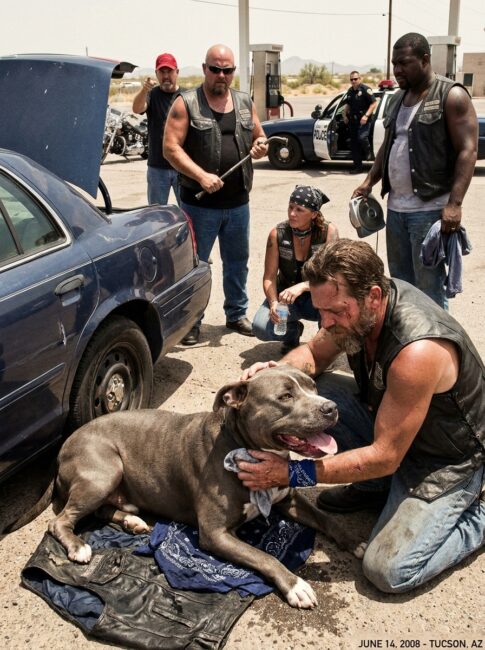
They like one decisive act, one hero moment, one door opened just in time. The truth is messier. The dog was overheated, dehydrated, and too weak to stand. The pavement burned through the knees of my jeans. Maria kept checking her breathing and telling us not to pour ice water on her, not to panic, not to crowd.
“Shade. Cool water. Air movement. Small sips if she can swallow.”
Maria’s voice became the center.
Knox held his vest like a roof over the dog’s body. Preacher moved his motorcycle to block traffic and waved away people holding phones. Two younger riders ran inside for towels. Someone pulled a cooler from a saddlebag. Someone else brought a small battery fan from an RV parked near the diesel pumps.
I held the dog’s head on my lap.
Her fur was blue-gray under the dust, almost the color of storm clouds before rain. Her breathing came fast, then shallow, then fast again. Her eyes opened once when I soaked the bandana and laid it across her chest.
“Stay with us,” I said.
Her paw moved.
That white toe touched my wrist.
My stomach tightened, but I pushed the thought away because the living dog mattered more than the memory.
Then the owner came back.
He was angry in the way men get when they are trying to outrun shame. Loud first. Questions later. He shouted that we had destroyed his car, that we had stolen his dog, that he had only been inside for a few minutes, that he was calling the police even though the police were already turning into the lot.
Officer Renee Collins stepped out of the cruiser with one hand near her belt and the other held low.
She was a Black American woman in her forties, compact, serious, sun bouncing off her sunglasses. She looked once at the open trunk, once at the dog, once at the group of bikers surrounding her like a wall.
“Everybody breathe,” she said.
It was a good order.
Few of us followed it.
Maria gave her the temperature reading.
“One hundred forty degrees inside the trunk carpet.”
The owner said, “That thing lies.”
Maria looked up from the dog.
“I don’t.”
Officer Collins asked how long he had been inside.
“Five minutes.”
The gas station manager, now pale and sweating, said, “He was in there when they pulled in. At least twenty.”
June, a college kid working the register, spoke from behind the officer.
“I saw him park before the lunch rush. He didn’t go to the pumps first.”
The man turned on her.
“You don’t know anything.”
The dog flinched at his voice.
Not much.
Enough.
Officer Collins saw it.
So did I.
Animal control arrived with a transport crate, oxygen, and a tan-uniformed officer named Pete who looked like he had already hated this day before he got there. He knelt beside Maria and checked the dog’s gums.
“We need the emergency vet.”
The owner tried again.
“She’s mine. I can take her.”
Officer Collins stood between him and the dog.
“No, sir. You cannot.”
There are sentences that sound small until they land in the right place.
That one landed in all of us.
The dog was lifted onto a cooling blanket and carried toward the animal control truck. I stood up too fast and nearly fell. My jeans were wet. My hands shook. Annie’s blue bandana dripped onto the asphalt.
The Pit Bull lifted her head as they carried her away.
Her eyes found me.
Then her paw moved once toward the bandana.
The door closed.
The siren did not come on.
They drove fast anyway.
The owner was cited on scene and later charged with animal cruelty after the officer reviewed witness statements and footage. Knox wanted to say many things. Maria told him to say none of them while police were present. For once, Knox listened.
By sunset, the emergency vet called animal control.
The dog had survived the first hours.
Heatstroke.
Severe dehydration.
Burned paw pads from the trunk floor.
Fear.
But alive.
I sat on the curb outside the gas station after everyone left, staring at the dark stain where water had run across the asphalt.
The dog lived.
The man was being charged.
The bikers had done the right thing.
That should have been the ending.
Then Officer Collins walked back from her cruiser holding a microchip report and asked me, “Do you know a rescue called Saguaro Haven?”
The report had two names on it.
Registered rescue: Saguaro Haven Animal Rescue.
Dog name: Bluebell.
I took the paper from Officer Collins and read it three times, because sometimes the mind refuses to recognize a door it nailed shut itself.
Bluebell.
Blue.
Annie’s puppy.
The last foster.
The one with the white toe.
The one who scratched twice, paused, and scratched again.
Officer Collins watched my face.
“You know her?”
I did not answer right away.
Knox, who had walked back over with two bottles of water, looked from me to the paper.
“Hank?”
I handed it to him.
He read the name and went still.
The first twist was not that the dog had a past.
Every rescue dog has a past.
The twist was that her past had sat under my kitchen table, slept beneath Annie’s sewing machine, and left scratch marks on the inside of a laundry room door I had not opened in three years.
Maria drove me to the emergency clinic because she said no one with my face should ride a motorcycle.
The clinic smelled like disinfectant, warm towels, and fear pretending to be order. A young vet tech led us to a quiet room behind the main treatment area. Blue lay on a padded mat with a fan nearby and oxygen tubing close to her nose. Her eyes were open now, though heavy. She looked smaller than I remembered, which made no sense because she had been a puppy then.
Or maybe memory had made her safe and large.
I stood in the doorway.
“Blue?”
Her ear moved.
Not both.
One.
The vet tech looked at me.
“That’s the first response we’ve gotten to a name.”
I stepped closer and lowered myself into the chair beside her. My knees cracked. My throat did something worse.
Blue’s eyes followed my hand.
I untied Annie’s bandana from my wrist and placed it near her nose.
She sniffed once.
Then she pushed her muzzle into it.
The second twist came from Saguaro Haven’s director, Carla, who arrived an hour later with a folder and the weary fury of a woman who had spent too many years cleaning up other people’s cruelty.
Blue had been adopted two years earlier by a family who passed every check. Good home. Fenced yard. Vet reference. Follow-up photos. For a while, everything looked fine.
Then the family moved.
The phone number changed.
The updates stopped.
Saguaro Haven sent emails.
No reply.
They marked Blue as “lost contact” but had no legal reason to seize a dog they could not find.
The man at the gas station was not the adopter.
He was the adopter’s brother.
He had taken Blue after the family “didn’t want the trouble anymore.” He never transferred ownership, never updated the chip, never took her to a vet, and that day he had put her in the trunk because he said “the store didn’t allow dogs.”
Carla’s hands curled around the folder.
“He left her to cook because convenience mattered more than breath.”
No one softened that sentence.
The third twist came when Carla opened Blue’s old foster file.
There was a photo clipped inside.
Annie sitting on our back porch, thinner than she had been but smiling with her whole face, Bluebell asleep in her lap. The puppy’s white toe rested on Annie’s wrist. Annie’s blue bandana lay on the porch rail.
Under the photo, in Annie’s handwriting, were three lines:
Bluebell hates closed spaces. She scratches twice, then waits. Do not ignore this.
I turned away from the table.
Too late.
Maria placed a hand between my shoulder blades, firm enough to keep me upright.
The dog had been telling us the truth from inside the trunk.
Annie had written the translation years before.
And I, who had sent Blue away because I could not face loving another thing that might leave, had found her again only after she had almost been lost for good.
The next morning, I opened the sewing room door.
It stuck at first.
Wood swells in Arizona heat, and grief had made me a lazy carpenter.
Dust lifted in the sunlight. Annie’s old machine sat under a cloth. Boxes of fabric leaned against the wall. A mason jar full of buttons stood by the window. On the lower part of the door, near the frame, were the scratch marks Blue had made as a puppy.
Two lines.
A gap.
Two lines again.
Scratch.
Pause.
Scratch.
I sat on the floor and put my hand over them.
The small details began returning with new weight.
The white toe on Blue’s paw was not only a mark. It was the same paw that had rested on Annie’s wrist in the photo, then on mine at the gas station, as if the dog had been following a thread from one life to another.
The blue bandana was not only grief jewelry. It was a scent map. Annie’s thread. My sweat. The house she remembered. The old porch. The same rough man who used to complain when she chewed the rug and then fed her chicken under the table.
The scratch from the trunk was not panic alone.
It was language.
Blue had learned as a puppy that scratching brought doors open. Annie had told every future adopter: Do not ignore this.
Someone did.
For too long.
But on the day it mattered, twelve bikers at a gas station heard what her owner would not.
Blue stayed at the clinic for five days. The first two were careful. Fluids, cooling, pain medication, paw treatment, monitoring. Maria visited after her nursing shift. Knox came and pretended he only wanted updates for the club. Preacher brought a soft blanket and claimed it fell off a church donation truck.
I came twice a day.
At first, Blue watched me without moving.
On the third visit, she lifted her head when I entered.
On the fourth, she touched Annie’s bandana with her nose.
On the fifth, she stood for three seconds, wobbled, and leaned against my leg.
Carla asked what I wanted to do once Blue was cleared.
I had rehearsed responsible answers.
Foster.
Temporary.
Help with placement.
Not rush.
Not confuse grief with rescue.
Then Blue looked up at me with those amber eyes, older now, tired but steady, and made one tiny sound under her breath.
Not a bark.
Not a whine.
A question.
I heard Annie’s voice from years earlier.
Some dogs keep us.
“I’ll take her,” I said.
Carla did not look surprised.
Maria smiled like she had known for days.
Knox folded his arms and said, “About time.”
The legal process took weeks because ownership on paper and ownership in truth often stand on opposite sides of a room. The original adopter surrendered rights. The brother faced charges, fines, and later community service connected to animal welfare education, which Maria said was too kind and Officer Collins said was how courts sometimes worked when nobody asked our feelings.
Blue came home before the case ended.
She stopped at the threshold and froze.
Not because she did not remember.
Because maybe she did.
The house smelled different. Annie was gone. The sewing room had been closed for years. My boots were by the door. The old tile was the same. The light through the kitchen window was the same. Her puppy scratches were still at the sewing room door.
Blue walked to them.
Sniffed.
Then lay down with her nose touching the marks.
I sat beside her.
For a long time, neither of us moved.
That was our beginning.
Not clean.
Not happy in the simple way.
But alive.
A door opened.
A dog came home.
Blue did not become easy overnight.
Rescue stories often skip the after.
They show the opened trunk, the water, the grateful eyes, the adoption photo. They leave out the weeks when a dog wakes at every car door slam and hides under a table. They leave out the way heat can make a body remember danger. They leave out the owner learning that love after trauma is mostly patience with better lighting.
Blue hated trunks.
That was expected.
She also hated closets, laundry baskets, cardboard boxes, and the sound of packing tape. The first time I opened a new box of motorcycle parts, she backed into the hallway and shook until I carried the box outside.
So I changed the house.
No closed doors unless necessary.
No loud tape in front of her.
A cooling mat by the kitchen wall.
Water bowls in three rooms.
Annie’s bandana stayed on Blue’s bed, not as a shrine, but as a bridge.
The club changed too.
At first, Blue came only to short meetings. Ten minutes. Then twenty. She stayed near my boot, watching the room, deciding whether big men were safe. Knox sat on the floor the first time, which made his knees sound like gravel in a bucket.
“Hey, girl,” he said softly.
Blue sniffed his hand.
Then ignored him.
Knox considered this progress.
Maria brought treats approved by the vet and delivered them like medicine. Preacher hummed old gospel songs because he said every dog deserved music with bass in it. The younger riders learned not to crowd her. They learned to let her come to them. That might have been the first thing many of us ever learned gently.
Officer Collins visited once with paperwork.
Blue walked to her and sat.
The officer crouched.
“You look better than the last time I saw you.”
Blue wagged once.
Officer Collins looked at me.
“So do you.”
I pretended not to hear.
The biggest revelation came three months after the rescue, on a day hot enough to make Tucson shimmer. Our club had organized a pet safety drive at the same gas station. Free water bowls. Flyers about heat danger. Pet oxygen mask donations for local first responders. Knox called it “common sense with motorcycles.”
A woman came by with two kids and a little terrier in a cooling vest. She looked nervous at first because twelve bikers under a tent will do that to people. Then Blue stepped out from behind my chair and sat calmly in the shade.
The little boy asked, “Is that the trunk dog?”
I looked at Blue.
“She’s Blue,” I said.
He knelt, with permission, and held out his hand.
Blue sniffed him.
Then she did something she had not done since coming home.
She leaned.
Just a little.
Against his knee.
His mother covered her mouth.
The boy whispered, “She’s not scared?”
I answered before thinking.
“She is. She came anyway.”
That sentence stayed with me the rest of the day.
Maybe courage was not engines, leather, fists, or loud voices.
Maybe courage was a dog returning to the place where she almost died and choosing shade instead of fear.
Maybe courage was a closed man opening a sewing room door.
Maybe courage was hearing scratching and deciding permission could wait.
Every Sunday morning now, Blue and I ride to the clubhouse in my old pickup.
She does not ride on the motorcycle. Annie would haunt me for even considering it. Blue sits in the passenger seat on a cooling pad, harness clipped, window cracked just enough for smell but not enough for foolishness. She wears a blue collar with a small silver tag.
The tag says BLUE DAWSON.
Under it, smaller:
Found.
The club has a ritual.
Before every summer ride, Knox walks the parking lot with a temperature gun and checks seats, asphalt, and trunk lids if we are doing outreach. Maria stocks the cooler with extra water and towels. Preacher keeps a pet oxygen mask kit in his saddlebag because he says miracles should come prepared.
We stop at gas stations differently now.
Someone listens.
Not for engines.
For small sounds.
A scratch.
A whine.
A paw against metal.
Most days, we hear nothing.
That is good.
On the anniversary of Blue’s rescue, we returned to the same station. The manager had installed a shade canopy near the side wall and a sign reminding customers not to leave animals in vehicles. Officer Collins came off duty. Carla from Saguaro Haven brought adoption flyers. Maria brought homemade lemonade because she claimed bikers hydrated better when threatened.
Blue stood beside me under the canopy.
The trunk of the blue sedan was long gone. The asphalt had been repainted. Nothing remained of that day except what remained in us.
Knox handed me a tire iron as a joke.
I handed it back.
“Keep it,” he said.
I keep it in the garage now, hung beside Annie’s old sewing scissors.
Tools for opening things.
At night, Blue sleeps outside the sewing room door.
The door stays open.
Sometimes I sit inside and oil Annie’s machine even though I do not sew. Blue lies on the rug, white toe tucked under her chin, scar across her muzzle silver in the lamp light.
If I stop moving too long, she scratches the floor twice.
Pause.
Twice again.
I look up.
She looks back.
We understand.
People still ask if I regret breaking the trunk.
They ask because they want rules to make life neat. They want a clear line between property and mercy, between permission and duty, between someone else’s car and a living thing running out of breath inside it.
I tell them the truth.
I regret only that we did not hear her sooner.
Blue is older now.
Not old, but settled. Her blue-gray face has softened, and the white toe is still the first thing kids notice. She no longer shakes at every closed door, though she still prefers rooms with exits. She forgave the world in pieces, which is the only honest way to do it.
One evening, I found her asleep under Annie’s sewing table.
Same spot as the old photo.
Same paw stretched forward.
Same little scar on her muzzle.
For a second, the years folded.
Annie on the porch.
Blue as a puppy.
Me pretending I did not want to keep her.
Then the gas station.
The trunk.
The heat.
The officer’s voice.
Blue’s paw on my bandana.
A life can circle back without returning to the same place.
Blue opened her eyes.
I whispered, “You’re home.”
Her tail moved once against the floor.
Enough.
She nearly died in a trunk.
We did not ask permission.
She lived.
Follow this page for more unforgettable dog stories about rescue, loyalty, second chances, and the quiet animals who teach people when to open the door.