Part 2: A Police Officer Found a Dog Lying Beside the Train Tracks and Refusing to Move — What She Was Guarding Made Him Stop the Train and Change His Life
Part 2 — Rising Action
Before that morning, I believed I understood loyalty.
Police work teaches a version of it. Your partner watches your back. Dispatch keeps your voice in the room. Firefighters show up when the call turns ugly. Nurses tell you the truth with soft eyes and quick hands.
But dogs know a different kind.
They do not make speeches about it.
They do not promise.
They simply stay.
I had been staying too, or at least pretending to. After Elena died, I stayed in the house we bought together on the south side of Amarillo. I stayed in the same bedroom, though I slept on only my side. I stayed in the same job because the uniform told me where to put my hands when I did not know what to do with them.
Sofia was nine then.
She had her mother’s dark hair, my serious eyes, and a habit of leaving little notes around the house so silence could not settle too long.
One on the fridge said, buy cereal.
One on the bathroom mirror said, smile today, Dad.
One on my patrol bag said, come home safe.
I folded that one and kept it in my shirt pocket every shift.
The truth was, after Elena, I had become a man built out of schedules. I could handle traffic accidents, domestic calls, missing wallets, barking complaints, and drunks who wanted to debate the Constitution at 2 a.m. I could not handle the dog bed still stored in our garage.
Elena had wanted a dog.
A German Shepherd, specifically.
She said our house needed one more heartbeat.
I always said, “When things slow down.”
Things did slow down.
Just not the way we planned.
After the funeral, Sofia asked twice if we could still get one. I said not yet. Then I said maybe later. Then she stopped asking and started drawing dogs in the margins of her homework.
That was the first seed I did not recognize.
The second was my old patrol partner, Mike Donnelly, retiring the month before the track call. He had worked K-9 years ago and told me, while cleaning out his locker, “Dogs don’t save people because they’re trained. Training gives shape to what was already there.”
I told him that sounded like something from a coffee mug.
He laughed.
“Wait until one teaches you.”
I did not expect it to happen behind grain elevators with a freight train coming.
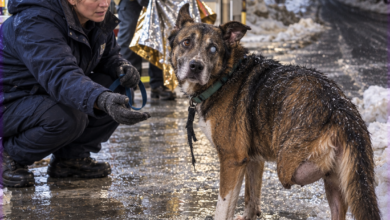
Maggie and Boone, though I did not know their names yet, had been seen by people for weeks before I reached them. A gas station clerk near the rail crossing said two Shepherds had been sleeping behind the dumpster, but always together. A teenager on a bike had tossed them beef jerky and said the female ate last. A rail worker remembered seeing the male limp days earlier, with the female walking slow beside him.
No one reported them until the tracks.
Not because nobody cared.
Because stray dogs become part of the background in places where people are tired.
The morning before the rescue, a storm rolled through Amarillo with hard wind and cold rain. It flooded low spots, knocked down branches, and sent loose trash across roads. Later, we found paw marks in the mud near a drainage ditch where the male must have slipped and injured his leg.
The female stayed.
Through rain.
Through cold.
Through the rumble of trains.
Through the night.
At some point, she could have left him and found food. She could have searched for shelter. She could have saved herself.
Instead, she lay where he could see her.
That detail stayed with me.
Because grief had made me pull away from everyone who loved me.
And there was this dog, hungry and soaked, doing the one thing I had forgotten how to do.
Stay close.
Part 3 — False Climax
The train did not stop fast.
People think emergency brakes work like movie brakes.
They do not.
A freight train is a mile-long decision that cannot change its mind quickly. Steel wheels on steel rails. Thousands of tons. Momentum with no mercy.
I heard rail control through dispatch.
They were contacting the engineer.
The engineer had seen my patrol lights.
The train was braking.
But it was still coming.
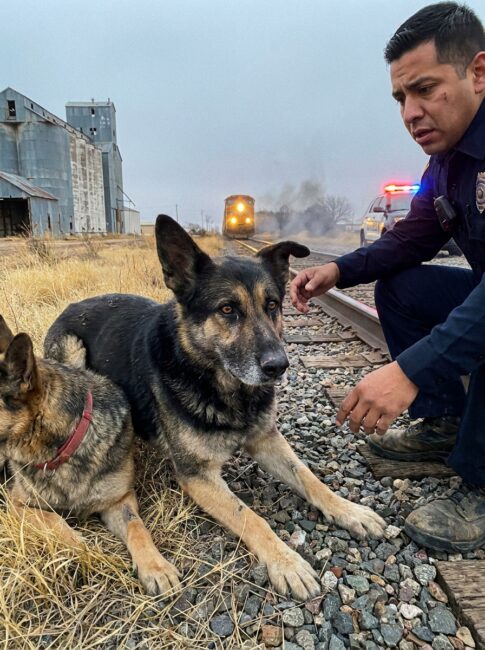
I ran down the gravel beside the tracks, waving both arms in the red-blue wash from my patrol car. My boots slipped on loose rock. My radio bounced against my chest. The female Shepherd — Maggie, though I did not know it yet — watched me come without moving from Boone’s side.
“Come on,” I said. “Move.”
She did not.
Boone lifted his head once, then dropped it.
His injured leg lay under him at an angle that made my stomach tighten. There was no way he could run. Maybe no way he could stand. His eyes followed Maggie, not me.
The horn blew.
Not far away now.
I could see the engineer’s cab.
I could see the front light trembling across the rails.
I made a choice I do not recommend.
I stepped onto the track and moved toward the dogs.
Not in front of the train.
Not exactly.
Close enough that every sensible part of my body screamed at me to get off the line.
Maggie growled when I reached Boone.
A low, torn sound.
She was terrified.
Not of me.
Of losing him.
“I know,” I said.
My hands were shaking.
“I know.”
I crouched, turned sideways to make myself smaller, and reached first for Boone’s collar. He did not bite. He barely had strength to lift his head. Maggie pressed her nose against my wrist, then snapped her teeth once in the air.
Not to hurt.
To warn.
The train brakes shrieked.
Metal screamed against metal.
I could smell heat.
“Daniel, get clear,” dispatch said in my ear.
My own name sounded like it belonged to somebody else.
I hooked both arms under Boone’s chest and belly.
He was heavier than he looked.
Dead weight is a cruel phrase. He was alive, but fear and pain had made his body give up helping. I lifted, and his injured leg shifted. He cried out.
Maggie barked.
One sharp sound.
Then she did something that saved us seconds.
She grabbed Boone’s loose collar in her teeth and pulled with me.
Together.
A police officer and a starving dog.
We dragged him down the gravel slope as the train crawled closer, brakes screaming, horn crying above us like the sky had split.
One foot.
Two.
Maggie slipped.
I fell to one knee.
Boone’s body slid against the rock.
“Come on,” I said through my teeth.
Maggie pulled again.
The train finally stopped with its front engine less than twenty yards from where Boone had been lying.
Twenty yards is nothing.
Twenty yards is everything.
For a moment, nobody moved.
Then the engineer climbed down, pale and shaking.
I was sitting in the gravel with Boone against my legs and Maggie pressed along his side, her body still between him and the train.
She looked at me.
Not grateful.
Not relieved.
Just watching.
As if asking whether I understood yet.
I thought I did.
A dog had refused to abandon her injured friend.
I stopped a train.
We saved them both.
That seemed like enough story for one morning.
It was not.
Part 4 — The Twist
The first twist came from a blue collar tag hidden under Boone’s matted fur.
Animal control arrived with blankets, a crate, and two officers who knew better than to approach fast. Maggie would not leave Boone. Every time someone tried to lift him without her, she pushed her body under their hands and barked once.
Not wild.
Firm.
Like she was still in charge.
So we moved them together.
Boone on a stretcher blanket.
Maggie walking beside him, nose touching his ear every few steps.
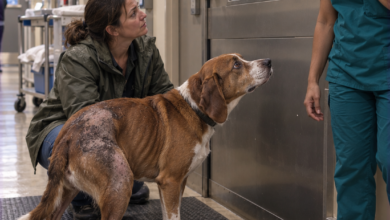
At the emergency vet, Dr. Claire Whitman checked Boone first. Broken radius. Dehydration. Old infection in one paw. No internal bleeding. Maggie had cuts, burrs, sore pads, and a deep exhaustion that did not show until Boone was behind a glass door getting X-rays.
She collapsed then.
Not dramatically.
She simply folded to the floor.
I knelt beside her before I thought better of it. She placed her chin on my boot and closed her eyes.
That was when the vet tech found the tag.
It was cracked, scratched, and almost hidden under mud.
One side said BOONE.
The other had a phone number.
We called.
Disconnected.
Then we ran the number through old city records. It belonged to a man named Franklin Hodge, who had died nine months earlier in a trailer fire outside Canyon.
The second dog had no tag.
No microchip.
But she did have a scar along her belly that looked surgical.
Dr. Whitman scanned her twice.
Nothing.
Then she said, “Wait.”
She shaved a small patch between Maggie’s shoulders where the fur had grown thick over old scar tissue. There, beneath the skin, was a microchip that had shifted and become hard to detect.
The registry came back with a name.
Magnolia.
Owner: Elena Reyes.
My hand went cold on the counter.
“That’s my wife,” I said.
Nobody spoke.
Dr. Whitman looked at the screen, then at me.
“Elena Reyes?”
I nodded, but my throat had closed.
Elena had volunteered at an animal rescue before she got sick. She fostered dogs sometimes, usually the ones who needed quiet homes for a few weeks. I remembered one Shepherd puppy years ago, black-and-tan, one floppy ear, too serious for her size.
Elena called her Magnolia.
I called her Maggie because it was easier.
We fostered her for seventeen days.
Then a retired man named Franklin Hodge adopted her.
He had another Shepherd named Boone.
Elena cried when Maggie left but said, “She found her person.”
I had forgotten that.
Or maybe I had buried it because so many memories of Elena came with sharp edges.
Maggie had not forgotten.
The dog lying exhausted on the clinic floor had once slept in our laundry room while Elena sat beside her reading adoption forms.
She had been in my house.
She had been loved by my wife.
And on that morning by the tracks, she had looked at me like she knew something I did not.
The second twist was harder.
When Franklin died, no family claimed the dogs. A neighbor told investigators he had called several shelters, but they were full. After the trailer fire, the dogs disappeared. People assumed they ran off.
They had been on their own for months.
Together.
Maggie could have returned to us if she remembered the address. Maybe she tried. Maybe roads, hunger, and fear moved them farther away. Maybe Boone, older and slower, could not make the distance.
But somehow, on the day Boone could no longer move, the call came to me.
Not another officer.
Me.
The husband of the woman who had once saved Maggie first.
I do not call that fate out loud.
But I have never been able to call it random either.
Part 5 — Revelation
After I learned Maggie had been Elena’s foster, the small details rearranged themselves.
The way she watched my face at the tracks.
The way she hesitated before letting me touch Boone.
The way she pressed her chin to my boot at the clinic after he went behind the glass door.
Maybe she did not know me the way people know names.
But dogs keep maps we do not understand.
Scent.
Voice.
Body rhythm.
The laundry soap Elena used.
The leather of my patrol boots.
The house smell that may have clung to my jacket for years.
Maggie had known enough to choose me as the person worth risking trust.
That realization did not feel grand.
It felt quiet.
Like someone opening a drawer I had kept closed.
When Sofia arrived at the clinic after school, she walked in holding her backpack with both hands. My sister had brought her. I had not planned for Sofia to meet the dogs yet, but children and truth both have a way of arriving before adults are ready.
Maggie lifted her head.
Sofia stopped in the doorway.
“Dad,” she whispered. “That’s Mom’s dog.”
Not foster dog.
Not old dog.
Mom’s dog.
I looked at my daughter.
“You remember her?”
Sofia nodded. “Mom called her Magnolia when she was in trouble.”
Maggie’s tail moved once against the blanket.
Once.
That was enough.
Sofia knelt slowly, just as Elena had taught her around scared animals. Maggie sniffed her sleeve, then pushed her face into Sofia’s chest.
My daughter did not cry loudly.
She never did.
She just closed both arms around the dog’s neck and pressed her face into the dirty fur.
For a moment, the clinic hallway held three kinds of grief.
A child missing her mother.
A dog missing everyone she had lost.
A man realizing he had been refusing the kind of love his wife had tried to bring into their home.
Boone’s surgery happened that night. Pins, splint, antibiotics, fluids. Dr. Whitman said recovery would be long but possible. Maggie refused food until Boone woke from anesthesia. She stood at the kennel door, shaking with fatigue, eyes fixed on him through the bars.
A tech tried to lead her away.
Maggie planted her feet.
I understood then why I could not separate them.
One dog had been willing to die rather than leave the other.
That kind of bond is not a problem to solve.
It is a promise to respect.
The next day, the rescue Elena had volunteered with sent over Maggie’s old file. Inside were photos I had not seen in years. Elena sitting cross-legged on our kitchen floor, Maggie asleep against her knee. Sofia at age four feeding Maggie a treat with both hands. Me in the background, washing dishes, not paying attention to a moment I would one day want back.
There was also a note in Elena’s handwriting.
Magnolia bonds deeply. Do not place alone if attached to another dog. She chooses one friend and stays.
I read that line three times.
She chooses one friend and stays.
Elena had written it before Boone.
Before Franklin.
Before the tracks.
Before the morning Maggie lay beside a train line and said with her body what no human could have said better:
Not without him.
The adoption question should have been complicated.
It was not.
The rescue offered to take them.
The clinic could hold them until a foster opened.
A retired couple even asked about Boone after hearing the story.
I said no before they finished.
My house had room.
My daughter had been drawing dogs in notebook margins for two years.
My wife had once said we needed another heartbeat.
Now two had arrived.
When I told Sofia we could adopt them both, she looked older than nine for one second.
Then she asked, “Can we keep their names?”
“Yes.”
“Because Mom knew Maggie?”
“Yes.”
“And Boone is her best friend?”
“Yes.”
Sofia nodded.
“Then they come together.”
That night, I went into the garage and pulled out the dog bed Elena bought years before. It was still wrapped in plastic, dusty along the edges. I carried it inside, set it near the living room window, and stood there with one hand on the wall.
The house looked different immediately.
Not fixed.
Not healed.
Different.
Like it had been waiting for someone to ask it to hold life again.
Part 6 — Echo
Boone came home first in a splint that made him walk like a poorly built table.
Maggie came beside him, of course.
She entered the house slowly, nose low, reading every corner. At the hallway, she stopped. Her ears lifted. Then she walked straight to the laundry room and stood in the doorway.
That was where she had slept as a foster.
Four years earlier.
Sofia looked at me.
“She remembers.”
I did not answer because my mouth had tightened too much.
We placed Boone’s recovery bed in the living room where he could see the front door, the kitchen, and Maggie. Especially Maggie. If she walked too far away, he lifted his head. If he whined, she came back.
Their routine became ours.
Every morning at 6:00, I gave Boone his medicine hidden in turkey.
Every morning at 6:05, Maggie inspected the bowl to make sure he had swallowed.
Every morning at 6:10, Sofia sat on the rug between them and read aloud from whatever library book she had chosen that week.
Maggie liked stories with animals.
Boone liked sleeping through all of them.
On Tuesdays, we drove to the vet.
On Fridays, we drove past the old rescue where Elena had volunteered. Sofia asked if we could start helping there when Boone healed. I said yes before fear could answer for me.
The house grew new sounds.
Nails on tile.
Water bowls sliding.
Boone snoring under the window.
Maggie’s soft huff when my alarm went off too early.
At night, after Sofia went to bed, I sometimes found Maggie sitting by the front door. Not anxious. Not asking to leave. Just watching.
I would sit beside her and place one hand on her back.
“You found your way back,” I told her once.
She leaned into me.
Maybe that was all she needed to say.
We kept one ritual from the tracks.
Every March, on the morning of the rescue, I take Maggie and Boone to the old grain elevators. Not too close to the rails. Never again. We park near the service road where the weeds grow high and the sky opens wide.
Sofia brings two biscuits.
One for each.
I bring Elena’s old rescue badge, the one she wore on Saturday adoption days.
We stand there for a minute.
No speech.
No lesson.
Just wind, dogs, and the sound of trains far away.
Then we go home together.
Always together.
Part 7 — Ending
Boone learned to run again.
Not fast.
Not straight.
But enough to make Sofia laugh when he chased Maggie across the backyard and forgot which leg had once betrayed him.
Maggie never stopped watching him.
Even in sleep, one ear seemed tuned to his breathing.
Sometimes I would see them on the rug, Boone stretched on his side, Maggie pressed against his back, and I would think about that morning by the tracks.
How close the train had come.
How still she had stayed.
How much love can fit inside one refusal to move.
One evening, Sofia found Elena’s old photo album and placed a picture on the coffee table. Elena sat on our kitchen floor with a younger Maggie curled beside her. The dog’s ear was folded the same way. Her eyes were the same amber.
Sofia studied it for a long time.
Then she carried the photo to Maggie.
Maggie sniffed it.
Licked the corner once.
Then lay down beside Boone.
I turned away to make coffee I did not want.
When I came back, Sofia had placed the photo on the shelf by the front door.
Above the hooks where the leashes hung.
Now, every time we leave the house, we pass it.
Elena smiling.
Maggie young.
A life before the tracks.
A life after them.
Some calls end when the report is filed.
Some follow you home.
Some put two bowls on your kitchen floor.
The train stopped.
The dogs stayed.
So did we.
Follow this page for more unforgettable dog stories about loyalty, rescue, second chances, and the quiet ways animals bring people back to life.