Part 2: The Pit Bull Puppy Wouldn’t Stop Biting the Leash Meant for His Sister — Then We Realized He Was Trying to Put the Empty Loop Around His Own Neck
Part 2, The Puppy We Had Not Planned to Choose
My name is Lauren Hayes. I was thirty-nine and scheduled home visits for a pediatric therapy company near East Memphis. My job involved finding ways to place twenty-seven therapists into thirty-one homes without asking anyone to drive through rush-hour traffic twice.
Most days, I solved problems by moving names across a screen.
Dogs were not supposed to be complicated.
Ava and I had begun visiting shelters eleven months after our old mixed-breed dog, Henry, died at thirteen. Henry had slept beside Ava’s bed during the infection that took most of the hearing in her left ear. After he died, Ava stopped leaving her bedroom door open at night.
She never asked to replace him.
She asked whether another dog might need the empty bed.
We visited three shelters. Ava passed the barking puppies and the dogs that jumped against their gates. She spent her time beside the ones who watched from the back.
At Memphis Animal Services, Nell sat beneath a molded plastic bench while Otis stood between her and every visitor.
Neither puppy looked neglected. Their blue-gray coats had been cleaned, their ribs were covered, and their nails had been trimmed. Otis had a narrow scar beneath his jaw. Nell had white toes, soft folded ears, and eyes the color of weak tea.
When Ava entered the room, Otis smelled her shoes, hands, and coat pocket.
Nell watched him.
Only after Otis sat did she crawl from beneath the bench.
Ava offered the back of her hand. Nell touched it once, retreated, then returned and rested her chin across Ava’s wrist.
That small weight decided everything.
Celia told us the puppies were believed to be littermates. A code-enforcement officer had found them inside a condemned rental property thirteen days earlier. No owner had responded to the shelter’s notices.
Nell had passed her adoption evaluation.
Otis had not.
The file described leash fixation, barrier chewing, and distress during separation. Celia said he would remain for further observation and could be adopted later if the behavior team cleared him.
I asked whether the puppies were bonded.
“They’re young,” she said. “Young dogs usually adjust.”
Otis walked to the door whenever Nell approached it. He always stood on her left side. When she turned the wrong way, he touched her shoulder with his nose.
I noticed the pattern.
I mistook it for control.
During the adoption meeting, Ava rolled a yellow tennis ball across the floor. Otis chased it. Nell waited until his nails struck the far wall, then ran in the direction he had gone.
Ava rolled the ball behind Nell.
The puppy never turned.
“She might be focused on her brother,” Celia said.
Ava looked at me.
I should have listened then.
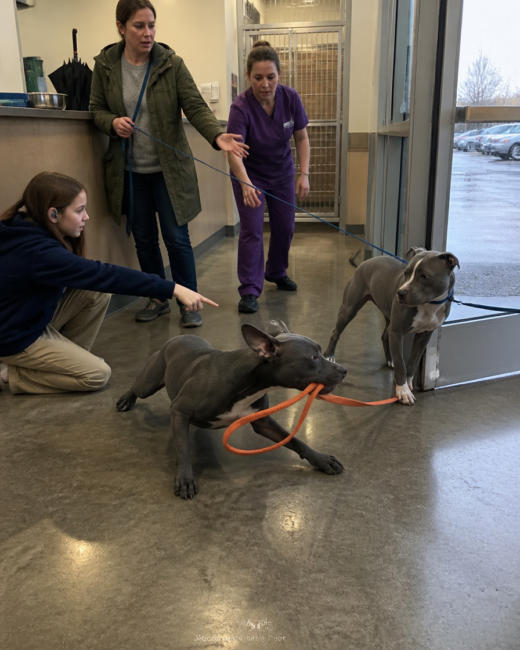
At 4:18 that afternoon, I signed Nell’s paperwork. Celia brought two slip leads into the lobby because shelter dogs had to wear a backup lead when crossing the parking lot. Nell wore the green one. The orange one stayed over my wrist while Celia adjusted the puppy’s collar.
Otis slipped through the meet-and-greet gate as another volunteer entered.
He saw Nell beside the exit.
Then he ran.
Everything that followed—the biting, pulling, crawling, and empty loop pressed beneath his chin—lasted less than three minutes.
The warning on his record had lasted thirteen days.
By 4:27, the shelter director had paused our adoption and led us into the small office behind reception.
The body-camera video waited on a black computer screen.
Ava sat beside me.
Nell lay beneath her chair.
Otis remained outside the office with Celia. Each time Nell moved, we heard his nails slide across the other side of the door.
Then the director pressed play.
Part 3, What the Officer Found Behind the Bedroom Door
The footage shook as Officer Daniel Ruiz entered the condemned duplex on Eldridge Avenue. The date in the corner read March 3. The time was 2:14 a.m.
Rain had entered through two broken windows. Plaster sagged from the ceiling, and the hallway floor was covered with damp clothing, fast-food wrappers, and pieces of insulation.
Ruiz called, “Animal control.”
A puppy cried behind a closed door.
The camera turned.
Otis stood midway down the hall.
He was thinner than the puppy we had met. His hip bones showed beneath his wet coat, and one side of his face was dusted white from drywall. A short red clothesline trailed from his mouth.
Ruiz crouched and held out a slip lead.
Otis backed away.
He did not run toward the broken front door. He carried the clothesline to a bedroom and pushed one end beneath a gap less than two inches high.
The line moved.
Something on the other side had taken it.
Ruiz tried the knob. The door was locked. He called for the code officer to bring a pry bar.
Otis began pacing between the officer and the door. Each time Ruiz stepped away, the puppy caught the loose end of the slip lead and pulled it back.
“Easy,” Ruiz said. “I’m not leaving.”
Otis pressed the officer’s lead against the bottom of the door.
On the other side, Nell cried.
The sound was thin and irregular. She scratched twice, stopped, then scratched again after Otis tapped the wood with one paw.
Ruiz placed several pieces of kibble on the floor.
Otis ate one.
He picked up the next piece, carried it to the door, and pushed it beneath the gap.
He repeated the action eleven times.
Ava leaned toward the screen.
The shelter director stopped the video.
“What?” I asked.
“Go back,” Ava said.
Ruiz had aimed his flashlight toward the baseboard. A line of dry kibble crumbs ran along the gap. Beside them were small pieces of bread, part of a cracker, and the torn corner of a paper food tray.
Otis had access to the hallway and kitchen.
Nell did not.
The veterinary intake report listed Otis at fourteen pounds and Nell at fifteen. Staff had assumed he was naturally smaller.
The footage suggested another reason.
He had been moving food beneath the door.
Ruiz’s partner arrived with the pry bar. Each strike made Otis jump. Nell gave no response until the door itself moved.
When the frame split, Otis placed his body between the officers and the opening. Ruiz reached down cautiously.
Otis grabbed the slip lead.
He pulled it through the gap.
The loop fell beside Nell.
She placed one paw inside it.
Nobody had trained that sequence. Otis did not understand locks, pry bars, animal-control rules, or adoption forms. He understood something narrower and more useful: humans held loops before doors opened, and a loop around a dog meant that dog came through the door.
Ruiz slipped the lead around Nell’s neck.
Otis backed away.
Only then did he allow the officers to open the door.
Nell was found beside an overturned laundry basket. A dry water bowl sat beneath the window. The bedroom contained no food, but small items had been pushed through the gap: kibble, bread, paper, half a dog biscuit, and a strip of towel.
The red clothesline ran beneath the door.
Ruiz believed the former tenants had once used it as a makeshift coupling lead. One loop remained tied loosely around Otis’s old collar. The other end had been pushed beneath the door to Nell.
The officer clipped a second lead to Otis.
Both puppies walked out.
Otis stayed on Nell’s left.
At the front steps, Nell hesitated. Ruiz moved ahead and called her.
She did not respond.
Otis struck the porch twice with one paw.
Nell followed the vibration.
The body-camera video ended with both puppies inside the animal-control van, their leads tied to the same steel ring. Nell lay against Otis’s ribs. Otis remained awake.
The shelter director closed the laptop.
Celia returned with the intake paperwork. A note written by Ruiz had been scanned upside down beneath a page of vaccination records.
Female may have hearing impairment. Male uses touch and floor tapping to direct her. Keep together until evaluated.
No one in adoptions had seen it.
The puppies entered separate computer records. Nell’s medical exam noted that she responded when a technician clapped. The technician had been standing on her right.
Otis’s attempts to cross the kennel divider were recorded as barrier frustration. His leash grabbing became possible resource guarding. The same actions that had helped an officer find Nell were reclassified after no one knew their history.
Celia sat down.
“I wrote one of those notes.”
She had seen Otis bite the strap securing their kennel divider. She had moved him away and marked the behavior without asking why he had chewed only the section nearest Nell’s bed.
The director called the shelter veterinarian. Nell’s adoption remained paused pending a hearing test. Otis’s behavior hold would be reviewed the next morning.
I asked whether they could stay together overnight.
The director looked through the office window. Otis stood against the door. Nell lay beneath Ava’s chair with her nose pointed toward the sound of his nails.
“We can move them into the family kennel,” she said.
Ava shook her head.
“What happens when another person adopts him?”
No one answered.
Our landlord allowed one dog.
Otis might require training, medical care, and a home with someone experienced in managing mouthy behavior. I had one income, one child, one crate, and no yard—only a fenced patio behind our duplex.
Every sensible fact said I should take Nell once her hearing test was finished and let the shelter find Otis another family.
Ava placed both hands flat on the office table.
“When I couldn’t hear after the hospital, Henry slept on my left,” she said. “Nobody trained him either.”
She looked down at Nell.
“You can’t call something a problem just because you didn’t see who it was helping.”
The director turned the laptop back on.
She watched the final thirty seconds again.
Otis tapped the porch.
Nell followed.
Part 4, The First Night with Only One Puppy
The shelter could not release Otis while the behavior review remained open. Nell, however, had already been approved, vaccinated, and legally adopted before the process was paused.
The director offered two choices. I could leave both puppies overnight, or take Nell home and return for her hearing assessment at 8:00 the next morning.
Ava wanted to leave them together.
I worried that walking out without Nell would make the adoption disappear beneath another form, another shift change, another computer note nobody read. I signed a temporary return agreement for the morning appointment and carried Nell to the car.
Otis stood behind the lobby glass.
The orange lead remained around his neck.
As I placed Nell inside the crate, she looked past me toward the shelter. Otis struck the glass with his paw.
Twice.
Nell pushed against the crate door.
The drive to Berclair took nineteen minutes. Nell did not whine. She braced her front paws against the left side of the crate and watched the rear window until the shelter disappeared.
At home, she walked through the kitchen, living room, and Ava’s bedroom. She smelled Henry’s old bed, stepped inside it, then climbed out.
She returned to the front door.
Ava sat beside her.
“We’re going back.”
Nell watched her mouth.
At 6:03, I placed kibble in a white bowl. Nell smelled it but did not eat. She carried three pieces to the front door and arranged them against the threshold.
At 6:19, she found the green leash on a hook beside my coat. She rose on her hind legs, pulled it down, and dragged it to Henry’s empty bed.
She placed the loop in the center.
At 7:11, Ava tapped the kitchen floor twice.
Nell came immediately.
My daughter tried calling from the puppy’s left side. No response. She tapped one heel. Nell turned. She waved. Nell crossed the room.
Ava had developed the same habits after meningitis. She touched furniture before walking around someone who could not see her. She flicked lights to get attention. She preferred people who faced her when they spoke.
That evening, she began teaching me how to speak to Nell.
“Don’t surprise her from the left.”
“Let her see your hand before you touch her.”
“If she’s asleep, tap the floor.”
Nell responded to every instruction.
She still would not eat.
At 8:42, I called the shelter. A night employee checked the family kennel and told me Otis had refused dinner too. He had pushed six pieces of kibble beneath the kennel divider even though Nell was no longer on the other side.
At 9:17, Nell began pacing.
She walked from the front door to Henry’s bed, from the bed to the kitchen wall, then back to the door. Each time, she carried the green leash a few feet.
Ava placed her tablet on the floor and opened the short video she had taken in the meet-and-greet room.
The recording showed Otis standing on Nell’s left. A metal gate slammed outside the frame. His shoulders moved.
Nell turned toward him.
He tapped the floor.
She sat.
When the video ended, Nell pressed her nose against the speaker. The screen showed Otis frozen in the final frame.
Nell lay down.
Ava replayed it.
The puppy slept with her chin across the green loop.
At 10:26, my phone rang.
Officer Ruiz had heard that his body-camera note had been found. He asked whether I was the person adopting Nell.
“I thought I was.”
He was quiet.
“Those two didn’t survive that house separately.”
I looked at the puppy beside Ava.
Ruiz explained that the duplex had been empty for at least five days. A neighbor reported barking on the second night, but the address was placed in the wrong inspection queue. The puppies may have spent three or four days behind that locked door.
Otis could reach rainwater beneath a broken window in the hallway.
Nell could not.
The red clothesline had allowed her to pull a dented plastic cup beneath the door. Otis repeatedly pushed the cup toward a puddle, filled it as best he could, and dragged it back by the line.
Ruiz found scratch marks beside the puddle and water trails leading to the bedroom.
The officer did not claim the puppy had planned each step like a person. He had watched Otis repeat actions that produced a result. Food went under the door. Water moved on the line. A human holding a loop opened barriers.
“He kept trying what had worked,” Ruiz said. “That’s all problem-solving is sometimes.”
At 11:08, Nell woke and scratched the front door.
Ava was already wearing her shoes.
“The shelter is closed,” I said.
“We can wait outside.”
Rain had stopped, but cold water still fell from the gutters. We put Nell’s crate in the car, packed a blanket, and drove back across Memphis.
The shelter’s overnight entrance faced the medical wing. A security guard allowed us to park beneath the light after I explained.
At 11:46, an employee brought Otis into the medical lobby.
Nell was asleep inside her crate.
Otis saw her through the bars.
He did not jump.
He walked to the crate, pressed his left shoulder against its door, and tapped the tile twice.
Nell’s eyes opened.
Her entire body loosened.
The employee opened the crate. Nell stepped out, touched her nose to Otis’s chest, and walked directly to the bowl of food the employee had placed nearby.
Otis waited.
Nell ate.
Then he ate beside her.
Ava slept across two plastic chairs while I sat on the floor with both leads wrapped around my wrist.
At 2:13 in the morning, Otis lifted his head. The green and orange leads had fallen apart.
He picked up the orange one and placed it across Nell’s green loop.
Then he went back to sleep.
The door stayed open.
Part 5, What the Empty Leash Had Always Meant
Nell’s hearing test began at 8:12 the next morning. The veterinarian used a series of tones while sensors recorded the electrical response from each ear.
Her left ear showed no measurable response.
Her right ear registered only higher-volume sounds.
Nell was not completely deaf, but ordinary voices, distant barking, closing doors, and approaching vehicles often disappeared unless they came from her right side.
Otis had become her early-warning system.
The veterinarian observed them in a quiet room. When someone entered behind Nell, Otis touched her left shoulder. When a cart rolled through the hallway, he moved in front of her before she saw it. When the veterinarian called from the far corner, Otis turned his head and Nell followed his movement.
He never pulled her by the collar.
He gave information.
That discovery removed one explanation for his behavior, but the shelter still needed to determine whether his leash biting posed a risk. A behavior specialist named Dr. Marlene Cho reviewed all three recorded incidents.
The first happened during intake. Ruiz tried to lead Otis toward one kennel while another officer took Nell toward medical examination. Otis grabbed Ruiz’s lead, carried it to Nell, and dropped it over her back.
The second happened when staff removed Nell for vaccination. Otis bit the strap securing the divider, opened the gap, and lay outside the treatment-room door.
The third was ours.
In every case, Otis released the moment the puppies were placed together or both dogs wore leads.
He did not guard the leash from people. He delivered it to them.
He did not bite harder when someone reached for it. He changed his grip so the loop remained open.
Dr. Cho placed an empty lead on the floor with no puppy nearby. Otis smelled it once and walked away.
She placed Nell near the exit wearing a green leash.
Otis picked up the empty orange lead and carried it to Dr. Cho.
She did not move.
He pressed the loop against his neck.
The room became still.
Dr. Cho crouched and slipped it over his head.
Otis walked beside Nell to the door.
“He understands the outcome,” she said. “He doesn’t know what adoption is. He knows paired leads mean paired movement.”
The behavior warning was removed at 10:36.
Another problem remained.
Otis had a faint heart murmur during intake. The shelter had delayed additional testing because urgent cases filled the clinic schedule. An echocardiogram was arranged that afternoon through a rescue partner.
I spent the waiting period making calls.
Our landlord said no to two dogs.
I explained their size, age, training plan, medical review, and hearing-related dependence.
He said the lease was clear.
Ava sat beside me in the shelter courtyard. Nell slept with her head on Otis’s stomach. The orange and green leads ran parallel across the concrete.
“We can find a different place,” she said.
Moving meant another deposit, higher rent, changing her bus route, and leaving the duplex where we had lived for seven years.
“We can’t decide that in one morning.”
“He decided in a locked house.”
She did not say it to hurt me.
That made the sentence harder.
At 2:20, the veterinary cardiologist called. Otis had a mild innocent murmur common in growing puppies. His heart structure was normal. No medicine or activity restriction was needed.
He was cleared for adoption.
A family from Collierville had already asked about him after seeing his photograph online. They owned a fenced yard and an adult Pit Bull. On paper, they could offer more space than I could.
The shelter director asked whether I intended to adopt him.
I looked at the two leads.
“I need until tomorrow.”
Shelter rules did not allow informal holds. Otis remained available.
That afternoon, I took Nell home again. Otis watched from the family kennel, but this time Celia stayed with him. She wore the orange lead around her own wrist so he could see it.
Nell walked out only after Ava tapped the floor and showed her the green loop.
At home, the landlord’s property manager called.
The duplex beside ours had become vacant that morning. It had a larger fenced patio and an exception in its older lease allowing two pets with individual deposits.
The rent was eighty-five dollars more per month.
The carpets needed cleaning. The kitchen cabinet beneath the sink had water damage. Moving next door would still require changing our address, transferring utilities, and spending money I had planned to save.
Ava opened our kitchen drawer and removed the envelope where she kept birthday cash.
It held eighty-seven dollars.
“For the first month.”
I pushed it back toward her.
She pushed it to the center of the table.
Nell placed one white paw on the envelope.
At 4:02, the shelter called.
The Collierville family had met Otis.
He had greeted their dog, accepted treats, and allowed them to touch his paws. Then a volunteer walked Nell past the glass door on her way to the clinic.
Otis left the treats.
He found an empty leash beneath the bench.
The family watched him carry it to the door.
They withdrew their application.
Not because they disliked him.
They wrote one sentence on the form:
We have room for a dog, but his family is already waiting.
Part 6, The Brother Who Kept Her World from Going Silent
I signed Otis’s adoption papers at 5:41 that afternoon.
The property manager faxed the pet exception while I stood at the shelter desk. I paid one deposit from savings and arranged to pay the second over three months. Our move would cover twelve feet—the distance between two neighboring front doors.
Celia brought Otis from the family kennel.
He wore the orange lead.
Nell waited beside Ava in the lobby with the green one.
Otis did not bite either leash.
He walked to Nell, smelled her ears, and touched her left shoulder with his nose. Nell turned toward the exit.
Both puppies crossed the threshold together.
Getting two young Pit Bulls into a home built for one required more than placing another bowl on the floor. Otis chewed the corner of a kitchen mat during the first week. Nell urinated beside the back door because she could not hear us approach to let her out. They woke at 4:50 each morning and treated the narrow hallway as a place for shoulder-to-shoulder races.
We hired a trainer who worked with deaf dogs and bonded pairs.
She taught us light signals, hand cues, floor taps, and separate resting exercises. The puppies learned that distance did not always mean disappearance.
Otis practiced staying on a mat while Nell walked into the next room. At first, he lasted two seconds before following. Then five. Then twelve.
Nell practiced watching humans instead of waiting for Otis to react. Ava taught her a flat palm for stay, two fingers for come, and a hand against the chest for safe.
Otis watched every lesson.
Within three weeks, he knew the signs too.
The trainer also changed how we used leashes. The puppies wore separate leads, but the handles had matching orange bands. Before any door opened, Ava showed both handles.
Otis checked Nell.
Nell checked Ava.
Then we moved.
Small details from the shelter began making sense.
Otis had always stood on Nell’s left because that was the side where sound vanished. His higher ear was not a strange expression; he raised it while checking noises she missed.
Nell had followed the tennis ball only after hearing—or feeling—Otis strike the wall. She was not slow. She had been waiting for information.
Otis’s body between Nell and visitors was not simple possessiveness. He turned sideways so she could see both his face and the approaching person.
The kibble Nell arranged beside our front door echoed the food pushed beneath the bedroom gap. Food had arrived where doors separated them.
The lead she dragged to Henry’s bed was not a request for a walk. A loop beside an empty place had once brought her brother through a barrier.
The warning notes changed too.
Fixates on leashes meant he had discovered a tool with a predictable result.
Attempts to cross barriers meant he had learned what closed doors could cost.
Distressed when female littermate is removed meant the only hearing system Nell trusted had been taken away—and the only dog Otis had kept alive had disappeared.
The behavior had never been meaningless.
The context had been missing.
Ava understood that before any of us because people had misunderstood her silence too. Teachers had called her distracted when she did not respond from the left. Children had accused her of ignoring them. One substitute teacher moved her seat to the back after Ava asked him to face the class while speaking.
Otis did not make her hearing return.
He made her less willing to apologize for how she listened.
For a school presentation that spring, Ava brought photographs of the puppies and titled the project Information Can Arrive in More Than One Way. She demonstrated hand signals, floor vibration, light cues, and Otis’s shoulder touch.
She did not present Nell as helpless.
She showed how Nell compensated.
She did not present Otis as a hero.
She showed what he had observed.
Afterward, a boy asked whether the dogs had to remain together every second.
Ava shook her head.
“They need to know separation ends.”
That became our goal.
By six months, Nell could sleep in Ava’s room while Otis rested in the kitchen. By eight months, Otis could attend a training class alone. He checked the door three times during the first session but completed every exercise.
When he returned home, Nell smelled his face, shoulders, paws, and collar.
Then she walked away and brought him a rubber ring.
Their bond did not disappear when their fear eased.
It changed shape.
The shelter invited us back on the first anniversary of their rescue. Officer Ruiz attended. He had not seen the puppies since the body-camera footage.
Otis recognized his scent before the man reached the courtyard. The dog stopped, raised his uneven ears, and walked toward him.
Ruiz crouched.
Otis smelled the officer’s hands.
Then he searched Ruiz’s belt and found the coiled slip lead clipped near his radio.
He touched it once with his nose.
Ruiz removed the lead and placed it on the ground.
Otis picked it up.
For one second, I thought he would carry it to Nell.
He did not.
He placed it in Ruiz’s hand.
Then he turned and ran back to his sister.
Ruiz remained crouched with the empty loop across his palm.
Part 7, Two Loops Beside Every Door
Otis and Nell are three years old now.
Otis weighs fifty-eight pounds. The white crescent on his chest has widened, and his right ear still rises higher when a truck turns onto our street. Nell weighs fifty-two pounds. Her hearing has not changed, but her confidence has.
She no longer waits for Otis before entering every room.
She still looks for him before crossing an unfamiliar doorway.
We moved into the neighboring duplex twelve days after their adoption. The distance was short enough that Ava carried our dishes across one stack at a time. Otis and Nell transported their own toys, walking back and forth through the shared yard while I moved boxes.
Otis carried the orange leash during the final trip.
Nell carried the green one.
The damaged cabinet beneath the kitchen sink was repaired. The carpet was replaced. Ava chose the bedroom overlooking the patio, and both dogs watched from the doorway while she placed Henry’s old bed beside the window.
She did not ask either puppy to sleep in it.
On the first night, Nell lay there.
Otis slept across the threshold.
Every evening at 8:30, we follow the same routine. Ava takes the orange and green leads from a wooden hook beside the front door. She holds them where both dogs can see.
Otis steps into his loop.
Nell steps into hers.
Ava taps the floor twice.
The door opens.
We walk one mile through the neighborhood, crossing Macon Road at the light and circling the small park behind the elementary school. Otis stays on Nell’s left when traffic is heavy. On quiet streets, they wander on opposite sides of the sidewalk.
We no longer attach their leads together.
We do not need to.
Once each month, we volunteer at the shelter’s family-kennel program. Ava photographs bonded dogs, writes observations about how they communicate, and checks whether medical or intake notes have been attached to both electronic files.
Celia now requires staff to document the purpose of a behavior before labeling it. A dog grabbing a leash may be overstimulated. A dog chewing a divider may need training. A dog blocking a doorway may be frightened.
But the shelter asks one more question now.
Who is this behavior helping?
The old warning remains in Otis’s archived file. Celia offered to delete it.
I asked her to keep it beside the correction.
Repeated leash grabbing during separation. Possible resource guarding.
Below it, Dr. Cho added:
Observed behavior is communicative and functional. Dog presents unused lead to handler when bonded littermate is moved. No aggression observed.
Two sentences.
The first nearly separated them.
The second allowed someone to look again.
Last March, Officer Ruiz gave Ava the red clothesline recovered from the duplex. Evidence control had approved its release after the property case closed. The rope was faded, stiff, and frayed at both ends.
Ava did not place it in a display case.
She tied two loose loops and hung it beneath the green and orange leads.
Otis smelled it for a long time.
Nell touched one end with her white paw.
Then both dogs walked away together.
Some nights, before turning off the lights, I find the orange and green leads on the floor instead of the hook. Otis has placed them side by side near the door.
He does not chew them.
He does not pull.
He simply checks that two loops remain.
I hang them up again.
One for Nell.
One for him.
The door opens for both.
Follow this page for more gripping dog stories about quiet devotion, second chances, and the misunderstood actions that reveal how deeply dogs remember one another.