Part 2: He Was Too Weak to Stand in the Rain — But the Tail He Wagged for Me Changed Both of Our Lives Forever
Part 2 — Rising Action
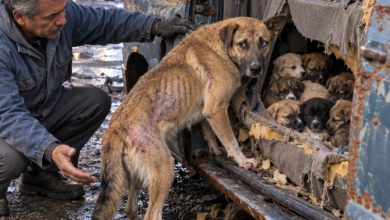
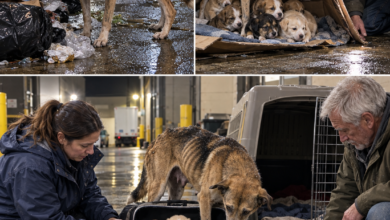
We kept him at the clinic for five days before I admitted the truth to myself: if he went anywhere after discharge, it was going to be my place.
Officially, he was a foster.
That word makes rescue people feel responsible and temporary at the same time. It lets you set up a crate in your living room without confessing what you already suspect—that some animals cross your threshold and begin rearranging the architecture of your life before you have chosen where to put the water bowl.
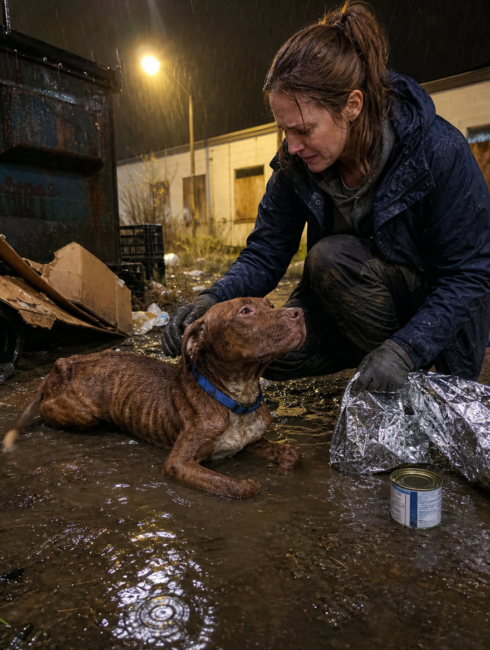
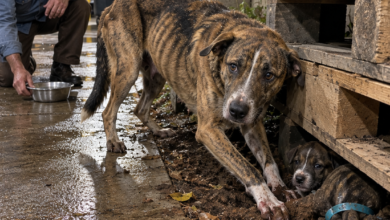
I named him Marlow on the third day, mostly because I needed something gentle to call him besides “buddy” and “hang on.” He was still too weak to object.
My apartment sat on the second floor of a narrow building in the Sellwood neighborhood, close enough to the river that mornings smelled faintly of wet leaves and old wood. I carried him upstairs the first week because his legs shook after more than a few steps. Milo, my elderly gray tabby, accepted the situation with the grim patience of a landlord who had not approved a sublease.
The first month was not dramatic.
That matters too.
People love rescue stories when they jump from ruin to miracle in a clean straight line. Real recovery looks more like paperwork, medication schedules, stool monitoring, and repeated negotiations over whether a body can trust tomorrow.
Marlow had to relearn almost everything.
Food came in measured amounts every four hours because his system could not manage a normal meal. At first, he ate flat on his side, as if even lifting his shoulders required calculation. By the second week, he could hold himself upright for the whole bowl. His tail began tapping the floor whenever I entered with the food tray, but only if I spoke first.
“I’m here,” I’d say.
Tap.
Tap.
The first time he drank from a bowl without collapsing his chin into it, I texted a video to Dr. Leah like I’d documented a moon landing.
The first time he got angry—properly angry—was over a heating pad. I tried to remove it for laundering, and he put one paw on it and gave me a look so offended I laughed out loud.
“Possessiveness,” I told him. “Excellent sign.”
The bath came on day ten. Until then, he smelled like antiseptic, wet concrete, and the long aftermath of neglect. I expected fear. Instead, he stood trembling in the tub and watched every movement of my hands with polite attention, as if bathing were a service he had once known well and had not expected again. When warm water ran over the ridge of his spine, his eyes half closed. When I towel-dried his ears, he leaned—just once—into my wrist.
Three days later he slept without waking every hour.
A week after that he discovered toys were not theoretical objects reserved for other dogs.
I had brought home a faded rubber ball from the clinic. Marlow stared at it for two days as though it might reveal itself as a trap. On the third day, he touched it with one paw. On the fourth, he picked it up and carried it exactly six feet before dropping it, apparently overwhelmed by the implications.
His body improved more slowly.
He had been starved long enough that his thighs looked carved instead of muscled. His gait was hesitant, almost apologetic. We built strength with short hallway walks, slow leash loops around the block, and rehab exercises Dr. Leah designed using couch cushions, low cavaletti poles, and the patience of saints.
He hated the rain at first.
That surprised me because the rain had been part of the night I found him. But maybe that was exactly why he hated it. The first time I clipped on a leash during a drizzle, he froze under the awning and looked back at me like I had misunderstood the terms of the lease. So I stood beside him and waited.
“I’m here,” I said.
The tail tapped once against the doorframe.
We walked three houses and came back.
Small distances became rituals. A corner. Then the mailbox. Then the coffee shop patio where the barista with the nose ring learned his name and slipped him a plain scrambled egg from the breakfast line after I promised she was not violating sixteen health codes.
By the end of the first month, Marlow had one full-speed tail wag in him each day. He spent it carefully.
Usually on me.
Sometimes on children.
Once on an elderly man who sat on the bench outside the pharmacy and cried quietly while petting his head. Marlow climbed half into his lap despite being too weak to arrange the maneuver gracefully. The man kept rubbing that torn ear and saying, “Thank you, thank you, thank you,” without explaining to whom.
Marlow’s strangest habit revealed itself in week five.
Whenever I knelt beside him, he would study my face for a second, then shift his body so his right side faced me. Only the right. If I sat on the other side, he would awkwardly reposition. At first I thought it was comfort. Later I realized it was training.
Someone, somewhere, had taught him to present that side.
The second seed came from music. My kitchen radio was usually tuned low to a local station, and one Sunday morning an old Nat King Cole song drifted out while I was cleaning food bowls. Marlow, who had been dozing on the rug, lifted his head so fast he knocked the water dish.
Then his tail began beating the floor.
Not a polite tap.
A real wag.
He stood, walked to the speaker, and sat there trembling with attention until the song ended.
I remember writing that down on a sticky note because it felt important in a way I couldn’t yet explain.
By the end of month two, he could walk half a mile.
By the middle of month three, he could trot.
He had gained fourteen pounds, most of it where it belonged. The hollows above his eyes softened. His coat deepened into a warm rust-brown with a white chest that looked like someone had brushed a cloud down the middle of him. When the sun hit him in the hallway, individual hairs glowed copper.
There was one milestone I kept waiting for.
The yard behind the rescue clinic had a stretch of grass no larger than a generous living room. Most foster dogs hit it, sniff once, and begin rolling or peeing or tearing around like fools. Marlow approached it as though I had opened a portal.
The first time his paw touched the lawn, he jerked backward hard enough to slip his collar.
The second time he sniffed it and sneezed.
The third time he stood at the edge, studying the green with the gravity of a bomb technician.
“It’s just grass,” I told him.
Marlow looked at me as if I were the least credible person in Oregon.
So we did what rescue work always reduces to when stripped of glamour: we repeated the possible thing until it became ordinary.
I sat on the grass.
I touched it.
I pulled a blade and let him sniff my fingers.
I lay down on it once, fully clothed, for his benefit. A volunteer from intake opened the back door, saw me there, and closed it again without speaking, which I appreciated.
Three days later, Marlow put one paw on the lawn.
Then another.
He stood there stiff and confused, tail low, nose working furiously.
“I’m here,” I said.
The tail moved.
A week after that, he lay down on the grass for the first time.
Not long. Just long enough for the sun to touch his side and for him to discover that the ground could be soft without being dangerous.
That evening, I found him asleep with his head on my shoe by the front door.
He had begun choosing joy in fragments.
I had no idea then that someone else, far from my apartment, was about to recognize those fragments before I did.
Part 3 — False Climax
The video happened on a Tuesday.
It was exactly three months and two days after I found him in the rain.
Spring had finally shifted into one of those clear Oregon afternoons that make the whole city look freshly washed. The rescue yard behind the clinic was empty except for me, Marlow, and a volunteer named Ava who had offered to help set up a low agility tunnel for another foster.
Marlow had been doing better with grass. Not confident, not normal, but curious. He would step onto it now without bracing like a statue. He would sniff, circle, and even lie down if I sat first. The rehab chart said “improving steadily.” Dr. Leah said “another few weeks and he’ll surprise you.” I was hoping for a decent trot and maybe one awkward play bow if the universe was feeling generous.
Ava unhooked the leash and asked, “You want me to get the ball?”
“Only if you want to witness disappointment,” I said.
She tossed it anyway.
Marlow watched the ball roll across the grass and stop near the fence.
Then he looked at me.
I said the same thing I always said before new, frightening things.
“I’m here.”
What happened next felt less like an achievement than a door swinging open.
Marlow took one step onto the grass.
Then two quick steps.
Then he broke into motion.
Not a careful rehab trot. A full-body, clumsy, glorious burst of dog. He ran crooked at first, back end wobbling, front end leading like his heart had started before the rest of him could catch up. Then something clicked. His stride opened. His head lifted. His ears flew back.
And his tail—
the same tail that had once only stirred rainwater—
began whipping behind him so hard his whole back half seemed powered by gratitude.
He reached the ball, overshot it, spun, barked once in surprise at himself, then bounded through the grass in a loose circle as if the yard had suddenly become the entire known world and he intended to examine all of it at speed.
Ava screamed.
I laughed so hard I nearly dropped my phone.
Then I started filming.
In the clip, you can hear me saying, “Go, Marlow! Go, baby, go!” in a voice that sounds two octaves younger than mine. He darts across the frame, leaps at nothing, skids, corrects, and races back toward me with the kind of joy that makes you understand why humans have been writing about dogs for centuries and still not finishing the job.
At one point he stops dead in a sun patch, looks up at the sky, then sprints again as if remembering he now lives on a planet with room.
He ran for less than a minute.
It changed everything.
I posted the video that evening with a simple caption: “Three months ago he was dying in a rain puddle. Today he touched grass, found sunlight, and ran.” By midnight it had been shared twenty thousand times. By morning it was on local news pages. Donations hit the clinic. People wrote from three countries. A woman in Ohio said she watched it every time she felt hopeless. A man in Texas asked if Marlow was available for adoption and whether we would consider transporting him.
For twenty-four hours, the story seemed complete.
A starving dog rescued from the rain survives.
A weak tail wag becomes a full one.
A scared body learns grass, sunlight, and speed.
Everybody cries.
Everybody shares the video.
The foster fails and adopts him.
That was the version strangers wanted, and if life had been a cleaner machine, maybe that would have been enough.
I almost let it be.
Then the email arrived.
It came from a woman named Dana Huxley, a nurse at a hospice center across town. The subject line read: I Think I Know Your Dog.
At first I assumed it would be another false lead. Viral rescue stories attract people who half-recognize every brindle mutt they’ve ever loved. But Dana had details.
The torn right ear.
The faded blue collar.
The way he turned his right side toward people who knelt.
The way his tail responded to the phrase “I’m here.”
At the bottom of the email, she had written one sentence that made my hands go cold on the keyboard.
If this is who I think he is, he used to sit beside dying patients who had nobody else.
Part 4 — The Twist
I called Dana on my lunch break and sat in my car gripping the steering wheel while she told me about a dog named Roscoe.
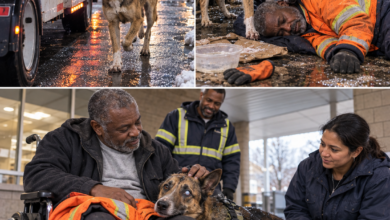
For four years, Roscoe had visited the Harbor Light Hospice House with a volunteer named Samuel Boone, a retired school custodian and widower who believed, after losing his wife, that no one should die without somebody at the bedside. Sam had no formal therapy certification for the dog at first. He just had a gentle Pit Bull mix, a calm presence, and the stubborn conviction that grief recognized gratitude faster when it came on four legs.
Over time, Harbor Light worked with them, documented the visits, and cleared Roscoe through volunteer training. He learned to approach beds from the patient’s right side so IV lines and monitors were less likely to tangle. He learned to lie still for hours. He learned to rest his chin lightly near a hand without demanding anything in return.
And, Dana said, he had one habit everyone at the hospice remembered.
Whenever a nurse, aide, or family member entered the room, Roscoe’s tail would move—softly, slowly, almost ceremonially—as if saying, thank you for coming in.
My throat tightened around the steering wheel.
Dana continued. Eight months earlier, Sam had suffered a stroke. He survived, but the recovery was bad, and he was transferred first to rehab, then to a long-term care facility. His estranged adult son, Kyle, signed papers agreeing to keep Roscoe “temporarily” while Sam recovered. Roscoe stopped coming to the hospice. Staff asked about him repeatedly. Sam kept saying, “He’s waiting for me.”
Three months later, Kyle stopped answering calls.
Sam deteriorated before anyone could locate the dog.
“He died six days before that running video went up,” Dana said quietly. “The last thing he asked me was whether Roscoe still wagged when people came close.”
I could not speak for a second.
Rain tapped lightly on the windshield, and Portland traffic moved around me while the whole story I thought I understood opened like a false wall.
The dog in my apartment had not just been grateful.
He had been practicing the only language of hope he knew.
Dana asked whether she could send photos.
When they came through, I stared at them one by one. Marlow—Roscoe—sitting in a plaid bandana beside a hospital bed. Roscoe resting his head on an old woman’s blanket. Sam, tall and stooped, in a Mariners cap and weathered work jacket, smiling with one hand on that torn ear.
There was no doubt.
The twist inside the twist came an hour later when Dana forwarded a scanned page from Sam’s volunteer file. It wasn’t official paperwork. It was a note written in blocky blue ink and tucked into his badge sleeve after his stroke, probably because he knew his time was moving faster than his plans.
If Roscoe is ever found, it said, tell whoever has him this:
He wags when he is scared. He wags when he is tired. He wags when people are kind. I taught him that meeting mercy halfway is still a form of courage. If he chooses you, please don’t send him back into loneliness.
I sat in my parked car and cried so hard a man in the next vehicle checked whether I needed assistance.
By that evening, we had more facts.
Animal control opened a cruelty investigation on Kyle based on witness statements, phone records, and a security video from a gas station showing a man matching his description pushing a thin dog out of a car weeks before my dispatch call. He was eventually charged, though by then I cared less about punishment than I did about the chain of small betrayals that had placed a hospice dog in a rain puddle alone.
The larger truth, the one I kept turning over, was harder to carry.
All through his worst night, the dog I found had not been thanking me in some simple, fairy-tale way.
He had been doing his work.
Even starving.
Even soaked.
Even nearly gone.
He had seen a human kneel and answered the only way his body knew:
I see you. Thank you for coming close.
That realization split the story open.
I had thought I rescued a dying stray.
In part, I had.
But I had also stumbled onto a former comfort dog whose entire life before abandonment had been spent easing other people’s fear. And in the exact moment when anyone would have forgiven him for bitterness, he had comforted me.
Reverse savior.
That was the real story.
The dog in the puddle had saved a piece of me before I knew it needed saving.
Part 5 — Revelation
Once you know a past, the old details stop looking random.
They rearrange themselves into evidence.
The right-side presentation. Of course. That was hospice training.
The way he held still during baths and exams. Of course. He had spent years being handled by caregivers, patients, and strangers in vulnerable rooms.
The reaction to music? Dana knew that too.
Sam apparently ended every volunteer shift by sitting in the car with Roscoe and playing Nat King Cole on the drive home because, as he once told the nursing staff, “Nobody should leave a place like this without a soft landing.”
Even the phrase “I’m here” had a history. Dana said Sam used it before entering patients’ rooms, before sitting beside new admissions, and before bringing Roscoe close to a bed.
“I’m here,” he’d say.
Then Roscoe’s tail would begin its slow answer.
I walked into my apartment that night and looked at the dog sleeping on my rug as if I had been handed a second biography under the first. He opened one eye, saw me, and the tail swept once against the floor.
“I know,” I whispered.
Then, after a moment: “I didn’t know, but I know now.”
The next week I brought him to Harbor Light.
I expected something cinematic. Dogs in viral stories are always expected to behave like actors with impeccable timing. Roscoe had other ideas. He sniffed the front hedge, peed on a decorative rock, and pulled me toward the automatic door like a man with old dinner reservations.
Inside, the receptionist started crying before she finished saying hello.
Dana came out from the nurses’ station and knelt.
Roscoe turned his right side to her.
The tail moved.
People appeared one by one. An aide from evenings. A volunteer coordinator. The chaplain. A housekeeper named Milena who used to slip him little bits of turkey at Christmas. He greeted each of them with the same grave, gentle wag, as if the years between his last visit and now had been a scheduling problem rather than an abandonment.
They showed me Sam’s old volunteer chair in the break room, the guest book where families had written things like Roscoe made my father smile on his last day and Thank you for bringing kindness into Room 7. One woman, whose mother had died there two years earlier, happened to be visiting with flowers when she saw him in the hall. She put both hands over her face and said, “That dog sat with us when my brothers couldn’t get there in time.”
The revelation didn’t end with grief.
It changed the future too.
Harbor Light asked if I would consider bringing Roscoe back once he had settled more. Not as formal therapy work immediately. Just visits. Short ones. If he wanted them.
The first time we tried, he walked into Room 12 where a former teacher named Mr. Redd was losing a slow battle with lung cancer and had outlived most of his visitors. Roscoe approached the right side of the bed, waited, and looked at me.
“I’m here,” I said without thinking.
His tail began.
Mr. Redd laughed—a dry, tired laugh, but unmistakably a laugh—and said, “Well, aren’t you polite.”
Roscoe rested his chin on the blanket.
I watched that scene and felt something inside me rearrange.
The fatigue that had been calcifying for months did not disappear. Rescue work stayed hard. Dogs still died sometimes. Neglect stayed real. Bills stayed due. My apartment stayed too small for the number of leashes I now owned.
But the story I told myself about what any of it meant shifted.
Before Roscoe, I had begun believing rescue was mostly triage against a leaking dam. Necessary, exhausting, and endless.
After Roscoe, I remembered something I had forgotten.
That mercy can echo forward.
Sam had spent years carrying his dog into hard rooms so strangers would feel less alone.
Then Sam was gone. The son failed. The dog nearly died. And still, the mercy Sam taught did not vanish. It survived in a weak tail sweep in the rain. It survived long enough to reach me. It survived long enough to come back to the hospice.
The second sub-twist arrived with paperwork.
Because Sam had no surviving spouse and Kyle lost legal claim during the cruelty case, ownership of Roscoe fell into a gray area. Dana brought me a folder from Sam’s file containing copies of his emergency contact forms. On one page, under the line asking what should happen to his dog if he became unable to care for him, Sam had written years earlier:
If Roscoe ever chooses a person, trust his taste more than mine. He has always been better at reading people.
The rescue board laughed when I brought that line into the adoption meeting.
“You realize that’s not legally binding,” our director said.
“I realize,” I said.
But my hands were shaking anyway.
The paperwork took less than fifteen minutes.
The decision had probably been made the first night, somewhere between the puddle and the IV line.
I adopted him on a Friday.
He slept on my bed that night with the confidence of a man reclaiming property.
Part 6 — Echo
The ritual we built after that was small enough to sound ordinary and strong enough to hold us both.
Every Sunday morning, unless weather or health made it impossible, Roscoe and I stopped at the same coffee shop for one plain scrambled egg and one black coffee. Then we drove to Harbor Light for a short visit.
Not a hero tour.
Not a performance.
Just a dog doing work he understood and a woman following him into rooms she might otherwise have avoided.
Before entering each room, I would pause with my hand on the door and say, “I’m here.”
Roscoe’s tail would answer.
The nurses began listening for it. They told me later there was a specific sound when his tail tapped a chair leg or the base of a recliner—light, steady, impossible to mistake once you knew it. Families started asking for “the tail dog” if a patient had been agitated or lonely.
He never forced himself on anyone. Some days he only stood at the bedside and watched. Some days he tucked his body under a hand and stayed until the breathing in the room changed. Once he spent forty minutes beside a man who had not spoken to anyone all morning, then accepted one careful piece of cracker like payment.
At home, he kept learning the luxuries of being a dog without assignments. He discovered blankets in sun patches. He discovered that Milo’s tail was not, in fact, a toy, though this lesson required repetition. He learned the difference between a clinic leash, a hospice leash, and the green long line that meant we were going to the big field.
And the field remained ours.
Every few days, I took him back to the fenced grass behind the clinic or to the quiet dog run near Oaks Bottom. He never again hesitated at the edge of the lawn. Sometimes he paused to sniff the wind, as if still verifying the world had not shrunk overnight. Then he ran.
Not with the desperate astonishment of that first time.
With ownership.
The tail that once only stirred muddy water now cut great bright arcs through sunlight.
I started filming less.
Not because the joy had faded.
Because it no longer felt temporary enough to document like proof.
Part 7 — Ending
The last time I saw Dana, she asked whether I ever thought about the rain puddle anymore.
I told her the truth.
All the time.
Not because I like suffering revisited.
Because I like the measurement of distance.
The dog in that puddle had been almost gone.
The dog beside me in the parking lot that afternoon leaned against my leg, smelled faintly of shampoo and grass, and watched a squirrel with the interest of a philosopher considering a rival theory.
When I knelt to clip on his leash, he turned his right side toward me by habit.
“I’m here,” I said.
The tail moved.
Not weakly.
Not carefully.
Fully.
Like a flag.
Sometimes rescue stories end where people think they should: the stretcher, the adoption photo, the video, the first run.
Ours didn’t.
Ours kept going into quiet rooms where old people reached for a brindle head and felt less alone. It kept going through rainy mornings, coffee-shop eggs, and grass under a dog’s feet. It kept going every time Roscoe answered kindness with the same simple movement he had given me when he had almost nothing left.
I used to think I saved him because I stopped the car.
Now I think the truth is more balanced than that.
I brought him in from the rain.
He brought me back from the edge of leaving.
That tail told me something before I knew how badly I needed to hear it.
Come close.
Stay soft.
Mercy still counts.
He wagged first.
I’m still answering.
Follow this page for more unforgettable dog stories about rescue, healing, and second chances.