Part 2: I Fed a Starving Dog Through a Backyard Fence From My Wheelchair — Months Later, He Became the Strength That Carried Me Home
Part 2 — The Name He Had Before the Chain
Atlas had been adopted from a regional rescue eighteen months before he moved into the house beside mine.
His intake record described him as a two-year-old German Shepherd mix found near an interstate rest area outside Clarksville. He had been thin but friendly, and shelter staff noted that he leaned against people after only a few minutes.
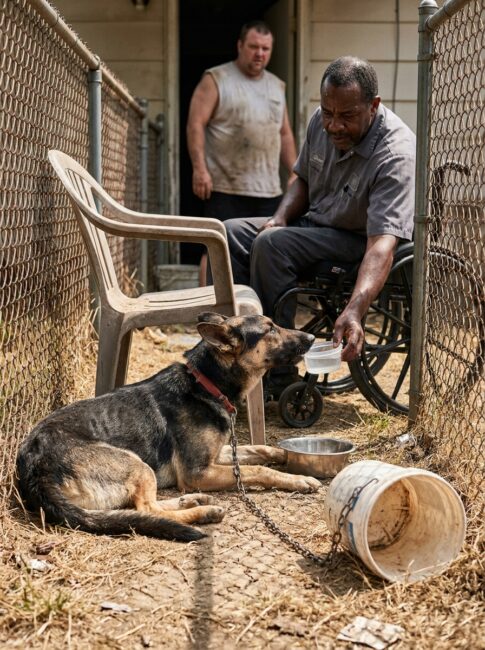
The rescue named him Atlas because of his wide shoulders and serious expression.
Derek changed the name to Brutus after adopting him.
According to the original application, Derek owned a fenced property, worked from home, and wanted a companion for long hikes. The address he provided belonged to his former girlfriend. The photographs of the fenced yard were hers.
Within months, the relationship ended.
Derek moved repeatedly and took Atlas with him—not because he loved the dog, investigators later believed, but because his former girlfriend had paid part of the adoption fee and wanted Atlas returned.
The dog became one more object through which control could continue.
The veterinarian, Dr. Melissa Grant, showed me the microchip record after receiving permission from animal control.
“Atlas was reported missing by the former girlfriend,” she said. “Derek told the rescue she had stolen him, then stopped responding.”
“Can she take him?”
“Not automatically. The court and rescue will decide ownership after the cruelty investigation.”
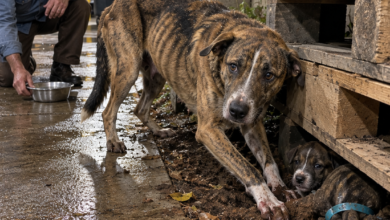
Atlas weighed fifty-four pounds.
A healthy dog of his size should have weighed closer to seventy-five.
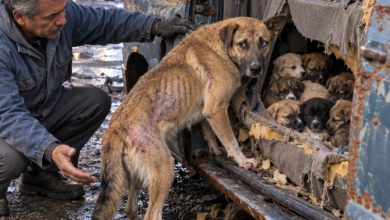
He was dehydrated, anemic, covered in flea bites, and suffering from an infected pressure wound around his neck. X-rays showed an older rib fracture and damage to one hip that had never been treated.
The staff shaved the fur around the collar wound.
Beneath it were parallel scars.
The chain had not been a recent decision.
Atlas remained in the clinic for eleven days. He received fluids, antibiotics, small meals, and treatment for parasites. The damaged hip did not require surgery, but rehabilitation would be necessary before strenuous activity.
I visited each afternoon.
The first time I entered his recovery room, Atlas stared at my wheelchair.
The chair made him nervous.
My brakes clicked.
The footplate reflected light.
The wheels moved without footsteps.
I stopped near the doorway.
“It’s still me.”
His bent ear lifted.
I placed one piece of chicken on the floor, then rolled backward.
Atlas approached carefully.
He ate the chicken.
Then he smelled my front wheel.
The next day, I let him investigate the chair before I moved. On the third, he walked beside me for several feet in the clinic hallway.
I began learning what frightened him.
Chains.
Raised male voices.
Garden hoses.
Metal bowls scraping concrete.
Hands reaching over his head.
Atlas began learning things about me too.
When my left leg developed a muscle spasm, my foot sometimes shifted from the chair’s plate. Atlas watched the movement closely. When I dropped my phone, he moved toward the sound and smelled it.
“Could teach you to pick that up,” a veterinary technician joked.
I laughed.
At that point, the idea of Atlas becoming an assistance dog seemed impossible.
He was still learning that food would return the following day.
I was still pretending I visited only because I had started the case.
The legal hearing took place two weeks after Atlas’s rescue. Derek’s attorney argued that the dog’s condition resulted from illness and that I had interfered with his feeding routine.
Animal control presented the veterinary records.
I presented my photographs and dated videos.
Mrs. Alvarez, the tenant who lived behind Derek’s property, testified that she had heard him strike Atlas and threaten anyone who reported him.
The rescue produced the adoption contract.
Derek lost ownership immediately.
Criminal charges continued separately, but Atlas became legally available for foster placement.
His former co-adopter had relocated overseas and could not take him. She provided a statement giving the rescue full authority to choose a permanent home.
The rescue coordinator asked whether I would foster Atlas.
I laughed again.
“I live alone.”
“So do many dog owners.”
“I can’t chase him if he gets loose.”
“That is why fences and leashes exist.”
“I’m in a chair.”
She looked at me without pity.
“And?”
That single word exposed an assumption I had not realized I was making.
Other people often treated my disability as proof I could not handle ordinary responsibility.
Now I was doing it to myself.
My home had a wide hallway, an accessible entrance, low counters, and a fenced backyard. I worked from home. Atlas already trusted me more than most people.
I agreed to a two-week trial.
Atlas entered my house on a Tuesday afternoon.
He spent the first hour walking from room to room, smelling doorframes and checking exits. He refused the expensive orthopedic bed donated by the rescue and lay instead beside the left wheel of my chair.
When I rolled into the kitchen, he followed.
When I moved toward my office, he followed.
When I stopped, Atlas stopped.
That evening, I transferred from my wheelchair to the sofa. Atlas watched closely, head tilting each time I shifted my weight.
“You don’t need to supervise.”
He lay beside the chair anyway.
At bedtime, I expected him to sleep near the front door.
Instead, Atlas lowered himself across the bedroom threshold.
Not inside.
Not far away.
Close enough to hear me breathe.
I turned off the lamp.
For the first time in years, there was another living heartbeat inside my house.
I slept better than I had since before the accident.
The two-week trial never ended.
Part 3 — The Person I Had Become Good at Hiding
Before Atlas, I described myself as independent.
The word was partly true.
I could transfer without assistance, drive an adapted van, cook, work, and manage most household tasks. My wheelchair gave me access to a life that would otherwise have remained beyond reach.
But independence had become an excuse.
I used it to avoid asking for help.
I also used it to avoid being seen struggling.
After my injury, friends visited often. They brought food, modified the bathroom, built the front ramp, and promised nothing important had changed.
Then time did what time always does.
People returned to jobs, children, marriages, and ordinary responsibilities. Invitations became less frequent because venues were inaccessible, or because friends did not know whether I wanted to attend.
Often, I declined before anyone could decide I was inconvenient.
My world narrowed.
Atlas noticed nothing unusual about the wheelchair.
Once he understood its movement, he treated it as part of me.
He learned not to walk across my path. He waited beside doors rather than blocking them. When I transferred, he stepped back without leaving the room.
His physical recovery continued through short walks and rehabilitation exercises. Because I could not easily manage a standard leash while propelling my manual chair, the rescue’s trainer introduced a waist-and-chair-safe leash attachment with an emergency release.
The arrangement allowed Atlas to walk beside me without being tied rigidly to the chair.
Our first neighborhood walk lasted six minutes.
Atlas stopped at the end of my driveway.
The street was unfamiliar from his new side of the fence. Cars passed. A lawn sprinkler clicked. Somewhere behind us, a metal gate slammed.
His body lowered.
I stopped too.
“We can go back.”
Atlas looked toward the house.
Then toward the sidewalk.
He took one step.
I rolled beside him.
We traveled to the next mailbox and returned.
The following day, we made it two houses farther.
Within a month, Atlas and I reached the small park at the end of the street.
I had lived there for four years and never visited it.
The path was paved, but a steep incline near the entrance had always discouraged me. I could climb it by pushing hard on the rims, but doing so strained my shoulders—joints wheelchair users depend on for nearly everything.
That day, I stopped at the base.
Atlas looked back at me.
“Not today.”
He returned to my side.
There was no disappointment in him.
No judgment.
We sat beneath a tree near the entrance instead.
Children played on the accessible playground. A woman walked laps with a stroller. Two older men argued over a chessboard.
Nothing dramatic happened.
That was the beauty of it.
I was outside.
Atlas lay beside my wheel, watching birds.
The chair was not keeping me home.
Fear of being watched had been doing that.
A mobility-dog trainer named Sarah Jennings began working with us after noticing how closely Atlas monitored dropped items.
Assistance work was not an automatic destination. Atlas needed medical clearance, temperament testing, obedience training, and the freedom to stop if the work caused stress.
Melissa examined his hips and shoulders.
“He may be suitable for retrieval and access tasks,” she said. “But any pulling must be limited, controlled, and performed only with a properly fitted harness.”
The dog’s health mattered more than the story people might want.
Training began with simple tasks.
Atlas picked up a cloth pouch.
Then my keys.
Then a phone fitted with a durable case and fabric tab.
He learned to bring medication from a low drawer, press an accessible door plate, tug open a lightweight cabinet using a rope handle, and carry small items in a backpack designed for dogs.
He also learned something nobody intentionally taught him.
When frustration made me breathe differently, Atlas placed his chin on my thigh.
The first time he did it, I had dropped a pan while transferring food from the stove. It landed beyond my reach, and I swore loudly.
Atlas flinched.
Then, instead of retreating, he approached and rested his head against me.
My anger disappeared before I had decided to release it.
“You’re not supposed to comfort me,” I said. “I’m supposed to be fixing you.”
His tail moved against the cabinet.
We were both beginning to understand that rescue was not a permanent role assigned to one side.
Sometimes I carried his fear.
Sometimes he carried mine.
Part 4 — The Night Atlas Brought Me the Phone
The event that changed our training happened five months after Atlas came home.
It was raining hard, and a storm had knocked out power across part of Nashville. I had finished closing the back shutters when one of my wheelchair’s front casters caught against a loose edge in the kitchen threshold.
The chair stopped.
My body did not.
I fell forward.
Normally, I could recover from a floor transfer using a stable surface and upper-body strength. This fall was different. My left shoulder struck the cabinet, and my hip twisted beneath me.
The wheelchair tipped partly onto its side.
My phone had landed near the refrigerator, nearly eight feet away.
Atlas rushed into the room.
I lay still for several seconds, assessing pain.
Nothing felt broken, but my shoulder could not support a transfer. The storm covered any sound I might have made. My closest neighbor, Mr. Franklin, was away visiting family.
“Atlas,” I said. “Phone.”
We had practiced the command dozens of times.
Never under real stress.
Atlas looked at the phone.
Then at me.
“Phone.”
He crossed the kitchen, took the fabric tab gently between his teeth, and brought the device to my hand.
The screen had cracked but still worked.
I called my sister.
Then emergency services.
While we waited, Atlas lay against my back, providing warmth and pressure. Every time I shifted, he moved with me.
Paramedics arrived within fifteen minutes. The shoulder was badly strained, and the hip injury required observation, but nothing was fractured.
At the hospital, my sister Denise sat beside the bed with Atlas’s leash wrapped around her wrist.
“He brought you the phone?”
“Yes.”
“You always say you don’t need anybody.”
I looked at the dog.
“He isn’t anybody.”
Denise raised one eyebrow.
“You know what I mean.”
I did.
The fall exposed the weakness inside my version of independence. I had designed my life to minimize reliance on people because reliance frightened me more than injury.
Depending on Atlas felt different at first because he did not judge the need.
Then I realized most people who loved me had not judged it either.
I had judged myself on their behalf.
The recovery from my shoulder injury forced me to accept help. Denise stayed for a week. Club volunteers from the rescue brought meals. Sarah handled Atlas’s exercise.
Instead of feeling diminished, I felt connected.
That lesson became central to Atlas’s mobility training.
An assistance dog does not make a disabled person complete.
I was already complete.
Atlas made certain tasks safer and extended my reach, just as my wheelchair did. Tools do not erase disability; they help a person navigate a world often designed without them in mind.
After orthopedic clearance, Atlas began learning controlled wheelchair assistance using a custom Y-front mobility harness. The harness distributed pressure safely across his chest and shoulders. He never pulled from a collar, and he never hauled my full weight over long distances.
The task was specific.
On short inclines or rough pavement, I propelled the chair while Atlas added steady forward assistance on command. If he slowed, stopped, or showed discomfort, the task ended.
Sarah taught me to watch his gait, breathing, and posture.
“Partnership means both of you get a vote,” she said.
Atlas learned the cue “forward.”
At the park incline, we tried it for the first time.
I pushed the rims.
Atlas leaned gently into the harness.
Together, we climbed.
At the top, I released the cue.
“Free.”
Atlas turned toward me, tail moving.
I laughed loud enough that people across the playground looked over.
For the first time since moving into the neighborhood, I did not care who was watching.
Part 5 — The House Where Atlas Had Been Chained
Derek Shaw’s criminal case took nearly a year.
The court found him guilty of aggravated animal cruelty and violating previous probation conditions connected to another incident. He received jail time, mandatory counseling, restitution, and a long-term prohibition on owning animals.
Some people believed the sentence was too light.
Others believed it was excessive for “just a dog.”
I had learned that the phrase just a dog usually meant someone had never been saved by one.
I gave a victim-impact statement at sentencing.
Not on Atlas’s behalf as though I could speak for every feeling he carried.
I spoke about what was documented.
The infected collar wound.
The untreated fracture.
The heat exposure.
The twenty-three days I watched a living creature become smaller while the law required enough evidence to intervene.
Then I spoke about the person Atlas had become once cruelty stopped controlling his environment.
“He was never stubborn,” I said. “He was afraid.”
“He was never ungrateful. He was starving.”
“He was never worthless. Someone simply benefited from treating him that way.”
Derek stared at the table.
I did not need him to look at me.
Atlas waited outside the courtroom with Sarah because the building permitted service dogs in training, but the proceeding itself would have exposed him to unnecessary stress.
Afterward, I rolled into the lobby.
Atlas stood.
His tail moved in a wide, steady arc.
I touched his white chest.
“That part is over.”
Of course, trauma does not follow court calendars.
Several months later, the duplex next door was sold. A young couple moved in and replaced the chain-link fence with a wooden privacy fence.
Before construction began, they invited me into the backyard.
It was the first time I had crossed onto the property.
The broken plastic chair remained near the old doghouse. The rusted chain had been removed as evidence, but the bare circle in the dirt showed where Atlas had walked the same limited path.
He entered beside my chair wearing his assistance harness.
At first, he stopped.
His ears lowered.
The muscles along his back tightened.
I considered turning around.
Then Atlas smelled the ground.
He approached the place where the water bucket once stood. He sniffed the doghouse. Finally, he walked toward the fence gap where I had passed him food.
On the other side of that gap was my driveway.
Atlas stood there for several seconds.
I wondered whether dogs understand geography as memory, whether he connected the smell of dust and wire with the man in the wheelchair who had appeared every morning.
He looked at me.
Then he sat.
I reached through the memory between us and touched his head.
“This is where we met.”
The new homeowners planted a maple tree where the chain had been anchored.
They asked whether I wanted the broken doghouse removed.
“Yes.”
We dismantled it together.
I could not lift the boards, but I held the trash bags open and directed which pieces contained exposed nails.
Atlas watched from the shade.
The space did not need to become a monument.
It needed to stop being a prison.
By autumn, grass covered the dirt circle.
The maple tree was small but alive.
Atlas no longer looked toward the yard when we passed.
He had more important places to go.
Part 6 — The Miles We Found Together
Atlas completed his assistance-dog evaluation eighteen months after his rescue.
The certification process tested obedience, public access, recovery after distractions, task reliability, and his ability to remain calm without shutting down.
Sarah made one condition clear.
Atlas’s history would not earn him a passing score.
Compassion could not replace safety or competence.
He passed because he was ready.
His working tasks included retrieving dropped objects, opening lightweight accessible doors, carrying medication, activating low switches, seeking help from a designated person, and offering controlled forward assistance on short inclines.
At home, he also learned to pull the laundry basket using a padded handle.
He considered this task beneath his dignity unless socks were involved.
Our lives expanded.
We visited coffee shops.
Libraries.
Outdoor markets.
The greenway near the Cumberland River.
I attended my niece’s college graduation instead of watching online because Atlas could retrieve dropped items and help me manage the long accessible route from parking to seating.
I returned to a state park for the first time since my injury.
Not every trail was accessible, but one paved route followed the lake for nearly two miles.
Atlas walked beside me.
At an incline, he assisted.
On level ground, he simply matched my pace.
People occasionally stopped us to praise him.
Some said, “He gives you independence.”
I usually smiled.
The fuller truth was more complicated.
Atlas helped me become comfortable with interdependence.
He taught me that receiving help did not erase competence. Trust did not weaken either partner. Depending on another living being for one task did not make the rest of my life less mine.
In return, I protected his right to rest.
Atlas did not work all day.
His harness came off at home. Once released, he became a regular dog who chased leaves, slept upside down, stole towels from the bathroom, and barked suspiciously at inflatable holiday decorations.
Every evening, we followed the same ritual.
I removed the harness.
Brushed the fur beneath the straps.
Checked his paws and shoulders.
Then I said, “Free.”
Atlas ran into the backyard.
Sometimes he circled the maple tree next door before returning.
Not the exact place where he had once been chained.
Near it.
But now every circle was his choice.
The rescue organization began using our story in public education—not as a tale of a disabled man made whole by a heroic dog, but as an example of reciprocal care.
I spoke at adoption events about documenting neglect, reporting through legal channels, supporting animal-control officers, and understanding that rescued dogs do not owe immediate affection.
Atlas usually slept during my speeches.
Afterward, people approached with stories.
A veteran whose dog woke him from nightmares.
A woman with multiple sclerosis whose Labrador helped with doors.
A teenager who fed a neighborhood cat through a fence until a rescue intervened.
The details changed.
The pattern remained.
Someone noticed.
Someone returned.
Someone refused to let suffering stay private.
Part 7 — The Legs I Already Had
Atlas worked beside me for eight years.
Age reached him gradually.
His black muzzle became gray. The old hip injury stiffened during winter. He began taking longer to rise after naps.
Melissa monitored him closely.
The day came when she said the words I had prepared for and still did not want.
“No more mobility pulling.”
His shoulders remained healthy, but arthritis in the hip made forward-assistance work unfair.
I nodded.
Atlas retired from that task immediately.
He continued retrieving light objects and pressing door plates for another year, but the working harness appeared less often. Eventually, it remained on its hook.
People asked whether losing his assistance changed my independence.
It changed my logistics.
Not my life.
By then, I had a power-assist device fitted to my wheelchair for steep inclines. Home automation controlled doors and lights. Friends understood how to help without turning help into pity.
Atlas had not been my only path forward.
He had been the partner who helped me believe more paths existed.
In retirement, he slept in my office during work calls and greeted clients through the screen when they asked about the gray face behind my chair.
Denise visited every Sunday.
Mr. Franklin brought biscuits.
Sarah stopped by for walks that became slower and shorter.
On warm evenings, Atlas and I sat near the fence where we first met.
The gap beneath it had long been filled.
We no longer needed it.
Atlas developed heart disease at thirteen. Medication gave us another good year. Then one morning, he refused breakfast and could not stand without help.
Melissa came to the house.
Atlas lay on his bed beside my wheelchair.
I lowered myself to the floor using the transfer technique I had practiced for years. My shoulder complained, but I wanted to be level with him.
His cloudy eyes followed me.
“You remember that fence?” I asked.
His bent ear shifted.
“I couldn’t come over it.”
My hand rested on his white chest.
“You couldn’t reach me either.”
Atlas exhaled slowly.
“So we met in the middle.”
Denise sat behind me with one hand on my shoulder.
Before Melissa gave the final medication, I removed Atlas’s collar.
No chain.
No harness.
Nothing attached to him.
I placed my forehead against his.
“I saved you once,” I whispered.
His tail moved against the bed.
“Then you gave me back the whole neighborhood.”
Atlas’s breathing softened.
The room became quiet.
He died with his head resting against the wheel he had once feared.
We buried his ashes beneath the maple tree planted in the neighboring yard. The new owners placed a small stone near the trunk with my permission.
It reads:
ATLAS
HE CROSSED NO FENCE ALONE
For years, people summarized our story with one sentence:
“I rescued him, and he became my legs.”
I understand why they liked it.
The line sounds complete.
But Atlas was never my legs.
My legs did not work as they once had, and that did not make me less whole. My wheelchair gave me mobility. Technology gave me access. People gave me support.
Atlas gave me something else.
He gave me a reason to use all of it.
He was the nose pressed near my wheel when I wanted to stay home.
The steady body beside me on a crowded sidewalk.
The gentle forward pull on one difficult hill.
The mouth carrying a phone across a kitchen floor.
The patient eyes waiting whenever I needed to try again.
I fed a starving dog through a fence because he could not reach his bowl.
Months later, he retrieved the world I had placed beyond my own reach.
Not by carrying me everywhere.
By reminding me that I still wanted to go.
That is different.
And it is greater.
Today, I still visit the park at the end of our street. The power-assist device hums quietly on the steep entrance. At the top, I stop beneath the tree where Atlas and I once sat during our first six-minute walk.
Children play.
Neighbors wave.
Life moves without asking whether I feel ready.
Sometimes I imagine Atlas beside my wheel, one ear upright and the other bent, waiting for the next direction.
“Forward,” I used to say.
He would lean gently into the harness.
I would push.
Neither of us did all the work.
That was the point.
People believe rescue means one strong person reaching down toward someone helpless.
Atlas taught me another version.
Sometimes rescue happens sideways.
Through a fence.
Across a kitchen floor.
Up a difficult hill.
Two living beings move toward each other with whatever strength they have left.
Then they keep going together.
I saved Atlas from a chain.
Atlas saved me from a life measured only by the places I believed I could not reach.
He was not my legs.
He was my reason to move them forward—even when the movement came through wheels.
And every mile mattered.
Follow this page for more unforgettable dog stories about rescue, disability, loyalty, and the partnerships that help two lives move forward together.