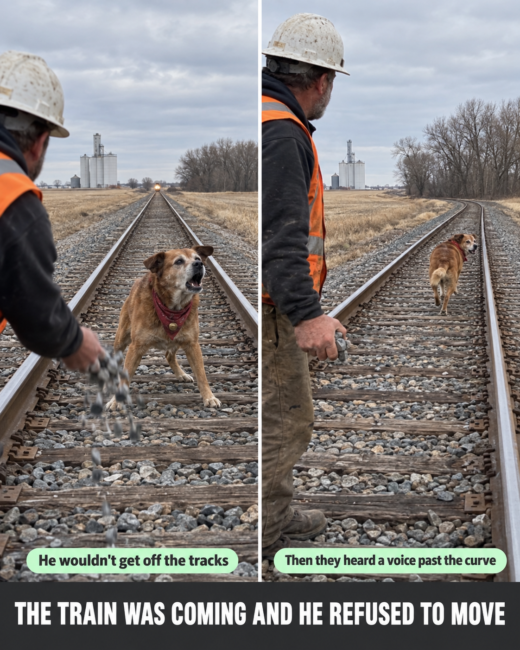
A Scruffy Dog Planted Himself in the Middle of the Railroad Tracks and Barked at an Oncoming Freight Train While a Railroad Worker Threw Rocks to Drive Him Away
Part 2: Past the Curve
Connie didn’t think. She threw her pickup into reverse, swung it onto the gravel farm road that ran beside the tracks, and floored it.
The flagman was shouting into his radio behind her. She could see him in her mirror, red flag in one hand, the radio pressed to his face.
The gravel road followed the rails west toward the cottonwoods. Dust boiled up behind her. The rust-red dog was racing along the tracks ahead of her, ears flat, red bandana snapping in the wind.
She rounded the bend and slammed on the brakes.
There was an old private crossing there. Just a rutted dirt lane cutting across the tracks between two wheat fields, leading to a white farmhouse with a sagging porch and a FOR SALE sign out front.
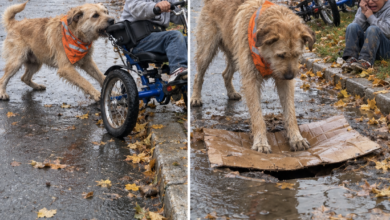
And stuck in the middle of the tracks was a power wheelchair.
An old man sat in it. Thin, white-haired, a faded blue-and-white striped railroad cap on his head, a plaid flannel shirt and a blanket over his knees. He was rocking the chair back and forth, back and forth, his face gray with fear and effort.
The chair’s front wheel was jammed. Wedged deep in the narrow gap between the steel rail and the wooden crossing planks. The motor whined. The chair didn’t move an inch.
The rust-red dog skidded to a stop in front of him and planted himself between the old man and the curve, facing east. Toward the train. Barking.
Connie jumped out of the truck and ran.
“Sir! Sir, are you okay?”
The old man looked up at her. His eyes were watery and blue. “My wheel,” he said. “It’s stuck. I’ve been trying for half an hour. Boxcar went for help. He kept going for help.”
Connie grabbed the back of the wheelchair and pulled. It didn’t move. She got down on her knees on the railroad ties and tried to work the front wheel loose with her hands. It was jammed solid. Steel against steel.
The chair was heavy. Three hundred pounds with the batteries. And the old man was strapped into it with a seatbelt across his lap, the buckle twisted and caught under the armrest.
“I can’t get it,” Connie gasped. “I can’t get it!”
Behind them, around the curve, the train horn blew again. Long and deep. Closer now. So much closer.
The ground was trembling under Connie’s knees.
“Leave me,” the old man said quietly. “Please, ma’am. Take Boxcar and get off the tracks.”
“No.”
“Please.”
Connie pulled out her phone with shaking hands. Who do you call? 911? The railroad? There was a blue sign posted on a pole beside every crossing in America, with an emergency number on it. She’d driven past them her whole life without ever reading one.
She ran to the pole. Squinted at the sign. Dialed.
A dispatcher answered. Connie screamed the crossing number into the phone. “There’s a man in a wheelchair stuck on the tracks! There’s a train coming!”
“Ma’am, we’re contacting the engineer right now,” the dispatcher said, calm and fast. “That’s an eastbound loaded grain train. Over a mile long. Even in emergency braking, it needs more than a mile to stop. Get yourself clear of the tracks.”
“I can’t leave him!”
“Ma’am, get clear.”
The dog was still barking at the curve. Hoarse. Desperate.
And then Connie understood.
That dog hadn’t been barking at the train back at the highway crossing for no reason. He’d been running back and forth between this old man and the flagman for who knew how long. Trying to bring somebody. Trying to make somebody understand.
And the only person who’d been there had thrown rocks at him.
Connie ran back to the wheelchair and grabbed the old man’s hand.
“We’re getting you out,” she said. “Help is coming.”
The old man looked down at the dog standing guard in front of him.
“He’s been trying to tell people,” he whispered. “Since this morning. Nobody would listen. Nobody ever listens to old dogs.”
Then he looked past Connie, down the gravel road, and his whole face changed.
Connie turned.
The flagman was running toward them along the tracks. Not jogging. Running for his life, his orange vest flapping, his white hard hat gone, his boots pounding on the railroad ties.
And the old man in the wheelchair was staring at him like he’d seen a ghost.
Part 3: Boxcar
“Who’s that?” Connie asked.
The old man didn’t answer. He was gripping the armrests of his wheelchair so hard his knuckles were white.
The dog had turned around. He wasn’t barking at the curve anymore. He was staring at the running flagman, his tail beginning to move.
“Sir,” Connie said. “What’s your name?”
“Harold,” the old man whispered, not taking his eyes off the man on the tracks. “Harold Whitaker.”
The Silver Alert. An eighty-one-year-old man missing from the Ellinwood Senior Living Center in a power wheelchair.
“Harold, how did you get out here?”
Harold took a shaky breath.
“I drove,” he said. “Six miles. Down the shoulder of Highway 56 in this contraption. Took me three hours.” He almost laughed. “First time in eight months I’ve been outside without a nurse holding my arm.”
He reached down with a trembling hand and touched the rust-red dog’s head.
“This is Boxcar,” he said. “He’s mine. Eleven years old. I found him as a puppy, hiding under a grain car in the rail yard in Hutchinson. That’s how he got the name.”
The dog leaned against the wheelchair.
“I was an engineer on this line for forty-one years,” Harold said. “Santa Fe, then BNSF. Drove freight right down these rails. Boxcar rode with me my last two years before I retired. Against the rules. Every single run.” He touched the faded red bandana around the dog’s neck. “That’s my old engineer’s bandana. And that’s my forty-year service pin.”
Connie looked at the little brass pin. A tiny locomotive.
“When my Margaret died last winter, I fell in the kitchen,” Harold said. “Broke my hip. Couldn’t live alone anymore, they said. So I went to the home in Ellinwood.” His voice cracked. “And the home doesn’t take dogs.”
“So where’s Boxcar been?”
“With the Peters family. Our neighbors. That farm.” He nodded across the wheat field at a distant red barn. “They were good to him. But yesterday Ruth Peters called the home. They sold their place. They’re moving to Wichita on Friday. Apartment. No dogs.” His blue eyes filled. “She said they’d have to take him to the county shelter.”
“Oh, Harold.”
“Eleven years old,” Harold whispered. “Nobody adopts an eleven-year-old mutt with a bent ear. I know how those shelters work.”
He looked at the white farmhouse across the tracks with the FOR SALE sign.
“So this morning, I got in this chair and I drove out here. I went to the Peters’ barn and got my dog. And I thought, I’ll just go home. One more time. Sit on my own porch with my own dog. Margaret’s roses are still out back.” He wiped his eyes. “I don’t know what I was thinking. I don’t know what I thought would happen after.”
“And the tracks,” Connie said.
“I’ve crossed this crossing ten thousand times,” Harold said. “Never thought twice. But this chair…” He shook the armrest. “The wheel went right in that gap. Boxcar tried pulling me. Pulling on my sleeve. Then he took off running. I heard the train horn way down the line. And I knew.”
He looked down at the dog.
“He ran to the highway crossing,” Harold said softly. “He knew there’d be people. He knew that’s where help would be. He’s been running back and forth for half an hour.”
“There was a flagman there,” Connie said slowly. “The gates are broken. He was throwing rocks at Boxcar. Trying to scare him off the tracks.”
Harold went very still.
“A flagman,” he repeated. “At the Highway 56 crossing.”
Connie nodded. She turned to look at the man running toward them. He was only a hundred yards away now, his face red, his chest heaving.
“Does the railroad still send the same guy out on that stretch?” Harold asked, his voice suddenly strange. “When the gates go down? A track inspector out of Great Bend?”
“I don’t know. Why?”
Harold didn’t answer. He was staring at the man in the orange vest. And his face had gone completely white.
“Oh, no,” he whispered. “Oh, no. Not him. Please, God. Not today.”
The ground shook. The horn blasted again around the curve, so loud Connie felt it in her teeth.
And the flagman reached the crossing, stopped dead, and stared down at the old man trapped in the wheelchair on the tracks.
“Dad?” he said.
Part 4: Josh
For one frozen second, nobody moved.
The flagman stood on the railroad ties in his orange vest, chest heaving, his sunburned face gone gray. Harold sat in his wheelchair and stared up at him.
The rust-red dog trotted to the flagman, sat down at his boots, and looked up at him with his bent ear and his gray muzzle.
“Josh,” Harold whispered.
“Dad.” Josh Whitaker’s voice cracked down the middle. “What are you doing here? What are you doing out here? The home called me two hours ago. I’ve been calling the sheriff. I thought…”
He stopped. He looked down at the dog at his feet. At the faded red bandana.
“I threw rocks at him,” he said slowly. “I threw rocks at him. I saw that bandana and I thought, that can’t be. That can’t be Dad’s. Boxcar’s with the Peters family. Dad’s at the home.” His face crumpled. “He was trying to tell me. He was trying to bring me to you. And I threw rocks at him.”
“You didn’t know,” Harold said quietly.
“I should have known.” Josh dropped to his knees beside the wheelchair and grabbed the jammed front wheel with both hands. He yanked. It didn’t move. He yanked again. “I should have known that dog anywhere. I grew up with that dog. I should’ve…”
He stopped pulling. He looked up at his father.
“Why’d you leave the home, Dad? Why?”
Harold looked away, across the wheat field.
“The Peters are moving,” he said. “They were taking Boxcar to the county shelter. Friday.”
Josh closed his eyes.
“I called you about it,” Harold said softly. “Yesterday. Three times.”
“I was out on the line,” Josh whispered. “I didn’t check my messages.”
“You haven’t checked my messages in a long time, son.”
The words hung in the cold Kansas wind.
Connie stood back by her pickup. She knew she shouldn’t be listening. She couldn’t help it.
“I’m sorry,” Josh said, his voice breaking. “I’m sorry, Dad. I know you hate it there. I know. But you fell. You were lying on that kitchen floor for six hours before Ruth Peters found you. I thought you were dead. I thought…” He wiped his face with the back of his work glove. “I work sixty hours a week. I’m out on the rails all day. Rebecca and I have three kids in a two-bedroom house in Great Bend. I didn’t know what else to do. I thought I was keeping you safe.”
“I know you did,” Harold said quietly.
“And Boxcar…” Josh looked at the dog. “Rebecca’s allergic. You know she’s allergic. I thought the Peters would be good to him. I thought it was the best I could do.”
“It was,” Harold said. “It was the best you could do. I know that, son.”
“Then why does it feel like I put you both in a cage?” Josh whispered.
Harold reached out with a trembling hand and put it on his son’s shoulder. The first time he’d touched him in months.
“You remember when you were eight?” Harold said. “You rode with me in the cab. One time. Hutchinson to Dodge City. You wore my old bandana. You blew the horn at every crossing.”
Josh’s face crumpled.
“You told me you were going to drive trains too,” Harold said, “when you grew up. Just like your old man.”
“I didn’t,” Josh said hoarsely. “I didn’t make engineer. I’m just a track inspector.”
“You take care of the rails,” Harold said. “So men like me get home.” His eyes were wet. “I never told you how proud I am of that. I should have told you.”
Josh bent his head against his father’s knee and sobbed.
The dog pressed his whole body between them.
For one moment, on the cold steel rails in the middle of the Kansas wheat fields, nothing else existed. Just a father and his son and an old dog.
Then the train horn split the air.
Connie turned.
Around the bend, past the cottonwoods, a single blazing white headlight appeared. Then the massive orange-and-black nose of a locomotive. Then another behind it. Then a line of grain cars stretching back out of sight.
It was coming straight at them.
Brakes screaming. Sparks flying from the wheels. Slowing.
But not nearly fast enough.
Part 5: The Seatbelt
“Josh!” Connie screamed. “Josh, it’s here!”
Josh’s head snapped up.
He saw the locomotive. Six hundred yards away and closing. The engineer had thrown the emergency brakes. Every wheel was shrieking, sparks fountaining off the rails. But eight thousand tons of grain doesn’t stop in six hundred yards.
The ground under the crossing was shaking now. Hard.
Josh grabbed the wheelchair with both hands and heaved backward with every ounce of strength in his body. His boots slipped on the ties. He threw his shoulder against the frame.
The jammed wheel didn’t budge.
“Help me!” he roared at Connie.
She ran and grabbed the other side. They pulled together. The chair rocked. The wheel stayed buried in the gap between the rail and the planks, wedged so deep the steel had bent around it.
Five hundred yards.
“The seatbelt,” Josh gasped. “Get him out of the chair. Just get him out.”
He grabbed the seatbelt buckle across his father’s lap and pressed the release.
Nothing happened.
He pressed it again. Harder. The buckle was twisted, jammed under the armrest frame where Harold had been rocking back and forth for half an hour. The metal tongue was bent. It wouldn’t release.
“No,” Josh breathed. “No, no, no.”
He pulled out his pocketknife with shaking hands and started sawing at the nylon strap. It was thick. Heavy-duty. Made not to tear.
Four hundred yards.
The horn was screaming now. Nonstop. The engineer leaning on it. The roar of the brakes was deafening.
“Josh,” Harold said.
“I’ve almost got it, Dad. Hang on.”
“Josh. Look at me.”
Josh looked up. His father’s blue eyes were calm.
“You’ve got a wife and three kids,” Harold said quietly. “I’ve had eighty-one good years. Take the dog. Go.”
“No.”
“Take Boxcar and get off these tracks, son. That’s an order.”
“I’m not leaving you!” Josh screamed. The knife slipped. Sliced across his own palm. He didn’t feel it. He kept sawing.
Three hundred yards.
Connie was standing on the edge of the tracks with her hands over her mouth. She couldn’t move.
The rust-red dog was standing between the wheelchair and the oncoming train. Facing the locomotive. Every hair on his back standing up. Barking at the train.
Two hundred yards.
The nylon strap was halfway cut. Josh’s hand was slick with blood. The knife kept slipping.
He wasn’t going to make it.
He knew he wasn’t going to make it.
Harold knew it too.
The old man reached down and laid his hand on top of his son’s bleeding hand, stopping the knife.
“It’s okay, Josh,” he whispered. “It’s okay. I love you. Go.”
One hundred and fifty yards.
The headlight filled the whole world.
And Josh Whitaker made his choice.
He didn’t let go of his father.
He dropped the knife, stood up, turned around, and ran straight down the middle of the tracks toward the train, waving both arms and his bloody red flag over his head.
“STOP!” he screamed into the roaring headlight. “STOP! STOP!”
As if he could stop it with his body.
As if one man could hold back eight thousand tons of steel.
Exactly the way a dog had been trying to all afternoon.
Connie screamed his name.
The headlight swallowed him.
Part 6: What the Dog Did
The dog moved first.
While Josh ran at the train, while Connie screamed, while the whole world was horn and brakes and sparks, the rust-red dog spun around and lunged at the wheelchair.
He grabbed the half-cut seatbelt strap in his teeth.
And he pulled.
He threw his whole body backward, every ounce of his old, stiff, eleven-year-old frame, his teeth sunk into the frayed nylon, his paws scrabbling on the ties. He shook his head like a terrier with a rope toy.
The weakened strap tore.
Harold Whitaker tipped forward out of the chair onto the crossing planks, free.
Josh heard the strap rip. He spun around. He saw his father sprawled across the planks, the dog dragging at his flannel sleeve.
He ran back.
He didn’t remember the next three seconds. Only flashes. Grabbing his father under both arms. Lifting him like he weighed nothing. Throwing himself sideways off the crossing, down the gravel embankment, with his father in his arms and the dog’s teeth locked in his own orange vest.
They hit the bottom of the embankment in the wheat stubble and rolled.
The train screamed past.
Twenty feet away. A wall of orange steel and roaring wind and shrieking brakes that went on and on and on. The ground bucked under them. Gravel rained down. Josh lay on top of his father with his arms around his head and the dog wedged between them, and he didn’t let go.
Above them, there was a terrible crunch of metal.
The empty power wheelchair disappeared under the locomotive. Pieces of it skittered across the wheat field.
It took the train almost a full minute to stop. When it finally did, the locomotive was nearly half a mile down the line.
Then silence. Only the wind in the wheat.
Josh lifted his head.
His father was lying beneath him in the stubble, gasping, his railroad cap gone, a scrape on his cheek. His blue eyes were open.
“Dad,” Josh choked. “Dad. Are you okay?”
Harold looked up at him. Then, slowly, he started to laugh. A cracked, broken, crying kind of laugh.
“You ran at it,” Harold said. “You ran at an eight-thousand-ton train and waved a flag at it. Like a crazy person.”
“I know.”
“That’s the stupidest thing I’ve ever seen anybody do in forty-one years on the railroad,” Harold said, and then he was sobbing, and Josh was sobbing, and the old dog was licking both their faces.
Connie came scrambling down the embankment, crying, her phone still in her hand.
The engineer was running back down the line toward them. Sirens wailed in the distance from Ellinwood.
Josh sat up in the wheat stubble with his father in his arms. Boxcar climbed into Harold’s lap and lay across him, panting, his faded red bandana askew, his bent ear flopping.
“Boxcar cut the strap,” Connie said, breathless. “I saw it. He pulled it apart. While you were running at the train.”
Josh stared at the old dog.
“He tried all afternoon,” Harold whispered. “He went to the highway and barked at the train. He went to you and you threw rocks at him. He came back to me. He went back to you. Over and over. Nobody would listen.”
He stroked the dog’s gray muzzle.
“And when you finally came,” Harold said, “you ran the wrong way. Toward the train. Like him. Trying to stop it with your body.” He smiled through his tears. “Like father, like son, like dog.”
Josh laughed brokenly.
“Josh,” Harold said quietly. “I need to tell you why I really came out here today.”
Josh looked at him.
“Wasn’t just Boxcar,” Harold said. “It’s October fourteenth.”
Josh went still.
October fourteenth. His mother’s birthday. The first one since she’d died.
“Your mother planted those roses behind the house the year you were born,” Harold said. “Every October fourteenth, I cut her the last ones of the season. Forty-six years.” His voice broke. “I just wanted to cut her roses one more time. And I didn’t want to ask you. Because I didn’t want to be one more thing on your list.”
Josh pulled his father against his chest and held him.
“You’re not a thing on my list, Dad,” he said. “You’re my dad.”
He looked over his father’s head at the white farmhouse across the tracks. The sagging porch. The FOR SALE sign.
He made his decision.
Part 7: The Last Roses
That night, Josh Whitaker called the realtor and took his father’s farmhouse off the market.
Then he called his wife.
Rebecca listened to the whole story without saying a word. When he was done, she was crying.
“Josh,” she said. “Bring them home.”
It took two months. Josh rebuilt the porch with a wheelchair ramp. He widened the doorways. He put grab bars in the bathroom and a ramp off the back deck so Harold could get out to Margaret’s roses.
Rebecca saw an allergist in Wichita. Shots every week. “For Boxcar,” she said, “I’ll do it.”
In December, the whole family moved into the old white farmhouse beside the tracks, six miles outside Ellinwood. Josh, Rebecca, their three kids, an eighty-one-year-old retired engineer in a new wheelchair from a fundraiser the railroad union organized, and an eleven-year-old dog with a bent ear.
The BNSF engineer who’d been driving the grain train that day came to visit on Christmas Eve. His name was Danny Ortega. He brought a framed photo of Harold from the company newsletter in 1989 and a new red engineer’s bandana for Boxcar.
“Forty-one years on this line,” Danny told Harold, shaking his hand. “Your name’s still on the old crew boards in Hutchinson.”
Harold cried. He’d been crying a lot lately. Good crying.
Every afternoon, when the freight trains came through on the curve past the house, Josh’s youngest son, Caleb, ran out to the porch and waved. And the engineers blew the horn for him. Two longs, a short, and a long. Like they do at every crossing.
On October fourteenth the next year, Josh pushed his father’s wheelchair down the ramp off the back deck and out to the rose bushes behind the house.
Harold cut the last roses of the season with his own shaky hands. Seven of them. Red.
Then Josh pushed him across the yard to the edge of the property, where the old private crossing met the tracks. A new crossing now. Smooth rubber panels. No gaps.
They sat there in the October wind and waited for the afternoon freight.
When it came around the curve, its headlight blazing, its horn sounding two longs, a short and a long, the old rust-red dog didn’t run onto the tracks.
He didn’t bark.
He sat beside the wheelchair with his bent ear flopping in the wind and his new red bandana around his neck, and he watched the train go by, calm as a Sunday.
Josh tossed a tennis ball across the grass. Boxcar trotted after it.
Harold laughed.
“Last time you threw something at that dog,” he said, “it was rocks.”
“Yeah, well,” Josh said, smiling, wiping his eyes. “I’m learning.”
He put his hand on his father’s shoulder.
And they watched the train roll on toward Great Bend, a mile of grain cars clattering past, everybody on that porch exactly where they belonged.
If this story touched your heart, follow our page for more stories that remind us why dogs are the best of us. ❤️