Part 2: A Pit Bull Turned Her Face to the Wall Whenever a Family Came — Then One Woman Sat Down and Turned Away Too
THE THREE RETURNS
Hazel’s first adoption had lasted eleven days.
The couple who chose her had recently purchased a house with a fenced yard and wanted a calm dog who could “complete the family.” According to the return form, Hazel spent most of the first week beneath their dining-room table and would not play when guests visited.
They wrote that she seemed “uninterested in bonding.”
The second family kept her for almost three months.
They sent photographs during the first few weeks. Hazel sleeping beside a teenage girl. Hazel wearing a red holiday sweater. Hazel sitting near the back door with a tennis ball between her paws.
Then the family moved into an apartment that did not allow Pit Bulls.
They returned her on a Monday morning with a bag of food, two toys, and a blanket carrying the smell of the home she had begun to trust.
The notes said Hazel resisted entering the shelter.
Four staff members had to wait outside with her for forty minutes before she would cross the doorway.
The third adoption had lasted seventeen days.
A young couple took her home after telling us they had experience with rescue dogs. For the first week, Hazel followed the woman from room to room.
On the tenth day, the couple hosted a birthday party.
Hazel hid in the bedroom.
Someone opened the door.
She ran into the yard, found the gate locked, and scratched at the wooden fence until two nails bled.
The family returned her because they believed she had “severe escape behavior.”
The man who brought her back did not enter the building.
He handed the leash through the door and said he was late for work.
Hazel stood facing the parking lot long after his car disappeared.
That return had happened four months before I opened the security footage.
Nobody had connected the timing.
Before the first adoption, Hazel had greeted visitors at the kennel door.
After the second return, she stayed near the center but stopped wagging.
After the third, she began facing the wall.
The pattern became clear only when I laid the records side by side.
Hazel had learned that people arrived with bright voices, treats, and promises.
Then came the leash.
The car.
The unfamiliar house.
And eventually, the same shelter door opening again.
To us, adoption meant escape.
To Hazel, being selected had become the first step toward being abandoned.
The wall was not rejection.
It was prevention.
If nobody saw her face, nobody would fall in love with it.
If nobody chose her, nobody could return her.
I printed the camera stills and spread them across the staff table.
In one, Hazel carried the green rope toy with her tail high.
In another, she touched noses with the Beagle through the kennel divider.
The last image showed her during visiting hours, forehead nearly touching concrete.
Our shelter manager, Diane, sat down slowly.
“She’s protecting herself.”
“Yes.”
“By making herself unadoptable.”
I nodded.
For years, we had used the phrase “fear of abandonment” in behavior reports. Hazel was the first dog who showed me how calculated that fear could become.
She had discovered a method that worked.
Isolation hurt.
But return hurt more.
THE POST
We changed how we introduced Hazel.
Families were asked to enter quietly and avoid eye contact. Volunteers stopped reaching through the bars with treats. We placed a chair sideways near the kennel so visitors could sit without confronting her.
Nothing changed.
Hazel still heard unfamiliar footsteps and faced the wall.
After another month, Diane suggested we post her story online.
I resisted at first.
Shelter stories can become performances. A frightened dog gets turned into a symbol, and thousands of people say they would adopt her while nobody fills out an application.
But Hazel was running out of time.
She had spent seven months in Kennel 18. The constant noise had begun affecting her sleep, and a respiratory infection moved through the building.
So I wrote the post.
I did not call her broken.
I did not say she had given up.
I wrote:
“Hazel plays after midnight, when nobody is watching. During the day, she faces the wall because three homes taught her that being chosen can end with being returned. She is not refusing love. She is trying to survive it.”
We included two photographs.
The first showed Hazel facing the corner during visiting hours.
The second was a still from the night camera, her rope toy in her mouth, tail blurred from wagging.
The post spread farther than anything our shelter had shared before.
Local news pages reposted it.
Rescue groups across the country copied the photographs.
People wrote that Hazel reminded them of children from foster care, veterans returning from war, and adults who left relationships before they could be left.
Applications arrived.
Most came from people hundreds of miles away who had not read our adoption requirements.
Some wanted to “prove to Hazel that love exists.”
That phrase worried me.
Hazel did not need to become someone’s proof.
She needed someone who could tolerate being unwanted for a while.
The first approved applicant arrived with a bag of expensive treats and spent twenty minutes calling Hazel’s name.
Hazel faced the wall.
The woman cried and said she could not bear the rejection.
The second applicant asked whether medication would make Hazel affectionate.
The third said he wanted a dog who would sleep in his bed immediately.
For a week, Hazel’s story was everywhere.
Yet she remained in Kennel 18, staring at concrete while strangers explained what they needed from her.
Then Rachel Greene sent an application.
It contained only a few sentences in the section asking why she wanted Hazel.
“I know what it is like to make yourself difficult to choose. I will not ask her to trust me during the first visit. I only want permission to sit nearby.”
I read that answer twice.
Then I called her.
THE WOMAN WHO TURNED AWAY
Rachel was thirty-four, a white American woman with short brown hair, an old denim jacket, and a quiet voice that became even softer when she entered the shelter.
She worked as a librarian at a community college in South Memphis. She lived alone in a small brick house with a fenced backyard and no other pets.
Before arriving, she had completed the application, landlord verification, home inspection, and reference checks.
She had prepared for adoption.
But when she entered Hazel’s hallway, she brought no toy and no bag of treats.
Hazel heard her steps.
She walked to the wall.
Rachel stopped outside the kennel.
“That’s her?” she asked.
“Yes.”
Rachel looked at Hazel’s broad back, the white stripe around her neck, and the tip of one folded ear.
She did not call her name.
She did not crouch near her face.
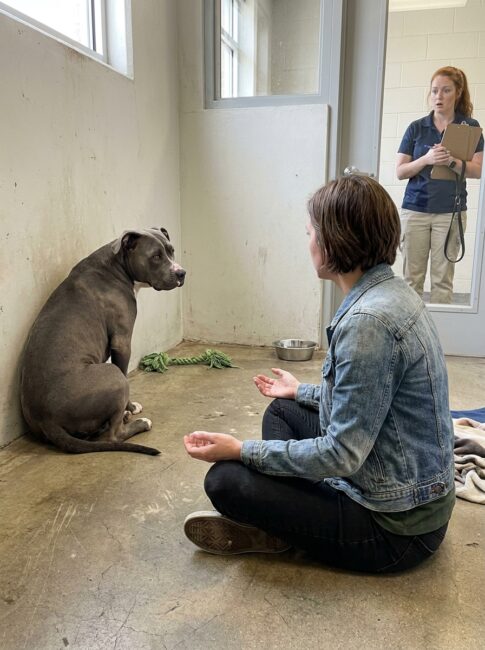
Instead, Rachel entered the meeting room attached to the kennel and sat on the floor.
Then she turned her back toward Hazel.
The two of them faced opposite walls.
For several minutes, nothing happened.
I remained outside the glass door with the leash hanging unused in my hand.
Rachel placed both palms flat against her knees.
“I did that too,” she said quietly.
Hazel’s ear moved.
Rachel continued speaking toward the wall.
“When people came to meet me, I used to refuse to talk. Sometimes I broke things before they could decide whether I was good.”
She glanced at me once.
I understood she was no longer speaking only to the dog.
Rachel had entered foster care at seven years old after her mother was sent to prison. Over the next eleven years, she lived in nine homes.
Twice, families began the adoption process.
Twice, they changed their minds.
One family said Rachel had become “too withdrawn.”
Another said she had “difficulty accepting affection.”
At fifteen, she began packing her belongings before each new placement ended.
She kept everything inside two trash bags.
“If you never unpack,” she told Hazel, “leaving doesn’t take as long.”
Hazel remained facing the wall.
Rachel did not move closer.
“I’m not going to make you look at me,” she said. “I won’t ask you to be grateful. I won’t ask you to make me feel chosen.”
An hour passed.
Rachel’s legs became stiff. She shifted carefully but kept her back turned.
Hazel lay down.
The gap between them remained nearly eight feet.
At ninety minutes, I offered Rachel water.
She shook her head.
At one hour and forty-five minutes, Hazel stood.
She took one step.
Then another.
Rachel’s shoulders tightened, but she did not turn.
Hazel crossed the room slowly, stopping whenever the floor creaked.
She sniffed the hem of Rachel’s denim jacket.
Rachel closed her eyes.
Then Hazel placed her nose against the center of Rachel’s back.
Just once.
A small, cool touch between the shoulder blades.
Rachel’s lower lip moved, but she kept her promise.
She did not turn around.
“Hi,” she whispered. “You found me.”
Hazel sniffed her again.
Then she sat behind her.
They remained back-to-back for another twenty minutes.
That was the first time Hazel chose a visitor.
THE ADOPTION THAT DID NOT HAPPEN QUICKLY
Rachel did not take Hazel home that afternoon.
That surprised many people who later heard the story.
They assumed the nose against her back became an instant adoption, complete with photographs and applause.
Rachel refused to rush it.
“I don’t want the first thing she learns about me to be that I make decisions for her,” she said.
She returned the next day.
Again, she sat facing away.
Hazel approached after forty minutes.
On the third visit, Hazel lay against Rachel’s back.
On the fourth, Rachel placed one hand on the floor between them. Hazel sniffed her fingers but did not allow touch.
On the sixth visit, Hazel rested her chin on Rachel’s open palm.
Rachel cried silently.
She did not close her hand.
The adoption took place two weeks after their first meeting.
Even then, Hazel refused to cross the shelter lobby.
The front doors stood open.
Rachel’s car waited outside with a blanket across the rear seat.
Hazel stopped at the threshold and pulled backward.
I expected Rachel to coax her.
Instead, she sat down on the sidewalk with her back facing the dog.
Traffic moved along the road.
Shelter visitors walked around them.
Rachel waited.
After twelve minutes, Hazel stepped outside.
She approached Rachel from behind and pressed her nose between her shoulder blades, repeating the gesture from their first meeting.
Then she walked beside her to the car.
The staff clapped quietly from inside.
Rachel did not.
She opened the rear door and sat on the back seat without pulling the leash.
Hazel climbed in on her own.
Before they left, Rachel looked at me through the open window.
“I can’t promise she’ll never be afraid again.”
“No one can.”
“But she won’t come back here because she failed to love me correctly.”
Hazel was sitting behind her, looking through the rear window.
For once, her face was not turned away.
THE FIRST SIX MONTHS
The first night in Rachel’s house, Hazel slept facing the wall.
Rachel placed a dog bed near the bedroom door and slept on top of the covers without trying to bring her closer.
The next morning, Hazel had moved three feet toward the bed.
During the first week, she ate only after Rachel left the kitchen.
She carried the green rope toy from room to room but dropped it whenever Rachel looked directly at her.
When the doorbell rang, Hazel went to the far corner of the hallway and faced the paint.
Rachel told visitors not to approach.
She placed a chair nearby and sat with her own back turned.
Sometimes Hazel remained there for an hour.
Rachel stayed.
The first major test came six weeks after the adoption.
Hazel chewed through the edge of the laundry-room door during a thunderstorm. When Rachel came home, splintered wood covered the floor.
Hazel stood in the corner, body lowered, waiting.
Rachel later told me she recognized the posture immediately.
It was not guilt.
It was preparation.
Hazel expected the leash.
The car.
The shelter door.
Rachel sat in the doorway and examined the damage.
“Well,” she said, “that door was ugly.”
Hazel did not move.
Rachel cleaned the wood, covered the opening with a board, and ordered dinner.
That night, Hazel slept beside the bed for the first time.
At three months, she began greeting Rachel at the front door with the rope toy.
At four months, she allowed a neighbor to toss treats without turning away.
At five months, she slept on her back in the center of the living-room rug, all four paws loose in the air.
Six months after leaving Kennel 18, Rachel invited me to visit.
I rang the bell and waited.
Hazel appeared behind the glass.
For a moment, I expected her to disappear toward the nearest wall.
She looked at Rachel.
Rachel said nothing.
Hazel looked back at me.
Then she brought the green rope toy to the door.
Her tail wagged.
Not wildly.
Not without caution.
But she remained facing forward.
That was enough.
THE NIGHT CAMERA
Rachel kept a small camera in the living room during the first months, not because she distrusted Hazel but because she wanted to understand what the dog did when she was alone.
The footage showed something familiar.
At night, Hazel carried her toys through the house, rolled across the rug, and stood at the windows watching passing cars.
But now she did those things during the day too.
The difference was not that Rachel had taught her how to play.
Hazel had always known.
She had simply stopped waiting until nobody was watching.
One afternoon, Rachel sent me a short video.
A delivery driver approached the porch.
Hazel heard the footsteps and looked toward the hallway wall.
She took one step in that direction.
Then she stopped.
Rachel sat on the floor and turned her back.
Hazel watched her.
Slowly, the dog walked away from the wall and settled beside Rachel, shoulder pressed against hers.
The delivery driver left the package.
Hazel never hid.
Under the video, Rachel wrote:
“She still remembers the old answer. She is learning she has another one.”
That sentence stayed above my desk for years.
Trust did not erase memory.
It gave memory competition.
THE SATURDAY VISITS
One year after the adoption, Rachel asked whether she and Hazel could volunteer at the shelter.
Hazel was not suited for crowded events or direct contact with strangers. She still disliked raised voices and pulled away when someone reached over her head.
But Rachel had another idea.
Every Saturday morning, they visited the quiet wing where our most withdrawn dogs lived.
Rachel sat outside the kennels with her back turned.
Hazel lay beside her.
They did not demand interaction.
They simply occupied the hallway without asking the dogs inside to perform hope.
One old hound approached the bars after three visits.
A young shepherd stopped barking and fell asleep near Hazel’s side of the corridor.
A terrified Pit Bull named Louie had spent weeks beneath his raised bed. During Hazel’s sixth visit, he crawled out far enough to touch noses with her through the kennel gate.
Rachel smiled but did not move closer.
Hazel understood the rule.
You do not chase someone out of hiding.
You make it safe for them to return.
People began asking about the gray Pit Bull in the hallway.
Some recognized her from the viral post.
“Is that the dog who faced the wall?”
Rachel always gave the same answer.
“She still does sometimes.”
That honesty mattered.
Hazel’s story did not end because fear vanished.
It changed because fear no longer made every decision.
THE FAMILY WHO ALMOST CHOSE HER
Two years after Hazel’s adoption, a family entered the shelter while Rachel and Hazel were volunteering.
The mother stopped in the hallway.
“I know that dog,” she said.
She had been part of the twelfth family that walked past Kennel 18.
Her daughter was older now, but she remembered Hazel too.
“She wouldn’t look at us,” the girl said.
Hazel stood beside Rachel.
The mother asked whether they could pet her.
Rachel looked at Hazel, not at the family.
Hazel stepped backward once.
Rachel turned sideways and waited.
After a minute, Hazel approached the girl’s open hand and sniffed it.
The girl did not touch her.
“That’s okay,” she whispered.
Hazel remained.
The family adopted Louie that afternoon—the frightened Pit Bull who had first emerged from beneath his bed to greet Hazel.
As they prepared to leave, the girl knelt several feet away.
“Thank you for helping him,” she told Hazel.
Hazel tilted her head.
Then she looked toward Rachel.
Not the wall.
Rachel opened the shelter door.
Louie walked out with his new family.
Hazel followed as far as the threshold, then sat beside the woman who had once turned her back and waited.
THE CORNER OF THE ROOM
Hazel is nine now.
More white has appeared around her muzzle, and the crooked pink patch beside her nose has faded beneath gray fur.
She still lives with Rachel in the small brick house in South Memphis.
The green rope toy has been replaced twice, though Rachel keeps the original in a wooden box near the bookshelf.
Hazel still faces the wall during thunderstorms.
Sometimes she does it when luggage appears.
Rachel rarely travels, but even an overnight bag can bring the old fear back into the room.
When that happens, Rachel does not say, “You should know better by now.”
She sits nearby.
She turns her back.
She waits.
Eventually, a nose touches her shoulder.
Every year on the anniversary of Hazel’s adoption, Rachel sends me one photograph.
The first showed Hazel asleep near the bedroom door.
The second showed her stretched across the couch.
The third showed her looking directly into the camera with the rope toy in her mouth.
The most recent photograph showed Rachel sitting on the floor beside a blank section of wall.
Hazel was not facing it.
She stood behind Rachel with her chin resting across the woman’s shoulder, both of them looking toward the open front door.
Beneath the photograph, Rachel wrote:
“She doesn’t need the wall today.”
I printed it and placed it beside the old security still from Kennel 18.
In the first picture, Hazel played only because she believed nobody could see her.
In the second, she stood in daylight beside the person who had seen her most clearly by refusing to look too soon.
Twelve families passed her kennel.
One woman sat down.
One woman turned away.
One woman stayed.
And eventually, Hazel turned back.
Follow this page for more unforgettable stories about dogs who learned to trust again.