My Old Dog Stole the Wedding Ring Right Out of My Groom’s Hand — When I Followed Him Outside, I Found the Man I Had Spent Thirteen Years Refusing to Forgive
Part 2 — The Window We Should Have Looked Through
The first blow left a pale mark near the corner of the rear window. The second broke the glass, and Daniel pulled me backward by the waist before I could reach into it.
My father used his folded suit jacket to clear the loose pieces from the opening, keeping his body between the broken edge and Lily. The emergency dispatcher’s voice came from the phone on the pavement. There was no shouting from him now, only short answers and one instruction to Daniel: “Open it from the other side if you can.”
I remember the sound of falling glass much more clearly than I remember my own voice. It scattered onto the asphalt like someone pouring a jar of buttons. Behind me, my sister, Megan, kept saying her daughter’s name with the same rising question at the end.
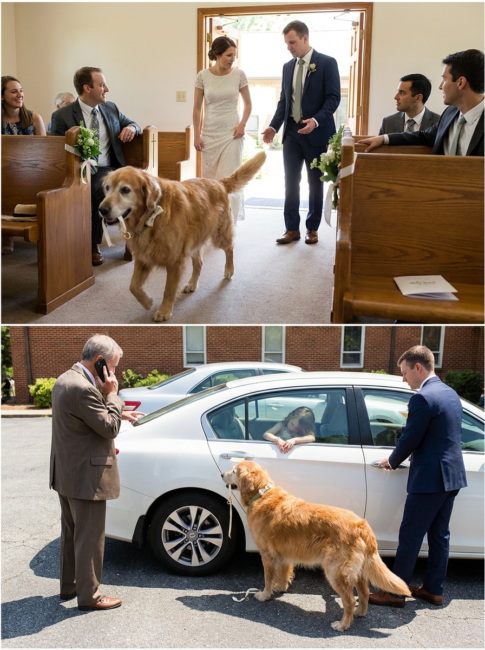
Daniel reached the lock through the broken window. My father opened the door and leaned across the seat, protecting Lily’s head as he lifted her out. Her loose white shoe fell into the footwell. For one foolish second, I thought about getting it. My mind had found something small enough to solve.
“Emma, move the dress,” Daniel said.
I stepped aside. My father carried Lily the few yards to the shaded church entrance, where the dispatcher told us to place her on the cool stone floor. Megan dropped to her knees beside her. A guest who introduced herself as a nurse knelt at Lily’s head and took over answering the dispatcher’s questions.
Lily did not wake up.
Her mother touched the yellow bracelet and whispered, “Baby, I’m right here.” She said it again, more firmly, as if the first time had not counted.
Murphy tried to follow them into the entrance, but his hind legs slid on the bottom step. I caught his collar before he fell. He was panting so hard that his whole chest moved beneath my hand, and for the first time since he had taken the ring, he looked at me without trying to make me go somewhere else.
“You did it,” I told him, though I did not yet know what he had done. “You got us.”
He leaned against my knee.
Our usher, Ben, stood beside the damaged car. He had one hand pressed against his mouth. When he began to explain, my father shook his head without looking up.
“Later.”
It was not forgiveness. It was a statement about what mattered at that moment.
The ambulance arrived while the church doors were still propped open with the little brass wedges we had borrowed from the fellowship hall. The paramedics moved people back, assessed Lily, and prepared her for transport. Their questions were specific. How old was she? How long might she have been in the car? Had anyone seen her drink anything? When had she last been alert?
Nobody could give them the answer they needed most.
Megan rode with her daughter. Her husband, Chris, who had been helping in the fellowship hall, arrived at the entrance with a stack of paper cups still in his hand. He let them fall when he saw the stretcher.
I watched my father stand aside as the paramedics passed. There was a thin cut across his knuckle. He wrapped it in the edge of his ruined jacket without seeming to notice.
Then Megan reached for him.
“Come with us,” she said.
The paramedic explained there was room for one family member in the back. My father nodded and told Megan he would follow in a car. He did not make himself necessary. He did not argue that he had been the one to find Lily. He stepped out of the way so her mother could climb in.
Daniel brought our car around. My father sat in the back seat with Chris, and I stayed at the church long enough to make sure Murphy could stand.
That decision has sometimes sounded strange to people when I tell this story. A child had just been rushed to the hospital, and I was kneeling in a wedding dress beside an old dog. But Lily had trained people caring for her. Murphy had run on painful hips, fallen against a pew, stood against a hot car, and spent the last of his strength making us listen.
He needed someone to notice him, too.
My mother brought his water bowl. We moved him into the shade and offered him water while she called his veterinarian. She promised to take him straight in. I kissed the white fur above his eye, and he touched his nose to my chin.
Only then did I realize the wedding ring was missing.
I stared at Daniel’s empty hand. He looked down at it, then back at me.
“Let it go,” he said.
For the first time that afternoon, somebody said something simple enough for me to understand.
We left the church with the flowers still arranged at the altar, the marriage license unsigned, and a hundred people trying to work out how a celebration had become a search for the minutes nobody had counted.
Part 3 — The Dog They Thought Had Forgotten
Murphy came into my life when I was ten, two years before my father left. He was a lanky Golden Retriever with oversized paws and a habit of carrying things he had no intention of chewing. Socks, dish towels, the corner of a blanket—if someone laughed and followed him, he considered the object useful.
My father had been the one who taught him the game.
“Get something, Murph,” he would say, and Murphy would find a slipper or a soft toy, then look over his shoulder until somebody came after him. We called it the follow-me game. It became our solution whenever the dog needed exercise and the weather kept us inside.
At twelve, I stopped thinking of that as a happy memory.
My father’s name was Paul. Before he became the man absent from birthdays and school meetings, he worked repairing restaurant equipment. He could make a broken refrigerator hum again with a screwdriver between his teeth and a flashlight tucked under his arm. He taught me to ride a bicycle in a church parking lot much like the one outside my wedding.
Then drinking took up more of his evenings. Jobs disappeared. My mother began answering the telephone in another room. Arguments became quieter, which frightened me more than when they had been loud.
One Thursday, he left with a duffel bag. He said he would call that weekend.
For years, I remembered the shape of that bag more clearly than the conversation.
He called sometimes. He missed more visits than he kept. There were apologies that arrived before Christmas and promises that did not survive January. Eventually my mother stopped telling me when he said he was coming, because she could no longer bear watching me wait by the window.
Murphy stayed beside me through all of it. When I cried into his neck, he never seemed to feel crowded. When I began sleeping with the hallway light on, he moved his bed to my doorway. I grew tall enough to drive, then old enough to leave home, while his face slowly turned white.
By the time I became engaged, his world had grown smaller.
His veterinarian had diagnosed arthritis. We had a treatment plan, rugs covering the slippery parts of our house, and a ramp Daniel built for the back steps. The cloudiness in his left eye was being monitored. More recently, the veterinarian had discussed changes that might be consistent with canine cognitive dysfunction, while checking for other things that could contribute to his confusion.
What I heard was simpler and much harder: we were losing pieces of him.
Some evenings he stood at the wrong side of a door. Once he barked at his reflection in the dark television screen. He sometimes needed me to guide him back to his bed even though it had been in the same corner for years.
People began speaking about him as if he had already left.
“He doesn’t remember much now,” my aunt said.
I understood that she meant to comfort me. It hurt anyway.
On good mornings, Murphy still found his way to my chair before I sat down. He still recognized the sound of a cheese wrapper from a room away. And when Lily visited, he lifted his head before she reached the porch.
She was five and believed old dogs should be spoken to carefully, as though they had important things to finish thinking about. She sat beside him rather than climbing on him. She brought him soft toys and announced what each one was before placing it near his paws.
“This is a duck, Murphy. It doesn’t have eyes anymore, but that’s okay.”
He adored her.
During our wedding rehearsal, Lily had tied a yellow ribbon around her own wrist after helping decorate his collar. “So we match,” she explained. He followed her from the aisle to the fellowship hall and lay down where he could see her eating a cookie.
That was why I wanted him at the ceremony. We arranged a bed near the front, water beside it, and an open side door so my mother could take him home if he became tired.
My father’s attendance had required a different arrangement.
Three months before the wedding, he wrote to me. He said he had been sober for several years. He was living nearby again. He did not ask to walk me down the aisle. He asked whether he could sit in the back.
I left the letter on our kitchen counter for nine days.
Daniel never told me what to do. He asked only, “Would seeing him there make the day harder for you?”
“Yes,” I said. Then, after a while, “Not seeing him might, too.”
So I sent one short reply. He could attend. He could sit in the last row. He was not to approach me unless I asked.
It was a boundary, not a reunion.
I told Ben, our usher, because I was afraid my father might decide a wedding gave him permission to make a speech. I used the words “Please don’t let him cause a scene.”
At the hospital, those words returned to me so often that they stopped sounding like language.
I sat in the waiting area with my dress folded awkwardly around my legs, wondering how much of what had happened outside the church had begun with people trying to carry out something I had said.
Part 4 — The Man Beside the Car
My father sat across from me in the hospital waiting area with his jacket folded over his injured hand. He had washed the blood from his skin, but tiny dark marks remained in the seams around his fingernails. Chris sat beside him, elbows on his knees, looking at a spot on the floor.
Nobody asked my father to explain until a nurse came out to tell us Lily was receiving treatment and being closely monitored. It was not a promise about the outcome. It was simply the first information we could hold.
Then Daniel leaned forward.
“Paul,” he said, “tell us what happened outside.”
My father looked at me before he answered. I nodded.
He had arrived early and sat in the back row as we had agreed. When the ceremony began, he found that he could not stay there comfortably. He said watching me walk past without looking at him had hurt more than he expected, even though he knew I owed him nothing.
“I went out the side door,” he said. “I was going to stand outside until it was over.”
The white car was parked in full sunlight beyond the church steps. He heard something near it—a dull knock, he thought, though he could not be certain later whether that was the first thing that drew his attention. When he stepped closer, he saw movement through the rear glass.
“At first I thought someone was getting changed,” he said. “Then I saw her hand.”
He tried the handle. He called toward the entrance for the driver. When nobody came immediately, he pulled harder and knocked on the window.
Ben saw a man who had been specifically asked to keep his distance standing beside the decorated wedding car, tugging at a locked door.
“He thought I was angry,” my father said.
“Did you tell him about Lily?”
“Yes. But I was shouting, and he was telling me to come away from the car. I said, ‘There’s a little girl.’ He thought I meant you.”
I shut my eyes.
The misunderstanding lasted only moments, but moments had become the whole story.
Ben took him by the arm and tried to move him toward the shade beside the building. My father pulled away. Ben became more certain he was dealing with an upset relative who might disrupt the ceremony.
My father called emergency services. He was trying to give the location, identify the car, and get somebody inside to find the driver when Murphy came through the church doors.
He had not broken the window immediately because he had first tried to get the door opened, then been pulled away, then found himself following the dispatcher’s questions while trying to make Ben understand. He did not offer that as an excuse. He rubbed his forehead with his uninjured hand.
“I should have made it clearer,” he said.
Daniel shook his head. “You were trying.”
Across the room, Chris began to cry. He bent forward, covering his face with both hands, and my father moved his chair a little closer without touching him.
Later, we pieced together how Lily had reached the car.
After scattering petals, she had gone to the side room where Megan was settling her younger brother with my cousin. Another relative had offered to take Lily’s basket away and bring her back to the pew. Lily asked to retrieve a little paper pinwheel she had left in the wedding car during photographs.
The relative thought Megan had heard and would follow. Megan thought Lily was being brought to sit beside me at the front until the vows were finished.
Two people believed there was a third person.
Lily slipped out through the side entrance. The driver had been moving things between the car and the fellowship hall. During the confusion of getting everyone seated, he locked the vehicle without realizing she had climbed into the back.
We did not know every movement she made inside. We would never know all of them. There was no hidden camera to give us a neat, complete explanation. We had a few people’s memories, a little pinwheel on the floor, and the place where her hand had left marks on the glass.
The uncertainty was its own punishment.
Megan later said the hardest part was remembering how relieved she had been when the music started. She had spent the morning keeping track of two children, a dress, a flower basket, and a missing hair clip. When the ceremony finally began, she had allowed herself to sit down.
“I thought she was with you,” she told me.
“I thought she was with you.”
We said those sentences once. Neither of us needed to hear them again.
Ben arrived at the hospital an hour later. He stood just inside the waiting area, looking younger than he had at the church. He was Daniel’s cousin, twenty-six, eager to be useful, and carrying out instructions without stopping to test his first assumption.
He went straight to my father.
“You told me,” he said. “I heard you, but I didn’t understand.”
My father looked at him for a long moment.
“Next time,” he said, “look through the window.”
Ben nodded, and then sat down several chairs away.
It was a hard sentence. It was also the only useful thing anyone could offer him then.
My phone vibrated in my lap. My mother had taken Murphy to the veterinarian, where he had been examined and was resting. His exertion had left him sore and exhausted, but she said he was alert and drinking.
Then she sent a photograph.
He was lying on a blanket with his chin against her shoe, looking toward the door.
Still waiting for somebody to come back.
Part 5 — What Murphy Still Knew
Lily opened her eyes that evening. We were not all in the room when it happened, and it did not happen with a dramatic announcement or a sudden rush into the hallway. Megan called me with a voice so quiet I could barely hear her.
“She asked where her shoe was.”
I put one hand over my mouth and slid down the wall until I was sitting on the floor.
Daniel crouched beside me. I handed him the phone because I could not make a sentence work. He listened, nodded, and began crying without trying to hide it.
The medical team kept Lily in the hospital for continued observation and treatment. We were grateful for every reassuring change and frightened by every pause between updates. Nobody who cared for her told us that waking up meant we could stop worrying, and we did not ask them to give us certainty they did not have.
But she had asked about her shoe.
For that night, a missing shoe was enough.
When I was allowed to see her briefly, she looked smaller in the hospital bed than she had in the church. Her hair had come loose from its curls. The yellow bracelet was still on her wrist.
“Did I miss the cake?” she asked.
“No,” I said. “We saved it.”
“Did Murphy get some?”
“Not yet.”
She considered that an unresolved problem.
Then her eyes shifted toward the doorway.
“Where’s the man?”
I knew which man she meant before Megan asked.
“The one who knocked,” Lily said. “He said stay with me.”
My father had been sitting down the hall, prepared to leave if his presence made anything harder. Megan went to get him. When he entered, he stopped a few feet from the bed, looking at her mother for permission before moving closer.
Lily studied him.
“You were loud.”
“I know,” he said. “I was trying to make sure you heard me.”
She lifted one hand, and he let her hold two of his fingers. He stood there with his shoulders bent and tears falling straight onto the front of his shirt.
I had spent years imagining what it would look like if my father finally understood the damage he had caused. In my angriest versions, he cried and I remained unmoved. I had never imagined him crying because another child was holding his hand.
Life had given me a scene I had not rehearsed.
I did not forgive him in that hospital room. I did not stop being twelve. But I saw him as something other than the worst thing he had done to me, and that was more unsettling than I expected.
The following morning, I went to get Murphy.
He tried to rise when I entered the examination room. I knelt before he could finish, and he settled back against the blanket with a small groan. His gray muzzle smelled faintly of water and the soft food my mother had brought.
The veterinarian reviewed his examination and the plan for rest and follow-up. We spoke about his arthritis, the exertion, and the changes we had been seeing at home. I asked the question that had been turning in my mind since the church.
“How could he be that confused one day and do that the next?”
She did not give him a human motive or turn the afternoon into a medical miracle.
“He can have difficulties and still recognize familiar people, routines, and things that matter to him,” she said. “We shouldn’t assume everything is gone because some things are harder.”
I rested my forehead against his.
For months, I had been measuring him by failures. The wrong door. The bowl he stared at. The pause before he recognized which room I was in.
I had stopped counting what he could still do.
Later, a guest sent us a short recording of the ceremony. It had begun as an ordinary wedding video from the aisle seat near the back. In it, Murphy was lying beside his bed with his head raised.
Before he moved toward Daniel, he turned toward the open side door.
There was a faint sound on the recording. None of us could identify it with certainty. A voice outside, perhaps. A knock. Something we had not noticed in the room.
Then Murphy looked at me.
Then at the door.
Then at me again.
He stood, crossed the runner, and reached for the ribbon hanging from Daniel’s hand.
My father watched the recording on Daniel’s phone.
“That’s the game,” he said.
I looked at him.
“What?”
“The ribbon. He took something so you’d follow him.”
I remembered the slipper in our old hallway. The dish towel in Murphy’s mouth. My father laughing as a younger dog trotted just far enough ahead to make us get up.
Get something, Murph.
We could not prove that was what he intended. Murphy could not tell us what he heard, what he saw through the open doorway, or why that particular object made sense to him. I did not need to claim he understood wedding rings or family estrangement or the meaning of a locked car.
He knew how to make me follow.
He had stopped at the church doors because I was behind him. He had barked when I was too slow. And once I reached the car, he dropped what he had carried.
The ring had never been the point.
My father handed back the phone.
“He always did like having a job,” he said.
For the first time in thirteen years, we shared a memory without either of us reaching for an argument.
Between us, Murphy slept with one paw resting against my ankle.
Part 6 — An Invitation With No Promise Attached
We found the ring the day after the wedding that wasn’t. A guest had seen it beside the rear tire, picked it up, and given it to the church caretaker while the rest of us were trying to leave for the hospital.
It came back to me in a plain envelope.
I opened it at our kitchen table. A short length of ivory ribbon was still threaded through the gold band, damp marks dried into the fabric.
Daniel sat opposite me with two cups of coffee. His wedding tie was hanging from the back of a chair. My dress lay over a spare bed upstairs, its hem gray from the pavement and the hospital floor.
“Do you still want to marry me?” he asked.
I looked up.
He gave a tired smile. “I’m checking. It was a fairly strong objection from your dog.”
I laughed, then cried, then did both so awkwardly that he came around the table and held me until I could breathe properly.
We were allowed to laugh again.
That felt like permission we had been waiting for someone else to give.
Lily stayed under medical care until her team was satisfied she could go home with a follow-up plan. Her parents listened carefully, asked questions, and took the written instructions as seriously as if they were carrying her for the first time.
At home, ordinary things returned unevenly. She wanted toast cut into triangles. She complained about shampoo in her eyes. Then, on a car ride, she asked whether the doors would open when she needed them to, and Megan had to pull over before she could answer calmly.
Murphy’s recovery was slower than he wanted. We followed his veterinarian’s plan and kept his world quiet. Daniel carried his bed from room to room so he could stay near us without having to choose between company and rest.
My father came by on the fourth afternoon.
I had invited him to return a borrowed phone charger. That was the reason I gave, though the charger could have been posted in an envelope.
He stood on the porch with it looped neatly in one hand. He did not step inside until I moved aside.
Murphy lifted his head from the rug.
My father crouched carefully, leaving space for him to decide. The dog sniffed his hand, then pushed his nose under it.
“Hello, old fellow,” my father said.
I stood beside the kitchen counter and watched the hand I remembered fixing bicycle chains stroke the fur above Murphy’s cloudy eye.
For a moment I felt angry at the dog.
You can just do that? I thought. You can let him touch you?
Then I felt ashamed of wanting an animal to carry my rules.
My father looked up.
“I’m not going to tell you this makes up for anything.”
I folded my arms.
“Good.”
He nodded. “It doesn’t.”
That was the first useful beginning we had ever had.
We sat at the kitchen table. Daniel took Murphy outside for a few quiet minutes, not because we asked him to, but because he understood there were things I could not say while being watched by someone who loved me.
I asked my father why he had left.
He gave me answers that were painful partly because they were ordinary. He had been drinking. He had been ashamed. He had convinced himself that he would return when he had something better to offer, then used each missed month as a reason to avoid the next conversation.
“I made leaving easier for myself by pretending you were better without me,” he said. “That wasn’t a decision I had the right to make.”
There was no secret noble purpose. No hidden sacrifice that transformed my childhood into a misunderstanding.
He had failed us.
Hearing him say it plainly did more than any grand explanation could have.
I told him about the birthday when I kept my shoes on until bedtime because he had promised to take me out. I told him that for years I became frightened when somebody said they would be “a little late.” I told him I hated that a good thing he had done could make me feel disloyal to the child I had been.
He listened without correcting my memory.
Once he started to speak, stopped, and said, “Go on.”
By the time Daniel returned, my coffee was cold and my father’s eyes were swollen. Nothing had been repaired completely. But nothing had been argued away, either.
A week later, Daniel and I decided to return to the church. We would keep it small, on a cool morning, with the doors open and Murphy’s bed near the front. Lily could decide whether she wanted to carry flowers again. No one would expect her to.
I went to my mother before I called my father.
She had raised me. She had earned every place of honor in that room. I would not use a rescue to push her to the edge of my wedding.
When I told her what I was considering, she held my hands.
“Inviting him beside you doesn’t erase where I’ve been.”
“I know.”
“Do you?”
I looked down at our hands. “I’m trying to.”
She squeezed them.
So I called him.
“Mom is walking with me,” I said. “She’s always been the person I wanted beside me.”
“Of course.”
“There’s another side.”
He said nothing.
“I’m not promising what happens after that,” I told him. “I’m asking if you’d like to walk me down the aisle.”
For several seconds, all I heard was his breathing.
Then he said, very quietly, “Yes.”
Part 7 — This Time, We Walked Slowly
We got married twelve days later with twenty-three people in the church and a portable fan humming near the open doorway. There were fewer flowers. Nobody had replaced the little scuff Murphy’s nails had left against the end of the front pew.
I was glad about that.
My dress had been cleaned, though a faint mark remained near the hem where I had knelt beside him on the pavement. The seamstress offered to work on it again. I told her it was fine.
Lily arrived holding both her parents’ hands.
She wore a blue cotton dress instead of the flower-girl dress, and both her shoes stayed on. Before she went inside, she asked to see the back of the car. Megan opened the door, waited while she looked, and closed it only after Lily stepped away.
Nobody hurried her.
Inside, Murphy lay on his thick bed beside the front pew. We had put his rubber-backed runner down again, but this time there would be no job for him to do.
Daniel knelt to check his water. My mother adjusted the fan so it moved the air without blowing directly into his face. Lily sat beside his bed and placed the old stuffed duck between his paws.
“There,” she whispered. “You can keep that.”
He smelled it, then lowered his chin.
My father waited with me in the small entrance at the back of the church. His brown suit had been cleaned, but he wore a different jacket. The bandage on his hand was smaller now.
My mother stood on my other side.
For years, I had imagined a wedding photograph with an empty place where he should have been. I thought filling that place would require me to forget why it had been empty.
Standing there, I understood I could remember all of it.
The missed birthdays could remain true. My mother’s years of steady work could remain true. The man who carried Lily into the shade could also remain true.
I did not have to flatten him into one thing.
My father looked down the aisle, then at me.
“How fast?” he asked.
It was such a small question. He had finally thought to ask me how I wanted something to happen.
“Slow,” I said.
So we walked slowly.
My mother held my left arm. My father offered his right, and I rested my hand on it. He did not grip me or pull me closer. He let me choose the weight I put there.
Halfway down the aisle, Murphy lifted his head.
His cloudy left eye did not seem to find me at first. He turned slightly, listening. Then his tail moved against the side of his bed.
Once. Then again.
I stopped.
Nobody made a joke about another interruption. Nobody told me to keep moving because the music was playing.
I stepped off the runner and knelt beside him, carefully gathering my skirt away from his paws.
“I’m here,” I said.
He touched his nose to my wrist.
That was all. There was no sudden return of youth, no easy leap to his feet, no promise that his confusion would disappear because he had saved someone. His hips still hurt. Some evenings would still be difficult. We would still have to help him find the right side of a door.
But he was here, too.
When I stood, my father was wiping his face with a folded handkerchief. My mother had one hand on his shoulder.
We finished the walk.
Daniel took my hands at the front, and this time he had removed the ring from the ribbon before the ceremony began.
The minister glanced at Murphy, then at us.
“Everyone ready?”
Lily raised her hand from the front pew.
“Murphy is.”
We laughed gently, including my father, who seemed surprised by the sound of his own voice in a happy room.
Daniel put the ring on my finger.
I had imagined that moment as the center of the day. I thought I would remember the exact pressure of the band sliding over my knuckle, the words Daniel spoke, the way the light fell through the windows.
I do remember those things.
But I remember more clearly what happened afterward, when everybody stayed for sandwiches in the fellowship hall instead of a formal reception. My father asked Lily whether she wanted him to cut her sandwich. She said she could do it herself.
“All right,” he said, and handed her the plate.
My mother sat across from him. They spoke carefully, mostly about Lily and the weather and the old church kitchen. Nobody pretended those ordinary subjects were easy.
Murphy slept beneath our table with the stuffed duck tucked against his chest.
Over the following weeks, my father began coming on Sunday mornings. At first he stayed half an hour. Sometimes we talked. Sometimes he helped Daniel repair the loose boards on our porch while I sat nearby with Murphy.
He learned to arrive when he said he would.
I learned that I did not have to call every visit forgiveness. I could call it Sunday and see whether he came again next week.
Lily developed her own ritual. Whenever she visited, she touched Murphy’s head and told him where everyone was.
“Mom’s in the kitchen. Dad’s outside. Aunt Emma’s right here.”
Then she placed his duck where he could reach it.
On evenings when Murphy stood uncertainly in the hallway, I stopped calling to him from another room. I went to him. I let him smell my hand, and we walked back together at whatever speed his legs allowed.
Sometimes my father was there to see it.
He never said the dog remembered him. He never tried to turn Murphy into evidence that I should trust him. He simply moved the chair out of our path and waited until we were settled.
Last Sunday, I found the old ivory ribbon in the kitchen drawer. I had meant to throw it away after the wedding, but instead I put it in the small box with our vows and the photograph of all three of us walking down the aisle.
Outside, my father knocked at the promised time.
Murphy raised his head.
I opened the door.
This time, someone stayed.
Follow this page for more stories about loyal dogs, second chances, and the small acts of love that bring people back to each other.