The Dog Wouldn’t Leave a Car Bound for the Crusher — What He Guarded Was the Only Home He Had
Part 2 — The Car That Had Been a Room
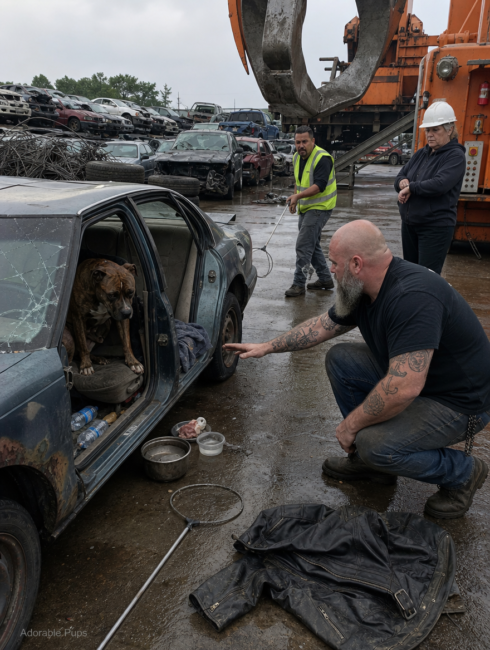
My name is Clay Mercer. I was forty-eight years old and had worked at North Shore Auto Recovery in Cleveland for fourteen years when the brindle Pit Bull appeared inside the 1998 Buick LeSabre.
I had also been riding motorcycles since I was nineteen. My arms carried faded eagles, roses, dates in Roman numerals, and one crooked anchor a friend gave me in a garage after too much whiskey in 1997. People who saw me at a stoplight usually locked their doors.
Dogs rarely did.
Our club transported shelter animals when county vans were full. We carried crates in trailers behind our bikes, repaired kennel gates, and sometimes sat outside runs with animals that would not let staff touch them. Nobody took photographs for us. Most of the men would have left if a camera appeared.
That experience did not make me fearless around the Pit Bull.
It taught me not to lie to him.
“I’m coming inside,” I said. “I won’t touch what’s yours.”
The Buick moved another inch before Earl stopped the conveyor again. I pulled myself through the damaged rear door and sat sideways on the blue blanket, keeping my hands on my knees.
The dog smelled of rainwater, old motor oil, and the coppery odor of worn paw pads. His left hind leg shook. A small crescent of white fur sat beneath his chin, while the missing edge of his ear gave him a rougher face than he deserved.
He watched me breathe.
I watched him watch.
The inside of the Buick revealed itself slowly. A toothbrush lay inside a paper cup near the gearshift. Three paperback westerns were stacked under the parking brake. A portable radio hung from the dashboard by electrical tape, and a knitted green cap had been tucked between the windshield and the defroster vent.
Someone had made rules here.
Clothes in the trunk. Water behind the passenger seat. Food beneath the blanket. Personal papers hidden where strangers would not find them.
The dog lay over the most important hiding place.
I moved my left hand one inch across the blanket.
His growl returned.
I stopped.
“Okay.”
The growl ended.
Outside, Luis called animal control again. The dispatcher said their nearest officer was dealing with two loose dogs near Parma and could not reach us before five.
The crusher line had already been delayed twenty-three minutes.
Our owner, Sandra Pike, walked over from the office wearing safety glasses and a white hard hat. She was sixty-one, five feet two, and the only person in the yard who never raised her voice because nobody wanted to make her repeat herself.
“Can we pull that car?” she asked.
“Not without moving the three behind it.”
“How long?”
“An hour.”
She looked through the broken rear window at me.
“You have ten minutes.”
I turned back to the dog. His eyes had shifted from my face to the passenger doorway, where the water bowl remained on the ground.
“You’re thirsty,” I said.
His tongue touched his nose.
I dipped two fingers into the water and held them over the rear seat. A few drops fell onto the blanket. He leaned forward, smelled them, and licked the fabric without standing.
I repeated it.
On the fourth attempt, he drank from my cupped hand.
His tongue was hot and rough. His teeth remained an inch from my wrist, yet he took only the water. When my palm emptied, he looked toward the bowl again.
I slid it onto the floor.
He stretched his neck, drank three times, then returned his chin to the torn driver’s cushion.
That was the first piece of trust he gave me.
The second came when I noticed the photograph.
Its corner protruded from the wallet beneath him. Only a strip of blue sky and part of a man’s hand could be seen, but the dog had positioned his paw across it with care. Not random pressure.
Covering.
I reached toward the edge of the wallet.
His upper lip rose.
“I need to know who you’re waiting for,” I said.
The Pit Bull lowered his head until his nose touched the man’s visible hand in the photograph.
Then he stayed there.
Part 3 — The Man Missing From the Driver’s Seat
Sandra gave us thirty more minutes after I told her the Buick contained a person’s belongings. Luis pulled the crusher’s master disconnect, and Earl lowered the loading claw to the ground.
The yard fell quiet by degrees.
Without the hydraulic pump, I could hear rain tapping the Buick’s roof. Water passed through a hole near the rear window and struck the floor mat with a slow, hollow tick.
The dog listened too.
I later learned that sound had been part of his life for nearly eleven months. On rainy nights, the man who lived in the Buick placed an empty soup can beneath the leak, slept across the rear seat, and let the dog stretch out behind the steering wheel.
At that moment, I knew none of it.
I only knew the dog did not want the wallet moved.
Luis crouched beside the open passenger door and spoke in Spanish, the same low stream of words he used with scared animals at our weekend transports. The Pit Bull did not understand the language, but he understood that Luis had put down the catch pole.
I tore the turkey sandwich into pieces and placed them in a line across the rear blanket. The first piece landed eighteen inches from the dog’s paw.
He stared at it.
His stomach tightened visibly beneath his ribs.
He did not eat.
I moved the next piece closer to him, then slid the final piece against the edge of the wallet. He smelled the bread, lifted it with his front teeth, and placed it on the seat beside the photograph.
He was hungry enough to shake.
He still would not swallow food near the wallet.
“Maybe the owner’s dead in the trunk,” someone whispered outside.
I heard him.
The dog heard him too. His ears turned toward the rear of the car, but his body remained over the driver’s seat.
We checked the trunk through the outside release. It contained a sleeping bag, a red gasoline can, two plastic storage bins, and a folded cardboard sign with thick black letters. No person.
Sandra searched the towing record. The Buick had been collected from an industrial street near the Cuyahoga River at 10:26 Monday night after a city contractor marked it as a derelict vehicle.
No registered owner could be reached.
The plate had expired fourteen months earlier. The last address connected to the title was an apartment building demolished in 2021. The name on the old registration was Arthur Bell, age sixty-seven.
I said the name aloud.
The dog’s head came up.
“Arthur?”
His ears moved forward.
I repeated it.
This time his tail struck the seat once.
The sound was small, but every man outside the car heard it.
“His owner,” Luis said.
“Maybe.”
I tried “Art.”
The dog rose so quickly that I braced for another bite. Instead, he looked through the windshield, then toward the yard gate. His front paws shifted, exposing more of the wallet.
I could now see the photograph inside the clear plastic sleeve. A thin white man with a gray beard sat on the Buick’s hood. The same brindle Pit Bull leaned against his leg.
The man’s left hand rested behind the dog’s damaged ear.
The photograph had been taken in summer. A paper cup stood on the hood, and a bridge crossed the background. Both man and dog looked away from the camera, their attention fixed on something beyond the frame.
“Art isn’t coming through that gate,” I said.
The dog watched it anyway.
I held the photograph between two fingers without pulling. His body hardened. A growl started in his chest, but his tail remained still rather than tucking beneath him.
He was warning me.
Not hunting me.
I removed my hand.
The afternoon rain thickened. Water ran down the dashboard and collected around the dog’s paws. He shook once, spraying the inside of the car, then immediately lowered himself over the wallet again.
Luis called MetroHealth because the paper visible behind the photograph carried part of the hospital’s blue header. Privacy rules kept the receptionist from telling him much, but she agreed to transfer the call to a social worker after he explained that we had found a dog guarding personal documents inside a condemned vehicle.
We waited on hold.
The dog began to pant harder.
His paw pads were split, not cut by glass but worn smooth from distance. Fine road grit had packed into the cracks. A raw place the size of a dime showed beneath his right front toe.
“Those aren’t yard injuries,” I said.
Luis looked at the mud dried above the dog’s ankles.
“He walked here.”
The social worker answered at 4:51. Her name was Marisol Vega. She listened without interrupting while Luis described the Buick, the photograph, and the man’s name.
Then she asked one question.
“What color is the dog?”
“Dark brindle,” Luis said. “White chest. Left ear damaged.”
The line became quiet.
Marisol took one long breath.
“His name is Moose,” she said. “And we have been looking for him since Monday night.”
The dog heard the name.
His body lifted from the wallet.
For one hopeful second, he looked through the windshield again.
Part 4 — What Was Hidden Beneath Him
Marisol reached the salvage yard at 5:34 in a silver sedan driven by a hospital security officer. The rain had slowed, but water still ran in narrow rivers between the rows of cars.
She was thirty-six, wore navy scrubs beneath a tan raincoat, and carried a canvas bag filled with dog food, bottled water, and a red rope leash.
Moose recognized her.
He did not leave the Buick.
His ears lifted when she approached, and his tail tapped the driver’s seat twice. He even leaned toward her hand when she reached through the passenger door.
Then Marisol touched the wallet.
Moose snapped.
His teeth closed around the sleeve of her coat without reaching skin. He released at once, retreated across the seat, and covered the wallet with both front legs.
Marisol did not pull away from the car. She sat on the wet concrete beside the open door.
“It’s Art’s,” she said.
Moose lowered his head.
She told us Arthur Bell had been living in the Buick since the previous July. He once worked maintenance at a steel warehouse, but a back injury, two surgeries, and a rent increase had taken pieces of his life in the wrong order.
First the job.
Then the apartment.
Then everything that would not fit inside the car.
Moose had been with him before the eviction. Art could have surrendered the dog when the apartment manager gave him ten days to leave. Instead, he sold a television, paid for Moose’s vaccinations, and moved both of them into the Buick.
“Art ate at St. Malachi’s three nights a week,” Marisol said. “Moose waited outside the dining hall. We tried to get them into temporary housing, but none of the available rooms allowed dogs.”
Art refused the bed.
He returned to the Buick.
People called that stubbornness. Marisol had once called it the same thing. Then she watched Art spend a February night in eighteen-degree weather because the only heated shelter that accepted him would have sent Moose to an unknown kennel.
After that, she stopped using the word.
On Monday morning, a delivery driver found Art collapsed beside the Buick near the river. Paramedics transported him to MetroHealth with pneumonia, sepsis, and kidney failure.
Moose ran beside the ambulance until it reached the intersection.
A city contractor arrived later to clear the vehicle. Witnesses said Moose had been lying beneath the rear bumper. When workers tried to leash him, he slipped between two trucks and disappeared.
The Buick was towed that night.
Nobody knew Moose had followed it.
“We searched the block until two in the morning,” Marisol said. “Art kept asking if we had found him.”
She opened the canvas bag and removed a faded green cap.
The same kind of cap I had seen wedged near the Buick’s windshield.
Moose smelled it.
His legs folded.
He crawled toward the passenger side without standing fully, stretched his neck across the console, and pressed his nose into the fabric. Marisol placed the cap on the seat.
Moose held it between his paws.
For the first time since we found him, he ate.
One piece of kibble.
Then another.
He still kept his hindquarters across the wallet.
Marisol looked at me.
“Can you reach it while he has the cap?”
I moved slowly from the back seat. My fingers touched the worn leather. Moose turned, but Marisol held the green cap beneath his nose and whispered his name.
He did not bite.
I pulled out the wallet.
The stitching had broken along one edge. Inside were seven dollars, a bus card, an expired Ohio identification card, and the photograph of Art sitting on the Buick’s hood with Moose beside him.
Behind the photograph was a folded hospital paper dated May 29.
Discharge instructions.
Arthur Bell had been treated for pneumonia three weeks earlier. The page listed medication times, follow-up appointments, warning signs, and the phone number of the social-work office.
At the bottom, someone had written in blue pen:
Keep Moose with patient whenever possible. Patient will refuse placement without dog.
Marisol pressed two fingers against her lips.
The wallet had not been left on the seat. Art had hidden it inside the torn cushion, deep enough that a person looking through the car would not see it.
Moose had known exactly where it was.
Or he had watched Art put it there.
Sandra stepped into the doorway and asked the question none of us wanted to answer.
“Where is Mr. Bell now?”
Marisol looked down at the green cap between Moose’s paws.
“Arthur died at 8:07 this morning.”
Moose continued holding the cap.
The rainwater on the Buick’s roof gathered above us, then fell through the hole into the empty soup can.
One drop.
Then another.
Nobody spoke.
The crusher line had been waiting for more than an hour. Six cars stood behind the Buick, and the yard had to close before dark.
Sandra touched the vehicle’s processing tag.
“We still have to move it.”
Moose lifted his head.
The loading claw started behind us.
He dropped the cap, crawled back across the console, and lay over the driver’s seat.
The wallet was now in my hand.
He no longer had anything beneath him to guard.
He stayed anyway.
That was when I understood the wallet had never been the whole reason.
The car was.
Part 5 — The Fifteen Miles Home
North Shore closed the crusher line at 6:10. Sandra moved the remaining cars into a second queue and told Earl to leave the Buick where it stood until morning.
Moose refused every leash.
He let Marisol touch his face. He drank when I held the bowl against the seat. He ate pieces of chicken from Luis’s palm. But when the red rope passed near his neck, he backed against the steering wheel and showed his teeth.
Marisol called a veterinarian who worked with the outreach program. Dr. Hannah Price arrived after seven and examined Moose inside the car because moving him would have required sedation.
His temperature was normal. He had lost an estimated eleven pounds, his paw pads were abraded, and a thorn was buried beside one rear toe. He carried no major injury.
“He didn’t wander here,” Dr. Price said after studying the wear on his feet. “He moved with purpose.”
The distance between the river lot and our salvage yard was 14.8 miles by the route used by the tow truck.
We reconstructed Moose’s journey over the next four days.
A bakery camera recorded the Buick passing West 25th Street at 10:41 Monday night. Thirty-seven seconds later, Moose appeared at the edge of the frame, running along the sidewalk.
A gas station two miles east caught him drinking from a puddle at 11:16. He left when the tow truck’s flashing amber lights appeared at the next intersection.
At 12:03, a bus camera recorded him crossing behind the Buick near Broadway Avenue. By then he was limping.
The tow truck continued onto the industrial road while Moose vanished from the cameras.
A railroad worker saw a brindle dog beside the tracks shortly before 2:00 a.m. A night guard at a warehouse left half a sandwich near the fence. The food was still there at sunrise.
Moose reached our property through a drainage opening beneath the eastern fence. Mud on his chest matched the black soil around that gap, and paw prints led from it directly to the row where the Buick had been unloaded.
He passed an open garbage bin.
He passed the employee break area, where two bowls of water sat outside for stray cats.
He passed three unlocked storage sheds.
Moose went to the Buick.
The driver’s window would not open, but the rear window was gone. Scratches on the door showed where he had jumped, fallen, and tried again until he pulled himself inside.
Then he climbed into the driver’s seat.
The vehicle had arrived at 12:47 a.m. Moose likely entered less than two hours later. He remained there through Tuesday morning, Tuesday night, and most of Wednesday before the processing crew moved the car toward the crusher.
He had walked nearly fifteen miles to find the vehicle.
Not because it was comfortable. Rain entered through the missing window. The seats smelled of mildew. The engine had not started in months, and the floor was covered in broken glass.
He returned because Art had returned to that car every night.
The Buick held the wool blanket that carried his smell. It held the cooking pot from which Moose had eaten scraps, the water jugs Art filled at a gas station, the western novels Art read aloud, and the driver’s seat where Moose slept while the old man rested three feet behind him.
It was the only address Moose understood.
Marisol returned to the hospital and searched Art’s social-work file. One note, written six weeks earlier, recorded a conversation about emergency placement.
The caseworker had asked Art where Moose should go if he became too sick to care for him.
Art had rubbed the dog’s damaged ear before answering.
“He stays with the car,” he said. “He’ll wait for me there.”
The caseworker assumed he meant the dog should remain somewhere familiar until Art left the hospital.
Art may have meant nothing more than that.
Moose turned the sentence into a duty.
He found the car.
He found the wallet hidden in the driver’s seat.
Then he waited for the man who always came back.
By Thursday morning, Dr. Price had treated his paws, but Moose still would not step onto the ground. We placed a ramp beside the passenger door. He came halfway down when I held Art’s green cap.
Then the loader started.
Moose spun, scrambled back into the Buick, and covered the driver’s seat with his body.
His fear was not of leaving us.
His fear was that the car would leave without him.
Sandra stood beside me with the salvage paperwork in her hand. The Buick had a scrap value of $438. Storage, processing, and towing brought the total to $611.
“I can hold it until noon,” she said. “After that, it has to be cleared.”
I looked at Moose through the windshield.
He sat behind the wheel, facing the gate.
The photograph of Art and Moose was inside my shirt pocket. I could feel its damaged plastic edge against my chest whenever I breathed.
“I’ll buy it,” I said.
Sandra thought she had misheard me.
“You’re buying a car that doesn’t run.”
“I know.”
“It has no title fit for the road.”
“I don’t need to drive it.”
“Clay, the frame is rotted.”
“I’m not fixing the frame.”
She looked from me to the Buick.
“What are you buying, then?”
Moose lowered his chin onto the steering wheel.
“His house.”
Part 6 — What I Brought Into My Yard
I paid $611 from the account where I kept money for motorcycle parts. That summer I had planned to replace the pipes on my Road King.
The pipes could wait.
Luis used the flatbed to carry the Buick to my house in Old Brooklyn. I rode in the cab while Moose remained inside the car, secured by a barrier Dr. Price fitted across the open rear window.
He never stopped watching the road behind us.
At every red light, he stood and looked through the windshield. When the truck turned west, he braced his paws against the dashboard. His eyes searched sidewalks, bus stops, gas stations, and underpasses.
He was still looking for Art.
My house sat on a narrow lot with a detached garage, a chain-link fence, and a maple tree that dropped branches whenever the wind came from Lake Erie. I parked the Buick beneath that tree, three feet from the garage.
We lowered the flatbed.
Moose refused to leave.
I opened every door and sat on the grass with the green cap in my lap. Dr. Price placed food on the ramp. Luis walked away so the yard would feel less crowded.
Moose remained behind the wheel until sunset.
At 8:07—the hour Art had died the previous morning—he climbed down.
His first step touched the ramp. His second slipped, and I moved forward before remembering not to grab him. Moose recovered without help, crossed the grass, and smelled the fence.
He inspected the back steps, the garage, my motorcycle, and the water dish near the porch.
Then he returned to the Buick.
He slept in the driver’s seat.
For eleven days, that was as far as our relationship went.
I fed him beside the open door. I changed the bandages on his paws while he stood on the rear blanket. I removed the broken glass, sealed the roof leak, and covered the missing window with clear plastic.
I left the interior otherwise untouched.
The dented cooking pot remained behind the passenger seat. Art’s western novels stayed beneath the parking brake. His green cap rested on the dashboard, and his discharge paper went into the glove box inside a waterproof sleeve.
The wallet stayed with me until the hospital finished its paperwork. Art had no surviving spouse or children. A cousin in Toledo declined the belongings but asked that the photograph remain with Moose.
I placed it in the glove box too.
Moose watched me close the compartment.
Every night after that, he touched the glove-box door with his nose before settling behind the wheel.
That was the first seed I had missed at the salvage yard. He had not guarded the wallet because leather, money, or paper meant anything to him. He guarded the place where Art stored the objects he handled whenever he needed to prove who he was.
The second seed was the way Moose kept looking through the windshield.
He was not merely watching strangers. The windshield had been his front window. From that seat, he had seen Art leave for meals, appointments, day labor, and showers at the outreach center.
Art always disappeared through that rectangle.
Art always returned through it.
Moose had waited beside the same steering wheel hundreds of times before the night the ambulance came.
He was repeating the only routine that had ever brought Art back.
On the twelfth morning, I opened my back door and found Moose standing at the bottom step. He had left the Buick before sunrise.
I placed a strip of chicken on the first step.
He ate it.
I placed another on the second.
He climbed halfway, smelled the doorway, and retreated across the yard.
The house was too open. Too clean. Too unfamiliar.
I began leaving the door open while I made coffee. Moose could hear the refrigerator, the sink, and the low radio beside my chair. He could smell bacon when I cooked it and the leather jacket hanging in the hallway.
For seven mornings, he watched from the car.
On the eighth, rain began before dawn. Water struck the clear plastic covering the rear window with a hard, uneven sound.
Moose climbed down, crossed the yard, and stood outside my door.
I did not call him.
I sat at the kitchen table and turned one page of my newspaper.
He stepped inside.
His nails clicked across the linoleum. He smelled each cabinet, walked through the living room, then stopped beside a pair of black motorcycle boots near the couch.
Moose lowered his body between them.
I kept reading the same sentence until the newspaper shook in my hands.
He remained inside for twenty-three minutes.
Then he returned to the Buick.
Progress came that way—not as a straight line, but as a series of small permissions. Moose ate breakfast in the kitchen yet slept in the car. He followed me into the garage but ran back to the driver’s seat whenever a tow truck passed.
He let me attach a collar after three weeks.
He let me close the passenger door after six.
On August 2, he rested his chin on my knee for the first time. I was sitting in the Buick’s open doorway, replacing the torn edge of the driver’s cushion with a strip of canvas.
His chin was heavier than I expected.
I put the needle down.
Neither of us moved for almost ten minutes.
I had lost my younger brother, Danny, nine years earlier. He had lived in a travel trailer behind a repair shop after his marriage ended, and I had spent two years calling it a bad decision instead of visiting him.
After Danny died, the property owner hauled the trailer away before I arrived.
I saved his helmet.
I lost the room where he had spent his last year.
That was why I understood Moose before I understood myself.
People looked at the Buick and saw rust, mold, unpaid parking tickets, and a machine that would never run again.
Moose saw mornings when Art shared half an egg sandwich. Winter nights when the engine heater worked for twelve minutes. Rain falling into a soup can. A gray-bearded hand reaching between the seats to scratch the damaged edge of his ear.
The car was not proof that Art had failed.
It was proof that he had kept one promise after everything else disappeared.
Moose stayed with him.
Art stayed with Moose.
I had not rescued a dog from an old vehicle.
I had moved their last room somewhere safe.
Part 7 — The Driver’s Seat Light
Moose has lived with me for fourteen months now.
He sleeps inside the house during storms and on the coldest winter nights. He owns a thick bed beside my couch, though he often ignores it for the patch of floor between my motorcycle boots.
But every evening at 9:20, Moose stands.
He walks through the kitchen, noses open the loose screen door, and crosses the yard to the Buick.
I follow with a flashlight.
The car no longer sits on bare soil. Luis and I poured a small concrete pad beneath it, replaced the rotted tires with used ones, and sealed the windshield crack so water would not spread through the glass.
We did not restore it.
The rust remains.
The hood is still held by green wire. Art’s dented cooking pot stays behind the passenger seat, his western books remain under the brake, and the green cap has faded another shade beneath the windshield.
Moose climbs through the passenger side because the driver’s door jams. He checks the glove box with his nose, turns twice, and lies behind the wheel.
I switch on a small battery lamp clipped beneath the rearview mirror.
Then I sit on the grass while he settles.
Some nights he stays for an hour. Some nights he sleeps there until dawn. On October mornings, when the air turns cold enough to fog the windows, I cover him with Art’s wool blanket and leave the passenger door partly open.
Once a week, I open the wallet.
Seven dollars remain inside. The expired identification card remains behind the photograph, and the folded discharge instructions remain in their waterproof sleeve.
I do not read the medical warnings anymore.
I read the handwritten line at the bottom.
Keep Moose with patient whenever possible.
The hospital could not keep them together.
The city could not.
For one night, even death could not make Moose accept that they had been separated.
He followed the Buick for fifteen miles, climbed through broken glass, found the seat where Art had hidden his wallet, and placed his own body between it and every hand that tried to take him away.
He was ready to disappear with the car because, from his place behind the wheel, leaving it may have meant abandoning Art.
Last Tuesday, I found Moose awake before sunrise. His chin rested on the steering wheel, and his eyes faced the gate.
I opened the passenger door and sat beside him.
“You found him,” I said. “You found everything he left.”
Moose turned his head.
I touched the missing edge of his ear the way Art had in the photograph.
His eyes closed.
The battery lamp above us went dark, but neither of us moved. The Buick smelled of old cloth, dust, cold metal, and the faint trace of a man whose address had once been four doors and a broken windshield.
At 6:14, Moose climbed out.
He waited beside the passenger door until I joined him, then walked across the yard toward my house.
I left the Buick behind us.
I did not close the door.
Follow this page for more gripping dog stories about quiet loyalty, unexpected rescues, second chances, and the homes animals refuse to forget.