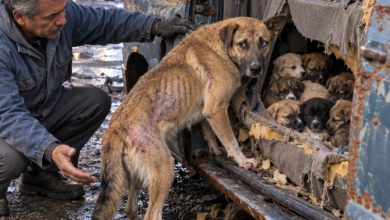
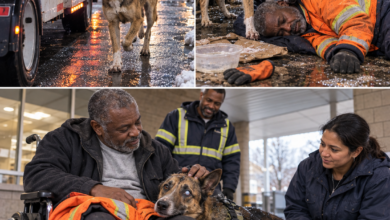
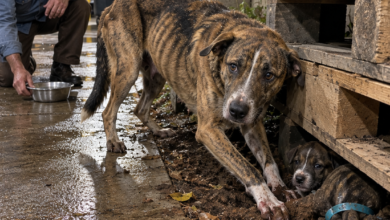
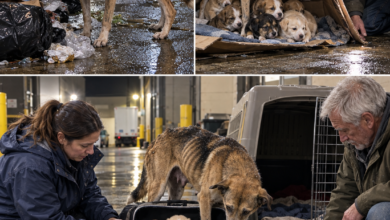
Five Bikers Heard a Weak Cry From a Forest Lake — What They Found Tied Beneath the Water Changed Their Club Forever
Part 2 — The Name on the Microchip
Harbor spent her first forty-eight hours inside an oxygen enclosure.
The veterinarian, Dr. Lena Park, explained that the greatest danger did not end when the dog began breathing. Water inhalation could cause inflammation, infection, and delayed respiratory failure.
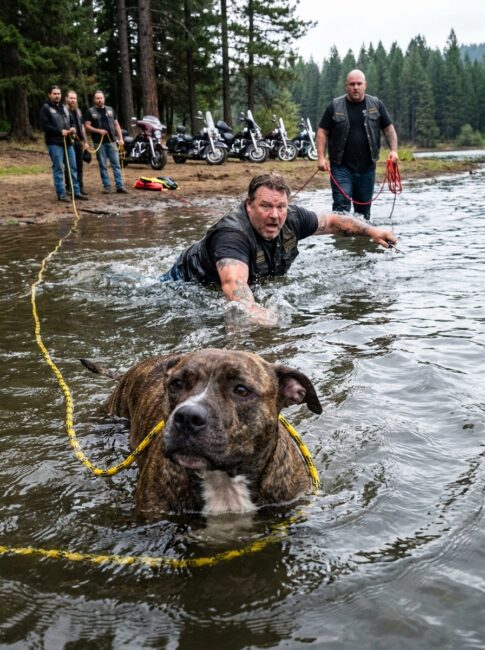
Her body temperature remained low.
Her gums were pale.
Deep rope abrasions circled her ribs and hindquarters.
She also had an untreated infection in one ear and scars across her abdomen suggesting that she had delivered more than one litter.
“She has been bred before,” Lena said.
“How many times?”
“There’s no exact way to know.”
Harbor appeared about four years old.
Her teeth were worn unevenly, and several were chipped. The pads of her paws showed she had spent long periods on rough concrete or gravel. She had not received routine veterinary care in almost two years, despite the information linked to her microchip.
The registered owner was Curtis Vale, a thirty-six-year-old man living outside Springfield.
He told deputies Harbor had escaped through a damaged fence five months earlier. According to him, he had searched briefly, assumed someone had taken her, and never filed a lost-dog report because “she wasn’t worth much.”
The sentence entered the police report.
It also entered the mind of every biker sitting in the clinic waiting room.
Miguel stood so quickly that his chair struck the wall.
“He said what?”
Doc raised one hand.
“Sit down.”
“He tried to drown her and says she wasn’t worth much?”
“We don’t know yet that he put her there.”
Miguel looked toward Harbor’s treatment room.
“We know.”
Emotionally, we did.
Legally, the sheriff’s department needed evidence.
That distinction frustrated us, but it mattered. We had spent years being judged by appearances. We would not demand that another person be convicted by appearance alone, even when every instinct pointed in one direction.
The forest access road leading to the reservoir had two cameras.
One belonged to the county and monitored fire-season traffic. The other belonged to a private timber company concerned about illegal dumping.
Deputies requested both recordings.
At 4:11 that morning, a dark green pickup entered the road carrying one driver and something moving beneath a tarp in the truck bed.
At 4:39, the same truck left.
The tarp lay flat.
The license plate was partly obscured by mud, but the first three characters matched Curtis Vale’s vehicle registration.
That was not enough for an arrest.
The investigators needed more.
We gave statements separately. Every man described the rope, stone, dog’s position, water conditions, and timeline without comparing details beforehand.
The stone was recovered by a dive team. It was a rectangular concrete landscaping block with chipped red paint along one edge.
During a warrant search at Vale’s property, deputies found a row of identical blocks lining a damaged flower bed.
One block was missing.
They also found the same brand of yellow-and-black nylon rope used on Harbor.
Fibers collected from the truck bed matched the rope taken from the lake.
Inside a garbage bin sat Harbor’s old veterinary documents and several advertisements offering Pit Bull puppies for sale.
The investigation suggested Harbor had been bred repeatedly. Her most recent litter had not survived, and a veterinarian had recommended spaying her because another pregnancy could be dangerous.
Vale allegedly decided a dog who could no longer produce puppies had become an expense rather than an asset.
He did not take her to a shelter.
He did not contact a rescue.
He drove her into the forest before sunrise.
The worst detail came from a message recovered from his phone.
He had written to a friend:
“Took care of the dog problem. Nobody will find her out there.”
He underestimated how far one weak cry could travel after five motorcycle engines stopped.
Vale was arrested for aggravated animal cruelty, evidence tampering, and illegal dumping on protected land.
When the arrest became public, people expected our club to celebrate.
We did not.
An arrest did not erase what Harbor had experienced.
It did not restore the minutes she spent stretching her nose above cold water.
It did not explain why an animal who had been used, neglected, and finally discarded still licked the hand of the first stranger who touched her.
Justice mattered.
But Harbor’s life could not remain organized around the man who tried to end it.
That was why Doc made a rule during our second clinic visit.
“No threats online. No riding to his house. No names on the club page until charges are public. We help the case, not his defense.”
Miguel disliked the rule.
So did I, if I am honest.
The image of the rope beneath Harbor’s body returned every time I closed my eyes. Part of me wanted Vale to see five motorcycles outside his home and understand how fear felt.
But fear was the tool he had used.
We were not going to make cruelty our language.
We posted instead about Harbor’s medical fund.
Donations arrived from bikers, dog owners, truck drivers, teachers, nurses, veterans, and people who had never trusted a motorcycle club before seeing the photograph of five leather vests surrounding an oxygen kennel.
The bill was covered in three days.
The remaining money went to the county shelter’s emergency-care program.
Harbor survived the first week.
Then the real work began.
Part 3 — The Dog Who Would Not Lie Down Near a Door
Harbor came out of oxygen support on the fifth day.
Her lungs remained inflamed, but she could breathe without the mask. The veterinary team moved her into a quiet recovery room with padded floors and a low bed.
She refused the bed.
Instead, Harbor stood in the farthest corner, even when her legs shook from exhaustion.
If anyone closed the door, she began panting.
If someone carried rope, a leash, or an electrical cord through the hallway, her body flattened.
The sound of splashing water sent her beneath the examination table.
Physical healing followed a schedule.
Antibiotics twice daily.
Wound cleaning every morning.
Small meals four times a day.
Short supported walks.
Fear had no schedule.
I visited before work and again after dinner. I owned a small motorcycle-repair shop in Eugene, and my employees covered more hours than they should have during those first weeks.
At the clinic, I sat on the floor and repaired carburetor parts, cleaned tools, or completed invoices while Harbor watched me.
She rarely approached.
That was fine.
The first time she moved closer, she stopped four feet away.
The second time, three.
By the end of the second week, she lay near my boot but kept her face turned toward the exit.
Lena called it proximity without surrender.
Harbor wanted company.
She did not yet believe company remained safe once it came close.
Doc visited in plain clothes because the medical smell on his emergency jacket made her nervous. Miguel brought roast chicken and was ordered to stop feeding her enough for three dogs. Owen built a raised feeding stand. Nate read aloud from the history book he taught at the community college.
Our club meetings moved to the veterinary parking lot.
Five motorcycles lined the curb.
Five intimidating men sat around a folding table drinking bad coffee while a brindle dog watched through a window.
Other patients’ owners stared at us.
A woman carrying a Chihuahua eventually asked, “Is she one of yours?”
I looked at Harbor.
“Not yet.”
The legal owner had forfeited his claim after the arrest, and the county placed Harbor under the rescue organization’s custody. She could enter foster care once medically cleared.
All five of us offered.
The rescue coordinator did not choose based on emotion.
Miguel had two energetic dogs already.
Owen lived upstairs without a yard.
Nate traveled for work.
Doc worked long paramedic shifts.
I lived alone in a one-story house outside Eugene with a fenced acre and enough space to avoid forcing Harbor into closeness.
My wife, Sarah, had died from cancer four years earlier. Our only son lived in Idaho with his family. The house had been quiet since Sarah’s death, though I kept two coffee mugs in the cabinet nearest the machine out of habit.
I had never removed her gardening gloves from the mudroom.
The rescue coordinator asked whether grief made me more likely to adopt Harbor for the wrong reason.
“What is the wrong reason?”
“Trying to fill an absence.”
I considered the question.
“Harbor isn’t Sarah.”
“Good.”
“She isn’t medicine either.”
“What is she?”
I looked through the recovery-room glass.
“A dog who needs somewhere nobody will use her.”
That answer earned me a foster inspection.
Harbor came home thirty-one days after we found her.
She wore a wide padded harness because pressure near her abdomen frightened her. I drove my truck rather than putting her near a motorcycle.
At the house, she refused to cross the doorway.
I stood inside.
She stood outside.
The scene lasted twenty-three minutes.
I did not pull the leash.
Finally, Harbor extended one paw across the threshold.
Then another.
She inspected every room slowly. She avoided the bathroom because the faucet dripped. She would not enter the laundry room because a coiled garden hose hung on the wall.
In the living room, she found a space between the sofa and bookcase and lowered herself there.
I had prepared a bed near the fireplace.
She ignored it.
That evening, I placed her food near the bookcase and sat at the kitchen table.
Harbor ate only after I turned away.
At bedtime, I left every interior door open and slept on the sofa.
At 3:00 a.m., I woke to find her standing several feet away.
She watched me breathe.
When I opened my eyes, she retreated.
“It’s okay.”
Harbor remained near the hallway.
I placed one hand on the carpet.
She approached slowly and smelled my fingers.
Then she lay down facing the front door.
For the next month, that was how we slept.
Me on the sofa.
Harbor near the exit.
Two creatures who had both learned that losing someone could happen without warning.
Neither of us asked the other to pretend otherwise.
Part 4 — The Promise Five Bikers Made
Harbor’s first three months of recovery changed our club.
Before her, the Black Pines MC organized one major charity ride each year and helped members when medical bills, layoffs, or funerals struck.
After Harbor, animals began appearing everywhere.
A mechanic called about a dog living behind his shop.
A waitress asked whether we could transport donated food to a rural shelter.
A veteran needed help getting his elderly shepherd to a veterinary appointment after losing his driver’s license.
People had always known those needs existed.
They had not thought of bikers as the people to call.
Harbor changed that without trying.
The photograph that spread online showed her resting in the clinic, my tattooed hand lying several inches from her paw. The caption read:
Five bikers heard what everyone else almost missed.
The post reached hundreds of thousands of people.
Messages followed.
Some thanked us.
Some shared stories of abandoned animals.
Others admitted they would have crossed the road to avoid men who looked like us.
Miguel printed those comments and taped them inside the clubhouse bathroom because he considered personal growth funnier when people had to read it above a toilet.
We founded a small emergency program called Harbor’s Line.
The name carried two meanings.
A safe place after danger.
And a line no one was permitted to cross when harming something weaker.
We used donations to fund emergency veterinary care, transport rescued animals, repair shelter fencing, and support temporary foster placements for pets belonging to domestic-violence survivors.
We were not animal-control officers.
We did not trespass, seize dogs, or confront suspected abusers.
Every request went through licensed rescues, veterinarians, or law enforcement.
Doc insisted on it.
“Good intentions don’t give us authority.”
That sentence protected the program.
It also protected Harbor’s criminal case.
Vale’s attorney argued that public attention had prejudiced the community. He described us as an angry motorcycle gang targeting his client.
The prosecutor responded with our records.
Every message had been referred to law enforcement.
Every public statement avoided threats.
Every piece of evidence had been preserved.
Five men with tattoos had behaved more carefully than the defendant expected.
Vale eventually pleaded guilty after his phone records, security video, rope fibers, and landscaping blocks made trial risk impossible to ignore.
At sentencing, the judge reviewed photographs from the lake and clinic.
Vale’s attorney asked for leniency, arguing that no animal had died.
Lena testified that survival did not reduce the severity of the act.
“Harbor lived because strangers arrived during the final minutes she could keep her airway above water,” she said. “That is not evidence of limited harm. It is evidence of interrupted killing.”
The judge sentenced Vale to prison, ordered restitution for veterinary costs, and imposed a lifetime prohibition on owning or breeding animals.
We attended the hearing without club colors because the prosecutor requested it.
Harbor did not attend.
She spent the morning in my backyard discovering that fallen leaves could be chased without consequence.
That was a better use of her time.
The verdict brought relief.
Not closure.
Closure is a word outsiders use when they want suffering to fit inside a completed box.
Harbor still panicked near ponds.
She still trembled when a leash fell across the floor.
She still refused to drink from deep bowls.
The law could punish the man.
It could not teach her that the world had changed.
That became my responsibility.
Or more accurately, our shared work.
Part 5 — Learning That Water Could Stay Below Her Feet
For six months, Harbor avoided every form of water except the shallow ceramic dish in my kitchen.
Rain was difficult.
The sound against the roof made her pace.
Puddles stopped her during walks.
The irrigation ditch at the edge of my property caused her to pull backward until the harness pressed against her shoulders.
I never dragged her forward.
Several well-meaning people said I was reinforcing the fear.
Our behaviorist, Tara Mills, disagreed.
“You reinforce fear by proving her warnings do not matter,” she said. “She needs to learn she can refuse and remain safe.”
We started with choice.
A dry blue kiddie pool sat in the yard for three weeks.
No water.
No treats placed inside.
No commands.
Harbor ignored it.
Then she sniffed the edge.
A week later, she placed one paw inside and immediately removed it.
I said nothing.
The next day, she stood in it for three seconds.
Progress did not require applause every time. Sometimes human excitement creates pressure where calm is needed.
When Harbor could enter the empty pool willingly, I added one cup of water.
Not enough to cover the bottom.
She smelled it and left.
I emptied the pool after five minutes.
The next session, two cups.
Then four.
The process took months.
Meanwhile, Harbor’s relationship with the motorcycles developed unexpectedly.
At first, the engines terrified her. I started my Harley only when she was inside with windows closed. Later, Miguel rolled one silent bike into the yard and left it there.
Harbor approached after three days.
She smelled the tires.
The leather seat.
My gloves resting on the fuel tank.
Eventually, she lay beneath the sidecar Owen had restored from an old touring rig.
The sidecar became her shaded place during clubhouse gatherings.
We fitted it with a padded floor, safety harness, high windshield, and removable cover. Harbor climbed inside while it remained stationary.
Then while the engine idled.
Then during a slow loop around my driveway.
Months later, she joined us for a two-mile ride along a quiet rural road.
She wore protective goggles and a secured harness. I watched her more than the road until Doc threatened to confiscate my handlebars.
Harbor did not crouch.
She lifted her nose into the wind.
The same dog once tied so she could not move now watched the world pass from a vehicle built for open roads.
Her first public ride was part of a shelter fundraiser.
People expected our club president or a flag bearer to lead.
Harbor rode first.
Five motorcycles followed.
The image spread widely: a brindle Pit Bull sitting upright in a sidecar, one folded ear visible beneath her goggles, club members riding behind her.
She became the face of Harbor’s Line.
Not because we wanted to turn her trauma into marketing.
Because people saw possibility in her.
We always told the complete truth.
Harbor had not been improved by cruelty.
Cruelty gave her fear and scars.
Safety gave her choices.
Time gave her confidence.
Community gave her a life larger than the lake.
Two years after the rescue, Tara suggested visiting a quiet shoreline where Harbor could remain far from the water.
We chose a small pond on private rescue property.
The bank sloped gently, unlike the steep reservoir edge. No boats. No current. No strangers.
Harbor stopped fifty feet from the water.
I sat in the grass.
She remained behind me.
We stayed for ten minutes and left.
The next visit, forty feet.
Then thirty.
Each time, Harbor chose the distance.
During the seventh visit, she approached the wet sand.
Her paws stopped before the waterline.
A small wave created by wind moved toward her.
Harbor backed away.
Then she returned.
She touched the water with one paw.
Nothing pulled her under.
She looked at me.
I remained seated.
Harbor stepped in again.
Only ankle-deep.
Only for seconds.
But she chose every one of them.
Miguel filmed from far away. The video showed no dramatic swimming or triumphant music.
Just a dog standing in shallow water while five bikers remained quiet enough for her to hear her own decision.
That was the victory.
The first water had been forced upon her.
This water waited.
Part 6 — The Member Who Never Needed a Patch
Harbor became an official club member without a vote.
Miguel proposed a leather patch reading ROAD CAPTAIN, but I refused to put leather clothing on a dog during Oregon summers.
Instead, Owen made a small aluminum tag shaped like our club emblem.
It read:
HARBOR
MEMBER SIX
NO ONE SINKS ALONE
The tag hung from her purple collar.
Harbor attended charity rides, shelter events, veterans’ picnics, and quiet mornings at the repair shop. She greeted children more easily than adults, perhaps because children tended to sit without demanding anything.
At the shop, she slept beneath the workbench.
Customers learned to place invoices on the counter rather than stepping over her bed. Delivery drivers carried biscuits. One woman began bringing her teenage son, who struggled with anxiety, just to sit near Harbor while his mother’s car was repaired.
The dog did nothing trained or theatrical.
She remained.
Sometimes presence is the most honest service a survivor can offer.
The five of us developed an annual ritual on the rescue anniversary.
We rode to the overlook above the reservoir but did not take Harbor to the original bank. I had no interest in asking her to confront the exact site for our emotional satisfaction.
We stopped near a forest clearing.
Harbor sat in her sidecar while we read the yearly report from Harbor’s Line.
Animals transported.
Emergency surgeries funded.
Foster homes supported.
Food delivered.
By the fifth anniversary, the program had helped more than three hundred animals.
Not all survived.
That truth mattered.
Rescue does not guarantee outcomes.
It guarantees only that suffering will not be ignored when someone has the power to respond.
After reading the report, we removed our helmets and remained silent for one minute.
Then Harbor usually sneezed, shook her goggles off, or attempted to steal Doc’s sandwich.
Life refused to stay ceremonial around her.
I loved that.
Harbor also changed my house.
Sarah’s gloves eventually came down from the mudroom hook, not because I had stopped loving my wife, but because grief no longer needed every object preserved exactly where death left it.
I framed one photograph of Sarah in the living room.
Beside it, I placed another of Harbor in the sidecar.
They represented different loves.
One did not replace the other.
At night, Harbor stopped sleeping near the front door.
First, she moved to the hallway.
Then the bedroom doorway.
Eventually, she slept on a rug beside my bed, snoring hard enough to rattle the water glass on the nightstand.
The first time she rolled onto her back while sleeping, I woke and watched for several minutes.
A dog exposes her stomach only when her body believes the room will not punish vulnerability.
That posture meant more to me than any viral video.
Harbor had finally stopped preparing to escape.
She believed she belonged inside.
Part 7 — The Last Ride Along the Water
Harbor lived with me for eleven years.
Her muzzle turned white.
Arthritis stiffened her hips.
The rope scars beneath her ribs faded but never disappeared completely. I felt them whenever I lifted her into the truck for veterinary appointments.
She stopped riding in the sidecar at thirteen because balance became difficult. We retired it to the clubhouse, where it remains beneath a framed photograph of her first charity ride.
The aluminum tag stayed on her collar.
Member Six.
Even after she could no longer attend events, the club came to her.
Meetings moved to my backyard during her final summer. Five large motorcycles lined the gravel driveway while five aging bikers sat beneath the maple tree and pretended we had gathered to discuss budgets.
Harbor moved slowly between us.
She checked each man.
Doc.
Miguel.
Owen.
Nate.
Me.
Then she lowered herself in the center.
Five bikers around one dog.
The formation had not changed much since the clinic.
Only the setting had become gentler.
Harbor’s heart began failing during the autumn. Medication helped for several months. Eventually, she stopped eating breakfast and struggled to breathe after crossing the living room.
Lena, who had treated her after the lake, came to my house.
By then, Harbor was fifteen.
I placed my old leather vest beneath her head.
The same vest we had used on the muddy reservoir bank.
Doc arrived first.
Then the others.
Nobody spoke much.
Harbor smelled each hand.
Miguel brought roast chicken even though she no longer wanted food. Owen polished her tag. Nate read the words aloud despite all of us knowing them.
“No one sinks alone.”
Outside, rain touched the windows.
Harbor lifted her head at the sound.
Her body tightened briefly.
I placed my palm near her nose.
“You’re not there anymore.”
She smelled my hand.
Then relaxed.
Before Lena administered the final medication, I leaned close.
“You were never worthless.”
Her eyes remained on me.
“You were never a problem.”
Her breathing slowed.
“And nobody gets to throw you away again.”
Harbor placed her nose against my knuckles.
The same place she had licked beside the lake.
Then she slept.
We buried her on the hill behind my house, where she could hear the motorcycles entering the driveway but never the reservoir.
Her grave marker is a smooth piece of granite.
No chain.
No stone resembling the block used against her.
Only the club emblem and five words:
SHE CAME OUT OF THE WATER.
Beneath it, smaller:
WE FOLLOWED HER HOME.
Harbor’s Line continues.
Miguel runs the transport schedule.
Doc trains volunteers in animal first aid.
Nate handles outreach.
Owen builds insulated shelter boxes.
I still repair motorcycles and attend most rides, though my knees now predict storms better than any weather report.
Each year, new riders hear Harbor’s story.
They expect the lesson to be about vengeance.
Five bikers find an abused dog.
Five bikers hunt the cruel owner.
That would fit the story strangers imagine when they see our leather vests.
But that is not what happened.
We did not break down a door.
We did not threaten a man.
We gave evidence.
Raised medical funds.
Attended court.
Helped shelters.
Changed how our club used its time.
The man who tied Harbor faced the law.
Harbor received a life.
Those outcomes were not equally important.
Punishment lasts for a sentence.
A rescued life continues into ordinary mornings, warm rooms, ridiculous habits, aging joints, and years nobody expected to exist.
That is where the victory lived.
Not in the arrest photograph.
In Harbor sleeping beside my bed.
In her nose lifted above a sidecar windshield.
In the first paw she placed into shallow water by choice.
In every frightened dog transported safely because people heard her story.
People say we saved Harbor.
That is partly true.
We cut the rope.
Pulled her from the water.
Paid for treatment.
Gave her a home.
But Harbor also changed five men who believed kindness was something done privately and strength was something proven through hardness.
She taught us another form.
Strength could kneel beside an oxygen kennel.
Strength could wait outside a crate without demanding trust.
Strength could let law work when anger wanted something faster.
Strength could build a sidecar for one frightened dog.
Strength could become useful.
The owner who discarded Harbor believed nobody would find her in the forest.
He was almost right.
Her cry had weakened.
Her head was sinking.
Our engines were loud.
A different route, another minute, one more wave—and the lake might have become the only witness.
Instead, Miguel’s brake line softened.
Five bikers stopped.
The engines became quiet.
And one small sound reached the shore.
That detail still troubles me.
It also guides everything we do.
Someone is always making a sound that can be missed.
A child.
A dog.
A neighbor behind a locked door.
A person too exhausted to ask twice.
The first responsibility is not heroism.
It is silence long enough to hear.
Harbor survived because five noisy men stopped moving.
Everything after that began with listening.
She was tied to a stone and thrown away as though her life had no weight.
She spent eleven years teaching us the opposite.
Her life carried five bikers.
Then a motorcycle club.
Then hundreds of animals she never met.
The stone pulled her down once.
Love carried her farther.
Follow this page for more unforgettable dog stories about rescue, biker kindness, and lives that refuse to disappear beneath the surface.