Part 2: A Blind Elderly Woman Followed a Puppy’s Cry Into a Storm Drain — Years Later, That Same Dog Became the Eyes She No Longer Had
Part 2 — The Puppy From the Drain
The first thing I felt was how cold he was.
Someone placed him in my lap because I kept reaching into the air, asking, “Is he out? Is he breathing? Is he hurt?” A towel had already been wrapped around him, but cold came through it as if the rain had found a way to live inside his bones. He was smaller than I expected. Maybe eight weeks old. Maybe ten. A handful of shivering life with a heartbeat so fast it seemed impossible that such a tiny chest could hold it.
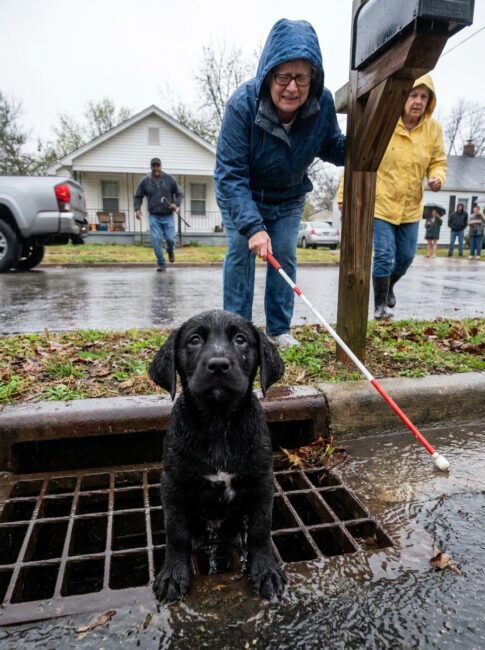
“He’s alive,” Lena said, though her voice trembled. “He’s scared, but he’s alive.”
I bent my face toward him. He smelled like muddy water, wet fur, and the sour fear of something that had been trapped too long. His little body jerked every time he coughed. His paws moved weakly against the towel as if still trying to climb out of a pipe that was no longer around him.
“What color is he?” I asked.
“Black,” said Mr. Hollis from across the street. “Mostly black. Little white mark on his chest. Looks like a Lab mix, maybe.”
“A baby,” Lena added. “Just a baby.”
I held him closer.
The rain kept falling, but the whole neighborhood had gathered by then. Mr. Hollis had been the one to pry the grate loose with a crowbar. Lena’s husband, Calvin, had climbed partly into the drainage opening with a rope around his waist while another neighbor held him steady. Someone called animal control. Someone else called the emergency vet. Voices overlapped around me, but the puppy was the only sound I cared about.
His breathing.
His coughing.
The tiny, exhausted whine he made when I tucked the towel beneath his chin.
I whispered, “You found the right street, didn’t you?”
The neighbors tried to decide what had happened. Maybe the puppy had wandered from somewhere uphill and slipped into the drainage ditch. Maybe someone had dumped him nearby before the rain. Maybe he had crawled into a pipe looking for shelter and gotten pushed down by rising water. Nobody knew. There were no tags, no collar, no person running up the road calling for him.
Only a puppy in a towel.
Only a blind old woman who had heard him before the rain took his voice completely.
Lena drove us to Blue Ridge Animal Clinic because I refused to let anyone take him without me. I sat in the passenger seat with the puppy against my chest, feeling his shivers move through my coat. Every few minutes I asked if he was still awake. Lena would glance over and tell me yes, then later she stopped answering quickly, and I knew she was worried too.
At the clinic, a veterinarian named Dr. Amelia Hart, a white American woman in her forties with a gentle voice and hands that sounded efficient on stainless steel, took him back immediately. I sat in the waiting room with my damp cane across my knees and my hands still curved as if holding him. That empty shape hurt more than I expected.
When Dr. Hart returned, she said he had mild hypothermia, water in his ears, a cough from cold stress, minor scrapes along his paws, and exhaustion. No broken bones. No severe infection that she could see. No microchip. He would need warming, fluids, monitoring, and several days of careful care.
“He’s lucky,” she said.
I shook my head.
“No,” I said softly. “He was loud.”
Dr. Hart paused, then laughed once, kindly. “That too.”
The clinic needed a name for his chart. Everyone looked at me, though I had no official claim to him. I thought about the sound under the street. The thin cry through water and metal. The way it had bounced along the pipe until it reached the one person on that road who knew how to follow a voice without seeing where it came from.
“Echo,” I said.
The name settled over him like it had been waiting.
Echo stayed at the clinic for three nights. I called so often the receptionist began answering with, “He’s still doing well, Miss Clara,” before I even spoke. On the second day, Dr. Hart let Lena bring me in to visit. Echo was wrapped in a warm blanket, and when I touched two fingers to his tiny head, he stopped shivering long enough to press his nose into my palm.
That was the first time I cried.
Not loudly.
Just enough for Lena to pretend she was looking for tissues.
On the fourth day, Dr. Hart said he could go into foster care while they searched for an owner.
I heard myself say, “He can come home with me.”
The room went quiet in the way rooms do when people are trying not to say something obvious.
“Miss Clara,” Lena began carefully, “a puppy is a lot.”
“I know.”
“You live alone.”
“I know that too.”
Dr. Hart spoke gently. “We can connect him with a rescue. He’ll be adopted quickly.”
I put my hand on Echo’s blanket. He was sleeping against my wrist. So small. So trusting after the world had almost washed him away.
“I heard him when nobody else did,” I said. “Let me be the first home he remembers after the dark.”
No one answered right away.
Then Lena sighed, and I knew I had won before she said, “We’ll need to puppy-proof your house.”
That was how Echo came home.
Not as a guide dog.
Not yet.
Just a rescued puppy with a cough, a white mark on his chest, and a cry that had found me through the rain.
Part 3 — Learning Each Other in the Dark
The first month with Echo was chaos wrapped in softness.
People imagine elderly women and puppies as a picture-card kind of sweetness. They forget puppies pee where they should not, chew things that matter, wake before sunrise, and believe human fingers are toys provided by a generous universe. Echo was no exception. He chewed the edge of my kitchen mat. He stole one of my slippers and dragged it under the table. He once fell asleep with half his body in his water bowl, then woke up offended that he was wet.
I loved him almost immediately.
That did not make it easy.
Because I could not see him clearly, I learned him by sound and touch. The click of his tiny nails on hardwood. The heavier thump when he jumped off the rug. The soft snuffle he made before sleep. The high, impatient whine that meant he had misplaced me even though I was three feet away. I put small bells on his collar at first, not because I wanted him to sound like a holiday decoration, but because stepping on a puppy is a fear no blind woman needs added to her morning.
Echo learned me too.
He learned the rhythm of my cane against the floor. He learned that I counted steps from bedroom to kitchen. He learned that when I said “easy,” I was feeling for the edge of something. He learned that my hands searched before they touched, and if he stayed still long enough, those hands would find his ears, his paws, his belly, and all the places a puppy wants scratched.
Lena came by every day that first week, then every other day, then whenever I lied badly about needing help. My granddaughter Sophie, who was sixteen and believed technology could solve most human problems, installed little textured markers on cabinet handles and ordered a talking pet-food scale. Mr. Hollis built a short fence around the front walkway so Echo could sniff the grass safely. Calvin fixed the loose board on my back porch after Echo discovered it before anyone else did.
The neighborhood that had gathered around the storm drain gathered around us again.
But still, there were moments when fear came.
At night, when Echo cried from his crate, the sound took me back to rainwater rushing under the street. I would sit beside him on the floor, fingers through the crate door, telling myself he was safe and reminding him of the same thing. Sometimes I whispered, “You’re not under there anymore,” though I was not sure which of us needed to hear it.
As weeks passed, his cough faded. His body filled out. His paws grew too large for his legs. Dr. Hart confirmed he was likely a black Labrador mix, smart, social, and unusually attentive to sound. She noticed something before I did.
“He watches you,” she said during one visit.
“Puppies watch everyone.”
“Not like this.”
I heard Echo’s tail thump against the exam table.
“He tracks your movements. When you reach for your cane, he shifts closer. When you pause at a doorway, he waits.”
“That’s because I feed him.”
Dr. Hart chuckled. “Maybe. But I’d pay attention.”
So I did.
At three months, Echo started walking ahead of me in the hallway, then stopping at the stairs before I reached them. At four months, he learned to sit when I dropped my cane. Not because I trained it well, but because the first time I dropped it, he startled, sat, and received such enthusiastic praise that he decided sitting near fallen objects must be a job. At five months, he began nudging my knee when I walked too close to the porch edge.
Lena noticed it one afternoon.
“Clara,” she said slowly, “did he just block you from the step?”
“He likes being dramatic.”
“He moved in front of your chair.”
“He likes chairs.”
“He’s guiding you.”
I told her not to be silly.
But that night, Echo led me from the living room to the kitchen with his shoulder brushing my calf, pausing when I paused, moving when I said his name, stopping before the rug corner that always curled up.
A puppy from a storm drain had begun learning the map of my darkness.
And for the first time since losing my sight, I wondered whether the world had not only taken something from me.
Maybe, somehow, it had sent something back.
Part 4 — The Trainer Who Heard the Same Thing
I did not decide Echo would become a guide dog.
He decided first, in the small stubborn way dogs make decisions long before humans give them official names.
Still, love is not training. Instinct is not certification. A dog can be devoted and still not be safe for mobility work. I knew enough to know that pretending otherwise could get us both hurt. So when Echo was nine months old, Dr. Hart connected me with Malcolm Reeves, a Black American mobility trainer in his early fifties who had worked with service dogs and orientation programs for over twenty years.
Malcolm arrived at my house on a chilly Tuesday morning. His voice was warm but practical. His shoes made soft rubber sounds on my porch. He greeted me before Echo, which I appreciated, then asked permission before touching the dog.
Echo sniffed him, wagged once, then sat beside my chair as if taking notes.
“He’s handsome,” Malcolm said.
“He knows,” I replied.
“He’s also watching your cane.”
I smiled despite myself. “Everyone keeps saying that.”
“Everyone may be right.”
The evaluation took several weeks. Malcolm tested Echo’s temperament, focus, confidence, recovery from startling sounds, interest in people, reactions to traffic, and ability to remain calm in public spaces. Echo failed some things at first. He wanted to greet children too enthusiastically. He believed squirrels were minor emergencies. He hated automatic doors the first time they opened toward us with a hiss. He was young, and young dogs are foolish in the way young things have earned the right to be.
But he had qualities Malcolm could not teach.
Echo checked back naturally.
He responded to my voice even in distraction.
He noticed changes in my pace.
He did not pull hard when uncertain.
Most importantly, he seemed to understand that our movement was a conversation, not a race.
“He may not be a formal guide dog in the traditional program sense,” Malcolm told me after the third session, “but with the right training, he can become a reliable mobility assistance dog for you. We go slowly, safely, and honestly. No shortcuts.”
I agreed.
Training changed both our lives.
Echo learned forward, left, right, halt, step, curb, door, wait, find chair, find home. I learned how to give commands cleanly instead of narrating my anxiety. Malcolm taught me that a guide partnership is not a dog dragging a blind person through the world. It is two nervous systems learning to trust one another’s information. Echo had eyes. I had judgment. He saw obstacles. I knew destinations. He could notice a low branch. I could decide whether we crossed the street.
Together, we became more capable than either of us alone.
The first time Echo stopped me at a curb, I cried.
Not because curbs are poetic.
Because I remembered the storm drain.
I remembered kneeling in rain, unable to lift the grate, furious at my blindness. I remembered thinking I could hear danger but not reach it. Now the puppy I had helped save was standing at my side, body steady, telling me with his pause: There is an edge here. Wait.
Malcolm let me cry for about ten seconds, then said, “Good. Now reward him.”
Practical people save sentimental people from drowning in moments.
Echo received chicken.
From then on, he took training more seriously because he believed curbs produced poultry.
By the time he was eighteen months old, Echo had grown into a strong, glossy black dog with a white mark on his chest shaped like a small uneven star. He wore a special harness for guided walking, though we still used my cane in unfamiliar places because safety is not pride. He knew the route to Lena’s house, the clinic, the little grocery, the church basement where I attended a book group, and the mailbox where his story began.
The first time he guided me to that mailbox, he stopped before the curb.
Rain had fallen earlier that morning.
Water trickled through the storm drain.
Echo turned his head toward the sound.
So did I.
For a long moment, neither of us moved.
Then he leaned gently against my leg.
The puppy from the pipe had become the dog who kept me from stepping into danger.
I put my hand on his head.
“I heard you need help,” I whispered. “Now you listen for me.”
Echo’s tail brushed my coat.
That was his answer.
Part 5 — The Day He Became My Eyes
The day Echo truly became my eyes did not happen during training.
It happened in the grocery store parking lot on an ordinary Thursday when nothing was supposed to happen at all.
That is how life likes to test what love has built.
We had gone to Henderson’s Market, a small grocery two blocks from my house, because I needed coffee, oatmeal, and the raspberry jam Sophie liked when she visited. Echo was in harness, calm and proud, walking at my left side. The pavement was damp from earlier rain. Cars came and went. Shopping carts rattled. Someone’s child cried near the entrance because childhood includes strong opinions about cereal.
Echo had guided me there many times.
We crossed the first lane safely.
At the second, he stopped so abruptly that I almost bumped his shoulder.
“Forward,” I said, thinking he had been distracted by a smell.
He did not move.
I lifted my head, listening. To my ears, the lane was quiet. No engine close. No tires on wet pavement. Nothing but distant cart wheels and the hum of the store’s automatic doors.
“Echo, forward.”
He held his position.
His body was firm, blocking me.
Then I heard it.
A soft electric whine.
A hybrid car backing out silently from a space I could not see, rolling toward the crossing lane without enough engine noise to warn me. The driver must not have seen us either, because a second later Lena, who happened to be leaving the store, shouted, “Stop!”
Brakes squealed.
The car halted close enough that I felt the air shift.
My hand tightened around Echo’s harness handle. My whole body went cold.
Echo stood steady.
Not barking.
Not panicking.
Just planted between me and the path of a car.
The driver apologized repeatedly. Lena cried. A bag of oranges spilled somewhere near my feet. People gathered, asking if I was all right. I said yes because physically I was. But inside, a truth had landed with such force I could barely speak.
Without Echo, I would have stepped forward.
Malcolm had trained him for traffic refusal, but training is theory until a dog chooses disobedience to keep you alive. That is the strange brilliance of guide work. A good dog must obey. A great one must know when not to.
At home afterward, I sat on the porch with Echo’s head in my lap and shook for a long time.
He licked my wrist once, then settled like a warm weight across my feet. I thought of the puppy in the drain, his cries nearly lost under rainwater. I thought of how helpless I had felt standing above a grate I could not lift. I thought of the neighbors, the crowbar, Calvin climbing down, the towel, the cold little body placed in my lap.
I had saved him by hearing.
He had saved me by seeing.
The circle was too perfect for me to trust easily.
Real life is rarely that neat.
And yet, there he was, breathing against my knees.
After the parking lot incident, the whole neighborhood treated Echo with a new reverence that he absolutely did not deserve around unattended sandwiches. Mr. Hollis called him “Officer Echo.” Lena brought him a steak bone Dr. Hart immediately confiscated in favor of safer treats. Sophie made him a blue tag that said BEST EYES IN TOWN, which I pretended was too silly and then kept on his harness bag.
News of what happened traveled because small towns are built partly from concern and partly from gossip. The local paper ran a story about the blind woman and the puppy from the storm drain. They wanted a quote. I gave them the only one that felt true.
“I heard him when he needed help,” I said. “Now he is my eyes.”
That sentence spread faster than I expected.
People wrote letters. Some sent dog toys. A retired teacher mailed a check to Blue Ridge Animal Clinic for “the next animal pulled from somewhere dark.” A little boy left a drawing in my mailbox of a black dog wearing sunglasses. I taped it to my refrigerator, crookedly, which Sophie later corrected while claiming not to cry.
But the best response came from Malcolm.
He called after reading the article and said, “Don’t let the poetry make you sloppy.”
I laughed for a full minute.
Then he added, softer, “He did well, Clara.”
“I know.”
“So did you.”
That part I had to sit with.
Because Echo was not my miracle alone.
We had become a team.
And teams are built from both sides.
Part 6 — Returning to the Sound
On the second anniversary of Echo’s rescue, rain came again.
Not heavy. Just steady, like the morning that started everything. I woke before dawn to the sound of water moving through gutters and Echo breathing beside my bed. He slept on a rug now, no longer the coughing puppy in a crate but a full-grown dog who took his responsibilities seriously unless there was cheese involved.
I lay there listening.
Rain on roof.
Rain in leaves.
Rain in the downspout.
Farther away, the faint rush of water along the curb.
Echo lifted his head before I moved.
“You hear it too?” I asked.
His tags shifted.
We went to the mailbox after breakfast. He wore his harness. I wore my blue raincoat, the same one from that day, though Lena insisted I replace it because the left pocket had a tear. I refused. Some objects become witnesses. You do not throw away a witness just because it looks tired.
Echo guided me down the porch steps, along the wet walkway, and toward the curb. He stopped exactly where he should, before the drainage channel. I could hear the water below. Not dangerous that morning, just moving.
I stood there with one hand on his harness and one on my cane.
Two years earlier, I had stood in almost the same spot feeling useless, angry, and old in a way that had nothing to do with age. I had heard a life in danger and could not reach it alone. But I had called. People had come. A puppy had lived. Sometimes rescue begins with accepting that your part is not the whole part. That does not make it smaller.
Lena came out carrying an umbrella.
“I knew you’d be out here,” she said.
“I’m predictable.”
“You’re sentimental.”
“That too.”
We stood together in the rain, three old friends if you counted Echo, which of course I did. Lena told me that Calvin still checked the storm grates on our street after every big rain. Mr. Hollis had convinced the city to repair a loose cover two blocks away. Sophie had started volunteering at an animal shelter near her college. Dr. Hart kept Echo’s puppy photo on the clinic bulletin board with a note about listening for distress sounds after storms.
A cry under a street had changed more than my house.
It had changed the habits of a neighborhood.
Later that year, our community began an annual event called Echo Walk, raising money for storm drain covers, local animal rescue, and mobility training support for blind residents with service animals. I found the name embarrassing. Echo found the event thrilling because many people came with treats and said he was handsome, which he already believed.
At the first Echo Walk, Malcolm gave a short talk about guide dogs and safe public behavior. He told people not to distract working dogs. Echo sat beautifully beside me until a toddler dropped a cracker, at which point he briefly considered resigning from professionalism. I felt the movement through the harness and whispered, “Leave it.”
He left it.
Barely.
Progress deserves honesty.
During the event, a woman asked me whether I believed Echo had been sent to me for a reason. I never know how to answer questions like that. I do not like turning suffering into destiny too easily. A puppy did not need to nearly drown so I could learn a lesson. Cruelty, accident, neglect, bad infrastructure — whatever put him in that drain, none of it becomes beautiful because the ending was kind.
But I do believe this: when pain happens, love can decide what it becomes next.
Echo’s cry became rescue.
His rescue became partnership.
Our partnership became a walk, a fund, safer grates, more alert neighbors, and a blind old woman who moved through her town with more confidence than she had felt in years.
That is not fate, maybe.
It is what kindness builds after the bad thing.
Part 7 — Now He Is My Eyes
Echo is five now.
He has a gray whisker on the left side of his muzzle, though Sophie says I am not allowed to call him middle-aged because he has “youthful energy.” He still has the white mark on his chest, now broader, shaped like a crooked little star. His coat is glossy. His paws are steady. His bark, once a tiny cry under rainwater, is now deep enough to make delivery drivers stand straighter.
He is working as I write this, though his definition of working includes sleeping beside my chair with one ear pointed toward me in case I move.
That is one of the things people misunderstand about guide dogs and mobility dogs. They imagine constant drama: heroic street crossings, danger avoided, lives saved in obvious ways. And yes, sometimes that happens. Echo has stopped me at curbs, guided me around construction cones, refused unsafe crossings, found empty chairs, led me to doors, and once steered me away from a sidewalk hole so smoothly I did not realize it until Lena gasped.
But most of what he gives me is quieter.
Confidence at the mailbox.
Freedom at the grocery store.
Companionship in rooms that once echoed too much.
A warm body breathing beside my bed.
A reason to step outside even on days when blindness feels heavier than usual.
He does not give me sight back. That would be the wrong way to tell it. My blindness remains. My cane remains. My careful counting remains. But Echo gives me information, partnership, and courage. He gives me a way to move through the world with another living creature saying, in every pause and turn, I am watching with you.
Sometimes people stop us and ask if they can pet him. When he is working, I say no. Some understand. Some look disappointed. A few act offended, as if his purpose is to decorate their day. Echo ignores them with the dignity of a dog who has survived worse than bad manners.
Children understand best when I explain.
“He’s my eyes right now.”
Once, a little girl asked, “But did you used to be his ears?”
I smiled so hard my face hurt.
“Yes,” I told her. “Exactly.”
Every year on the day I heard him, Lena and I walk with Echo to the storm drain. We do not make a ceremony of it. No speeches. No photos unless Sophie insists. We just stand by the curb, listen to whatever weather has brought us, and remember. Echo always sniffs the grate, then leans against my leg. I always touch the top of his head and feel, beneath my palm, the living answer to a cry that could have been missed.
There are things I cannot see anymore.
I cannot see the color of his coat in the sun, though people tell me it shines blue-black. I cannot see the way his tail moves when Sophie visits, though I hear it thump against the wall. I cannot see his eyes looking up at me, though I feel the attention of them more clearly than some people feel a stare across a room.
But I know him.
I know his steps.
His breathing.
His decisions.
His pauses.
His quiet pride when he finds the right door.
His guilty silence when he steals a biscuit.
His soft sigh when I remove the harness and he becomes, for the evening, only my dog.
People often say I rescued Echo.
I did.
But that was only the first half of the truth.
I heard him when he was trapped in the dark, and later, when I had become used to my own kind of darkness, he grew into the one who guided me through it. I was his ears beside the storm drain. He became my eyes at the curb, the crosswalk, the grocery store, the mailbox, and every ordinary place I once entered with more fear than I admitted.
Sometimes, late at night, I think about how close I came to dismissing that first cry as wind or water. One sound ignored, and my life would be smaller now. His would have ended beneath the street. That thought still frightens me, but it also teaches me.
Pay attention.
The world asks for help in voices small enough to miss.
A puppy crying under a storm drain.
A neighbor calling from a porch.
A cane tapping toward the curb.
A guide dog stopping before danger.
Love often begins as a sound someone decides not to ignore.
Echo lifts his head now because I have stopped typing. His tags make a soft chiming noise. In a moment, I will reach for his harness. He will stand, stretch, shake once, and come to my left side. We will go to the mailbox. He will stop at the curb. I will listen. Then, when the road is safe, I will say, “Forward.”
And he will lead me into the day.
If this story stayed with you, follow this page for more unforgettable dog stories about rescue, loyalty, healing, and the quiet miracles that happen when someone listens before it is too late.