For Two Years a Lonely Biker and the Woman Behind the Coffee Counter Said Almost Nothing to Each Other — Then One Morning She Set a Rescue Pit Bull Puppy on the Counter and Said, “Today He Chose You.”
Part 2
The puppy’s name was Bridge.
I need to tell you about him, because by the end you’ll understand he was named better than any of us knew.
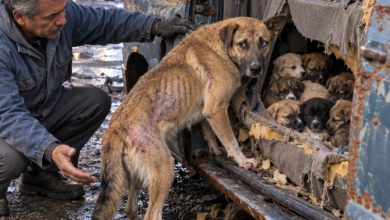
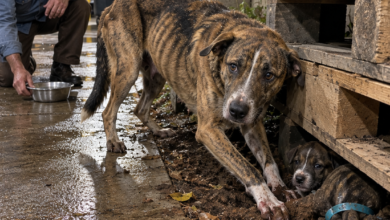
He was a Pit Bull, gray brindle over white, with a white blaze up his nose and one ear that flopped while the other stood. He had the blocky head and the big paws that meant he’d grow into something substantial, and he had eyes the color of weak coffee — which I’d notice the irony of later. He had a scar on his right hind leg, healed over, from whatever life he’d had before Sarah pulled him out of it. She told me he’d been found in a box behind a gas station with two siblings who didn’t make it.
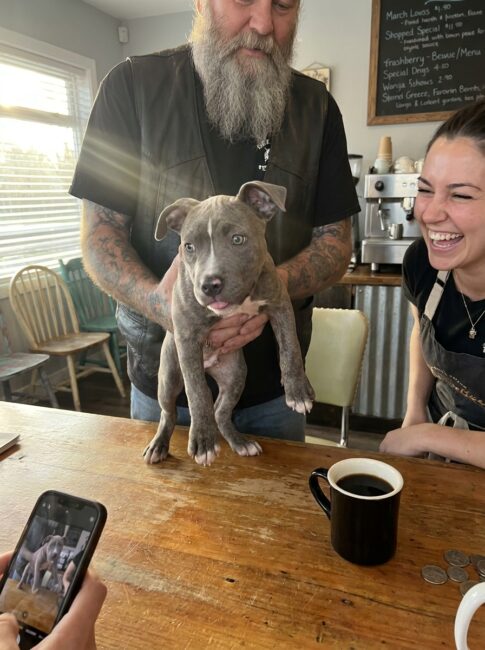
I should tell you about me and Sarah, too, the little I knew.
I’m Cleveland born. Fifty years old. I did eight years in the Army and a stretch after that I’ve made my peace with, and I came out the other side of all of it good with engines and bad with people. I do custom motorcycle work out of a shop on the west side. I’m decent at it. It’s quiet work, and I like quiet.
Sarah, I’d pieced together over two years of forty-word mornings, had opened the coffee shop after something. I didn’t know what. People don’t put everything they have into a little corner place at thirty unless they’re building a wall around something, or a door out of it. I didn’t know which hers was.
Here’s the small thing about Sarah I didn’t understand for a long time.
When she handed me that puppy, she said today he chose you. Like it was the dog’s idea. Like she was just the delivery service.
I thought she was being kind. Giving a lonely-looking biker a reason to get up in the morning.
It would take me a week, and one more sentence from her, to understand that Sarah hadn’t been talking about the dog choosing me at all.
Part 3
I took the dog home that Tuesday.
I want to be honest about what my life was before that. It was orderly and it was empty. I got up. I rode. I worked. I came home to a clean, quiet house where nothing was ever out of place because nothing ever moved but me. I ate standing up at the counter. I went to bed early because there was no reason not to.
I’d been doing that for years. I’d stopped noticing it was a problem the way you stop hearing a refrigerator hum.
Bridge fixed that in about four hours.
He chewed a boot. He knocked over a plant. He could not be more than six feet from me at any time, and when I sat down he climbed into my lap like he didn’t understand he was going to be sixty pounds someday, and he fell asleep with his head on my forearm, and I sat there in my quiet house not moving for two hours because I didn’t want to wake him.
I hadn’t held anything living in a long time.
The house stopped being so quiet. I started talking — out loud, to a dog, like every dog owner who swore they never would. I started getting up earlier because he got up earlier. I started coming straight home instead of finding reasons not to, because someone was waiting.
And every morning, I still went to the coffee shop.
But now it was different. Now I had something to say.
I’d come in and tell Sarah what Bridge had done. The boot. The plant. The way he howled at the mail truck. And Sarah would laugh — and I realized, standing there, that in two years I had never once heard her laugh. It was a good laugh. It was a laugh that had been kept somewhere out of use for a while.
We talked more in the week after Bridge than we had in the two years before him.
Because now there was a thing to talk about that wasn’t us. And for two people who didn’t know how to walk through a door toward each other, the dog was a reason to stand in the doorway and just — talk.
By Friday I’d learned more about Sarah than I’d learned in two years. That she’d grown up in Akron. That she’d opened the shop after a marriage ended badly. That she’d started fostering dogs because the apartment over the shop got too quiet at night and she understood, she said, what it did to you to come home to silence.
I understood that exactly.
I went home Friday night and Bridge met me at the door, and it hit me, sitting on my kitchen floor with this dog in my lap, that I was happier than I’d been in a decade, and that it had cost me a four-month-old Pit Bull and the courage to say a third sentence.
But there was something I couldn’t shake. And the next week, I brought it back to the counter.
Part 4
“I think there’s a problem,” I told Sarah, the following Tuesday. Exactly one week after she’d handed me the dog.
She looked up, worried. “Is he okay? Is he sick?”
“No. He’s good. He’s great.” I turned my coffee cup in my hands, which is a thing I do when I can’t find words. “It’s just — I bring him by sometimes. On the way to the shop. And every time I do—”
I stopped.
“Every time you do, what?”
“He likes you more than me.”
I said it like a confession. Because it was true. I’d bring Bridge by the coffee shop in the mornings and the second he saw Sarah he’d lose his mind — whining, pulling, tail going like a metronome, scrabbling across the floor to get to her. He loved me. He slept on my bed and followed me room to room. But when he saw Sarah, he came alive in a way that made it obvious where some piece of his heart still lived.
“You fostered him six months,” I said. “He misses you. I think — ” and this was hard to say, ” — I think maybe he should be yours. I don’t want to take him from you.”
Sarah was quiet for a moment.
She set down the rag she’d been holding. She looked at me across the counter, the same counter, the same six feet of distance we’d held for two years.
And she said the thing that closed the gap.
“Maybe Bridge wasn’t for you,” she said. “And maybe he wasn’t for me.”
I waited.
“Maybe he was for both of us.”
I stood there in that coffee shop and I felt something turn over in my chest that hadn’t turned in a very long time. I understood, all at once, what she’d done. What she’d been doing.
I thought I’d been handed a dog.
I’d been handed a reason.
Part 5
I’m not a smooth man. I want to be clear about that. What I said next was not smooth.
What I said was: “Do you want to get dinner. With me. Sometime. Not — I mean a real dinner. At a table.”
Two years of saying forty words, and that was the speech I’d built.
Sarah smiled. The same smile from the day with the puppy.
“Yes,” she said. “I’d like that.”
And here’s the twist, the thing I didn’t see until that exact moment, standing there having finally asked.
She’d planned it.
Not the dinner — she couldn’t have planned that. But the dog. Sarah told me, much later, that she’d noticed me from the first week I started coming in. That she’d seen my quiet and recognized it as the twin of her own. That for two years she’d wanted to say something and couldn’t, the same way I couldn’t, two lonely people fluent in everything except each other.
And then she’d started fostering Bridge, this scarred, thrown-away puppy, and one morning she’d watched me from behind the counter while I drank my coffee, and she’d thought: that man and I are never going to say the words. But the dog could. The dog doesn’t know how to be afraid of the words.
She didn’t give me a dog because she felt sorry for me.
She gave me a dog because it was the only sentence she knew how to say that I would actually hear.
Part 6
I sat with all of it later and let every small thing turn over in the light.
Today he chose you. She’d put it on the dog. Of course she had. Because I chose you was a sentence neither of us could survive saying across that counter. The dog was the disguise the truth wore so it could finally get said out loud.
The twenty-percent tip I’d calculated so carefully for two years so she wouldn’t think I was trying too hard. The extra second our eyes held before one of us looked away. The fact that she reached for the cup before the bell finished ringing — she knew my time, my order, my silence, as well as I knew hers. We had been having an entire relationship for two years. We’d just been having it without any words in it.
And Bridge — Bridge liking Sarah “more than me.” I’d brought that to her as a problem. It was the opposite. The dog wasn’t confused about who he belonged to. The dog belonged to the space between us. He pulled toward Sarah when he was with me and, I’d learn, pulled toward me when he was with her, because his entire purpose — the thing Sarah had built him into without either of us noticing — was to keep needing to be in both places. To make us keep meeting. To be the standing reason we could not just go back to forty words a year.
His name was Bridge.
Sarah swears she named him that months before she ever thought of giving him to me. Named him for the scar, she said — for the gap in him she was trying to close, the thrown-away part. She didn’t plan the name as a metaphor.
But that’s what he became. A bridge is a thing you build over a gap so two sides that were always there can finally reach each other.
That’s what he was. That’s what he did.
He carried two lonely people across two years of silence and set them down on the same side.
Part 7
We got married a year later.
Small ceremony, backyard, string lights, my motorcycle friends in their leather on one side and her coffee-shop regulars on the other, and everybody a little surprised and nobody surprised at all.
Bridge was the ring bearer. Full-grown by then, sixty-five pounds of gray brindle, a little satin pillow strapped to his back that he was deeply suspicious of. He walked the rings up the aisle between us — between Sarah on one end and me on the other — which felt exactly right, because that’s the only place that dog had ever stood. Between us. Connecting the two ends.
He sat at our feet during the vows. When I said mine, he leaned his whole weight against my shin and sighed, the same way he had the morning he sat on my boot in the coffee shop.
Here’s the small thing we do now.
Every morning, Sarah still opens the shop. And every morning at 6:40, I still come in for a black coffee, large, no room. The bell still rings. She still reaches for the cup before the door closes.
But now Bridge comes with me. And he doesn’t pull toward her anymore, or toward me. He just lies down in the middle of the floor, between the counter and the door, in the exact center of the room.
Right in the gap he spent his whole life standing in.
Part 8
I’m fifty-one now. Married. Not alone.
Sometimes I think about all those mornings. Seven hundred of them. Two people who wanted to speak and couldn’t, separated by six feet of counter and the whole weight of everything that had made each of us quiet.
We might have gone on like that forever.
We were going to.
Then a thrown-away puppy sat on my boot and sighed.
Bridge is asleep at my feet as I write this. Gray going a little white now around that flopped ear.
He built us.
Good dog.
Follow this page for more stories about the animals who say the words two people can’t.