Part 2: A Widow Found a Silent Dog Inside an Old Suitcase on Her Porch — Then the Hospital Bracelet in One Photograph Revealed Why Her House Had Been Chosen
Part 2 — The Suitcase Beside My Flowers
My name is Margaret Ellis. I was seventy-four when Benny appeared outside my home in Savannah, Georgia, and I had been a widow for seven months, eleven days, and several hours I had stopped counting.
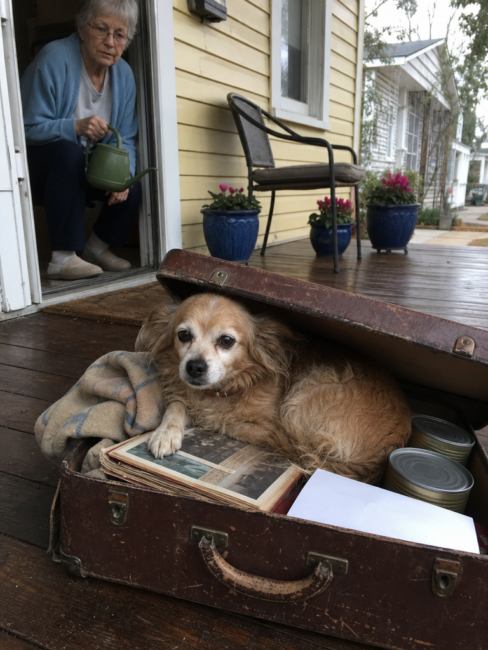
Thomas and I lived in the same pale yellow bungalow for forty-three years. We raised two daughters there, though both eventually moved west for work. We planted azaleas along the fence, tomatoes behind the garage, and winter cyclamen in blue ceramic pots beside the porch.
Thomas died after a short illness the previous summer. Our daughters called often, but distance turned every concern into a question they could not answer from across the country. Was I eating? Was I sleeping? Had I considered moving closer?
I told them I was managing.
Managing meant I washed one plate each evening, left his slippers beneath the bed, and continued making coffee for two before remembering the second cup belonged to nobody.
The flowers gave me a reason to open the door.
At 6:12 each morning, I carried water to the porch. That ritual placed me beside the suitcase on January 17.
Benny weighed approximately fourteen pounds. His tan coat grew long around his neck and ears, while cream fur covered his chest and the front of his paws. Age had softened the color around his muzzle, though the veterinarian later estimated he was only nine.
His red collar had no identification tag. A faint rectangular mark showed where one had recently been removed.
The suitcase contained everything a careful person might prepare for a short journey: food, medicine, a fleece blanket, vaccination records with the owner’s information cut away, and the album.
Nothing explained why the journey ended at my porch.
Benny remained inside the suitcase for the first six hours. I placed water near the open lid and sat several feet away. When I entered another room, he watched the doorway but did not follow.
By afternoon, he stepped onto the kitchen floor.
He circled the suitcase once and returned inside.
I called my veterinarian, Dr. Evelyn Brooks, who agreed to visit because Benny resisted being moved. She found no sign of injury or contagious illness. His heart was steady, though stress had increased his breathing.
“He may be waiting for the person who placed him there,” she said.
“So am I.”
Dr. Brooks looked at the unsigned letter.
“You may not get an answer.”
The album became my only lead. Anna’s name did not appear on the cover, but the photographs documented years of life with Benny. In the earliest pages, she looked about twenty-three. By the final page, illness had narrowed her shoulders and changed the shape of her face.
Benny watched while I turned each page.
When I touched Anna’s photograph, he lifted his nose toward my hand.
The last picture showed the hospital bracelet.
That small strip of printed plastic led me to St. Catherine’s.
Part 3 — The Woman in Every Photograph
St. Catherine’s Hospital occupied several connected brick buildings near downtown Savannah. I arrived after lunch with the album inside a canvas grocery bag and Benny’s letter folded in my coat pocket.
Benny remained at home with my neighbor, Dorothy Hale. He refused food but allowed Dorothy to sit beside the suitcase.
The hospital receptionist could not identify a patient from a photograph. She advised me to contact security or the patient-relations department, though neither could release medical information.
I opened the album to the final page.
A nurse crossing the lobby stopped.
Her badge identified her as Sarah Donnelly. She stared at Anna’s photograph before asking where I had found it.
“Inside a suitcase on my porch.”
“And the dog?”
“With my neighbor.”
Sarah closed her eyes.
“She did it.”
Anna Reed had spent five weeks moving between an oncology floor and a residential hospice unit connected to the hospital. Her treatment had stopped working months earlier. She understood that her time was short.
Benny remained her central concern.
Hospital rules allowed short pet visits through a volunteer program. The photographs showed him lying beside Anna beneath the window. Sarah said Benny refused to leave whenever the volunteer attempted to take him back to Anna’s apartment.
“He knew the building took her away from him,” Sarah said. “Every time the elevator opened, he pulled toward her room.”
Anna had no close family. Her parents died years earlier. A brother she had not spoken to in a decade lived overseas and could not be reached.
Friends visited, but none could take Benny permanently. One rented an apartment prohibiting animals. Another already cared for a dog who reacted aggressively to smaller animals. A third had a child with severe allergies.
Anna contacted rescues.
Every organization offered help. Some promised foster care rather than a shelter kennel. Anna appreciated the options, yet fear remained.
Benny had stopped eating during her first hospitalization. He lost weight within days and remained beside her apartment door until she returned.
Anna believed another sudden separation might cause him to shut down again.
“She asked whether dogs understand death,” Sarah said.
“What did you tell her?”
“I said they understand absence.”
Anna spent her final week assembling the suitcase. Sarah provided the cans of food. A social worker copied Benny’s vaccination records and removed Anna’s address at her request.
“Why remove everything?”
“She didn’t want the person to feel responsible for finding her. She wanted the decision to be about Benny.”
That did not explain why she chose me.
Sarah opened the patient notes she could legally discuss because Anna had left written permission concerning Benny’s placement. The final entry mentioned a taxi receipt and a yellow house with blue flowerpots.
My house.
Sarah asked me to wait while she contacted the driver.
His name was Leonard Price. He remembered Anna immediately.
On January 14, Anna requested a four-hour pass from hospice. Leonard helped her into the taxi with Benny on her lap and the suitcase in the trunk.
She gave him no destination.
“Drive where people look like they come home on purpose,” she said.
They crossed half the city.
Anna watched porches, yards, and windows while Benny watched from her knees.
At 6:12 the following morning, Leonard returned to my street alone. Anna was too weak to come. She had asked him to place the suitcase beneath my porch roof after confirming that I still came outside to water the flowers.
He waited across the street until I opened the door.
Then he left.
Anna died that afternoon.
Part 4 — The House She Chose From a Taxi
Leonard met me at a coffee shop the next day. He brought the receipt on which Anna had written my address and several notes describing the houses they passed.
The list contained no names.
White fence, barking dogs.
Apartment balcony, two cats.
Red door, children’s bicycles.
Yellow house, older woman watering flowers.
Anna had considered each home through a moving window. She did not knock because she feared a direct refusal would leave her without another plan. She watched how people handled ordinary things.
At one house, a man dragged a dog by its leash. She told Leonard to keep driving.
At another, two children chased a frightened cat beneath a car while adults laughed from the porch.
She rejected houses with perfectly trimmed lawns and chose mine because several flowers had died.
That surprised me.
“Why would dead flowers help?” I asked.
Leonard stirred his coffee without drinking it.
“She said you removed the dead parts without throwing away the whole plant.”
Anna saw me kneeling beside a cyclamen, trimming brown leaves while protecting the new growth beneath them.
Benny stood on her lap.
His front paws pressed against the taxi door.
Anna asked Leonard to stop.
For twelve minutes, they watched me water the flowerpots, sweep soil from the porch, and straighten the empty chair beside mine.
Thomas’s chair.
Anna noticed that I touched its back before going inside.
“She knew you had lost someone,” Leonard said.
“How?”
“She said nobody keeps an empty chair that clean unless it still belongs to somebody.”
The discovery unsettled me because Anna had recognized a life I believed I had concealed. My daughters heard grief in my voice. Dorothy saw it when she brought soup. Anna saw it from a taxi window.
She did not select a woman who appeared untouched by loss.
She chose someone who still cared for living things while carrying it.
Leonard drove Anna back to hospice that afternoon. She spent the remaining hours sleeping with Benny’s blanket beside her.
Before losing consciousness, she asked Sarah one final question.
“Did he stand when he saw her?”
Sarah said yes, though she had not been in the taxi.
The answer allowed Anna to rest.
Benny had chosen me before I knew he existed.
That did not mean he understood why Anna never returned.
For three days, he refused to eat.
Part 5 — The First Three Nights Without Anna
Benny drank small amounts of water, but he turned away from every food I offered. Dr. Brooks provided medication for nausea and advised me to avoid forcing him unless his condition worsened.
“He is grieving while surrounded by unfamiliar smells,” she said. “Give him something predictable.”
The album became our routine.
At seven each evening, I placed it on the floor beside the suitcase. Benny rested opposite me with his chin on Anna’s blanket.
I described each photograph aloud.
“Here you are in a red sweater. You don’t appear pleased about it.”
One ear moved.
“Anna is laughing beside you. She has frosting on her hand.”
Benny looked toward the page.
I did not pretend Anna could hear us or that Benny understood every word. I simply gave her name a place inside the room.
On the first night, he remained in the suitcase.
On the second, he rested one paw on the album.
On the third, he followed me into the living room after I closed it.
Thomas’s chair stood beside mine.
Benny sniffed its legs, then returned to the suitcase and pulled out a folded photograph that had slipped beneath the lining.
The picture showed Anna sitting in the same kind of upholstered hospital chair Thomas used during his final weeks. Benny rested on her lap.
He carried the photograph into the living room and placed it beneath Thomas’s empty chair.
Then he lay beside it.
I sat in my chair and opened the album again.
This time, I told Benny about Thomas too.
I described the way he burned pancakes, repaired radios nobody used, and sang the wrong words to songs without embarrassment. I told him Thomas had wanted a dog during retirement, but we postponed adoption because travel and medical appointments always seemed more urgent.
“We thought we had more time.”
Benny lifted his head.
I turned to Anna’s last photograph.
“She thought that too.”
We sat between two absent people whose lives had never crossed. Anna had sent Benny to me without knowing Thomas’s name. Thomas had left an empty chair without knowing a small dog would place another woman’s photograph beneath it.
On the fourth morning, Benny left the suitcase before I opened the album.
He walked to the kitchen bowl.
He sniffed the food and turned toward me.
I sat on the floor.
Benny took one bite.
Then another.
By noon, half the bowl was empty.
That afternoon, he followed me to the porch.
Part 6 — Reading Anna Back Into the Room
Benny did not become cheerful overnight. Grief moved through him in small changes rather than one clear transformation.
He began sleeping outside the suitcase but kept one paw inside it. He followed me between rooms while maintaining several feet of distance. Whenever a car stopped near the house, he returned to the porch and waited.
At 6:12 each morning, I watered the flowers.
Benny sat beside the blue pots.
The first week, he watched the road. During the second, he watched me. By the third, he brought Anna’s blanket outside and lay beneath Thomas’s chair.
Sarah visited one Saturday with a sealed envelope Anna had left at hospice. The note was addressed only to “the person Benny chooses.”
Anna explained that the medication bottle belonged to Benny’s mild heart condition and included permission for the hospital social worker to release his veterinary information. She had also prepaid one year of medication through Dr. Brooks’s clinic.
The final paragraph concerned the album.
Please don’t remove me from his life to make room for yourself. He has enough room for both.
I read that line twice.
Anna understood something I had not. I kept avoiding Thomas’s name around visitors because I feared grief made people uncomfortable. I had considered storing Anna’s album once Benny settled, believing the photographs might prevent him from attaching to me.
Anna asked for the opposite.
Remembering was not a barrier to belonging.
I placed the album on the lowest living-room shelf, where Benny could reach it. Every evening, I removed it and read one page.
Eventually, we added photographs.
The first showed Benny beside the cyclamen. The second showed him sleeping beneath Thomas’s chair. Another captured him wearing a raincoat he disliked as much as the red sweater Anna had once put on him.
I did not place the new pictures over Anna’s.
They began after hers.
My daughters visited in March. They expected to persuade me to move closer to one of them. Instead, they found Benny following me through the garden with a small glove in his mouth.
He belonged to Anna.
He belonged to me.
Neither fact canceled the other.
The suitcase remained in the bedroom for six months. One morning, Benny climbed out, pulled the blanket onto his new bed, and left the empty case behind.
I stored it in the hall closet.
He never searched for it.
Part 7 — The Woman Who Watered Flowers
Benny and I visit Anna’s memorial garden on the third Sunday of every month. Her ashes were placed beneath a young magnolia tree through a community program for patients without family burial arrangements.
I bring no cut flowers.
Instead, I carry water.
Benny sits beside the tree while I pour it slowly around the roots. Then we open the album to one page and remain there until he stands.
He always decides when we leave.
At home, our morning ritual continues at 6:12. I water the cyclamen while Benny inspects the porch, though he no longer watches every passing car.
Thomas’s chair remains beside mine.
Anna’s photograph no longer rests beneath it because Benny moved it one evening. He carried the picture to his bed and placed it beside a newer photograph of the two of us in the garden.
Both remain there.
People sometimes describe the story as though Anna gave me a dog and Benny replaced my husband. Neither is true.
No life replaced another.
Anna found a place where Benny’s grief would not be treated as a problem to erase. Benny gave me a reason to keep opening the door before sunrise.
The damaged suitcase stays in my closet. Rosie-colored rust marks one latch, and Benny’s fur remains caught inside the lining.
I have never repaired it.
Some objects should continue showing the distance they carried.
A woman with almost no time left searched an entire city for someone who watered flowers. She could not know that I had been waiting for a reason to plant new ones.
Benny sleeps beside my bed now.
Every morning, he wakes before I do.
Then we open the door together.
Follow this page for more unforgettable dog stories about grief, quiet kindness, and the unexpected doors where two lonely lives finally meet.