Part 2: A Judge Let a Pit Bull Into the Courtroom to Prove Who She Belonged To. She Crawled Past Her Legal Owner and Climbed Into the Lap of the Homeless Boy Charged With Stealing Her.
I need to back up.
I didn’t know Elijah before the trial. I didn’t know the dog. I learned everything in that courtroom, and then I spent three weeks after the verdict digging into the parts that didn’t make the record.
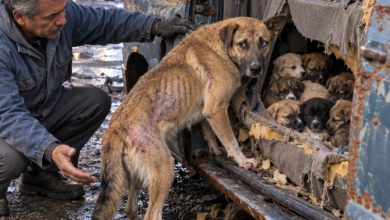
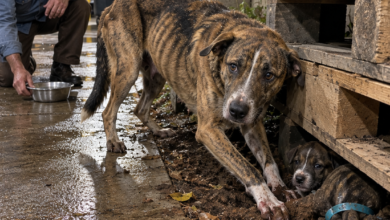
The dog was a female pit bull. White with gray patches. Maybe forty-five pounds — small for the breed. Her ribs showed through her coat, and the coat itself was patchy, thin in places, bare at the elbows where she’d been lying on concrete too long. Her ears were intact but scarred at the tips — bite marks, the vet would later say. From other dogs.
She had a cut across her left eye that had healed shut. One working eye. Brown. It moved around that courtroom like a searchlight.
Her name — on Gerald Faust’s registration — was Bella.
Elijah never called her that.
Two things I noticed during the hearing that didn’t mean anything to me at the time.
The first: when Elijah spoke, the dog’s breathing slowed. Not relaxed — regulated. Like a child hearing a lullaby. Like the voice itself was medicine.
The second: Elijah had scars on both forearms. Thin. Parallel. Not self-harm — they were too irregular, too jagged. They looked like something else. I didn’t know what.
I’d find out later.
Gerald Faust testified first.
He sat in the witness chair in clean khakis and a button-down shirt, and he told the court he’d owned the dog for two years. Bought her from a breeder in Clarksville. Kept her in the backyard, fenced lot, food and water, shelter. He described himself as a responsible pet owner.
He spoke clearly. He made eye contact with the judge. He used the word “property” four times.
When the prosecutor asked him to describe the night of the break-in, he said he’d come home from work at 6 p.m. and found his back door kicked in and a “young man” standing in his living room holding his dog.
“She was shaking,” Faust said. “He’d scared her.”
Elijah’s public defender — a woman named Tanya Rhodes, early forties, the kind of lawyer who wears flat shoes because she walks the halls all day — asked Faust three questions on cross.
“Mr. Faust, has your dog ever been to a veterinarian?”
“She didn’t need one.”
“Has your dog ever been inside your house?”
“She’s an outside dog.”
“Mr. Faust, has Animal Control ever visited your property?”
He paused.
“Once. A neighbor complaint. They found nothing wrong.”
Rhodes entered a document into evidence. It was the Animal Control report from that visit. The officer had noted: Dog appears underweight. Multiple scars on face and forelegs. Owner states dog is involved in “play fights” with neighbor’s dogs. No actionable violation at time of inspection. Follow-up recommended.
The follow-up never happened.
I wrote that down: follow-up never happened.
Then Elijah testified.
He was thin. Six feet, maybe 140 pounds. He wore a county-issued jumpsuit that was too big in the shoulders. His hands were in his lap, and they didn’t move the whole time he spoke.
He told the court he’d been sleeping in a drainage culvert off Dickerson Pike for three weeks when he first heard the dog.
“It wasn’t barking,” he said. “It was — smaller than barking. Like she was trying to make noise but was afraid to make too much.”
He said he walked to the fence and looked through a gap in the boards. The dog was chained to a cinder block in the yard. No water. A bowl of food that was empty and flipped over. She was lying on her side on concrete, and her ribs moved but the rest of her didn’t.
“I came back the next day,” he said. “And the next.”
For two weeks, Elijah came to the fence every night. He brought what he had — half a gas station sandwich, a handful of fries, a piece of bread. He pushed the food through the gap in the boards.
The dog wouldn’t eat while he was there. She waited until he stepped back. Then she crawled to the fence, ate, and crawled back to the cinder block.
“She was afraid of hands,” Elijah said.
His voice was steady when he said it. But his jaw tightened.
“On the fourteenth night, she ate while I was still there. She came to the fence and she ate from my hand through the boards.”
He stopped.
“That’s when I saw the wire.”
The chain wasn’t a chain. It was a wire — a thin gauge wire, the kind used for hanging ceiling fixtures — wrapped around her neck and twisted shut with pliers. It was embedded in her skin. The fur around it was gone. The skin was red and swollen and wet.
Elijah looked at the judge.
“I went home and got a pair of wire cutters from the construction site on Shelby Avenue. I came back at two a.m. I kicked in the back door. I cut the wire off her neck. I picked her up.”
He paused.
“That’s when the owner came home.”
The courtroom was quiet after that.
Judge Caldwell sat still for a long time. She looked at the file. She looked at Faust. She looked at Elijah.
Then she said, “Bring the dog in.”
The bailiff went out and came back with an animal control officer. The officer had the dog on a short lead. She was wearing a collar — not the wire, a new one — and she walked with her head low, her one good eye scanning the room.
The officer walked her down the center aisle.
They passed the gallery. They passed my row.
They reached Gerald Faust.
The dog stopped.
Her body went rigid. Her tail tucked so far under it pressed against her belly. She lowered herself to the floor — not sitting, sinking — and she urinated. A puddle spread on the courtroom tile. She didn’t look at Faust. She looked away from him. She pressed her body against the officer’s legs, trying to get smaller.
Faust shifted in his chair.
“She’s nervous,” he said. “Strange place.”
Judge Caldwell didn’t respond.
The officer walked the dog forward. Past Faust. Past the prosecution table.
Toward the defense table.
Elijah was sitting with his hands in his lap, still. He didn’t call the dog. He didn’t make a sound. He didn’t move.
The dog saw him.
Her tail came out. Slowly. Not wagging — just out, like a periscope checking whether it’s safe.
She pulled against the leash. The officer let the slack out.
She walked to Elijah. She put her front paws on his knee. She climbed — forty-five pounds of scarred, underweight pit bull — into his lap, and she put her head under his chin, and she exhaled.
The whole room heard it.
A long, slow breath. The kind you hold for weeks and release only when you finally feel the thing you’ve been waiting for.
Elijah’s hands came up. He held her. His eyes closed.
I looked at Judge Caldwell. Her glasses were off. She was pressing her thumb and forefinger against the bridge of her nose.
The courtroom reporter had stopped typing.
I thought that was the moment — the dog chose the boy, the judge saw it, case closed.
It wasn’t.
Tanya Rhodes stood up.
“Your Honor, I’d like to enter one more item into evidence.”
She handed a folder to the judge. Then she turned to Elijah.
“Elijah, can you tell the court how you knew what a wire embedded in skin looks like?”
The courtroom went still.
Elijah didn’t answer for a long time. The dog was still in his lap. His hand was on her back, moving in slow circles.
“Because I had one,” he said.
Rhodes opened the folder. Inside were photographs — taken at the county intake facility when Elijah was booked. The photos showed his neck. Beneath the collar of his jumpsuit, hidden until booking, was a scar. It circled his entire neck. Thin. White. The width of a wire.
“Elijah was removed from his home at age eleven,” Rhodes said. “His stepfather restrained him with electrical wire for extended periods. He was placed in foster care. He aged out of the system at sixteen. He has been unhoused since.”
She looked at the judge.
“He recognized the wire on the dog because he wore one.”
I stopped writing.
The scars on his forearms. I’d thought they were something else. They weren’t. They were from wire too — wrapped around his wrists when he was a child. Thin. Jagged. Irregular. Not self-harm.
Restraint marks.
Elijah had seen himself in that backyard.
A body on concrete. A wire cutting in. Afraid to make too much noise. Eating only when the hand was far enough away.
He didn’t rescue a dog.
He rescued the version of himself that nobody came for.
Judge Caldwell called a recess.
When she came back, she read her decision without looking up from the paper.
She dismissed the burglary charge. She cited Tennessee’s animal cruelty statute and initiated a separate investigation into Gerald Faust. She ordered the dog transferred to Elijah under supervised custody through a nonprofit foster arrangement.
Then she took off her glasses and spoke directly to Elijah.
“Mr. Vance, I have been on this bench for twenty-two years. I have seen thousands of cases. I have never let a dog into my courtroom before.”
She paused.
“I let this one in because the law wasn’t going to tell me the truth. She did.”
She looked at the dog in his lap.
“That animal urinated in fear when she passed the man who legally owned her. She climbed into the arms of the boy who broke down his door. The law says that’s burglary. That dog says it’s the only thing that should have been done.”
Faust stood up. His lawyer touched his arm. He sat back down.
The gallery was silent. A woman in the second row — I later learned she was a foster parent from Elijah’s file — was crying without making a sound. The bailiff was standing at the door with his arms at his sides, staring at the floor.
I thought about the Animal Control report. Follow-up recommended. No one followed up. No one knocked on the door again. No one came back to check on the dog with the scars on her face and the wire around her neck.
And I thought about the system that was supposed to hold Elijah. Removed at eleven. Foster care. Aged out at sixteen. A year and a half on the street. No one knocked on his door again either. No one followed up. The same two words, the same result — a body on concrete, waiting for someone to come back.
Elijah came back.
Every night for two weeks. With half a sandwich. With a handful of fries. Through a gap in the boards of a fence. At two in the morning with wire cutters he walked two miles to find.
A seventeen-year-old kid sleeping in a drainage culvert — no home, no family, no system that held him — came back for a dog that the county itself had checked on once and forgotten.
I sat in my car in the courthouse parking lot and thought about the breathing.
The way the dog’s breath slowed when Elijah spoke. Not relaxed. Regulated. Like a child hearing a lullaby from the one voice that never hurt her.
She wasn’t calming down.
She was remembering what safe sounded like.
I followed the story after the trial.
The nonprofit — a small Nashville rescue called Second Lead — placed Elijah in transitional housing. He got the dog. He still has her.
He doesn’t call her Bella.
He calls her Wire.
I asked him why once, during an interview at a coffee shop on Gallatin Road. He was sitting in a booth with Wire on the floor beside him, her head on his shoe. He’d gained weight. His hair was cut. He was enrolled in a GED program through the rescue’s partner organization.
“Because that’s what we both wore,” he said. “And we both took it off.”
Every morning, Elijah walks Wire down Dickerson Pike. Past the drainage culvert where he slept. Past the house on Dickerson where she was chained. The house is empty now — Faust was evicted after the animal cruelty investigation.
They walk past it every day.
Wire doesn’t flinch anymore. She walks with her head up. One eye open. Tail out.
Elijah told me he walks that route on purpose.
“So she knows she doesn’t have to be afraid of it,” he said.
He paused.
“So I don’t either.”
I keep the courtroom photo on my desk.
The one the sketch artist drew — the moment Wire climbed into Elijah’s lap. His eyes closed. Her head under his chin. Forty-five pounds of broken dog in the arms of a boy the system lost.
Two wires.
Two scars.
One of them broke down a door at two in the morning because he knew what it felt like to wait for someone who never comes.
She doesn’t wait anymore.
Neither does he.
If you’ve ever seen a dog tell the truth when no one else would — share this with someone who needs to hear it.