Part 2: My Mother Hadn’t Opened Her Front Door In 8 Months After Dad Died — Then A Starving Pit Bull Puppy Showed Up On Her Porch, And A Year Later My Brother Confessed What He Had Done
The puppy stayed on the porch for three days.
That’s what my mother told me, much later, when she could finally tell the story straight through without her voice breaking in the middle. Three days. He didn’t run away. He didn’t wander into a neighbor’s yard. He drank the water she set down. He ate the half-slice of wheat bread she put on a paper plate the second morning. And every time she opened the door to check, he was lying on her welcome mat in the same exact spot, like a small brown comma at the end of a sentence she did not yet know she was writing.
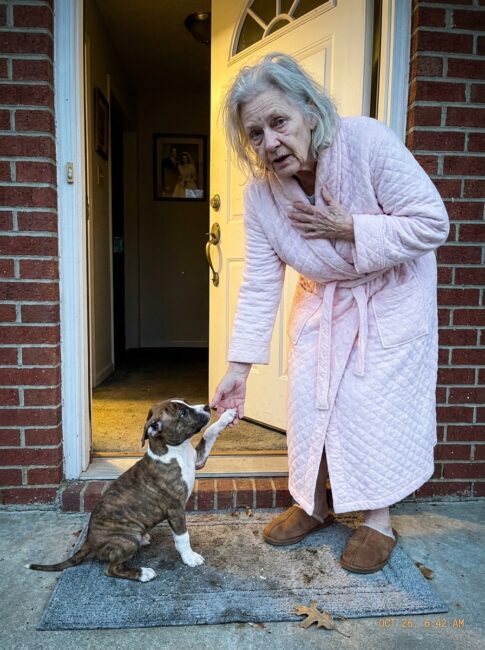
On the third night, it rained.
She told me she stood at the kitchen window for two hours watching him through the curtain. He had crawled under the porch swing. He was shivering. The temperature dropped to thirty-eight. At one in the morning, she opened the door and said, “Get in here. Just for tonight. Just until the rain stops.”
He walked in slowly. He did not jump up. He did not bark. He went straight to the rug in front of the cold fireplace, lay down, and closed his eyes like he had been waiting his whole short life to be invited inside that specific house.
My mother stood there in her nightgown looking at him.
Then she turned off the porch light, closed the front door, and locked it for the first time in months — instead of just leaving it unlocked the way she had been doing, half-hoping, I think, though she would never have admitted it, that someone or something would come.
She did not tell me about him for two more weeks.
The first time I knew anything was different was on a Sunday phone call in late October. I called at four. She picked up on the second ring instead of the sixth. Her voice had texture in it. Color.
I said, “Mom?”
She said, “Hi, honey. Listen, I have to call you back. The puppy got into the laundry basket again.”
I said, “What puppy?”
She paused. Then she laughed.
She actually laughed. I had not heard my mother laugh since February. It was a small, slightly guilty laugh, the kind a kid laughs when they get caught with their hand in the cookie jar. She said, “Oh. Right. I haven’t told you yet. There’s a dog. He’s mine now, I guess. His name is Noah.”
I sat down on my back porch in Murfreesboro and I did not know what to do with my hands. I had been waiting eight months for one good piece of news about my mother. I had not realized, until that moment on the phone, that I had stopped believing one was coming.
I said, “Mom. Can I come see him?”
She said, “Sunday. Bring the girls. I’ll make pot roast.”
She had not made pot roast since Dad died.
The first Sunday back at her house, my daughters cried in the car before we even went inside.
They were sixteen and fourteen. They had been worried about their grandmother for the better part of a year. When my mother opened the front door and stepped out onto the porch — actually stepped outside, in real shoes, with her hair brushed and a little lipstick on for the first time since February — they fell apart on the front lawn.
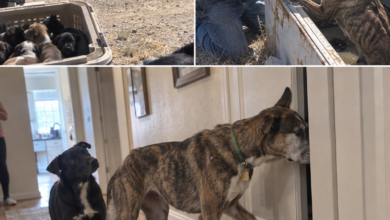
Noah came running out behind her. Twelve weeks old by then. Still thin but cleaner. He had grown into his ears. He greeted my daughters like they had raised him from birth.
We ate pot roast at the dining-room table. My mother told the puppy story three times, each time a little more vividly. The third time, she got to the part about the rainy night and she stopped and pressed her napkin against her eyes and said, “I don’t know why I didn’t let him in sooner. I was afraid. I think I was afraid he would die on me. Like Walter.”
That was the first time she had said my father’s name out loud at the dinner table since February.
It was also the first time anyone in our family understood, fully, what had been happening inside that house for eight months.
She had not been depressed in some abstract way. She had been hiding from one specific terrifying thing — the possibility of loving someone else, anyone else, even a little, and watching them go.
The puppy on the porch had walked her past it.
Slowly. One bowl of water at a time.
Carrie flew back from Denver the second weekend in November and stayed for five days. She and Mom and Noah went to a craft fair in East Nashville. They went to the grocery store. They went to the cemetery, which my mother had not visited since the headstone was set in May.
My mother told Carrie at the cemetery, with one hand on Walter’s headstone and the other on Noah’s leash, “I’m sorry I made you fly all this way for nothing in May, sweetheart. I wasn’t ready then. I don’t think I would have made it if you’d pushed me.”
Carrie called me crying from the airport on her way home. “Danny,” she said, “she’s coming back. She’s actually coming back. I didn’t know if she would.”
By Thanksgiving, our mother was almost herself.
Not the same — she will not be the same again, ever, and she has told us so, and we have stopped asking her to be — but herself in the ways that mattered. Cooking. Laughing. Telling stories. Asking about the grandkids. Putting on lipstick.
Mike came down for Thanksgiving with his wife, Janet, and their two boys.
He hugged Mom on the porch so long that Janet had to put her hand on his shoulder. He played with Noah on the living-room rug for an hour before dinner. He ate two full plates. He let Mom fuss over him. He called her Mama the way he had as a little boy, and she swatted him with a dish towel the way she had when he was eight.
It was the best Thanksgiving our family had had in a long, long time.
After dinner, while Mom and the kids were in the living room and our wives were starting on the dishes, Mike pulled me aside in the kitchen by the back door.
He said, “Danny. I need to tell you something. I have been holding this for fourteen months and I cannot anymore.”
I thought it was about money. I thought it was about his marriage. He looked terrified.
He said, “I’m the one who left the puppy on Mom’s porch.”
I did not understand him at first. I said, “What?”
He said, “In October. The Pit Bull. Noah. I drove down at five in the morning. I left him on the welcome mat with a small pile of dog food in a paper plate. I drove around the block four times to make sure she’d opened the door and brought him in. I almost stopped twice. I didn’t stop. I drove home to Louisville and I prayed the whole way.”
I had to lean against the counter.
He kept going.
He said, “Danny, I knew if I asked her — if any of us asked her — if she wanted a dog, she’d say no. She told Carrie no in May. She told you no every time you offered to come over. She would have told me no too. She would have told me especially. I was the one she would have apologized to and gently turned down. So I did not ask her.”
He looked at me with his eyes red.
He said, “I let the dog ask her instead.”
He said, “Because Mom can say no to her son. But she could not say no to something hungry on her porch.”
Mike had bought Noah from a small backyard rescue outside Louisville two weeks before he drove him down.
He had picked him out specifically. The lady who ran the rescue had pulled him from a county shelter where he was scheduled to be euthanized that Friday — a runt, ten weeks old, owner-surrendered, no medical issues but no takers because he was a Pit Bull and the shelter had eleven other Pit Bulls. Mike had paid the adoption fee. He had taken Noah home for two weeks to make sure he was healthy and house-trainable. He had told Janet what he was planning to do, and she had told him he was insane, and then she had cried, and then she had helped him pack a small bag of puppy food and a soft towel for the drive.
He drove down to Nashville at three in the morning on that Tuesday in October.
He sat in his truck across the street from Mom’s house for an hour and a half before he could make himself do it.
He carried Noah up the walkway at five-forty-five a.m. He set him down on the welcome mat. He whispered to that puppy, “Buddy. I need you to do something for me. I need you to stay right here. Don’t run. Don’t move. There’s a lady inside who is forgetting how to be alive. I need you to remind her.”
Then he scratched the door — once, lightly, with one knuckle — and walked back to his truck and drove away.
He told me all of this in our mother’s kitchen with the dishwasher running and our wives laughing in the living room and our mother teaching her grandsons how to give Noah a treat with the proper hand signal.
I asked Mike, “Why didn’t you tell us?”
He said, “Because if it didn’t work, I didn’t want her to know. And if it did work, I didn’t want her to feel tricked.”
I asked him, “Why are you telling me now?”
He looked through the kitchen doorway at our mother. She was on the floor in her good Thanksgiving slacks, scratching Noah’s belly, laughing at something one of his boys had said.
He said, “Because it worked, Danny. And because I think she needs to know, before too much more time goes by, that somebody fought for her. Even when she told us all to leave her alone.”
Mike told her on Saturday morning.
Carrie flew back in from Denver. We sat in Mom’s living room with coffee and Noah asleep across my mother’s feet, and Mike told her the whole story — the rescue, the shelter list, the drive, the prayer, the scratching at the door.
My mother listened without interrupting once.
When he finished, she was quiet for a long time. Noah snored.
Then she said, very softly, “I knew.”
Mike said, “What?”
She said, “Honey. I knew. Not at first. But by the third week, I knew. The puppy was too healthy. Too well-socialized. He sat when I said sit, by week two — somebody had been working with him until very recently. And he came when I called him by a name I made up, but he also came when I accidentally said Buddy once. I watched him on the porch on day two and I thought — somebody loved this dog yesterday.”
She looked at Mike.
She said, “I knew it was you. By Christmas, I knew. You were the only one of my children stubborn enough to do something like that and not tell me.”
Mike started crying.
My mother got up off the couch — slowly, carefully, the way she does now at seventy-six — and she walked over to where her middle son was sitting and she put both her hands on his face the way she did when he was a boy.
She said, “Michael. You did the only thing that would have worked. You knew me better than I knew myself.”
She kissed his forehead.
She said, “And you were right about one thing. I could say no to my children. I had been saying no to my children for almost a year. But I could not say no to something that was hungry on my porch in the rain. You knew that. You knew that about me before I did.”
Mike said, into his hands, “I’m sorry, Mama.”
She said, “Don’t you dare. Don’t you dare apologize to me for saving my life.”
That was eleven months ago.
Noah is almost two years old now. He is enormous — sixty-five pounds of muscle and joy, brindle and white, with a square head and a tongue that is always slightly too big for his mouth. He sleeps on the foot of my mother’s bed. He goes everywhere with her. He has a bandana for every season and his own Christmas stocking that hangs next to Dad’s on the mantel — my mother put Dad’s back up in December a year after she had taken it down, because, she said, “He should be here too. Noah would have loved him.”
My mother walks Noah twice a day around the same block.
She has met every neighbor on Eastland Avenue. She knows their names now. She knows their dogs’ names. She brought a casserole to a young couple who lost a baby in March. She joined a book club. She started gardening again — Walter’s tomato plants are back in the side bed, although Noah keeps stealing the green ones and burying them in the yard, which makes her laugh until she has to sit down.
She told me on the phone last Sunday, “I am not done missing your father, Danny. I will never be done. But I am done hiding from the world because of it. There is a difference.”
I wrote that down on a Post-it note in my office. It is still on my monitor.
I am forty-nine years old now and I want to remember it.
Every Thanksgiving since the confession, our family has a small ritual.
After dinner, after the dishes, before dessert — Mike walks out to the front porch alone for about five minutes. He sits on the porch swing. Noah goes with him. The rest of us stay inside and pretend not to notice. We don’t ask what he does out there. He doesn’t tell us.
But last year, on his way back inside, my fourteen-year-old daughter — who had been standing by the front window and seen more than the rest of us — asked him quietly, “Uncle Mike, what were you doing out there?”
Mike rubbed Noah’s head and smiled.
He said, “I was just thanking him, sweetheart. That’s all.”
I think about my brother sometimes — driving back to Louisville at six in the morning in October, alone in his truck, having just left a ten-week-old puppy on his depressed mother’s porch with no plan, no guarantee, no way of knowing if it would work — and I do not know how he found the courage.
I do not know how he carried that secret for fourteen months.
I do not know what it cost him to drive away that morning.
But I know this.
My mother opened her door because something hungry was on the other side of it. She fed it. She let it in. She let it stay. She let it walk her back into her own life one block at a time.
And the thing on the other side of the door had been put there, in the cold, by a son who knew that the only way to save his mother was to give her something that needed her more than she needed to keep grieving.
He didn’t ask her if she wanted help.
He let a puppy ask her.
She couldn’t say no.
Some doors don’t open for words.
Some doors open for hunger.
Some sons love their mothers in a language only puppies speak.
CTA for end of post: If this story moved you, follow the page — there are more like Eleanor and Noah I haven’t told yet.