Part 2: A 40-Year-Old Man Bought a Golf Cart in a Florida Retirement Community — But It Was His Pit Bull Who Found Him a Family
Part 2
The first invitation came from Lot 14, a pale yellow duplex with plastic flamingos in the mulch and wind chimes that sounded expensive enough to be inherited.
Her name was Marjorie Bell, and she was eighty-five, all silver curls, coral lipstick, and the kind of sharp-eyed hospitality that can still feel like interrogation if you haven’t been loved properly in a while.
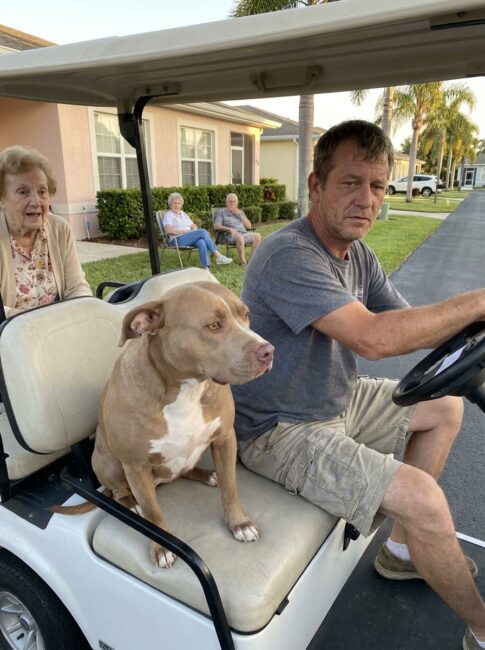
Daniel had slowed the golf cart because Putter had spotted her first.
That was how it always worked.
Putter noticed people the way some dogs notice squirrels—immediately, joyfully, with his whole body. Marjorie had just stepped out to water her potted begonias when the dog sat straighter, tail beating against the vinyl seat so hard it made the whole cart jitter. Daniel gave the usual small apologetic shrug people with friendly dogs develop.
“Sorry,” he said. “He thinks everybody’s his aunt.”
Marjorie laughed despite herself.
“Well, he’d be right this time.”
That was all it took.
Daniel parked at the curb. Marjorie crouched more carefully than she used to and let Putter sniff her fingers first. Then she did what older women with biscuit tins and private grief often do when a good dog appears unexpectedly in front of them.
She adored him on sight.
Putter leaned in.
Marjorie cooed something ridiculous.
Daniel sat there with one forearm on the steering wheel, smiling politely and waiting for the interaction to end.
It didn’t.
Marjorie looked up at the dog, not the man, and said, “Would this handsome boy like a biscuit?”
Putter answered by almost stepping off the cart.
Daniel laughed once. “He definitely would.”
“Bring him inside a minute, then.”
She said it so casually that Daniel almost obeyed before the sentence registered properly.
Bring him inside.
Not both of you.
Not come in.
Bring him.
Marjorie had already turned toward the front door.
Daniel clipped on the leash and followed her up the walkway, then stopped at the threshold when she opened the storm door and held it wide for the dog.
“Go ahead, sweetheart,” she said to Putter.
The dog looked back at Daniel for permission.
Daniel gave the leash a tiny slackening nod.
Putter stepped inside.
Daniel remained on the porch for half a second too long, waiting for the natural companion sentence to arrive.
It didn’t.
Marjorie smiled over her shoulder in a perfectly unembarrassed way. “He’ll only be a minute.”
Then the door shut most of the way, leaving Daniel outside looking at his own reflection in the storm glass like he had just delivered flowers nobody ordered for him.
He went back to the golf cart and sat there.
For nineteen minutes.
Long enough to hear Marjorie laughing at something inside. Long enough to watch two bicycling retirees pass slowly and pretend not to notice that the younger man with the pit bull was waiting outside like a chauffeur whose client had gone in for tea. Long enough to feel first ridiculous, then wounded, then strangely grateful that at least one living creature associated with him had been welcomed somewhere.
When Putter finally came back out, he smelled like store-bought peanut butter biscuits and triumph.
Marjorie leaned in through the passenger side of the cart to scratch under his chin. “Same time tomorrow?” she asked the dog.
Then, almost as an afterthought, she added to Daniel, “You too, I suppose, if you’re driving.”
That became the pattern.
Not every day.
Often enough.
Putter made friends first.
Daniel hovered at the edges.
At Lot 22, a retired mail carrier named Frank Letts left a bowl of ice water on the porch every afternoon because “that dog pants like he’s trying to cool the whole state of Florida.” At Lot 31, a widow named Ginny with arthritic fingers and a dead husband’s workshop still full of untouched tools started keeping liver treats in a ceramic jar labeled BUTTONS because that had once been her poodle’s name and relabeling the jar felt too much like betrayal.
Nobody was rude to Daniel exactly.
That almost made it harder.
They were polite in the way communities can be polite when they have not yet decided whether you are temporary, tragic, or simply not one of them. People waved at him from lawn chairs, then bent forward to talk directly to Putter. Men who had spent years distrusting pit bulls found themselves kneeling in khaki shorts to scratch his chest while Daniel remained standing with the leash in his hand like an extra in the dog’s social life.
The second major invitation came from Frank.
He was seventy-eight, sun-leathered, stooped just enough to suggest stubbornness rather than weakness, and lived alone with three framed military portraits on the hallway wall and a habit of leaving his TV too loud. The first time Putter saw him, the dog whined until Daniel pulled over.
Frank stepped out with a mason jar of water and said, “This for the dog or me?”
Putter made the decision by heading straight for him.
Frank laughed and held the door open with his hip. “Come on in, then.”
Again, the invitation attached itself to the dog first.
Again, Daniel stayed outside.
Again, he told himself it didn’t matter.
By the fifth time it happened—with different houses, different biscuits, different old stories being poured into the dog’s ears while Daniel waited in the cart watching evening light slide across perfectly clipped lawns—he had begun to understand something humiliating.
Putter was not merely making the neighbors softer.
He was making Daniel visible by degrees they could tolerate.
They did not know what to do with a forty-year-old inheriting a dead grandmother’s house and moving into retirement without a wife, without children, without the easy narrative of medical necessity or midlife reinvention. They knew even less what to do with a man who seemed lonely but not conversational, decent but not practiced in being received. Putter solved that by being impossible not to greet.
The dog was the bridge.
Daniel was the toll waiting on the other side.
It might have stayed that way too, except for the seventh visit to Frank’s house.
That evening, Putter trotted inside like he owned half the deed. Daniel stayed in the cart as usual, listening to cicadas and the soft clink of ice in someone’s glass. After a few minutes, Frank opened the screen door and stood there looking mildly annoyed.
“You coming in or not?”
Daniel blinked. “I’m sorry?”
Frank jerked his chin toward the living room. “Putter already took the good rug. Might as well come get coffee before he starts paying taxes.”
Daniel laughed before he could stop himself.
It startled both men.
That was the first real crack in the wall.
And once it opened, the whole community began changing in ways Daniel had never quite dared to hope for.
Part 3
Coffee with Frank became Thursday.
Then Thursday turned into “stop by if the lights are on,” which in retirement communities is less an invitation than the beginning of kinship.
Frank was not easy company in the polished social sense. He complained about everything that deserved it and much that did not. The HOA. Weather forecasts. His own knees. The decline of diner pie. But he treated Daniel with the casual roughness older men sometimes reserve for people they’ve decided to accept before either party is ready to say so.
Putter accelerated the process shamelessly.
If Frank had a biscuit, the dog nudged Daniel’s leg until he sat down too.
If Daniel remained too long on the porch, Putter would walk halfway into the living room, look back, then return to the threshold and stare until Daniel followed, as if embarrassed on his owner’s behalf.
The dog performed this social engineering all over Palm Palms Village.
At Marjorie’s, he placed his chin on Daniel’s knee while she told stories about meeting her husband in 1958 and losing him in 2019, thus trapping Daniel in the chair long enough to hear not just the polished version, but the real one involving cigarettes, infidelity, forgiveness, and one secret bank account she discovered after the funeral and never told anybody about.
At Ginny’s, Putter once dragged Daniel by the shoelace toward the kitchen while the old widow stood at the stove pretending she had not cooked too much chicken and dumplings “by accident.”
At a corner unit overlooking the retention pond, a retired nurse named Loretta began leaving crocheted dog blankets folded over the porch rail for “that sweet bowling-ball-headed creature,” and Daniel, forced to ring the bell and say thank you, ended up being invited to stay because Loretta had opinions about every medication ever prescribed in America and needed someone young enough to move the patio fan while she argued with him.
One by one, the invitations changed shape.
At first: Bring Putter by.
Then: Bring Putter and stay if you want.
Then, eventually, and far more tenderly for how rarely it was spoken aloud: You should come even if the dog’s asleep.
But Daniel rarely came without him.
That detail mattered too.
Putter was not a prop in the story of Daniel’s social recovery. He remained the emotional logic of it. People trusted the dog’s judgment long before they trusted their own read on the younger man. If Putter pressed close to Daniel, they assumed he was safe. If Daniel scratched absentmindedly behind the dog’s ears while listening instead of talking, the silence no longer looked suspicious. It looked like character.
Two years is a long time in a retirement community.
Long enough for new medications, cane replacements, shingles, memorial services, fresh gossip, dead lawns, new knees, and one pit bull to redraw the borders of social belonging.
In those two years Daniel learned who kept extra sugar packets in purses and who still balanced checkbooks by hand. He learned which widowers ate canned soup unless someone interrupted them. He learned that Marjorie’s coral lipstick meant she was having a hard day because she only wore it when she needed reminding she was still a woman and not just a widow with begonias. He learned that Frank left one porch light on after midnight because darkness pressed too heavily against him when the house went entirely black.
And the elders learned him too.
They learned that Daniel had moved in after losing not only his grandmother, but also the vague unfinished version of himself he thought would exist by forty. That he had once been married briefly and badly, and the marriage had ended not with infidelity or drama but with two exhausted adults deciding loneliness together was somehow lonelier than loneliness alone. That he freelanced remotely doing bookkeeping for small businesses, which explained why he was always home. That he had spent most of his first year in Palm Palms eating takeout alone because every community event felt like trespassing on someone else’s nostalgia.
He did not volunteer these things at once.
People earned them.
That was part of why the friendships held.
One Sunday in late October, Loretta called him because her ceiling fan had stopped working. Daniel came over with a step ladder and a screwdriver. Putter sprawled in the kitchen while Loretta complained about contractors. By the time Daniel fixed the wiring, Ginny had arrived with peach cobbler “because I happened to bake one,” and Frank wandered in without knocking because nobody in Palm Palms respected doors once affection had been established. Marjorie came by ten minutes later carrying napkins and insisting she had only come to return a casserole dish, though she was not carrying one.
The six of them ended up eating around Loretta’s table while Putter sat exactly in the middle of the kitchen floor accepting tributes like an emperor disguised as a rescue dog.
Someone said, “This is becoming a thing.”
Someone else answered, “Then make it Sunday.”
They did.
Sunday dinners started with four people, then six, then eight.
By spring, the standing group included Frank, Marjorie, Ginny, Loretta, two married couples in their seventies who argued in the affectionate professional tone of people married long enough to know the fight will outlive both of them, and Daniel. Sometimes an extra neighbor joined. Sometimes somebody missed because of cardiology appointments or grandchildren or grief. But the circle held.
And in the center of it, almost every week, sat Putter.
Not at the table, obviously.
Under it.
Between knees and dropped napkins and orthopedic shoes.
He moved from lap to lap in spirit if not in size. He learned who dropped roast chicken on purpose and who cried after a second glass of wine. He placed his square heavy head in the right thigh at the right moment with a timing Daniel privately believed bordered on supernatural.
One night, after Marjorie had told a story about her sister’s dementia and gone quiet halfway through the punchline, it was Putter who crossed the room and leaned against her shin until she finished the sentence. Another week, when Frank’s blood pressure medication had him shaky and irritable, Putter parked himself so firmly against the old man’s leg that Frank had to rest one hand in the dog’s fur to keep from dropping his fork.
By then the neighborhood had a name for them.
Not Daniel and the retirees.
Not the Sunday crowd.
Putter’s family.
It started as a joke, then survived because no better phrase arrived.
“The card game’s at Putter’s family tonight.”
“Did you hear Loretta invited Putter’s family for brisket?”
“Frank’s at the clinic, someone call Putter’s family.”
Daniel would hear this and pretend it didn’t move him every single time.
But once, after dinner, while loading casserole containers into his golf cart basket and clipping on Putter’s leash in the orange wash of a Florida sunset, he said the truest thing he had said in years.
“I didn’t have friends,” he told Frank softly. “Not really. Then Putter had friends. After that, I was ‘Putter’s owner.’”
Frank snorted. “You make that sound like a demotion.”
Daniel looked down at the dog and smiled into the fading light.
“No,” he said. “It was enough.”
That line might have been the whole story if life had stayed simple.
But Palm Palms was aging in real time, and love in retirement communities is never abstract for long. Knees fail. Memory frays. Spouses die. People vanish from the dinner table one pill organizer and one ambulance ride at a time. What mattered was not just that Daniel had been let in.
It was that, over time, he became one of the people who stayed.
Part 4
The winter Frank fell and spent six weeks in rehab, Daniel was the one who watered the man’s tomatoes, checked his mail, and made sure the television remote still had batteries for the day he came home.
When Ginny’s daughter flew in from Arizona after a minor stroke and announced with the brisk righteousness of distant adult children that her mother should “probably stop hosting all these people,” it was Daniel who quietly moved the casseroles to his own house the following Sunday so the dinners could continue without anyone having to call them necessary.
When Marjorie finally admitted she couldn’t see well enough to drive her own golf cart to the mail kiosk after dusk, Daniel started picking up her letters during his afternoon loop. She repaid him in biscotti and gossip, which in Palm Palms counted as legal currency.
Putter, of course, remained the soft center of all of it.
He grew older without losing his delight. His muzzle silvered. His hips stiffened just enough that Daniel added a foam pad to the golf cart seat and lifted him more often than the dog preferred to admit was helpful. Yet every evening when the key turned and the little cart hummed to life, Putter climbed in with the same thumping expectation he had on the first lonely loops.
The route changed over time.
Less circling. More stopping.
More porches.
More names.
At Lot 14, Marjorie still kept biscuits in a floral tin specifically for him.
At Frank’s, there was always water in a metal bowl on the porch and one old man pretending the dog preferred his company to anyone else’s.
At Loretta’s, Putter no longer scratched at the door because she had installed a ridiculous little dog-level bell on the outside wall labeled PRESS FOR SERVICE, and he had learned that one paw there summoned both a person and a treat.
Some evenings Daniel drove the loop alone for a few extra minutes after dropping people home from dinner or picking up a prescription or repairing one more misbehaving lanai light. On those drives he would glance over at Putter in the passenger seat and feel, not gratitude exactly, because gratitude was too neat a word for what had happened.
The dog had not just introduced him.
He had translated him.
Made his silences legible.
Made his awkwardness affectionate instead of suspect.
Made a community of aging strangers feel less like a museum of endings and more like a place where life was still happening in stubborn, crockpot, blood-pressure-checking, porch-sitting ways.
Two years after Daniel moved into Evelyn Wexler’s house, Palm Palms no longer called him the golf cart ghost.
He had become Daniel from Lot 6.
Or, more often, Putter’s Daniel.
And once you are named inside a place, you are no longer merely living there.
One Sunday in early spring, the whole group gathered around Daniel’s patio because it was the only one big enough to fit eight folding chairs and one dog bed large enough for Putter to ignore. Someone brought chicken salad. Someone else brought rolls nobody admitted were store-bought. Marjorie wore coral lipstick. Frank argued about baseball statistics no one else cared about. The married couple in their seventies bickered gently over whether the key lime pie needed more lime or more mercy.
Halfway through the meal, Loretta raised her glass and said, “To Putter.”
Everyone echoed it.
Putter, asleep under the table with his head on Daniel’s shoe, lifted one eyelid and went back to dreaming.
Daniel laughed.
Then stopped laughing because something inside him had caught.
Not painfully.
Just enough.
He looked around the table—at the spotted hands, sun-thinned skin, hearing aids, bifocals, pill bottles tucked discreetly into purses, all these people who had once seemed closed to him and who now texted him when their ceiling fans rattled or their knees gave out or they simply did not want to eat dinner alone.
He said, more softly than the toast had been offered, “I think he found all of us.”
Nobody corrected him.
Later that night, after chairs had been folded, leftovers packed, and the last golf cart had buzzed away into the warm dark, Daniel sat on the front steps with Putter beside him. The community had gone mostly quiet except for sprinklers clicking on in distant sections and one television laugh track escaping through a cracked lanai door.
Putter leaned his heavy head into Daniel’s thigh.
Daniel rested one hand on the broad warm skull.
For a long while he said nothing.
Then, to no one and exactly the right witness, he spoke into the dark.
“I thought inheriting this house meant I got stranded in somebody else’s last chapter.”
Putter thumped his tail once without opening his eyes.
Daniel smiled.
“Turns out,” he said, “I just came in through the dog entrance.”
That line would have embarrassed him if anyone else had heard it.
But some truths are better spoken where only a dog can keep them.
The next afternoon, as always, they took the golf cart out.
Past the mail kiosk.
Past the shuffleboard courts.
Past the pond where the ducks behaved like union workers and refused to move unless bribed with bread.
People waved before the cart even slowed.
Marjorie came out with biscuits.
Frank shouted that the coffee was already on.
Loretta rang her ridiculous bell from the porch for no reason other than joy.
Putter’s tail started thumping against the seat like a second heartbeat, steady and sure.
Daniel glanced around the neighborhood that no longer felt borrowed.
Then he looked at the dog.
There are stories where a man rescues a pit bull and everyone notices the dog change. This was not exactly that kind of story. In Palm Palms Village, the dog had changed less than the people around him. He arrived friendly. He stayed friendly. It was the humans who learned, slowly and a little foolishly, how much easier love can be when it first enters a room on four legs and asks for nothing except a biscuit and a place to sit.
If stories like this stay with you, follow the page and come back for the next one.