Part 2: My New Pit Bull Always Slept In The Exact Middle Of Every Room — When I Found Out Why, I Drove Two Hours To Apologize To His Old Family
The first night I had Banjo, I did not realize anything was unusual.
He came home with me from the rescue at three in the afternoon on a Saturday. I had stocked up on everything the websites had told me to buy — two stainless steel bowls, a six-foot leather leash, a memory-foam dog bed in a corner of my bedroom, three different chew toys in a basket by the front door, and a small bag of high-quality kibble that I had paid more for than I usually paid for my own groceries.
He walked into my apartment. He sniffed the corners. He sniffed the kitchen. He came back into the living room. He looked up at me where I was sitting on the couch.
Then he walked to the middle of the rug, turned around twice, and lay down.
I thought it was sweet. I thought he was choosing me. I thought he was lying close because he wanted to be near.
It was only by Sunday afternoon, when I had moved to my desk in the office to do some weekend work, that I noticed he had followed me. He had walked into the office, looked around, and lay down — not at my feet under the desk where the warm draft from the laptop fan would have hit him, not on the small bath mat I had thrown in there in case he wanted somewhere soft, but in the geometric center of the floor, exactly in the middle, where he was equidistant from the desk, the bookshelf, the closet, and the door.
I made a note of it in my head. Funny dog.
By Monday night, I had noticed it three more times. By Wednesday, I was filming it on my phone to send to my sister. By the end of the second week, I had a small private collection of videos of Banjo lying in the exact middle of every room in my apartment.
I started measuring in week four. I had a soft tape measure in a kitchen drawer from a sewing project. I unrolled it across the rug while Banjo was lying on it, watching me sideways with one eye half-open, and I measured the distance from his shoulder to each of the four walls of the living room.
The differences were within two inches.
He was not lying near the middle. He was lying in the middle. He had picked the geometric center of a room without a tape measure, with his body, by feel.
I sat down on the floor next to him and I said, out loud, “Buddy. What is going on with you?”
He thumped his tail twice. He did not move.
I started taking him to therapy with me in week five.
Dr. Mona Aguirre had been my therapist for almost two years. She had a small soft office in the Lyn-Lake neighborhood of Minneapolis with a beige rug between two armchairs, a low coffee table with a box of tissues on it, and a window that looked out onto a maple tree that had just gone red for the season.
I had asked her, the session before I brought Banjo for the first time, if I could bring him. She had said yes. She had said it would be good. She had a soft spot for Pit Bulls — she had grown up with one, she told me, in San Antonio in the seventies, a dog named Reina who had slept under her bed every night until Mona was nineteen.
The first session Banjo came to, he walked into her office, looked at her chair, looked at my chair, and lay down on the rug in the exact middle between them.
He stayed there for the full fifty minutes without moving.
Mona did not say anything about it that session. Or the next one. By the third session — the one I want to tell you about — she had started watching him.
She was in the middle of asking me a question about my mother when she stopped mid-sentence and looked at Banjo on the rug.
She said, “Reese. Where do you sit at your kitchen table at home?”
I said, “In the chair closest to the wall. Why?”
She said, “And where does Banjo lie when you eat dinner?”
I said, “In the middle of the kitchen. He always lies in the middle.”
She said, “And if there were four people at your kitchen table, one in each chair, where would the geometric center of those four people be?”
I sat there for a moment. I worked it out in my head.
I said, “In the middle. On the floor. Where Banjo lies.”
Mona put her hand over her mouth. She did not say anything for almost a full minute.
When she finally took her hand down, she said, “Reese. I don’t think he is choosing the middle because he wants to be the center of attention. I think he is choosing the middle because it is the only spot in the room where he is equally close to every person who could be in it.”
I did not understand. I said, “What do you mean?”
She said, “I think your dog has a family in his head. Four people. One in each corner of every room he has ever lived in. And the only place in the room where he doesn’t have to be far away from any of them is the middle. He is not lying in the middle for himself. He is lying in the middle for them.”
She paused.
She said, “Reese. I think he is holding people together with his body.”
I called Diane at the rescue the next morning.
I said, “Diane. I need to know about his old family. The full intake. Whatever you have.”
She paused on the phone.
She said, “Can I email it to you?”
She emailed it to me an hour later.
The file was eleven pages. Most of it was medical — vaccination records, a neutering at age two, a flea-and-tick history. Behavioral observations from the foster he had been with for six weeks before I adopted him. A few notes from the original surrender form.
The surrender form was on page seven. It had been filled out by a woman named Karen Halverson on a Tuesday in August of 2024.
It listed the reason for surrender as Family unable to keep dog due to divorce. Both adults relocating to apartments that do not allow Pit Bulls. Children moving between households on rotating schedule. Dog deserves a stable home.
It listed the household composition at the time of surrender:
Karen Halverson, 41, mother Rob Halverson, 43, father Maddie Halverson, 14, daughter Jaxon Halverson, 11, son
Four people.
The behavioral notes were on page nine. They had been written in clean handwriting by Diane herself after a home visit she had done at the family’s house the week before the dog had been brought into the rescue.
There were three sentences in those notes that I read three times. I read them once, then I closed the laptop, then I opened it again, then I read them a second time, then I had to stand up and walk around my kitchen for ten minutes, then I sat down and read them a third time.
The three sentences were these.
Subject’s preferred resting position is the geometric center of any room. During home visit, all four family members sat in separate corners of the living room. Subject lay in middle of room facing all four simultaneously, did not move for the duration of the visit (approx. 90 minutes).
I sat at my kitchen table with my laptop in front of me and Banjo lying in the middle of my kitchen floor. I looked at him. He looked up at me. He thumped his tail twice.
I said, out loud, to a 60-pound Pit Bull who had been holding a divorcing family of four together with the position of his own body for years, “Oh, buddy. Oh, my God. I am so sorry.”
I did not sleep that night.
I sat on the couch in my living room and I watched Banjo lying in the middle of the rug. I tried to picture it. A house I had never seen, in a neighborhood I did not know, with a mother in one corner and a father in another corner and a fourteen-year-old girl in a third corner and an eleven-year-old boy in a fourth corner. Two parents who could no longer stand to share a couch. Two kids who had pulled themselves into opposite corners because that is what kids do when their parents are coming apart.
And a dog. In the middle. Trying to be near all four of them at once. Refusing to choose. Refusing to lie close to one and far from another. Refusing to leave any of them alone in their corner.
I thought about how long he must have done that. The notes had said he was four. He had probably been with the Halversons since he was a puppy. The divorce had not happened in a single year. These things take time. He had probably watched the corners of his family pull further apart for years before he started lying in the middle of every room. Maybe he had done it from the beginning. Maybe he had been doing it at six months old. Maybe he had been the only thing in that house that was still touching all four of them.
I thought about how, when the family finally broke and the parents had moved into apartments that would not take him, the dog had not actually known the family was over. He had just been put in a strange car and driven to a strange place and left there with strange people. He had not been told. He could not have been told.
He had kept lying in the middle.
He had been lying in the middle of foster homes for six weeks before I got him, looking for the four people he could not find, refusing to give up his post.
Then I had brought him home, and he had lain down in the middle of my one-bedroom apartment in Minneapolis, and he had been waiting for them to come back.
He was still waiting.
I cried so hard that night that I went and sat on the rug in the middle of my living room next to him. I put my arms around him. He let me. He did not move. He was sixty pounds of warm ribs and slow breathing, and I cried into the side of his neck for a long time, and at some point I fell asleep there with my arm around him, and when I woke up at five in the morning, he had not moved an inch.
He was still in the middle of the rug.
He was still on the job.
I called Diane on Saturday morning. I asked her if she could give me the Halversons’ contact information.
She said she could not, but she could pass a message.
I asked her to please, please ask Karen Halverson if I could come visit. I told her why. I told her what I had figured out. I told her I needed Karen — and Rob, if he would come — and the kids, if they would come — to know what their dog had been doing for them. I said I thought they needed to hear it from somebody.
Diane called me back two hours later.
She said, “Karen says yes. Sunday afternoon. They’ll all be there. Rob is driving over. The kids are with Karen this weekend. Two o’clock. She gave me the address.”
The address was in a small town two hours north of Minneapolis.
I drove up on Sunday morning. Banjo sat in the passenger seat the whole way. He did not lie down. He sat up. He watched the road.
I think he knew. I cannot prove it. But he knew.
The Halversons’ old house was a small brown colonial on a quiet street with two big oak trees in the front yard. Karen had arranged for everyone to meet there even though the house was on the market and empty — she had told Diane she wanted the dog to come back to the room, not to one of the new apartments that had only ever been half a family.
I pulled into the driveway. There was a dark green minivan there already. A man in a Carhartt jacket was sitting on the front steps. He stood up when I got out of the car. The front door opened and a woman came out with two teenagers behind her — a girl with her arms crossed, a boy with his hands in his hoodie pocket.
The four of them stood on the steps and they looked at the car. Then I opened the passenger door, and Banjo jumped down, and he looked at the four of them on the steps.
He did not run to them. He did not bark. He did not wag.
He walked. Slow. Calm. Up the walkway. Past Rob on the bottom step. Past Karen on the second step. Past Maddie. Past Jaxon. Through the open front door.
We all followed him in.
He walked through the empty foyer into the empty living room. The carpet was still there. The walls were bare. The furniture was gone. The room was a perfect rectangle of empty cream-colored carpet.
Banjo walked to the exact center of the room.
He turned around twice.
He lay down.
Then he looked up at the four of them — Karen in the doorway, Rob behind her, Maddie next to Rob with her arms still crossed but her face starting to crumble, Jaxon with his hood pulled all the way up — and he thumped his tail twice. Just twice. The way he always did.
Karen made a noise I cannot describe.
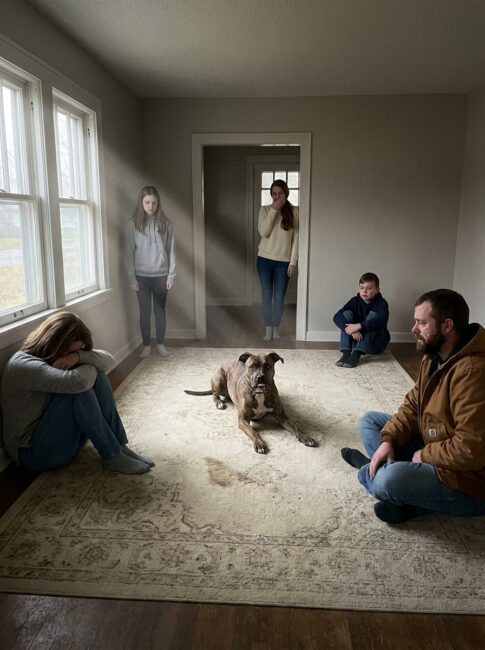
She walked into the room. She sat down in the corner where she used to sit. Rob walked in. He sat down in the corner where he used to sit. Maddie walked in slowly, dropping her arms, and sat down in her corner. Jaxon walked in last, pulled down his hood, and sat down in his.
Four people. Four corners. A dog in the middle.
Banjo did not move. He looked at all four of them.
I stood in the doorway with my hand over my mouth and I watched a family that had been broken for a year and a half remember, by sitting in their old corners around their old dog, that they had once all been in the same room.
The Halversons did not take Banjo back. They could not. Karen and Rob both lived in Pit-Bull-banned buildings now and could not change leases. The kids were too young to make decisions like this on their own.
But before I left that house, all four of them sat in the middle of the room on the floor with Banjo. They put their hands on him at the same time. Karen on his head. Rob on his back. Maddie on his front paw. Jaxon on his ribs.
Banjo lay in the middle of all four of them and he closed his eyes. He breathed slow. His tail thumped twice.
He had finally been in the middle of his family again.
When it was time to go, Maddie cried. Jaxon cried. Rob, a forty-three-year-old man in a Carhartt jacket, cried into the back of his hand.
Karen said to me, in the doorway, “Take care of him. He took care of us for a long time. Even when we couldn’t take care of each other.”
I said I would.
I drove home in silence with Banjo in the passenger seat. He sat up the whole way, the way he had on the drive up. He did not lie down. He watched the road.
That was eight months ago.
Banjo still lies in the middle of every room in my apartment. He still has not used the dog bed in the corner. He still picks the geometric center of every space he enters and he still shows up to the job every single time.
But the meaning of it has changed for me.
I do not see him as a clown anymore. I do not see him as a show-off. I do not see him as a dog who loves attention. I see him as a dog who, four years ago at six or eight weeks old, walked into a house in a small town two hours north of Minneapolis and decided that as long as he was alive, no one in that family was going to be alone in their corner.
Karen and Rob check in on him now. The kids text me pictures of themselves to show him. Maddie sent me a video last week of herself playing the violin — she had remembered that Banjo used to lie in the middle of the music room when she practiced, and she wanted me to play the video for him so he could hear her.
I played the video for him.
He lay in the middle of my living-room rug and he closed his eyes and he listened to her all the way through.
I think about him sometimes when I am writing late at night and he is on the rug in the middle of my apartment.
I think about how he is sixty pounds of muscle and a square jaw and a pink tongue, and how he looks like the kind of dog people cross the street to avoid, and how, all this time, he has been doing the most tender job a dog can do.
He has been refusing to be far away from anyone he loves.
Even when the people he loves cannot stand to be in the same room.
Even when there are no people in the room at all.
He keeps the middle.
He waits.
If this story moved you, follow the page — there are more like Banjo and the Halversons I haven’t told yet.