Part 2: An Old Pit Bull Spent Ten Years at Our Shelter and Nobody Adopted Him. Every Time We Got a New Puppy, He Did the Same Thing at Night. We Did Not Understand What He Was Doing Until We Read the File of the Woman Who Surrendered Him in 2014.
Part 2
Moose was surrendered to the Stockton County Animal Shelter on the afternoon of March 14th, 2014.
He was four years old at the time. Sixty-one pounds. Brindle-and-white Pit Bull mix. A small notch in the top of his right ear that had healed years before. Soft brown eyes. Calm temperament. The surrender note in our intake binder, filed by a part-time receptionist named Karen who has long since retired, listed him as “good with kids, good with cats, good with other dogs, no history of aggression.”
The reason for surrender was listed in one line.
Owner deceased. No family to take dog.
The owner’s name was Linda Caruthers. She had been forty-seven years old. The address on the surrender form was a small house on East Hammer Lane that was rented at the time and has changed hands twice since. The person who actually brought Moose in was listed as Linda’s neighbor — a woman named Donna Pruitt — who had signed the form on Linda’s behalf the day after Linda’s funeral.
That was all we knew.
That was all we knew for ten years.
I started at the shelter in October of 2012. Moose came in two years after that. I met him on his second day. He was sitting in the middle of kennel three with his front paws crossed, looking at the wall, in the way some dogs do when they have decided that the new place is the place now and there is no use being upset about it.
I took him out for his first walk that evening.
He walked beside me on a loose leash. He did not pull. He stopped at every corner. He sat without being told when I stopped to talk to a coworker in the parking lot. He was, without exaggeration, the easiest dog I had ever walked in the two years I had been there.
I went home that night and I told my husband: “We’re going to have a hard time keeping him. Somebody is going to adopt him in a week.”
It did not work out that way.
In Moose’s first six months at the shelter, we had eleven applications for him. None of them went through. Two were denied during the home check. One adopter changed her mind. One adopter took him home and brought him back the next day because her boyfriend “didn’t like the look of him.” Three were people who had wanted a puppy and had taken one look at Moose’s gray-flecked muzzle and walked past. Four were people who, the day-shift staff later told me, had never returned our follow-up calls.
By the end of his first year, the applications had dropped off.
By the end of his second year, we had stopped putting him on the website’s “available now” page, because every time we did, he got passed over, and we had started to suspect — though we would never have said this out loud — that being on the website was hurting him.
By the end of his third year, Moose was a fixture.
He was the dog every volunteer knew by name. He was the dog who came out for the Saturday community walk every weekend. He was the dog new staff were introduced to first. He was the dog that, the day-shift manager Pilar joked, had a longer tenure at the shelter than most of us did.
Nobody asked, anymore, why he had not been adopted.
There was one detail about him I am going to mention now, because it matters at the end.
Every single night, after I did my eleven-forty-five walk-through, Moose would do one specific thing.
He would walk to the front of his kennel.
He would sit down facing the hallway.
He would look toward the intake door at the front of the building for about three minutes.
Then he would lie down again.
He did this every night. For ten years. I assumed, in the way you assume things about a dog after a while, that he was checking. That he was making sure nothing new had arrived. That he had developed a routine.
I did not understand, until I read the file in July, that he had been checking on purpose.
He had been checking for puppies.
Part 3
The puppies started getting noticed around year three.
I had been keeping the count, by then, in a small green notebook I kept in the bottom drawer of the intake desk. I had not told anyone I was keeping it. I just wrote down, on the dates the puppies came in, what Moose did.
By year three, the count was at twelve.
Pebble. Domino. A Beagle named Sundance. Two pit-mix siblings named Mango and Mochi. A Chihuahua named Pez. A husky-mix named Storm. A Lab named Olive. A pit puppy named Bean. A shepherd-mix named Birdie. A pit puppy named Daisy. A Boxer-mix named Sergeant.
He did the same thing every time.
He waited until the building was quiet. He waited until I had turned off the lobby lights. He waited until the new puppy had cried itself into the kind of exhaustion where a small animal stops crying not because it feels better but because it cannot cry anymore.
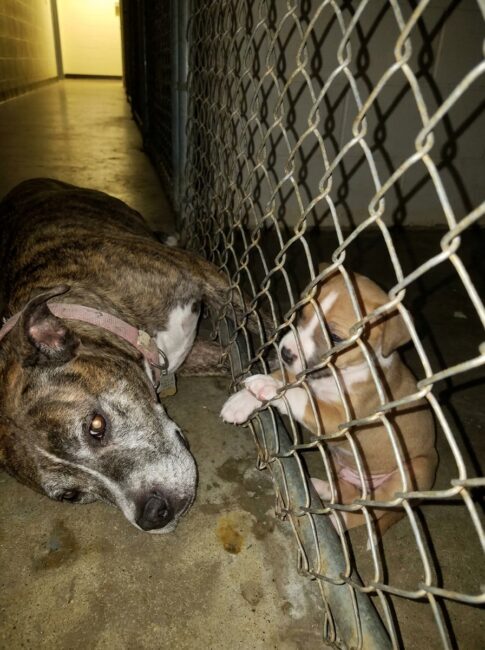
Then he got up. He walked to the front of his kennel. He turned and walked back to the chain-link wall closest to whichever kennel the new puppy was in. He lay down on his side. He pressed his ribs against the chain-link.
He breathed.
The puppies always — every single one of them — found their way to the wall.
Some of them took ten minutes. Some of them took an hour. One of them, a Boxer puppy named Sergeant who had come in from a really bad case in 2019, took three nights before he would come near the wall.
They all came eventually.
Once they were against the wall, they stopped crying.
Within a few minutes, their breathing slowed.
Within fifteen minutes, they were usually asleep with their small bodies pressed against the chain-link, against the ribs of an old Pit Bull who had been at the shelter so long he had stopped expecting anything for himself.
I started writing it down longhand in 2017.
I wrote: Moose lay against the chain-link with puppy [Storm] for four hours and twenty-three minutes tonight. Puppy slept from 12:48 a.m. until I left at 6:50 a.m.
I wrote: Moose with puppy [Birdie]. Six hours. Puppy stopped crying at 1:14 a.m.
I wrote: Moose with puppy [Bean]. All night. Bean refused to leave the wall in the morning even when the day shift came to feed her.
By year five, Pilar had noticed. She started asking me about it. By year six, we were both writing it down. By year seven, the day-shift staff were keeping track of which kennel to put new puppies in based on Moose’s location — always kennel two or kennel four, the kennels on either side of Moose’s kennel three. We started routing the most fragile cases — the youngest puppies, the worst-traumatized puppies, the puppies who had been pulled from hoarding cases — to those kennels first.
Moose handled them all.
He never failed once.
In the ten years and four months he was at the shelter, he sat with forty-seven different puppies through their first night.
He did not howl. He did not whine. He did not bark. He did not try to play with them. He did not try to get attention from staff. He did one thing — he lay against the wall and he breathed steadily — and the puppies on the other side stopped being afraid.
Every single one of those forty-seven puppies was adopted.
Moose never was.
Part 4
Moose died on a Sunday morning in late July of last year.
He was fourteen years old. He had been slowing down for about six months. The vet — a woman named Dr. Robles who has been doing our medical work since 2016 — had told Pilar in February that we were probably looking at “the end of the year, maybe spring,” and we had agreed, the three of us, that Moose was going to live out whatever time he had left in kennel three.
He did not make it to spring.
He went down on a Saturday afternoon. He could not stand up. Dr. Robles came in on her day off. She and Pilar made the call together. Moose was a quiet, settled dog by then. He let Dr. Robles do what she had to do with his head in Pilar’s lap on the floor of the intake room.
I was not there.
I work overnights. I had not been at the shelter when it happened. Pilar called me at home at four eleven on Sunday morning to let me know. I sat on the edge of my bed in the dark and I cried in a way I had not cried for an animal in a long time.
I drove in for my regular shift that night.
I walked the hallway with my flashlight. I stopped at kennel three. It was empty. They had pulled out his bed and his blanket and his water bowl. The kennel had been pressure-washed. It smelled like bleach and concrete.
I sat down on the concrete floor of the hallway in front of kennel three.
I did not turn my flashlight back on.
I sat there for about twenty minutes.
I want to tell you, here, that I thought the story was over. I thought we had lost one of the most extraordinary animals any of us had ever worked with, and that he had gone out as quietly as he had come in, and that we would all carry the memory of him for a long time and that would be that.
I thought that was the ending.
Two weeks later, on a Wednesday afternoon in early August, Pilar opened a filing cabinet in the back office to clean out the old intake records from 2014 and she found Moose’s surrender folder.
She brought it to me at the start of my Wednesday-night shift.
She said: “Andrea. There’s a second page on this. We never read the second page.”
Part 5
The Stockton County Animal Shelter, in 2014, used a two-page surrender form.
Page one had the dog’s name, age, breed, color, vaccination history, and reason for surrender. Page one was the page everyone read. Page one was the page that got photocopied and stapled to the kennel card.
Page two had a section called ADDITIONAL OWNER NOTES. It was a single full page of blank lined space where the surrendering owner — or, in Moose’s case, the surrendering neighbor — could write anything they wanted about the dog. Habits. Preferences. Triggers. Foods. Sleeping arrangements. Toys. The names of people the dog might miss.
Page two was a page most owners left blank.
Pilar handed me the folder. I opened it.
Page one was the page I had read a hundred times. Moose. Four years old. Brindle Pit Bull mix. Owner deceased. No family.
I turned the page.
Page two was full.
It was filled, top to bottom, in the careful handwriting of a woman who had taken time to do this right. The handwriting belonged to Donna Pruitt, the neighbor, who had written down everything she knew about Moose because Linda Caruthers — Moose’s actual owner — had asked her to.
I will not transcribe the whole page. Some of it was about food. Some of it was about a specific squeaky toy he liked. Some of it was about how he was scared of brooms.
The paragraph that mattered was in the middle of the page.
It said:
Linda raised Moose from a puppy alongside her son Caleb, who was born six weeks before Moose. Caleb passed away in 2013 at the age of three from complications related to a heart condition he was born with. For the eight months between Caleb’s diagnosis and his passing, Moose slept on the floor of Caleb’s hospital room every night Linda was allowed to bring him. The hospital made an exception for them. Moose would lay his body against the side rail of Caleb’s bed and breathe slowly so Caleb could feel him. Linda told me Moose taught himself this. Nobody taught it to him. He did it on his own. After Caleb passed, Moose started doing the same thing whenever Linda cried, which was every night for a long time. Linda passed last week. I do not know what to do for Moose. But please, whoever ends up with him, know that this dog has done a job for ten years that nobody asked him to do. He will keep doing it. It is the only thing he knows how to do anymore.
I sat in the office chair with the folder in my lap and I read the paragraph three times.
Pilar said: “He was waiting.”
I said: “He was looking for Caleb.”
She said: “He was looking for somebody who needed him.”
Part 6
I went out to the kennel hallway after Pilar went home.
I stood in front of kennel three. The kennel was still empty. We had not put another dog in it yet. We had not wanted to. None of us had talked about it, but none of us had wanted to.
I thought about what Moose had been doing.
I thought about the forty-seven puppies. I thought about Pebble in March of 2015 and Domino in April and Sundance and Mango and Mochi and Pez and Storm and Olive and Bean and Birdie and Daisy and Sergeant. I thought about every small ribcage that had pressed against the chain-link wall opposite Moose’s chain-link wall, in the dark, at three in the morning, in a building far from home.
He had not been looking for a person to adopt him.
He had been looking, every single night for ten years, for somebody who needed what he knew how to do.
He had been a hospice dog for a three-year-old boy named Caleb Caruthers in 2013. For eight months. He had taught himself, with no training, to lay his body next to a sick child and breathe slowly enough that the child could find his rhythm.
When Caleb died, Moose had kept doing it for Caleb’s mother.
When Caleb’s mother died, Moose had been brought to us.
He had been brought to us with one skill in the world.
He had spent ten years and four months using it on whoever needed it next.
Every single puppy who came through our shelter. Every frightened, exhausted, lost, hoarded, abandoned puppy who would not have made it through their first night without him.
He had taught forty-seven different puppies how to breathe.
He had taught them by being there.
He had been adoptable the whole time.
We had not understood, because the second page of his surrender form had been clipped behind the first page of his surrender form for ten years, in a filing cabinet in a back office, that he had been one of the most adoptable dogs in our shelter’s entire history.
Anyone who had read page two would have taken him home in a heartbeat.
No one read page two.
We had a dog who had spent eight months teaching a dying child how to breathe, and we had a dog who had spent ten more years teaching frightened puppies the same thing, and none of us had known.
I sat down on the concrete in front of his empty kennel and I cried for the second time in two weeks for the same dog.
Part 7
Pilar called a staff meeting on the Friday of that week.
She brought page two of Moose’s surrender form. She made photocopies. She put one in front of every person on staff.
She let us read it.
She let us be quiet for a while afterward.
Then she said: “I want to do something for him.”
She said: “I don’t want this to be the end of it.”
We started a program. We finalized it over six weeks. The other shelter staff helped me work out the details. Dr. Robles helped. Donna Pruitt — Linda Caruthers’s old neighbor, who I tracked down by phone in late August — helped us write the first draft of the language.
We called it Moose Nights.
It is a small program. It does not cost anything. It does not require donations. It does not need volunteers.
What it requires is this:
When a frightened puppy comes into our shelter, the overnight kennel attendant — me, three nights a week, and a younger attendant named Reggie on the other nights — pulls a folding chair out of the closet. We sit it in the hallway in front of whichever kennel the puppy is in. We sit in the chair. We do not pet the puppy. We do not talk to the puppy. We do not try to soothe the puppy.
We breathe.
We breathe slowly, with our chest facing the chain-link, in the dark, for as long as it takes.
Most nights, it takes about forty minutes for the puppy to come to the wall.
After that, they sleep.
We have done Moose Nights for thirty-one puppies since we started it, in mid-September of last year.
We have a photograph of Moose on the wall above the intake desk. It is a photograph I took of him in 2018, lying on his side in the kennel hallway after a long walk. He is looking at the camera. His muzzle is going gray. His eyes are soft.
Underneath the photograph, on a small brass plaque Pilar ordered from a trophy shop in Modesto, it says:
MOOSE. 2010 — 2024. HE TAUGHT FORTY-SEVEN PUPPIES HOW TO BREATHE. HE TAUGHT US TOO.
Part 8
I want to tell you one last thing about the night Moose died.
I was not at the shelter when it happened. I was at home, asleep, when Pilar made the call. But there was something Pilar told me later, when we were going through old paperwork together in August, that I have thought about every shift since.
Pilar said that at the very end, when Moose was on his side on the intake room floor with his head in her lap, he was breathing in a way she had never seen him breathe before.
She said his breaths got long. And slow. And deliberate.
She said they got longer than her own breaths.
She said she found herself, without meaning to, matching him.
She said she breathed with him for the last few minutes.
She said: “I think he taught me too. At the end.”
Moose.
Forty-seven puppies.
One little boy named Caleb in 2013.
One mother in the years after.
One coworker on the floor of an intake room in July.
You were not waiting for somebody to take you home.
You were already home.
You were the home.
Good boy, Moose.
Good boy.
Follow this page for more stories about the dogs who teach us how to stay.