Part 2: The Emaciated Mother Dog Stole Food From a Store Every Night — The Owner Followed Her to Six Puppies Where She Had Never Eaten a Single Bite
Part 2 — Six Breaths Beneath the Axle
The rescue dispatcher instructed Luis not to crawl beneath the truck or attempt to pull the puppies out. The vehicle’s tires were flat, the ground was uneven, and no one knew whether the frame had been stabilized.
Luis remained about twenty feet away.
He placed a shallow bowl of water halfway between himself and the mother, then sat with his body turned sideways. He avoided direct eye contact and kept his hands visible.
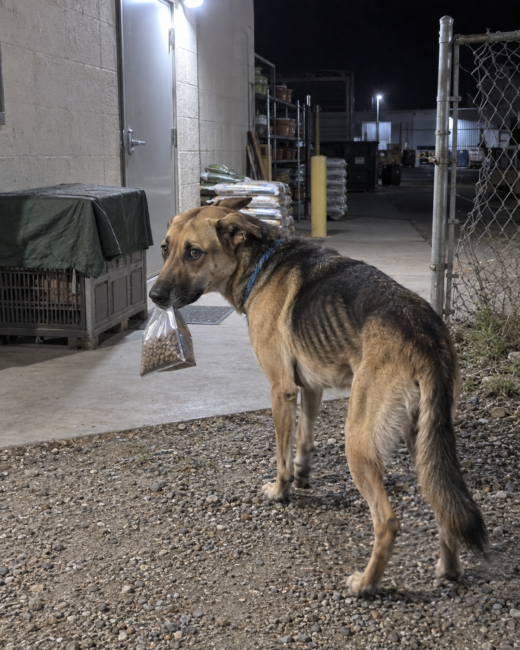
The dog did not approach.
She stood beside the rear wheel, her narrow chest moving rapidly. Every few seconds, she turned her head toward the space beneath the truck and listened.
At 3:04, two rescuers arrived in an unmarked utility van. Dana Pike, a forty-six-year-old field coordinator, stepped out first wearing a plain navy jacket and work pants. Her partner, Marcus Lee, carried folding barriers, transport crates, towels, and a long inspection camera.
Neither rescuer walked directly toward the dog.
Dana stopped beside Luis and asked exactly what he had seen: the mother’s route, the number of puppies, their estimated location, and whether any had moved away from the group.
“Six,” Luis said. “But the smallest one barely moved.”
Dana counted the visible heads from a distance.
One.
Two.
Three.
Four.
A fifth puppy shifted behind the plastic sheet. The sixth remained hidden beyond the rear axle.
Before anyone reached under the truck, Marcus examined the vehicle. Both rear tires had collapsed, and the truck leaned slightly toward the drainage ditch. Rust covered the wheel housing, but the frame appeared intact.
The rescuers called the fire department’s nonemergency assistance line for stabilization equipment. They would not risk placing a person under several thousand pounds of unsupported metal.
That decision created the first delay the puppies could not understand.
Wind pushed dust across the lot. The temperature was fifty-two degrees, but the approaching rain would make the shallow shelter colder and could send runoff beneath the chassis.
Dana opened a soft-sided crate and placed warmed towels inside. She arranged two exercise-pen panels in a wide arc, leaving the mother a clear exit so she would not feel trapped.
Food was placed in three locations.
The mother ignored all of it.
When Dana tossed a piece of kibble toward her, she picked it up and carried it beneath the truck. A puppy ate it from the gravel.
Dana tried again.
The same thing happened.
Each offered piece became another delivery to the litter.
The dog’s refusal to eat increased concern about her condition. Her ribs, spine, and hip points were visible beneath her coat. When she turned, her legs shook from fatigue.
Still, rescuers could describe only what they saw. A veterinarian would determine whether malnutrition, parasites, illness, or another problem contributed to her low body condition.
Dana began building trust through distance.
She tossed food closer to the mother but did not advance when the dog collected it. She spoke in an even voice and placed a water bowl beside the wheel.
The dog drank only after Dana moved back.
Luis watched the mother’s pattern. Each time she finished drinking, she touched the truck’s lower frame with her nose and looked toward the same dark opening.
“Is she checking on the little one?” he asked.
“Possibly,” Dana said. “Or there may be another route under there.”
The inspection camera could fit into the gap, but approaching with the unfamiliar pole caused the mother to step forward and stiffen.
Her mouth closed.
Her weight shifted over her front paws.
Dana stopped before the behavior escalated.
They needed to separate the mother from the truck long enough to inspect the space, but capturing her first might increase her distress if she could still hear puppies beneath the vehicle.
The fire crew arrived at 3:38 with wheel chocks and wooden cribbing. They stabilized the truck from outside the puppy area, testing each support before anyone moved closer.
Rain began as a soft tapping against the metal roof.
The mother looked upward.
Then six small cries rose from beneath the axle, and she pressed her body against the opening as if trying to cover it.
Part 3 — The Food She Would Not Swallow
Once the truck was stabilized, Dana moved the inspection camera slowly along the ground. She allowed the mother to smell the pole first, rewarding her whenever she remained relaxed.
The dog would not accept food from Dana’s hand.
She would pick up pieces tossed onto the gravel, carry them beneath the truck, and return empty-mouthed.
Luis opened another kibble pouch and poured a small amount into the bowl near the wheel. The mother approached, smelled it, and looked behind her.
A cream puppy emerged far enough to reach the bowl.
The mother stepped aside.
The puppy ate.
When it finished, she inspected the bowl but did not take the remaining pieces. Instead, she nudged it toward the opening with her nose.
Luis felt the accusation he had brought to the lot quietly disappear. He had followed a thief. What he found was an exhausted mother distributing every resource before allowing herself even the possibility of food.
Dana placed a second bowl several feet away. She wanted to know whether the mother would leave the puppies for a brief period if food remained available to them.
The dog walked toward the bowl, stopped halfway, and returned to the wheel.
No capture plan would work until the puppies were accessible.
Marcus slid the camera beneath the rear axle. The screen showed the first five puppies grouped on a piece of flattened cardboard. Their coats were dusty but intact.
The camera moved farther.
Behind the cracked plastic windbreak, a black-and-tan puppy lay in a shallow depression. One rear paw had become caught beneath a loose loop of packing strap.
The strap was not embedded, and no open wound was visible, but the puppy could not crawl toward the food.
The mother had been carrying pieces to that exact location.
“She knew which one couldn’t reach us,” Luis whispered.
Dana studied the screen. The trapped puppy breathed steadily and lifted its head when the camera light moved.
The rescue had a new complication. Pulling the puppy forward could tighten the strap. Someone needed to reach the loop and cut it without startling the mother or shifting the truck supports.
The opening was too narrow for an adult.
Marcus measured the distance from the opposite side. A removable section of cracked plastic blocked a larger access point near the front of the rear wheel.
The plastic was not attached to the truck. It had been wedged into the weeds as a windbreak, probably moved there by weather or by the mother herself.
Removing it would expose the litter to rain.
Dana prepared a replacement barrier before touching anything. A waterproof tarp was clipped above the larger opening, and towels were placed on a low rescue board.
The mother watched every movement.
Her ears remained pinned, but her body no longer leaned forward whenever Dana shifted. She had begun distinguishing between people who advanced and people who stopped when she asked.
That was the first small layer of trust.
At 4:07, Dana placed an open transport crate beside the truck and lined it with one of the used cardboard pieces from near the opening. The familiar scent mattered more than a perfectly clean blanket at that moment.
She scattered food inside.
The mother approached the crate, placed her front paws over the threshold, and looked back toward the puppies.
She withdrew.
Dana did not close the door.
The crate remained open while Marcus slowly removed the loose plastic panel from the opposite side. Rain struck the tarp above him, but the temporary cover protected the litter.
Five puppies became visible.
The sixth remained behind the axle.
The mother circled the truck, searching for the altered entrance. Luis stayed in one place so she always knew where he was.
When Marcus extended a padded cutting tool toward the trapped puppy, the mother gave a low growl.
He stopped.
Dana asked Luis to place one sealed food pouch near the dog. The sound of the crinkling bag was familiar. The mother smelled it, lifted it, and carried it toward the crate.
For a moment, everyone thought she might enter.
Instead, she placed the pouch inside and returned to the trapped puppy.
She had stocked the safer place without choosing it for herself.
Marcus resumed after the mother settled. The cutting tool opened the loose strap without touching the puppy’s skin.
The little dog pulled its rear paw free.
It tried to crawl forward, stopped, and made one thin sound.
The mother immediately lowered herself beside the opening.
Her body formed a barrier between the rescuers and the litter, but her muzzle remained close to the crate that now held food.
Dana waited.
There would be no grabbing, no rushing, and no attempt to overpower an exhausted dog protecting six lives.
The mother had shown them the problem.
Now they had to show her that the solution would include everyone.
Part 4 — One Puppy at a Time
The rescue plan depended on order.
The mother needed to see and smell each puppy as it left the truck. If the litter disappeared behind people or into a closed vehicle, she might retreat beneath the chassis or attempt to follow through a dangerous gap.
Dana positioned the transport crate where the mother could inspect it. Luis sat beyond the exercise-pen panels with another food pouch, while Marcus prepared six towels in a line.
The rescued puppies would enter the crate one at a time.
The trapped black-and-tan puppy came first because its mobility remained uncertain. Marcus slid the low rescue board beneath the opening, supported the puppy’s chest and hips, and drew it forward without pulling the freed rear paw.
The mother stood.
Her body stiffened.
Dana kept the crate door open and moved away from it. Marcus placed the puppy on the towel inside.
The mother approached immediately.
She smelled the puppy from nose to tail, focusing on the rear paw. When the puppy shifted and pressed against her muzzle, her shoulders lowered slightly.
She did not enter the crate.
She returned to the truck.
The next two puppies were accessible from the larger opening. A cream female and a tan male were transferred in towels, each handled close to the ground.
After every transfer, the mother inspected the crate.
Three puppies remained beneath the truck.
Rainwater began spreading across the low gravel behind the rear tires. The cardboard under the litter darkened along one edge.
The fire crew confirmed that the cribbing remained stable, but no one relaxed. The weather had turned a careful rescue into a narrowing window.
The fourth puppy backed farther under the axle when Marcus reached toward it. Rather than extending his arm blindly, he withdrew and used the inspection camera to locate the puppy’s position.
Dana placed a shallow trail of softened food on the rescue board.
The puppy smelled it.
The mother moved toward the opening, picked up the nearest piece, and stepped backward. The puppy followed her nose.
It reached the edge, where Marcus wrapped a towel around its body and guided it into the crate.
Four.
The mother counted by scent.
She touched each puppy, then looked toward the truck again.
The fifth puppy had wedged itself behind a rusted wheel shield. The panel was part of the truck and could not be removed safely with the litter beneath it.
Marcus approached from the opposite side and used the board to block the puppy from retreating farther. Dana placed food near the only safe exit.
The mother began pacing.
Her legs trembled more severely, and twice her back feet slipped in the wet gravel. Luis wanted to move toward her but remained seated because sudden concern could still feel like pressure.
“Easy,” he said. “They’re bringing them to you.”
The fifth puppy eventually followed the food. It emerged covered in dust, shook once, and was transferred into the crate.
Five small heads moved inside.
The mother did not lie down.
She stood beside the open crate, nose lifted toward the truck.
Dana looked at the inspection screen again.
The space where the puppies had been lying appeared empty, but the camera could not see beyond a bent sheet of metal closer to the truck’s center.
The mother walked to that exact spot.
She scratched once at the gravel.
Everyone stopped.
Marcus repositioned the camera through a gap near the front of the rear wheel. A small tan puppy was pressed behind the bent shield, nearly invisible against the dirt.
The rescuers had already counted six because the trapped puppy had been included. Now the visible heads in the crate totaled five.
This was still the sixth puppy, not a seventh. It had moved behind the shield during the transfer.
The mother had not lost count.
Dana placed the crate closer but kept the door open. The five rescued puppies cried when the mother stepped away.
She touched the truck frame with her nose and waited.
Marcus could not safely reach the final puppy from his position. The fire crew added a second cribbing point, allowing him to slide the rescue board several inches deeper without placing his torso beneath the truck.
The puppy turned toward the board.
Its paws slipped on wet gravel.
Marcus guided it with a rolled towel, creating a soft boundary rather than pushing its body. After two attempts, the puppy crawled onto the board.
At 4:46, the final puppy emerged.
The mother inspected it before Marcus could place it in the crate. She smelled its face, belly, and paws, then followed as it joined the other five.
Six puppies were now together.
Dana backed away.
Luis placed a bowl of wet food just inside the crate.
The mother looked beneath the truck one final time. She circled the chassis, checked both openings, and returned to the crate.
Her front paws crossed the threshold.
Then her hind paws.
Only when her nose had touched all six puppies did Dana quietly close the door.
The mother did not struggle.
She lowered herself around the litter, still too thin to cover them completely, and rested her chin beside the unopened food pouch she had carried inside.
For the first time since Luis found her, she allowed someone else to guard the entrance.
Part 5 — The Meal Divided Seven Ways
The transport van reached the veterinary clinic shortly after sunrise. The crate remained covered on three sides to reduce visual stress while allowing air to circulate.
The mother kept her body curved around the puppies. Whenever the vehicle slowed, she raised her head and checked them.
Clinic staff moved the entire crate into a quiet examination room before opening it. Separating the family immediately would have increased stress, so the veterinarian first observed them together.
The mother weighed forty-one pounds. Based on her frame, Dr. Helen Brooks estimated a healthier weight near fifty-six pounds.
Her ribs, spine, and hip bones were prominent, and muscle loss was visible along her back and thighs. The veterinarian assigned a body-condition score of two out of nine, confirming severe low body condition.
She was dehydrated but alert. Her temperature and breathing were stable. Bloodwork showed changes consistent with poor nutrition and parasite burden, but no immediate organ failure.
The puppies were estimated to be about five and a half weeks old. All six were underweight. The black-and-tan puppy freed from the packing strap had mild swelling around the rear paw but no fracture or open injury.
The smallest tan puppy was weaker than the others and had difficulty maintaining body temperature. It received warmed fluids and close monitoring.
The mother was named Mara.
The smallest puppy became Button because Luis had described it as barely larger than the buttons on his work jacket.
Mara’s recovery could not begin with an unlimited bowl of food. After prolonged undernutrition, sudden overfeeding could create complications. Dr. Brooks planned small, measured meals divided throughout the day, along with water, parasite treatment, and gradual nutritional support.
The first meal was placed in front of Mara.
She smelled it and looked toward the puppies.
A technician offered softened puppy food in a separate shallow tray. Five puppies crowded around it. Button remained beneath the warming towel.
Mara picked up a mouthful from her own bowl, carried it toward the puppy tray, and dropped it beside the others.
She returned for more.
The technician gently blocked the path with her knee and moved Mara’s bowl closer to her chest. She offered the mother a small portion by hand while another worker ensured the puppies had enough.
Mara hesitated.
Then she ate.
It was the first confirmed food she had swallowed for herself.
She stopped after three mouthfuls to check Button. The technician brought the warmed puppy beside her.
Mara smelled Button’s face and began eating again.
Throughout the first night, staff recorded every meal, bowel movement, temperature reading, and change in behavior. Mara remained guarded when hands approached quickly, but she permitted examination if a puppy stayed within reach of her nose.
At 1:20 in the morning, Button’s temperature stabilized.
At 3:05, the puppy crawled from the towel toward Mara’s foreleg.
Mara lowered her chin over Button’s back.
The family’s immediate danger had passed, but recovery remained uncertain. Parasite treatment caused loose stool in several puppies, and Mara’s appetite decreased during the second day.
The veterinary team adjusted hydration and monitored her bloodwork. No one interpreted one missed meal as failure, but with such little reserve, every reduction in intake mattered.
Luis visited after the store closed.
He brought clean towels and six small toys, then stopped outside the kennel room when Mara stiffened at the sound of his boots.
He sat in the hallway instead.
Dana handed him one of the same small kibble pouches Mara had been taking from the store. He opened it quietly and poured a measured amount into her approved feeding bowl.
Mara recognized the crinkling sound.
She approached the kennel gate, smelled Luis’s hand through the bars, and returned to the puppies.
This time, she ate from her own bowl while they slept.
Luis remained seated for almost an hour.
He had imagined confronting the animal stealing his inventory. Now he watched her consume a measured meal beneath a clinic light, each bite recorded because her body had gone so long without keeping anything for itself.
On the fourth day, Mara stood when Luis entered.
She did not retreat.
She picked up an empty food pouch, carried it toward him, and placed it beside the gate.
The bag contained nothing.
It did not need to.
It was the first object connecting the night she was found to the people now feeding her.
Part 6 — Teaching a Mother That Food Returns
After one week, Mara and the puppies moved into an experienced foster home with Dana’s colleague, Renee Whitaker. The house had a quiet converted laundry room, washable flooring, two exercise pens, and direct access to a fenced side yard.
The family remained together.
Mara’s feeding plan continued with four measured meals a day. The puppies received softened food separately so they would not compete with her bowl.
During the first meal, Mara carried several pieces toward the puppy pen.
Renee returned them to her bowl.
Mara carried them back again.
Instead of repeatedly taking the food away, Renee placed a small portion in front of the puppies and sat beside Mara’s full bowl. Once Mara saw them eating, she consumed her own meal.
The routine became six bowls first, one bowl beside them.
Over the next three weeks, Mara gained seven pounds. Her coat became less dull, and the sharp outline of her spine softened.
She still looked thin.
Recovery was gradual because healthy tissue and muscle required time, not simply calories. Short walks in the yard replaced the nightly miles she had traveled carrying food.
The puppies changed faster. They learned to climb over low barriers, respond to human voices, and sleep without pressing into a single tight pile.
Button remained the smallest but began following the others. The swelling in its rear paw resolved with rest and monitoring.
Mara’s setback arrived during the fourth week.
A paper grocery bag fell from the kitchen counter and landed near her feeding area. The sudden sound caused her to abandon the bowl and push beneath a utility table.
For the rest of the day, she refused food whenever a bag moved.
The sound that had once announced survival had become unpredictable.
Renee stopped using crinkling packages near the room. Meals were prepared out of sight and delivered in stable metal bowls.
Luis visited two days later. He sat outside the exercise pen with a sealed kibble pouch beside him but did not touch it.
Mara looked at the bag.
Then she looked at Luis.
He slid the pouch away and offered his empty hand.
Mara approached slowly, smelled his fingers, and remained beside him.
The interaction lasted less than a minute, but it changed Luis’s understanding. Mara did not need the object that connected them. She needed the person to stop asking anything from her.
By the sixth week, the puppies were medically cleared for adoption after appropriate vaccinations, microchipping, and individual behavioral assessments. Applications were reviewed separately rather than treating the litter as interchangeable.
Two puppies went to families with older children. A bonded pair of siblings adopted the two most active puppies into neighboring homes. Button entered a quieter household experienced with small, cautious dogs.
The final puppy left on a Saturday.
Mara searched the pen and smelled each blanket. She paced for several minutes, then returned to her meal.
Her maternal work was ending.
Her own placement had not yet begun.
Adult German Shepherd mixes often waited longer than puppies, and Mara remained cautious around unfamiliar people. Her severe low body condition had improved, but photographs from intake still shaped how potential adopters saw her.
Luis asked whether she could visit the store after closing.
The rescue approved a controlled outing. The loading area was secured, and the donation crate had been replaced with a weatherproof bin used only by partner groups.
Mara arrived wearing a properly fitted harness.
She recognized the building before the vehicle door fully opened. Her nose moved rapidly, and she looked toward the route leading to the abandoned truck.
Luis did not take her there.
The truck had been removed after the property owner received notice, and the area beneath it was no longer accessible. Returning Mara to the exact site offered no benefit.
Instead, Luis sat beside the loading door.
He placed a bowl of food between them.
Mara approached, ate half the meal, and lay down three feet from his boots.
She did not carry a single piece away.
For the first time outside the clinic or foster home, she ate as though there would be another meal tomorrow.
Part 7 — The Bag She Finally Left Behind
Luis and his wife, Elena, began the adoption process after Mara’s store visit. Their home had a fenced yard, one calm senior dog, and enough space to introduce the animals gradually.
The rescue did not approve the placement because Luis had discovered Mara. It evaluated the home, completed controlled introductions, and arranged a two-week foster-to-adopt trial.
Mara spent her first nights in a quiet room with her own bed, bowls, and an open crate. Luis sat outside the doorway while she decided whether to approach.
On the third evening, she rested near his chair.
By the second week, she followed Elena into the yard and walked parallel to the senior dog without tension. Her weight reached fifty-two pounds, and the muscles along her back continued returning.
Mara still checked doorways whenever food bags crinkled.
The behavior did not disappear completely.
Luis changed how supplies were stored at the shop. The donation bin remained locked from weather and wildlife, but a sign directed local residents to leave food during business hours so staff could distribute it through rescue partners.
He no longer called the missing packages theft.
Months after the rescue, Mara visited the store on a quiet Sunday morning. The loading light was off, and the parking lot where Luis had waited in his pickup stood empty.
He placed one sealed two-pound kibble pouch on the concrete near the door.
Mara walked toward it.
She smelled the corner she would once have gripped between her teeth. Her ears lifted, and for several seconds she looked toward the broken fence route that had led to the abandoned truck.
Then she returned to Luis.
She left the pouch unopened.
At home that afternoon, Mara ate from her own bowl while Elena prepared dinner. Afterward, she carried nothing away. She drank water, walked into the living room, and stretched across the rug beside Luis’s chair.
The dog who had once crossed industrial lots on trembling legs to divide every stolen meal among six puppies now slept deeply enough to miss the sound of a food package opening in the kitchen.
Button’s family occasionally sent updates. The smallest puppy had grown into a healthy, cautious young dog with Mara’s dark saddle and notched-ear shape.
The other five were thriving in their separate homes.
Mara did not know any of that in human terms. What she knew was more immediate: the bowl returned, the door opened again, and hands approaching her no longer took food from those she was trying to protect.
Luis had followed her intending to stop a loss.
Instead, he found six lives beneath a truck and one mother disappearing while keeping them alive.
The final pouch from that night remained in the store office, unopened. Luis kept it not as evidence of what Mara had taken, but as a reminder of what she had refused to keep for herself.
Outside, Mara slept beside the loading door.
This time, nothing was waiting beneath the truck.
Nothing needed her to run into the dark.
And when she woke, the food beside her still belonged to her.
Follow our page for more grounded dog rescue stories about quiet sacrifice, patient recovery, and the ordinary people who finally notice what an animal is trying to protect.