Part 2: A Patchy-Coated Stray Pit Bull Guarded an Unconscious Man While Traffic Passed — Then the Fifty-Year-Old Officer Found Him Again at the City Shelter Days Later
Part 2 — Getting Both of Them Off the Street
The Pit Bull remained beside Daniel’s cruiser as the ambulance disappeared.
He did not attempt to follow traffic. He sat with his weight tilted slightly to the left and watched the corner where the vehicle had turned.
Animal-control officer Renee Walsh arrived eight minutes later. She carried a slip lead, high-value food, and a folding barrier.
The dog noticed her but did not leave the cruiser.
Renee observed him before approaching. His posture was guarded, not aggressive. The bald patches around the hips and tail base were symmetrical enough to suggest a chronic skin problem, though only a veterinarian could determine the cause.
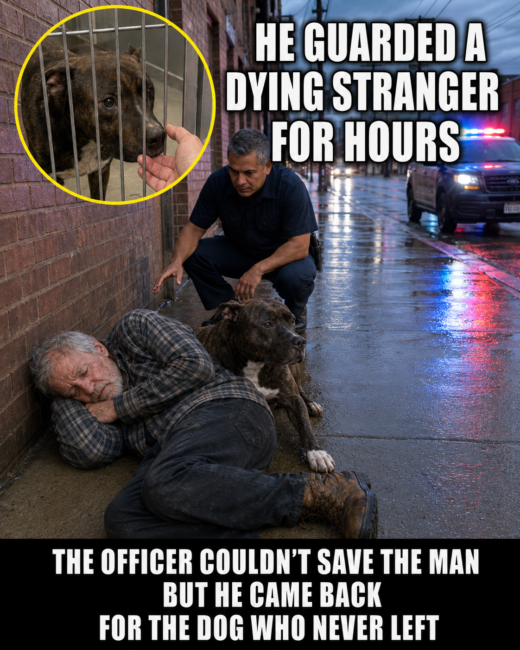
His ribs were visible when he breathed, but he was not severely emaciated.
Renee tossed a small piece of chicken several feet away.
The dog sniffed but did not eat.
She placed another piece closer to him and stepped back.
Again, he ignored it.
Daniel realized the dog was looking through the cruiser’s open door. The radio continued transmitting updates from the ambulance call.
“He thinks the man might be in there,” Daniel said.
Daniel walked slowly to the rear passenger door, opened it fully, and allowed the dog to inspect the empty seat from a distance.
The Pit Bull approached.
He smelled the threshold, the floor mat, and Daniel’s trouser leg. When he confirmed that the elderly man was not inside, his shoulders dropped for the first time.
Renee placed the slip lead on the ground rather than lifting it over him. She shaped a large loop and used food to encourage the dog to step forward.
The first attempt failed.
The Pit Bull retreated to the sidewalk where the stretcher had been.
Daniel sat beside the emergency blanket.
For nearly fifteen minutes, he did nothing.
Cars passed. The warning lights continued reflecting across the dog’s damp coat.
Eventually, the Pit Bull approached Daniel and sniffed the hand that had touched the elderly man.
Renee raised the loop gradually.
The lead settled around the dog’s neck without resistance.
He followed the scent, not the leash.
The transport crate created another complication. The metal floor was unfamiliar and the interior smelled of disinfectant and other animals.
The dog stopped at the entrance.
Daniel placed the brown coat the paramedics had left behind inside the crate. Hospital staff did not need it, and there was no identification in the pockets.
The Pit Bull recognized it immediately.
He entered, turned once, and lay with his nose against the coat.
At the shelter, staff scanned him for a microchip. None was found. He wore no collar or tag.
The intake team estimated his age at approximately four. They documented the brindle coat, white chest crescent, white left front paw, notched right ear, and patchy hair loss.
Because contagious causes could not yet be ruled out, the dog entered a quiet isolation kennel.
Dr. Helen Park performed the veterinary examination the next morning. Skin scrapings showed no evidence of mange mites. Fungal testing was negative.
The distribution of hair loss, flea debris in the coat, and thickened skin near the tail base supported a diagnosis of flea allergy dermatitis aggravated by prolonged exposure.
Treatment included parasite control, medicated bathing, medication to reduce itching, a balanced diet, and clean bedding.
His name remained blank on the kennel card.
Daniel spent that evening trying to identify the older man. A shelter resident recognized the photograph as Arthur Bell, a seventy-two-year-old who had slept intermittently near the warehouse district.
Arthur carried no telephone and listed no emergency contact. Outreach records showed that he had declined group shelter several times because crowded rooms triggered panic.
Nobody knew whether the Pit Bull belonged to him.
Two people in the encampment said the dog had begun following Arthur several weeks earlier. Arthur shared food with him but never claimed ownership.
On the day of the stroke, the dog had remained beside Arthur for at least four hours.
Daniel called the hospital before ending his shift.
Arthur was alive but critically ill.
There was still no family at his bedside.
Daniel looked at the brown coat folded on his passenger seat before remembering it was now inside an isolation kennel.
One patient had reached the hospital.
The other was waiting behind another locked door.
Part 3 — The Officer Returned After His Shift
Arthur Bell died the following morning.
Hospital staff had stabilized him initially, but the stroke was extensive, and complications developed overnight. No verified relative could be located before his death.
Daniel received the notification near the end of his shift.
He sat inside his cruiser for several minutes without starting the engine. Officers learn early that stopping does not guarantee rescue. Sometimes they arrive late. Sometimes help cannot reverse what has already happened.
Still, one part of the sidewalk encounter remained unfinished.
Daniel drove to the city shelter wearing the same uniform trousers and boots but no duty belt. He carried no plan beyond seeing the dog.
The Pit Bull remained in isolation while the skin tests were completed. Daniel could not enter the kennel, and direct contact was limited.
A technician led him to the observation window.
The dog was resting on a clean blanket. Fine flakes of dry skin remained visible along his back, and the bald areas near the tail looked dark against the brindle coat.
Daniel stepped into view.
The Pit Bull raised his head.
For two seconds, he remained still.
Then he stood, crossed the kennel, and placed his white paw against the bottom of the door.
There was no frantic barking or jumping.
He pressed his nose to the narrow gap and inhaled.
Daniel crouched on the opposite side.
The dog smelled his hand through the space beneath the door, then turned toward the brown coat on his bed.
He carried it to the front of the kennel.
He remembered the officer by scent.
Daniel asked what would happen after the stray hold. Shelter coordinator Melissa Grant explained that the dog would become available for placement if no owner appeared and his health and behavior allowed it.
“He may need time,” she said. “He guarded that man because he was bonded or because the situation frightened him. That doesn’t automatically tell us how he’ll behave in a home.”
Daniel understood.
He returned the following evening.
Then the next.
Because the dog remained in isolation, Daniel sat outside the glass and read reports while the Pit Bull rested where he could see him.
On the fifth visit, Daniel brought a list of possible names.
The dog ignored all of them.
Daniel watched him lift his head whenever footsteps approached the door. The dog checked the sound, confirmed who had entered, then lay down again.
“You kept vigil,” Daniel said.
The dog’s ears moved.
The word stayed.
Vigil.
When the isolation period ended, staff transferred Vigil to a quiet kennel with nonslip flooring. Daniel’s first direct meeting took place in a small exercise yard.
He sat sideways on a bench. A behavior specialist held the leash loosely.
Vigil entered, saw Daniel, and stopped.
His tail remained low. His mouth closed. He approached in an arc rather than a straight line.
Daniel placed one hand beside his boot.
Vigil smelled the fingers, then sat with his left shoulder touching Daniel’s knee.
That contact lasted almost a minute.
He still did not invite petting. When Daniel raised his hand, Vigil leaned away.
Daniel lowered it.
Recognition was not the same as complete trust.
For three weeks, they repeated the meetings. Daniel walked beside the behavior specialist, helped prepare meals, and learned how to administer the skin medication.
The bald patches slowly softened around the edges. Fine brindle hair began returning over the hips.
Vigil tolerated a hand on his chest before he accepted touch along the shoulders. He remained sensitive near the tail base, where the dermatitis had caused the most itching.
No owner came forward.
Daniel applied to foster him.
The department did not object to an officer adopting a dog, but Vigil could not accompany Daniel on duty. He was an untrained shelter animal with an incomplete behavioral history.
Daniel had not asked for a patrol dog.
He wanted Vigil to have a door that opened for him every evening.
The foster transfer occurred thirty-one days after the sidewalk rescue. Vigil entered Daniel’s house, checked every room, and chose the mat beside the front door.
That night, Daniel placed Arthur’s cleaned brown coat beside the bed.
Vigil rested his chin on it.
At 2:17 a.m., Daniel woke and found the dog sitting upright, watching the dark hallway.
He was still keeping watch.
But now the person behind him was breathing safely.
Part 4 — Becoming a Comfort Dog Without Pretending to Be a K9
The first month at home was quiet and uneven.
Vigil followed Daniel from room to room but rarely stepped closer than three feet. When Daniel closed the bathroom door, the dog waited outside it.
He slept near the front entrance, positioned where he could see both the hallway and the living room.
His skin improved with treatment. The itching decreased, and fine hair continued growing across his hips.
Then a setback arrived.
A new flea exposure in the shared courtyard triggered another flare. Vigil began scratching the tail base and sleeping poorly. Redness returned beneath the recovering coat.
Daniel contacted Dr. Park rather than changing medications himself. The veterinary team adjusted the prevention schedule, prescribed short-term itch control, and recommended laundering bedding more frequently.
Recovery required consistent management, not one successful bath.
Daniel also noticed that Vigil behaved differently around people living outdoors.
During ordinary neighborhood walks, he avoided strangers. If they reached toward him, he stepped behind Daniel.
But when they passed someone sitting beneath a blanket or beside a shopping cart, Vigil slowed.
He did not pull toward everyone.
He approached only when his leash remained loose and the person appeared comfortable with a dog nearby. Then he often sat several feet away, facing the street.
The behavior reminded Daniel of the sidewalk.
He mentioned it to the department’s community-outreach coordinator, Sergeant Lena Brooks. She made the limits clear.
Vigil could not simply ride in a police vehicle because he was gentle in several informal encounters. He would need medical clearance, stable behavior, obedience training, liability review, and formal approval.
He could never interfere with enforcement calls or emergency operations.
Daniel agreed to every condition.
Over the next eight months, he and Vigil worked with certified trainer Grace Kim. The goal was not to suppress the dog’s caution or transform him into a performing mascot.
They practiced calm neutrality.
Vigil learned to walk past dropped food, remain settled while wheelchairs and carts passed, retreat behind Daniel when overwhelmed, and rest on a portable mat.
He learned that a uniformed person raising a radio did not mean danger.
The first time a siren sounded during training, Vigil flattened himself to the ground and refused to move.
Daniel knelt nearby without pulling the leash.
The session ended.
For several weeks, they practiced at distances where sirens were faint. Vigil received food only when relaxed enough to eat. Gradually, the sound became predictable.
Still, emergency scenes remained off-limits.
Vigil completed a basic manners assessment and later passed the evaluation required by the therapy-dog organization working with the city’s outreach program.
His role was carefully defined: community comfort dog during scheduled outreach, always leashed, always supervised, never deployed to search, apprehend, detect, or protect.
Daniel’s patrol car was fitted with a secured travel crate, nonslip ramp, water, cooling equipment, and an emergency release plan.
Vigil wore a plain blue working vest marked “COMFORT DOG,” not a police K9 harness.
The first approved outreach shift took place eleven months after Arthur’s stroke.
Daniel and a social worker named Hannah Price visited a small encampment beneath an overpass. Vigil exited the vehicle, scanned the area, and stayed beside Daniel.
A man called Curtis shouted that he did not want police near his tent.
Daniel stopped twenty feet away.
Vigil looked at Curtis, then at Daniel.
The leash remained loose.
“Dog can stay,” Curtis said. “You stay back.”
Daniel handed the leash to Hannah, who was an approved handler, and stepped farther away.
Vigil walked only as close as Curtis permitted. He sat facing the traffic, his shoulder several feet from the tent.
Curtis stared at the recovering hair on the dog’s hips.
“What happened to him?”
Daniel answered from a distance. “He lived outside for a while.”
Curtis began talking to Vigil instead of the officer.
He described an infected blister on his foot and admitted he had stopped taking medication after losing his backpack.
Hannah arranged a mobile-clinic evaluation and replacement identification documents.
Curtis accepted help because the first conversation was addressed to a dog who demanded nothing.
When Vigil returned to the patrol car, Daniel opened the crate.
The Pit Bull looked back toward the tent before climbing inside.
The watch had begun again.
This time, the person was still alive to receive it.
Part 5 — The People Who Spoke to the Dog First
Vigil did not solve homelessness.
He could not create affordable housing, replace medical care, reverse addiction, or repair fractured families.
What he could do was make the first minute less confrontational.
Daniel’s uniform often caused people to stiffen before he spoke. Some had outstanding warrants. Some had experienced violence or been moved repeatedly from public spaces.
A dog sitting calmly at Daniel’s side changed the shape of the encounter.
People looked down.
They asked Vigil’s name.
They noticed the patchy coat still filling in and the notch in his ear. They asked whether he had been abandoned.
Daniel answered briefly, without using Arthur’s death as a performance.
“He stayed with someone who needed help,” he would say.
The second person connected to shelter through Vigil was a woman named Elaine. She had slept behind a laundromat for almost six months and refused transport because she would not leave her cart unattended.
Vigil approached the cart and sat beside one wheel.
Elaine warned Daniel not to touch her belongings.
He didn’t.
For twenty minutes, she spoke to the dog. She told Vigil about the apartment she had lost after her husband died and the paperwork stolen from her backpack.
Hannah offered temporary storage for the cart and a women’s shelter that accepted late arrivals.
Elaine agreed to visit without promising to stay.
She remained.
The outreach team counted placement only when a person physically entered a shelter, stabilization program, transitional room, medical respite facility, or recovery program.
Not everyone stayed permanently. Several left within days. Some returned to the street and accepted help again later.
The outcomes were imperfect because real recovery rarely moves in one direction.
During Vigil’s second year, he helped reconnect Daniel with a former construction worker named Marvin who had stopped speaking to outreach teams.
Marvin distrusted police and turned away whenever Daniel approached.
Vigil sat beside a concrete pillar ten feet from him.
Marvin asked if the dog bit.
“No,” Daniel said. “But he’ll move away if you reach too quickly.”
Marvin nodded as though he respected the boundary.
He allowed Vigil to smell his hand.
Over three visits, Marvin revealed that he had untreated hearing loss and could not understand workers speaking through masks. He often nodded without knowing what they had said, then avoided future appointments out of embarrassment.
Daniel arranged for an advocate to attend a clinic visit.
Marvin entered transitional housing six weeks later.
The outreach log recorded him as number eleven.
Daniel never told people they had been “saved.” Shelter placement was not the end of anyone’s story.
Vigil’s presence simply helped keep one door open long enough for a person to consider walking through it.
The dog’s own care continued alongside the work. Seasonal humidity occasionally irritated his skin. Daniel inspected the hips and tail base every evening, maintained parasite prevention, and carried clean bedding in the vehicle.
If Vigil scratched repeatedly or appeared tired, the shift ended.
He worked no more than two outreach periods a week, with rest days between them.
At home, he was not always vigilant.
He learned to sleep on his side, legs extended, stomach exposed. He carried Arthur’s brown coat from the front-door bed to the living room and eventually stopped sleeping on it.
Daniel stored it in a box but kept the small square of fabric Vigil had worn smooth beneath his chin.
During the third year, Daniel encountered an unconscious person behind a bus station.
Vigil stopped several feet away and sat.
The scene resembled the sidewalk where they had met, but Daniel followed protocol. He secured Vigil with Hannah, assessed the person, and called emergency services.
The man recovered after treatment for severe dehydration.
When he returned to thank the outreach team, he remembered only one detail from waking:
a brindle dog sitting beneath red and blue light.
He became placement number twenty-three.
Daniel wrote the number into the outreach log, then looked at Vigil asleep under the desk.
The dog did not know the count.
He knew only when someone needed company and when company had become too much.
Part 6 — Forty-Seven Doors Over Six Years
By Vigil’s sixth year with Daniel, the brindle hair had returned across most of his hips. The skin at the tail base remained darker and required lifelong monitoring, but the constant itching had ended.
Gray appeared around his muzzle.
His outreach shifts became shorter, and Daniel used a ramp even though Vigil could still enter the vehicle without it.
They had developed a language made mostly of pauses.
When Vigil leaned toward someone but kept his feet planted, Daniel asked permission before approaching. When the dog turned his head away or licked his lips repeatedly, they created more distance.
When Vigil sat with his back toward the street, Daniel knew the person in front of him had become the focus.
The forty-seventh placement began during a cold January morning.
A man named Thomas Avery had lived beside a heating vent for three winters. He declined group shelter because he believed his belongings would be stolen and because crowded sleeping areas made him panic.
Daniel had spoken with him nine times.
Thomas never accepted transport.
On the tenth visit, Vigil walked to the edge of Thomas’s blanket and stopped. He waited until Thomas extended two fingers.
The dog sniffed them, turned, and sat beside him.
Thomas looked at the blue comfort-dog vest.
“Does he sleep in your house?”
“Every night,” Daniel said.
“Was he always yours?”
Daniel told the shortest truthful version.
“He stayed beside a man who couldn’t get up. I met him there.”
Thomas studied Vigil’s face.
“Did the man make it?”
Daniel did not pretend.
“No.”
Thomas lowered his hand to the dog’s shoulder. Vigil remained still.
“Then why’d the dog go with you?”
“I came back for him.”
The answer settled between them.
Thomas asked whether the outreach shelter allowed people to keep one locked storage container. Hannah confirmed that it did. She also arranged a quieter sleeping area near an exit.
Thomas entered the warming center that afternoon.
Two weeks later, he transferred to medical respite care. He eventually entered supportive housing, though the process required months and several difficult returns to the street.
The outreach log listed Thomas as number forty-seven.
The number represented forty-seven entries through forty-seven doors—not forty-seven perfect endings.
Some found stable apartments. Some entered recovery. Some reconnected with relatives. Some disappeared before follow-up.
Three died.
Daniel kept their names rather than reducing them to outcomes.
Vigil never differentiated between the person who remained housed and the person who relapsed. If they met again, he approached with the same slow caution.
No disappointment. No accusation.
Only recognition.
The department honored Daniel and Vigil during a small community-services ceremony. Daniel accepted the plaque but declined to describe the dog as a hero.
Vigil had not been trained to understand housing systems or outreach policy.
He had carried one behavior from the sidewalk into every later encounter:
When someone could not move forward, he stayed nearby without forcing them.
After the ceremony, Daniel took Vigil through the old warehouse district. The appliance store had become a small grocery market, and the sidewalk had been repaired.
Traffic moved through the same intersection.
Vigil stopped near the place where Arthur had fallen. He smelled the pavement, looked toward Daniel, and continued walking.
There was no brown coat, no ambulance, and no frightened dog refusing food.
Only an older Pit Bull moving beside the officer who had returned.
Part 7 — The Dog Who Now Kept Watch Over the Living
Vigil retired from regular outreach shortly after his tenth birthday.
He still attended occasional daytime events, but long shifts and extreme weather were no longer appropriate. His comfort-dog vest hung beside Daniel’s jacket at home.
Most mornings, they walked one slow block before breakfast.
Vigil continued noticing people seated near the curb. He would glance at Daniel, waiting for the leash to loosen before approaching.
Sometimes the person wanted company.
Sometimes they did not.
Vigil accepted both answers.
Thomas Avery visited them nearly a year after entering supportive housing. He arrived carrying a new fleece blanket for the dog.
Vigil smelled him, turned once, and settled beside his chair.
Thomas ran a hand along the dog’s shoulder.
“He still remembers me.”
Daniel looked at the notched ear, the white paw, and the darker skin beneath the recovered coat.
“He remembers who sat with him,” he said.
That evening, Vigil carried the new blanket to the mat beside the front door. The old brown coat remained packed away, but the position echoed the first foster night.
Vigil lay facing the hallway.
Daniel turned off the living-room light and went to bed.
An hour later, he returned for water and found Vigil asleep on his side rather than sitting upright.
The dog no longer watched every doorway.
He had spent years sitting beside people society often stepped around. He had helped them speak, accept transport, enter treatment, or simply remain connected for another day.
Vigil had once kept watch beside a dying stranger because nobody else stopped.
Now, even in retirement, he was still teaching people to stop for one another.
But his own watch had finally softened.
Behind him was a warm house.
Ahead was no emergency.
And nearby, the officer who had once knelt on wet pavement was still there.
Follow the page for more powerful dog-rescue stories about loyalty, second chances, and the quiet bonds that change both animals and the people who finally stop.