A Delivery Driver Put a Blanket Over a Stray Dog Lying in the Snow — Then His Dismissal Sparked a Backlash That Reached the Company’s Founder
The dog was lying in the snow when Mikhail Savitsky arrived for work. He covered her with a blanket, picked up a delivery, and drove away.
By his account, he had completed only that one order when he learned he had been dismissed.
The explanation for his dismissal would become disputed. The image at the center of the story was painfully clear: a stray dog curled against a wall outside a pizza shop, snow covering her back.
Her name was Dodobonya.
In Chelyabinsk, Russia, she had become familiar to employees at a Dodo Pizza location. She had been sleeping near the restaurant for about a year, and people working there had offered food and warmth.
They knew her well enough to give her a nickname. They noticed when she returned.
Yet being familiar was different from having a home. At the end of the day, Dodobonya still had a porch instead of a room, a tiled corner instead of a place inside.
During the winter cold of February 2026, that difference became impossible to overlook.
Reports described temperatures around minus twenty degrees Celsius, or minus four degrees Fahrenheit. In the photographs shared with the story, the dog’s body was folded tightly into itself. Snow lay across her coat and the ground beside her.
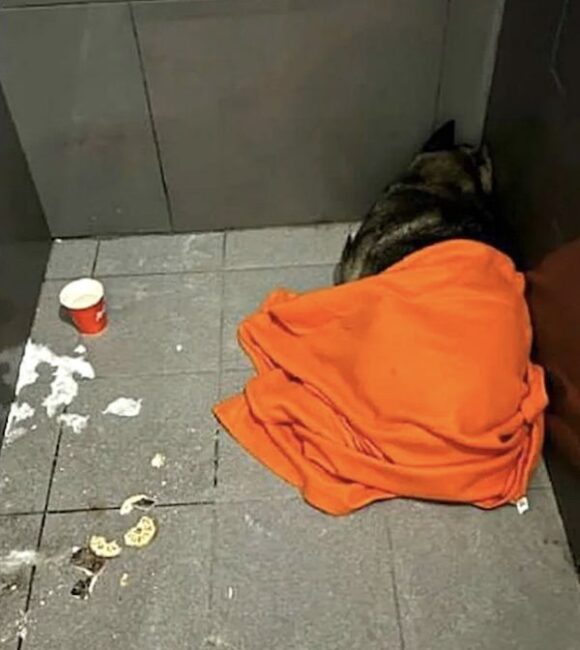
A second image showed her covered with an orange blanket.
The change between the photographs was simple. The dog remained in the corner, but someone had placed something between her body and the cold.
Mikhail said he was the employee who acted when he arrived and saw her outside. He covered her, went inside to collect an order, and continued his delivery work.
He later told local reporters that, while returning, he received word that his employment had ended. He said he had also been removed from the couriers’ work chat.
To Mikhail, the dismissal was connected to the dog.
He pointed to a message he attributed to management, warning employees against covering her and threatening consequences for anyone who continued. That message helped explain why his account provoked such an emotional response.
A blanket had become the focus of a workplace conflict.
Dodo Pizza offered a different explanation. The company said it had already planned to end the working relationship and cited employment-related issues. It denied that caring for an animal was itself a reason for dismissal.
That disagreement matters. The public controversy did not establish an independently settled explanation for why Mikhail lost his job.
But it did place Dodobonya’s circumstances in front of people who had never seen that restaurant or walked past its porch.
Readers encountered a dog lying in snow, a worker’s account of trying to warm her, and a dispute about what followed. Many responded with anger. Calls for a boycott spread, and the company faced a wave of negative reviews and demands for answers.
For people who love dogs, the photographs made the issue immediate. There was an animal outside who needed help, and the first visible response had been a blanket.
The larger response still had to address where she would go.
A blanket could offer some protection. It could not provide a permanent home or make a restaurant porch a suitable place to spend the winter.
Amid the controversy, Dodobonya was found and taken to a local shelter.
That was the most concrete change in her own story. The attention had helped move her situation beyond informal care outside a business and into an effort to provide continuing support.
The company pledged to cover her food, veterinary care, and other needs while a permanent home was sought.
Those commitments described what would be done for her. They were not an announcement that she had already been adopted, and her rescue did not need an invented adoption scene to carry hope.
She had been brought into care. People were making plans for her future.
Then the company’s founder, Fyodor Ovchinnikov, responded publicly.
He apologized to the delivery worker and said he would welcome Mikhail back, potentially in work connected with animal welfare. The invitation did not confirm that Mikhail had resumed his former job, but it marked a substantial change in the company’s public response.
The founder also announced plans to make Dodo Pizza’s restaurants in Russia pet-friendly and to support animal shelters over the long term.
A dispute centered on one dog had prompted promises extending beyond her.
The announcement gave the story a larger consequence, while leaving an important distinction intact: a public commitment is a beginning. Its value comes through the care and practical changes that follow.
For Dodobonya, that care had to remain personal. Whatever the brand announced, she was still an individual dog needing dependable attention and a suitable permanent home.
The founder also asked people to stop harassing the local manager.
That part of his response belonged in the same conversation about compassion. Concern for the dog could lead toward support for shelters and better decisions without requiring threats against another person.
What made this story travel was the closeness of its first image.
Dodobonya was beside a business where people worked, ordered food, and came and went. Employees had noticed her and cared for her. Her need was visible, familiar, and close enough to reach with a blanket.
Mikhail’s account put a human decision beside that need: he saw her, covered her, and went on with his shift.
The dispute that followed brought questions about his employment, management’s response, and the company’s responsibilities. Those questions deserved accurate reporting.
Dodobonya’s need for care did not depend on resolving every one of them.
By the time the story reached a wider audience, she had a name people remembered. Soon, she was in a shelter, with support pledged for her care and a search for something more lasting than a porch.
The photographs preserve both moments: the snow-covered dog and the orange blanket.
The ending supported by the reporting is hopeful enough to stand on its own. Dodobonya was taken into care. An apology was made. Broader commitments were announced.
And the dog who had spent so long outside was finally part of a plan to get her a home.