Part 2: A Basset Hound Blind in One Eye Waited Beside an Empty Chair All Afternoon — Then His Long Ear Brushed a White Cane, and a Woman Stopped
Part 2, The Chair Nobody Had Used
Evelyn’s question was whether she could meet him again on a quieter day. It was an ordinary request. We encouraged second visits, especially when a dog had spent an afternoon surrounded by unfamiliar footsteps and hands.
Still, I looked toward her niece before answering.
The mistake lasted only a second.
Her niece, Jo, looked back at Evelyn.
“Aunt Ev is asking you,” she said gently.
I turned toward the woman in the chair.
“Yes,” I said. “We can arrange that.”
She was the person considering a dog. Jo was the person who had driven her there. I knew the difference, and I had nearly let a white cane make me forget it.
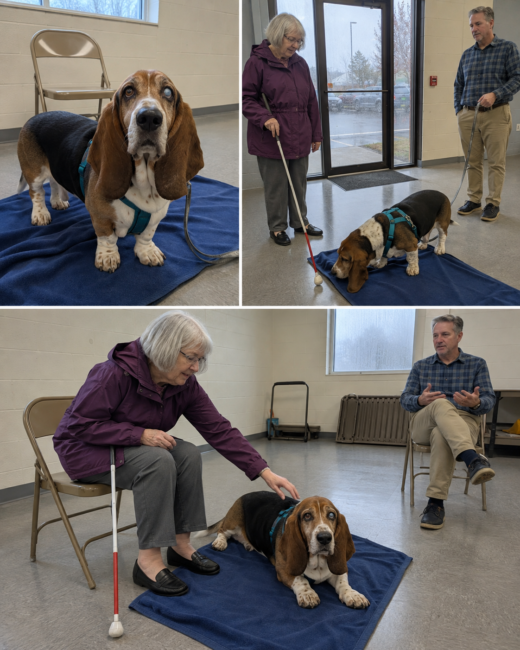
The hound stood beside Evelyn’s shoe, sniffing the damp hem of her coat. His left ear had folded against the leather toe. She kept her hand on his shoulder only while he remained close enough to choose the contact.
“What do you call him?” she asked.
“Hobbs.”
“Hobbs,” she repeated, without raising her voice.
He turned toward the sound.
She smiled, then asked me to describe him beyond his eye.
I told her about the black saddle, the tan face, the white chest, and the brown freckle on his right front paw. I explained how his ears seemed to arrive a moment after the rest of him whenever he changed direction.
“What is he doing now?”
“Smelling the fastening on your shoe.”
“An expert opinion. I’ve never liked those shoes.”
Hobbs lifted his head when I laughed.
The conversation gave him time.
He was no longer being presented like an exhibit while strangers decided whether to move on. He could investigate a shoe, hear a voice again, and notice that the hand beside him had not followed when he stepped away.
Evelyn told me she had limited usable vision. She could make out some shapes and changes in light, but reading print and recognizing faces were not reliable ways for her to gather information.
She used her cane to navigate. She lived in a ground-floor apartment. She had owned dogs before her vision changed, but not since, and she was not assuming that past experience answered every question about the present.
“I don’t need him to guide me,” she said. “I need to know whether we could live comfortably together.”
That was something we could explore.
Hobbs was a companion dog, not a trained guide dog. His calmness beside her chair did not establish how he would behave at a doorway, near traffic, or when surprised by something he could not see.
I said as much.
“Good,” Evelyn answered. “Then we’re talking about the same dog.”
We moved into the quieter room after asking whether she wanted to continue the visit. Jo described the doorway and offered her elbow. I took Hobbs through first, letting him inspect the floor rather than directing him between unfamiliar chair legs.
He turned once toward the noise behind us.
Then he followed.
Inside, we placed a chair where there was open space on both sides. Evelyn chose where to rest her cane, and I kept Hobbs’s leash clear of it. Nobody moved the cane without telling her.
The room became easier to understand.
For Hobbs, there were fewer feet arriving from his blind side. For Evelyn, there was less sound competing with our conversation. For me, there was finally enough quiet to stop summarizing them both.
She asked about his daily routine.
I told her his foster said he liked a slow walk before breakfast, disliked sudden hands above his head, and often slept near someone doing an ordinary household task. He could be stubborn about a smell without being interested in much else on the route.
“He sounds like somebody who reads all the footnotes,” she said.
He lowered himself beside her chair.
She waited until I described where he lay, then rested her hand briefly against his shoulder.
The empty chair was occupied now. There was still no promise of adoption.
But Hobbs’s head was on the floor, and the person beside him was asking what he needed on a Tuesday morning.
It was the most useful conversation we had had all day.
Part 3, The Side He Could Not See
Eleven weeks before the adoption event, Hobbs had been found behind a closed service garage after a summer rain. An employee arriving early saw a dog moving between a fence and a storage shed, then heard his nails scraping when he tried to turn in the narrow gap.
I had been volunteering on transport that morning.
The caller did not report a dangerous dog. He reported one that backed away whenever he approached, then bumped the wire fence with his shoulder.
By the time animal control arrived, the employee had stopped trying to touch him. He waited near the open yard gate and directed us toward the passage without crowding it.
Hobbs stood with his head angled sharply to the right.
His left eye was cloudy.
When the officer moved on that side, he startled and stepped backward. When she spoke and repositioned where his clear eye could locate her, his body became less rigid.
We changed where we stood.
That did more than reaching farther or calling louder.
The garage manager authorized access through a side opening so the officer could give him a wider route. With the space secured, she worked patiently enough to fit a lead without chasing him through the narrow passage.
He followed her a few steps.
Then he stopped at the change from gravel to concrete.
Nobody dragged him over it. She let him inspect the edge, shifted so he could see the route, and waited until he stepped forward.
That pause became part of his intake notes.
He needed information before movement.
The veterinarian examined both eyes. Further assessment established that old damage had left the left eye without useful vision. Its cloudy appearance would remain, and the team did not expect sight to return.
The right eye was functioning.
At his examinations, the left eye showed no sign of active pain requiring emergency intervention. We were given a continuing care plan and instructed to report new discomfort or changes rather than assuming every future problem would be harmless.
He did not need to become a different-looking dog to be adoptable.
He needed an accurate description of the dog he already was.
The found-animal process brought no identified owner. There was no readable tag and no microchip number to connect him with a household. We did not know whether he had wandered, been left, or lost his person in circumstances nobody had reported to us.
The shelter estimated him at eight years old.
His body condition was reasonable. He could walk, eat, and investigate the world with the thoroughness of a hound. We did not add other diagnoses because a difficult history seemed easier to tell if every part of him was damaged.
After his initial shelter stay, he moved to a foster home with Ruth Palmer.
Ruth learned that he preferred people to speak before touching him when they approached from his left. She kept furniture predictable, used secure footing near the back door, and allowed him to take a wider turn when he wanted to bring something into view.
She also learned that he stole dish towels if someone left them hanging low enough.
That detail mattered.
He was not only the eye.
At the adoption event, I had brought his medical summary, Ruth’s observations, and a photograph of him asleep beside her laundry basket with a stolen towel beneath his chin.
As the afternoon wore on, I had stopped showing people the photograph.
I told Evelyn that in the quiet room.
“Why?”
“I suppose I thought they wanted the important information first.”
“Wasn’t that important?”
Hobbs rolled one shoulder against the blanket, stretching a front leg toward her shoe.
I took out my phone and described the photograph instead of simply holding the screen toward her. Ruth’s red laundry basket. A yellow towel. One ear inside the basket, as though he had misjudged where his head ended.
Evelyn laughed.
Then she asked whether Ruth would be willing to speak with her.
It was not a question about saving him from an unhappy picture. She wanted to meet the household dog behind the event description.
I asked Ruth, and we arranged a call.
For the first time since we had found him beside the garage, his story was moving toward a home without requiring us to erase the way he saw it.
Part 4, Questions Worth Taking Home
Ruth joined our second meeting the following Wednesday. We used the same quiet room, but removed the spare folding chairs before Evelyn arrived so there would be room to move without weaving between legs and bags.
Evelyn came with a list recorded on her phone.
She had questions about feeding, veterinary visits, walking arrangements, grooming, and what happened if Hobbs became frightened. She wanted the medical information in a format she could read with her screen reader rather than relying on Jo to interpret every page.
The rescue provided it.
Access was part of the process, not a favor.
Ruth described his routine without polishing it. Hobbs sometimes resisted ending a walk because one patch of grass remained insufficiently investigated. He could bark when a delivery arrived. He preferred resting near someone but did not always want a hand on him.
He had never been trained to guide a person around obstacles.
Evelyn nodded.
“I have a cane for that. I’m asking whether he’ll object when I use it.”
We did not answer from the accidental brush at the hall.
Instead, the behavior coordinator, Dana, helped arrange gradual introductions to the ordinary movement and sound of Evelyn’s cane while respecting how she actually used it. Hobbs stayed on a loose leash with space to step away.
One quiet moment was a beginning, not a guarantee.
At first, he watched the tip move across the floor. He turned his head to keep it within the field of his right eye. When it stopped, he smelled a spot where it had passed.
Evelyn waited for Dana’s description before changing position.
Nobody tapped the dog with the cane, waved it near his face, or tried to teach him by startling him.
After a short session, he lay down.
We ended there.
The next visit included a walk in the rescue’s enclosed yard. Ruth handled the leash while Evelyn practiced the route with her cane and Dana beside them. Later, with guidance and in the same controlled space, Evelyn tried holding his leash herself.
Hobbs stopped at the first interesting smell.
She stopped too.
“Well,” she said, “we appear to have reached a paragraph.”
Ruth laughed from behind us.
There were practical concerns to work through. Hobbs could move quietly beneath a person’s attention. Evelyn needed clear walking routes and reliable ways to know where he had settled. His blind side made surprise contact something to avoid, particularly in narrow spaces.
We discussed those concerns directly.
The question was compatibility, not whether affection could replace a plan.
Evelyn’s apartment had one level and an enclosed patio. She already kept household items in consistent places. Her friend across the hall was willing to help with agreed dog-care tasks when needed, and Jo had offered scheduled transport for appointments.
Evelyn arranged a backup rather than assuming either person would always be available.
She also requested a home visit.
“I know my rooms,” she said. “I’d like you to tell me what I haven’t considered from his height.”
That afternoon, she showed us the route from the front door to the kitchen, the place she preferred to sit, and where a bed could be positioned outside the walking path.
Dana discussed comfortable resting stations and gradual training. Nothing was installed without asking Evelyn first.
It was her home, not a room we were entitled to rearrange.
Hobbs visited with Ruth for an hour.
He inspected the patio door, the kitchen threshold, and a basket beneath a table. Then he found the bed we had brought and turned twice before lowering himself.
Evelyn sat in her armchair.
“Where is he?”
“On the bed to your right,” Ruth said. “Facing the kitchen.”
She rested her hands in her lap and began telling us about the radio program she listened to in the mornings. Hobbs sighed.
When the visit ended, he went back with Ruth.
Evelyn did not ask us to leave him that night. She wanted another visit, the written plan, and time to make the arrangements she had promised.
Nobody mistook careful preparation for a lack of love.
Part 5, The Afternoon They Both Stopped
The foster-to-adopt trial began three weeks after the event. Ruth brought Hobbs, his blue blanket, his ordinary food, and the records Evelyn had already received electronically.
I came to help carry supplies.
Hobbs entered slowly, inspecting the doorway with his head turned slightly right. Evelyn stood clear of the route and spoke before he came close, giving him a sound he had heard on every visit.
His tail moved once.
Then he went to investigate the kitchen.
We left after making sure the immediate setup matched the agreed plan. A quiet first evening was more useful than three volunteers waiting for a photograph that proved everything had worked.
The first updates were encouraging.
He ate. He slept on his bed. He followed Evelyn’s voice into the kitchen without being called repeatedly. With the support arranged for outings, their days began acquiring an ordinary shape.
On the sixth afternoon, I was visiting when the difficulty appeared.
Jo had brought groceries and placed a shopping bag near the passage between the living room and kitchen. It was not where bags usually went. Hobbs approached from the kitchen while Evelyn came the other way with her cane.
He noticed the bag on his right and turned abruptly.
His blind side was now toward Evelyn.
She stopped when the cane contacted the unexpected bag, but Hobbs backed into her ankle at almost the same moment. He stiffened and gave a low growl.
Nobody had intended to corner him.
Evelyn went still.
I asked whether she wanted my assistance, then described where Hobbs stood. Jo moved the bag only after telling Evelyn what she was doing. I gave the dog room to turn toward my voice and guided him away without reaching suddenly over his head.
He settled behind a familiar barrier with space and water while we checked that Evelyn was unhurt.
She was.
But her hands remained tight around the cane handle.
We contacted Dana rather than deciding among ourselves what the growl meant. The veterinarian was also consulted about whether anything warranted a medical check, given his history. At his examination, no new eye problem was found.
The important change was in the space and the unexpected contact.
A warning deserved attention, not punishment.
That evening, Evelyn asked a question I had been afraid she might keep to herself.
“What if I can’t make this safe enough?”
I did not tell her that love would solve it. I did not remind her of the ear touching the cane as though one photograph could obligate her to a lifetime decision.
“If it isn’t a safe match, we will help you end the trial,” I said.
She nodded.
She needed a real choice, not the weight of our hoped-for ending.
Dana visited the following day. With Evelyn’s agreement, we reviewed the narrow passage, where deliveries were placed, and how Hobbs’s resting areas could remain out of travel routes. We practiced predictable introductions and arranged additional support for the trial.
Ruth remained available to take him back if needed.
The rescue extended the decision period rather than pressuring Evelyn to reach a conclusion while she was shaken.
For several days, Hobbs was more watchful in the kitchen passage. Evelyn moved more cautiously there too. We described what we saw, adjusted the plan, and kept the sessions short.
Trust did not return because someone announced that it should.
It returned through ordinary repetitions that ended without surprise.
A voice before an approach. A bag put away. A dog allowed space to turn. A person told clearly where he was resting instead of being left to guess.
Nothing about his eye changed.
What changed was how often the household asked either of them to manage an unexpected obstacle.
A week later, I visited at the same time of day. Evelyn asked Hobbs to wait at the resting station they had been practicing while she moved through the passage with support nearby.
He paused there.
She crossed.
Then he wandered toward the kitchen after her, his ears swinging.
Evelyn let out a breath and smiled.
“There’s room,” she said.
She meant the hallway. At least, that was all she claimed, and it was enough for that afternoon.
Part 6, The Dog Who Stayed Ordinary
As the extended trial continued, the most useful updates became the least dramatic ones.
Hobbs had waited while Evelyn opened the patio door. A visitor had announced herself before approaching his blind side. He had chosen his bed instead of lying across the route to the kitchen.
There were mistakes too.
He forgot the resting station when someone opened a packet that interested him. Evelyn once asked Jo to check a bowl because she could not tell whether he had finished or pushed the food to one side. A walk ended early when the street became busier than expected.
None of those moments was treated as proof that the arrangement had failed.
They were information for the next day.
Evelyn learned his different sounds. The brief scrape of nails before he turned on the mat. The low snort when a smell required further attention. The sigh that usually meant he had lowered his head, though she still asked for confirmation when someone was present and she needed to know.
Hobbs learned routines, not the meaning of visual impairment.
He heard her speak before touch. He found his bed in the same place. He encountered visitors who had been told not to surprise him from the left.
Evelyn continued using her cane.
He never became a substitute for it.
We did not dress him in a working-dog vest or describe ordinary companionship as a service task. When Evelyn traveled somewhere Hobbs could not appropriately accompany her as a pet, the care arrangements she had made were used.
He was allowed to be a dog who sometimes stayed home.
One afternoon, Evelyn called Ruth because Hobbs had stolen a tea towel from a low rail.
Ruth put the call on speaker while I was helping her load supplies at the rescue.
“That’s him,” she said.
Evelyn laughed.
“I thought you should know your reference was accurate.”
The towel was retrieved without a chase, and the rail was no longer used for things he could take. That became another adjustment, less moving than the cane story but more useful to the household.
A little mischief belonged in his new life too.
Near the end of the trial, Evelyn invited Dana and me over to review the remaining questions. She had made a list of what was working, what needed continuing help, and what the veterinary plan would cost.
She had also spoken with her backup caregiver herself.
Jo was present, but Evelyn led the conversation.
“I want to adopt him,” she said. “And I want the support we’ve discussed to remain part of the plan.”
Dana nodded.
Adoption did not mean every uncertainty disappeared or that asking for help became a failure. The rescue explained follow-up support, the care requirements, and what to do if circumstances changed.
Evelyn reviewed the documents in the accessible format she had requested. We did not rush her through pages by saying the important parts aloud and assuming that was equivalent to letting her read.
The decision belonged to her.
While we talked, Hobbs slept on the blue blanket beside her chair. His cloudy left eye was closed; the brown right one opened briefly when Dana shifted her bag.
He watched until the bag stopped moving.
Then he slept again.
That evening, I updated his record.
Adoption finalized.
Those two words could not hold the garage passage, the empty chair, the ear against the cane, or the shopping bag in the hallway. They could not hold Evelyn’s question about whether she could keep them both safe, or the relief of answering it honestly.
But they recorded something practical.
He had an address where people knew how to approach him.
Before we left, Evelyn asked me to describe the photograph taken that afternoon. I told her she was seated in the armchair, her cane beside her, with Hobbs resting nearby.
“Does he look comfortable?”
“He looks asleep.”
“Good. That’s the one.”
It was not the picture I might have chosen at the start of the day we met. There was no dramatic contact, no visible moment in which anyone appeared to be saving anyone else.
There was just a dog who had stopped watching the room long enough to rest in it.
Part 7, The Smallest Introduction
I visited Evelyn and Hobbs on a rainy morning several months later. She had invited me to bring a box of spare blankets the rescue was distributing to its adopters, and I arrived with the box damp along one corner.
She opened the door after asking me to wait while she settled Hobbs away from the entrance.
From inside, I heard her voice.
Then the quiet scrape of his feet.
When she invited me in, he was on his mat to the right of the hallway, watching the doorway with his head turned enough to use his clear eye.
The cloudy left eye was unchanged.
So were the long ears, the brown freckle on his front paw, and the expression that made every pause look slightly more considered than it probably was.
He had not been repaired into a more appealing dog.
He had become familiar to someone.
Evelyn directed me to the kitchen table and asked where I had set the box. I told her, then moved it at her request so it would not narrow the route.
Hobbs inspected my shoes.
He remembered them, or they smelled interesting, or both. I had learned to leave some explanations alone.
While Evelyn made tea, she told me about his latest veterinary check. His remaining sight was still useful, and the plan for monitoring both eyes continued. Nothing in the update suggested that the old loss would reverse.
She sounded pleased anyway.
“He enjoys his mornings,” she said.
I asked what that meant.
A slow outing. Breakfast. A determined investigation of the patio corner. Then time near her chair while she listened to an audiobook.
Sometimes he rested far enough away that she could not reach him.
She did not need constant contact to know the companionship was there.
There were still things that required planning. Appointments had to be arranged. Visitors needed to hear the same explanation about his blind side. Care supplies had fixed places, and the hallway remained free of shopping bags.
Evelyn talked about those things without presenting them as sacrifices.
They were how her household worked.
After tea, she asked whether I could stay while she and Hobbs practiced a short familiar route in the enclosed patio. I could, so I carried my cup to the chair beside the door.
She brought her cane and his leash.
The route was familiar. The surface was clear. Hobbs stopped at the corner where a fallen leaf had apparently changed the nature of the entire morning.
Evelyn waited.
“He’s reading the footnotes again,” I said.
“I’ve allowed time.”
When they came back inside, she put the leash away and rested the cane in its usual place. Hobbs walked past it toward his bed.
His long left ear brushed the white shaft.
A small sound, almost nothing.
Evelyn turned her head.
“There you are.”
I felt the first afternoon return with a clarity I had not expected: the rain on the community-hall windows, my empty chair, the apology I had started before she asked to meet him.
Back then, I had believed I was explaining a dog whose limitations people needed to understand.
Evelyn had asked for something more useful.
His mornings. His preferences. The side from which to speak.
She had wanted to know how to begin.
Now she lowered herself into her chair while Hobbs turned on the blanket. She asked where he had settled, and I told her his head was near the chair’s right front leg.
She reached only after he had heard her voice.
Her fingers rested on his shoulder.
He leaned into the contact for a moment, then stretched out and let her hand fall away when he moved.
Neither had to hold the other in place.
Before I left, Evelyn asked whether the rescue had another adoption event coming up. I told her we did.
“Put out the chairs,” she said.
I smiled, thinking she was joking.
Then I remembered how long his had remained empty.
At the next event, I placed a chair beside every resting area where the layout safely allowed it. I still explained medical conditions and behavior. I also described mornings, stolen towels, and the small habits that made each dog particular.
I left room for someone to stay.
Follow our page for more dog rescue stories about second chances, patient introductions, and the small moments that help overlooked dogs find a place to belong.