An Old Horse Lifted a Starving Puppy From a Muddy Ditch—Then We Found Where the Little Dog Had Been Hiding
Part 2 — The Story We Almost Invented
Ruth unfolded the towel across my arms instead of trying to take him.
The puppy stiffened when the fabric touched his back. His head disappeared beneath the edge of my jacket, and for a moment all I could see was the white tip of his chin.
“Give him a second,” I said.
We had both lowered our voices without discussing it.
Amos stood beside us with his neck extended. Mud darkened the hair around his lips. The empty sack lay at his feet, collapsed into a shape that no longer explained what we had just seen.
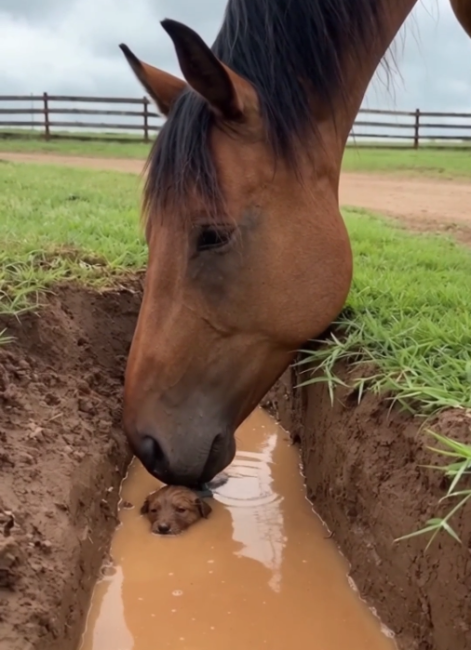
Ruth took his lead rope and moved him away from the ditch.
He followed, then turned his head back toward my arms.
I rose carefully.
The puppy didn’t struggle.
That worried me more than struggling would have. He pressed against the warmest place he could find and stayed there while I tried to judge his breathing.
He was wet through.
Under the coat, his spine made a hard little ridge against my fingers. His belly wasn’t round with a recent meal. When I loosened the jacket to check him, he tucked himself tighter.
We needed a veterinarian.
Ruth called while I carried him toward the house. She described a very young, very thin puppy, wet and weak, holding one front foot off the ground.
The clinic asked questions and told us to come.
I didn’t try to make him walk for a better answer.
I laid him on a dry towel in a carrier, with gentle warmth nearby as the clinic advised, and kept his face uncovered. He lifted his head when my hands moved away.
That was his first clear protest.
A small sound, barely stronger than the one in the ditch.
“I’m here.”
I stayed beside the carrier while Ruth brought the car around.
Then I remembered the sack.
At first, the sight of a puppy wrapped in farm burlap had suggested something deliberate. It was an ugly story to begin making, and I had begun making it before I could stop myself.
Ruth went back to retrieve it.
There was no knot.
No wire.
Nothing had been tied around him or closed over his head.
It was an old sack, split along one side, with loose folds that could cradle a small body without trapping it inside.
That didn’t tell us how he reached the ditch.
It did mean we shouldn’t pretend we already knew.
Ruth spread it on the porch long enough to look at it properly. A few strands of brindle hair clung to a dry section near the bottom.
“He’s been lying on this,” she said.
Maybe.
The puppy shifted inside the carrier. His nose moved toward the porch door, and he tried to push himself upright.
I thought he wanted to follow Ruth.
Then she brought the sack closer.
His nose kept moving.
We set it aside for the moment. Dirty bedding could wait; his condition couldn’t.
During the drive, I sat beside him in the back seat.
He didn’t have a collar. He didn’t have a name. There was no tag to give us somewhere to start.
At a stoplight, he lifted his head and put his white paw against the carrier door.
I could see a raw-looking patch on the underside, small but enough to explain why he had been protecting it.
I kept my fingers outside.
He sniffed them.
Then his paw slipped down again.
“Do you think he came from the road?” Ruth asked.
“I don’t know.”
It was the answer we would have to keep using.
We knew Amos had stood at the fence. We knew a corner of fabric had lifted. We knew my hands had reached the puppy after his own feet failed him.
The rest was still a blank space.
I looked down as he settled.
His body remained curled toward the side where I was sitting.
The carrier was dry. The car was warm.
Even so, he kept one eye open whenever my hand moved away.
Part 3 — Quiet Didn’t Mean Comfortable
The veterinary nurse put a scale on the examination table and asked me to set him down.
He crouched instead of standing.
His right front paw hovered just above the towel, and his eyes moved from my hands to the edge of the table.
“He was in a ditch,” I said, as though that explained everything.
It didn’t.
Dr. Ellis examined him slowly, starting with what he would tolerate. She checked his temperature, listened to his chest, assessed his hydration, and looked carefully at the sore pad.
The puppy tucked his head beneath her wrist.
There was mud in the folds of his ears and between his toes. Once they cleaned enough away, the little white chin became a clear patch rather than a trick of the light.
She estimated he was around nine weeks old.
He was underweight for his frame, with little reserve for cold, missed meals, or the effort of scrambling up a bank.
The paw had a superficial abrasion.
She cleaned and treated it, then explained the protection and rechecks it would need. She wanted us watching how he used it rather than assuming a small scrape couldn’t bother him.
“Was he starving down there?” I asked.
“He was thin before he went into the water,” she said.
That was the first thing the examination made clear.
The ditch hadn’t created his whole condition.
It had exposed a puppy who was already running short of what he needed.
She couldn’t tell us how long he had been without regular care or why. Being thin didn’t identify a person, a place, or an intention.
I appreciated that, though part of me wanted an explanation I could be angry at.
An explanation would have felt easier than not knowing.
The staff scanned for a microchip.
Nothing.
They checked him again before recording it.
Dr. Ellis discussed monitoring, appropriate food in manageable portions, and what changes would mean we should call immediately. There would be follow-up care, ordinary puppy prevention once appropriate, and tests guided by her findings.
No one handed us a miraculous timetable.
The puppy lay on the clean towel while they worked.
He didn’t growl.
He didn’t wag either.
At one point, he stopped responding to the sounds we made, and I asked whether his hearing might be wrong.
The nurse moved away to open a drawer.
A tiny rustle came from the paper packet in her hand.
His ears turned immediately.
“He hears that,” she said.
Then he lowered his face again when we leaned closer.
We had been reading his stillness as calm.
The change made us look again.
Dr. Ellis asked us to give him more space and less attention while she observed him from a little distance.
After a minute, his nose began moving.
He sniffed the towel.
He shifted onto his left side, away from the sore paw.
Then he licked a little food offered on a shallow dish.
It was the first useful thing he had done without somebody touching or encouraging him.
I realized how hard we had all been trying to make him show us he was all right.
He wasn’t all right yet.
He needed room for that.
Ruth had to return to the barn for the other animals. I stayed while the clinic finished its initial care and observation.
She called from the yard a little later.
“I found something.”
I looked at the puppy, now asleep with his nose against the towel.
“What?”
“The prints go behind the storage cabinet.”
We hadn’t moved that cabinet in months.
Ruth described a narrow space beside the wall, sheltered from the doorway. There were little tracks in dried mud, a few crumbs from the barn cats’ food, and a hollow in the dust.
A place just big enough for a puppy.
He hadn’t only passed through our yard.
At some point, while we were filling buckets and sweeping floors, he had found somewhere to lie down.
Part 4 — What He Recognized
I brought him home that afternoon with written instructions, a small supply bag, and the uneasy feeling that our familiar barn had contained something we hadn’t learned to notice.
Ruth met us at the house.
She had closed the feed-room door and kept Amos in a separate paddock while we sorted things out.
There would be no reunion arranged for a photograph.
The puppy needed a quiet place, and a horse needed his ordinary boundaries.
We set up a pen in the utility room beside the kitchen, away from the boarding dogs that sometimes visited and the barn cats that considered every doorway theirs.
The floor was warm enough. The light was soft. I could hear him from the table.
He crouched in the carrier until I stepped back.
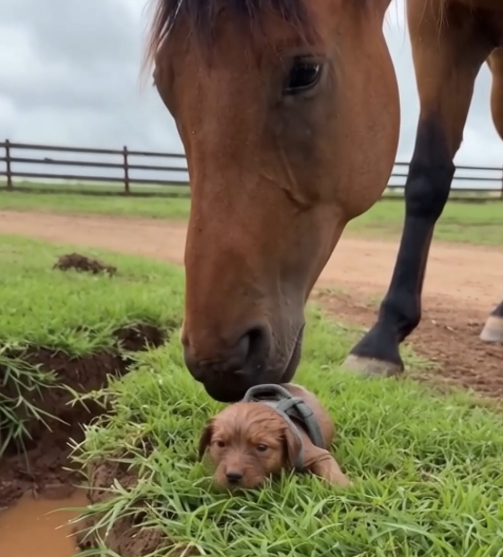
Then he came out.
Three feet moved normally.
The white right front paw touched down cautiously, lifted, and touched again.
He stopped at the edge of the towel.
That seemed to be the limit of his world for now.
I sat on the other side of the room with the care sheet in my lap.
Ruth went to finish the afternoon work.
For several minutes, the puppy watched my shoes.
Then he began crying.
Not loudly.
A small repeated sound that ended whenever I moved closer and started again when I sat down.
I thought he needed to be held.
When I reached toward him, he folded himself against the pen wall.
So I withdrew.
That left us with a puppy who wanted something and a person who kept guessing wrong.
Ruth came in carrying the old sack inside a plastic tub.
She had checked behind the cabinet more carefully.
There were more hairs there, matching his coat, and an indentation where the sack appeared to have rested. She remembered leaving it folded beside the cabinet after emptying it.
Neither of us could reconstruct what happened overnight.
He might have dragged it. Wind might have moved it through the unlatched doorway. Runoff could have caught it nearer the lane.
We couldn’t turn possibilities into a history.
But we could stop assuming the sack had only been a trap.
It might have been his bed.
We asked the clinic about a safe way to handle familiar bedding that was filthy from ditch water. Following their guidance, we cleaned what could be cleaned and kept the room and his paw care appropriate.
The sack wasn’t going back beneath a small animal unsupervised.
Instead, we placed a cleaned piece securely over part of his padded resting area, where loose strands couldn’t wrap around him.
I expected a dramatic response.
He sniffed it.
Then he stood with his nose down for a long time.
Eventually, he lowered his chest.
His sore paw extended carefully in front of him.
He fell asleep before I stood up.
That was the first time his whole body seemed to let go.
I sat back down.
Outside, Amos called once from the paddock when Ruth moved another horse past him.
The puppy’s ears lifted.
He opened his eyes, listened, and settled again.
I wanted to call that recognition.
Maybe it was.
Maybe it was simply a familiar sound from the place where he had hidden.
Either way, he went back to sleep.
That evening, I followed the feeding instructions and wrote down what he ate. I checked the paw without turning every movement into an examination.
He drank.
He went outside briefly in my arms to a safe, clean area.
He came back inside.
These were small things, repeated.
Between them, I began noticing how often I wanted to interrupt him. A sleeping puppy invited another check. A meal invited encouragement. An uncertain step made me want to move him somewhere easier before he could decide for himself.
I started keeping my hands in my lap for a few seconds before acting.
Sometimes he needed help.
Sometimes he needed a little time.
Once, he stood looking at the water bowl while I held my breath on the other side of the room. Then he walked to it, drank, and returned to his towel without looking at me.
I wrote that down too.
At midnight, he woke and cried.
I sat on the floor nearby until he settled, then moved to the chair rather than making him manage the whole room alone.
Around two, he took a few steps off the towel.
He approached my foot.
I kept still.
His nose touched the seam of my shoe, and he lay down against it.
For the first time that day, he had chosen contact without being lifted into it.
I didn’t pick him up.
I let his small warm body remain exactly where he had put it.
Part 5 — The Horse on the Other Side
We called him Button on the third morning.
Ruth said his nose looked like a dark button somebody had pressed into the wrong-sized face.
It wasn’t a grand name for a puppy rescued beside a twenty-two-year-old horse.
It suited the way he appeared beneath the kitchen chair.
Small. Particular. There.
We reported him found, shared clear photographs, and contacted the local people who helped reunite lost animals with families.
We described his white chin and right front paw without attaching an invented story to them.
Nobody who called could give us the details that would identify him.
One person had lost a much older dog. Another hoped he might be a missing puppy from a different county, but the markings didn’t match.
We kept checking.
Meanwhile, he needed breakfast whether someone recognized him or not.
He needed the scheduled paw check, a clean sleeping area, and the patient work of growing into a place.
The veterinarian was pleased with his early progress but reminded me that gaining steadily mattered more than gaining quickly.
His appetite was better.
His confidence was harder to measure.
Some mornings, he explored the kitchen while I worked.
Other mornings, the sound of a bucket outside sent him behind the chair.
Ruth began leaving notes by the kettle.
Ate well.
Slept forty minutes.
Walked to the water bowl by himself.
That last one made me smile for the rest of the morning.
Then he began stopping at the door that faced the barn.
He would stand there, nose low, and listen.
At first, I assumed he wanted to go outside.
Sometimes he did.
Other times, once carried into the yard for a short supervised outing, he turned toward Amos’s paddock and became still.
Amos stood well back from the fence.
Button watched him.
The horse lowered his head a little, breathed out, and returned to his hay.
Nothing more happened.
I had expected fear.
A puppy had been lifted out of muddy water close to a horse’s enormous mouth. I expected that shape above him to mean danger.
Instead, he sat down.
His shoulders lowered.
I could feel the change through the leash before I understood it.
We didn’t put him beneath the fence or allow him near the horse’s feet. He stayed with me on the safe side, with enough distance that neither animal needed to interact.
From there, he could look.
That was enough.
A neighbor suggested Amos must have known exactly what he was doing at the ditch.
Another said horses picked up sacks because they expected feed.
I couldn’t settle that argument.
I had seen a corner rise.
I had seen a puppy become reachable.
I had also seen the horse stop when I approached and release the fabric when I supported its weight.
Those were the things I could honestly keep.
Button didn’t need me to solve the horse.
He needed me to notice that the yard was easier for him when the familiar paddock sounds were nearby.
So we built quiet, safe outings around that.
A few minutes sitting with me.
A sniff of dry grass.
Back inside before he became tired.
The horse continued being a horse.
He nudged his empty bucket. He leaned into a scratch from Ruth. He objected when breakfast arrived later than he preferred.
Button watched all of it with increasing interest.
One afternoon, Amos snorted hard enough to scatter dust from his hay.
Button startled.
Then he gave one tiny bark.
I laughed before I could stop myself.
He looked up at me, surprised by the sound.
Then his tail moved.
Not a sweeping, effortless wag.
Two little movements against the grass.
I wrote that on the kitchen pad when we went inside.
Ruth added something beneath it after evening chores.
Amos ate every bit of dinner.
The two notes sat together beside the kettle.
One animal had done something we might never completely explain.
The other was beginning to have ordinary days.
Part 6 — When Feeling Better Wasn’t Enough
The limp returned when I thought we were past that part.
Button had been using the white paw more comfortably, and the skin was healing at the recheck.
He had also discovered that the house contained more than one room.
That combination made me careless about how much excitement fit into an afternoon.
I didn’t take him running or make him climb anything.
I simply let one good stretch of exploring become another.
Kitchen to utility room.
Utility room to hallway.
Outside for a little while because he seemed interested.
By evening, he held the paw up.
My stomach dropped.
I checked what I could without pressing or probing, then called the clinic.
They wanted to see him again.
There wasn’t a hidden broken leg or some new disaster waiting to turn the story darker. The healing area was irritated, and his activity needed to come back down while it settled.
Dr. Ellis went through the care plan again.
I listened more carefully than I had the first time.
“He’s feeling better,” she said. “That doesn’t mean everything is ready for everything he wants to do.”
I looked at Button.
He was trying to nose beneath the edge of the towel on the table.
I had let his curiosity make the decision.
The setback was small.
It was still mine to address.
We adjusted the routine, protected the paw as advised, and watched for changes that would mean another call.
The next few days were quieter.
Ruth took over more of the moving around. I used food puzzles suited to him, short gentle interactions, and rest rather than longer outings.
When he looked toward the barn door, we didn’t automatically go out.
Sometimes I carried his bed closer to the window instead.
He could hear the same sounds without covering the same ground.
I worried he would lose the little trust he had gained.
He didn’t.
He complained occasionally.
He slept.
He learned that the squeak in one soft toy belonged to something he could push with his nose.
Then, one evening, he rolled onto his side while I sat nearby reading the care notes.
His belly faced the room.
His legs loosened.
He had been with us for weeks, and I had never seen him sleep that way.
The smaller routine hadn’t made his world shrink back into fear.
It had given him room to rest.
The paw improved again.
This time, the return to activity followed the plan instead of my enthusiasm.
As he grew stronger, another question became harder to avoid.
What happened when he was ready for a permanent home?
I lived in the little cottage beside Ruth’s farmhouse. I worked at the barn and helped care for animals every day.
That didn’t automatically mean I had made a place for a dog of my own.
There were long mornings, veterinary costs, backup care, and all the days when a story wasn’t happening.
Ruth asked about those things.
She didn’t ask whether I loved him.
That part was obvious.
I made a schedule.
I worked out what I could afford.
We spoke about who would cover him if I was sick or away, and how to keep a curious growing dog safely separated from horses, feed, equipment, and visiting animals.
The arrangements were less romantic than the ditch.
They mattered more to the years ahead.
Still, I hesitated.
I told Ruth I wasn’t sure Button belonged with me or with the barn.
She watched him sleeping beside my chair.
“What do you mean?”
“He always wants to see Amos.”
“Sometimes,” she said.
That evening, rain began against the windows.
I stayed at the cottage instead of walking over to the main house.
Amos was in his shelter, out of sight and beyond any sound I could hear.
Button carried his soft toy to the rug.
He lay beside my slipper.
Then he slept.
I sat there longer than I needed to, looking at the small body against my foot.
I had been afraid I was only the person between him and the animal he trusted.
But he had followed me home, settled in my room, and closed his eyes.
Part 7 — Something Soft Beneath Him
Button stayed.
By the time the found-animal process was complete and we could make the placement permanent, that decision had become a collection of ordinary arrangements.
A name on veterinary records.
A food container in my kitchen.
A spare key for Ruth.
A place in my week that didn’t depend on whether I felt inspired.
I bought him a properly fitted harness as he grew, kept up his care, and learned which parts of the cottage needed rearranging before a puppy rearranged them himself.
He developed opinions.
The vacuum was suspicious.
The delivery driver was worth investigating.
A clean towel folded on a chair was apparently unfinished work.
His ribs became less prominent as he gained steadily. The sore patch on the white paw healed, and we kept following the veterinarian’s guidance rather than treating a better photograph as the end of his care.
By early summer, he could walk through the yard with an easy, loose movement that bore little resemblance to the scrambling puppy in the ditch.
He still checked the fence.
I used to tell people he was looking for Amos.
Sometimes he probably was.
Then I began noticing the other things he did there.
He sniffed along the lower rail.
He examined places where the grass moved in the breeze.
He watched Ruth cross the paddock with a wheelbarrow and turned toward the barn cat sitting beyond his reach.
The fence no longer marked the edge of one frightened little animal’s safety.
It had become a place where things happened.
He had grown interested in the world.
That was the change I had been waiting for without knowing how to describe it.
Amos remained part of his routine.
We kept their contact supervised and safely separated. There were quiet mornings when the horse stood nearby while Button sat beside me.
There were also mornings when the horse ignored him entirely.
Button learned to accept that.
Not every visit needed a meeting.
Not every calm day needed a reminder of the ditch.
One afternoon, a family touring the boarding barn recognized him from the photographs Ruth had shared when we were searching for an owner.
“Is this the puppy the horse saved?”
I looked at the healthy young dog nosing my pocket.
“Yes.”
The little girl with them crouched several feet away and waited after I showed her how to ask before approaching.
Button went to sniff her hand.
“Does he know?” she asked.
“Know what?”
“That Amos saved him.”
I looked across the fence.
The old horse was eating hay with a piece hanging from one side of his mouth.
“I don’t know,” I told her.
She considered that, then scratched Button’s shoulder.
He leaned into her fingers.
It seemed like an answer he could actually give.
The old sack was gone by then.
Once it was no longer needed as a familiar scent, I had thrown away what couldn’t safely be kept. For a while, I felt disloyal about it.
Then Button began sleeping with his head on a cheap washable blanket I bought at the farm store.
There was no ditch water in it.
No history.
Just something soft that belonged to him.
Near the end of summer, I took that blanket outside while Ruth and I sat near the paddock after evening chores.
Button settled beside my chair.
Amos approached the fence and lowered his head, stopping on his side of it.
For a moment, the shapes were almost familiar enough to make my chest tighten: the long chestnut face above the small brindle dog, the fabric between them.
But Button wasn’t struggling.
The ground was dry.
He lifted his head, looked at the horse, and gave one small thump of his tail.
Then he rested his white paw on the blanket.
Amos breathed out and turned back toward the hay.
I bent to straighten the corner beneath Button’s chin.
He didn’t wake.
The first time I saw him, someone had to hold a piece of fabric up to keep him out of the mud.
Now it only had to lie beneath him.
Follow our page for more compelling dog rescue stories, unexpected friendships, and the quiet second chances that help small, frightened animals finally feel at home.