An Old Silver Dog With a Belly Swollen Twice His Size Was Left Alone on a Freezing Park Bench, His Tired Eyes Following Everyone Who Walked Past Without Stopping
Part 2: Eleven Pounds
“It’s a tumor,” Dr. Brennan said.
He turned the screen so Dolores could see. A huge, dark, rounded mass filled almost the entire picture, pressing everything else in the dog’s belly out of the way.
“It’s growing off his spleen,” he said. “And it’s massive. I’d estimate ten or eleven pounds. Maybe more.”
Dolores put her hand over her mouth. Teddy pressed against her side.
“It’s been growing for months,” Dr. Brennan said quietly. “That’s why his belly is so swollen. That’s why he can’t stand. It’s crushing his stomach. He probably hasn’t been able to eat more than a few bites at a time in weeks.”
“Is it cancer?” Dolores whispered.
“I won’t know until I take it out and send it to the lab.” The vet took off his glasses and rubbed his eyes. “Most tumors this size on the spleen in an older dog are malignant. Hemangiosarcoma. If it is, even with surgery, we’d be buying him weeks. Maybe a couple of months.”
“And if you don’t operate?”
“If that thing ruptures, he bleeds to death inside in a few hours.” Dr. Brennan put his glasses back on. “And it’s going to rupture. Soon.”
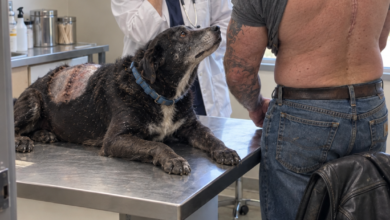
The old dog lay on the exam table, his swollen belly rising and falling, his amber eyes on Dolores.
“How old do you think he is?” she asked.
“Eleven. Twelve, maybe.” The vet looked at the dog’s gray muzzle. “Honestly, Mrs. Kowalczyk, at his age and in his condition, with a tumor this big, his chances of surviving the surgery itself are about forty percent. Maybe less. The anesthesia alone could kill him.”
Forty percent.
The rescue’s director, a woman named Carla Jennings, came into the room. She looked at the ultrasound. She looked at the old dog. She looked at the cost estimate on the clipboard. Four thousand dollars, for a surgery that might not work, on a twelve-year-old dog that nobody had claimed.
Dolores saw her face and knew what she was thinking.
“I’ll pay,” Dolores heard herself say.
Carla looked up, surprised.
“Not all of it,” Dolores said. “I’m a retired school librarian on a pension. But I can give five hundred dollars. Today.”
The old dog lifted his head off the table. He stretched his neck toward Dolores’s hand again. Laid his chin on top of it.
Carla Jennings watched him do it for a long time.
“We’ll cover the rest,” she said quietly.
They operated that afternoon.
Dolores sat in the rescue’s waiting room with Teddy asleep across her lap for four hours. Four hours on a hard plastic chair, watching the clock on the wall.
At 6:20, Dr. Brennan came out in his scrubs. His face was tired.
Dolores stood up so fast Teddy almost rolled onto the floor.
“He made it,” the vet said.
Dolores sat back down hard.
“The tumor came out in one piece,” Dr. Brennan said. “Eleven pounds, two ounces. It’s the biggest splenic mass I’ve ever removed. We had to give him two blood transfusions.” He paused. “We’ll know about cancer in three days.”
The three days felt like three years.
On the morning of the third day, Dr. Brennan called Dolores at home.
“It’s benign,” he said.
Dolores didn’t understand at first.
“It’s not cancer,” the vet said, and she could hear him smiling. “It was a hematoma. A huge, benign mass of blood and tissue. Once it’s out, it’s out. He’s going to be okay.”
Dolores burst into tears in her kitchen.
When she went back that afternoon, the old dog was lying on a padded bed in the recovery room, a long line of stitches down his shaved belly.
He’d weighed sixty-eight pounds when they brought him in.
He now weighed fifty-three. Fifteen pounds gone in a single night.
And as Dolores walked into the room, he did something nobody at the rescue had seen him do yet.
He stood up.
On his own. Wobbly, shaky, his thin legs trembling. But standing. For the first time in what must have been months.
Dolores knelt down, and he walked to her and laid his chin on her hand.
“Good boy,” she whispered. “Oh, good boy.”
A vet tech brought in a bowl of soft food and set it down beside him.
The old dog looked at it.
Then he turned his head away.
Part 3: The Door
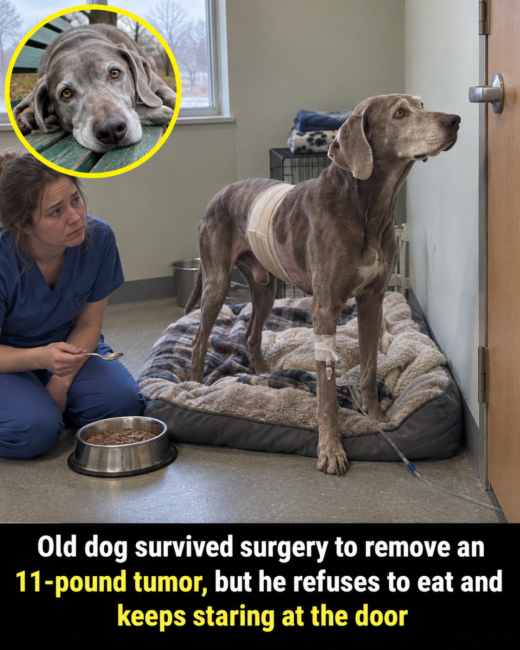
He wouldn’t eat.
Not the soft food. Not the chicken and rice. Not the expensive prescription diet. Not even the scraps of roast beef a vet tech named Jessica brought from her own lunch.
He’d sniff it. Then turn away.
“It’s not his stomach,” Dr. Brennan said on the third day, frowning at the chart. “His bloodwork is improving. The incision is healing well. Physically, he should be starving.”
“Then why won’t he eat?” Dolores asked.
The vet didn’t have an answer.
Dolores came to the rescue every afternoon after picking Teddy up from school. She sat on the floor of the recovery room and talked to the old dog. About her garden. About Teddy’s spelling tests. About nothing.
And she began to notice something.
The dog didn’t pay much attention to the young vet techs or to Dr. Brennan. He was polite. Gentle. But distant.
But every time an older person’s voice drifted in from the lobby, his head came up.
A gray-haired man dropping off a cat. An elderly couple asking about adoption. A retired volunteer who came on Tuesdays to fold towels.
Every single time, the old dog stood up, walked stiffly to the door of the recovery room, and stood there. Staring at it. Ears forward. Tail moving slowly.
Waiting.
Then the voice would fade, and he’d lie back down.
“He’s looking for someone,” Jessica, the vet tech, said quietly on the fourth day, watching him stand at the door. “Someone old.”
Dolores was quiet. She thought about the way he’d laid his chin on her hand on the park bench. The way that had felt so familiar.
Carla Jennings, the director, came into the room with a printout.
“I should have done this the first day,” she said. “We scanned him for a microchip at intake, but the number didn’t come up in the main pet registries. So Jessica ran it through every database she could find last night.” She held up the paper. “It’s registered. Just not to a person.”
“Then to who?” Dolores asked.
Carla read it aloud.
“Maple Grove Senior Living, Grand Rapids. Animal-Assisted Therapy Program. Dog’s name: Captain.”
The old dog’s head snapped up.
His ears lifted. His tail began to thump against the bed. Harder than they’d seen it move since he arrived.
“Captain,” Dolores whispered.
The dog stood up and walked to her.
“A therapy dog,” Carla said, looking at the printout. “Registered in 2016. That’s nine years ago.”
Jessica knelt beside the dog and ran her fingers along the worn line in his fur behind his front legs. The line Dolores had noticed on the bench.
“That’s from a vest,” Jessica said softly. “A therapy dog vest. He wore one for so long it rubbed the fur thin.”
She turned his old collar over in her fingers. Sewn onto the inside of the leather, faded and nearly worn away, was a small cloth tag. She squinted at it.
CERTIFIED THERAPY DOG. Pet Partners. Captain.
“I don’t understand,” Carla said. “If he’s a therapy dog at a nursing home, why on earth was he lying on a bench in Riverside Park?”
She picked up the phone and called Maple Grove Senior Living.
Dolores watched her face as she talked. Polite at first. Then confused. Then hard.
When she hung up, she stared at the wall for a long moment.
“The receptionist said they used to have a therapy dog named Captain,” Carla said slowly. “She said he retired two months ago. That he was adopted by a nice family.” She looked at the old dog. “She said all the residents were told he’d gone to live on a farm.”
The room went silent.
“Then how did he end up on a park bench,” Jessica said, “with an eleven-pound tumor in his belly?”
Nobody answered.
Dolores was staring at the printout in Carla’s hand.
Maple Grove Senior Living.
All the blood had drained out of her face.
“Dolores?” Carla said. “Are you okay?”
Dolores didn’t answer. She was looking at the old silver dog. At the small white star on his chest. At the notch in his right ear.
“My husband,” she whispered. “My Frank died at Maple Grove.”
Part 4: The Last Night
Frank Kowalczyk had been a mail carrier in Grand Rapids for thirty-six years.
A big, laughing man with a booming voice who knew every dog on his route by name and kept biscuits in his mail bag. He and Dolores had been married for forty-seven years.
Then came Parkinson’s. Then a fall. Then, at seventy-eight, Maple Grove Senior Living, because Dolores could no longer lift him by herself.
“I visited him every single day,” Dolores said quietly. She was sitting on the floor of the recovery room with Captain’s head in her lap. “Every day for two years.”
Carla and Jessica sat in chairs across from her. Teddy was in the lobby with a coloring book.
“In January, four years ago, the hospice nurse called me at two in the morning,” Dolores said. “She said Frank was going. That I should come. Now.”
She stroked Captain’s silver ear.
“There was an ice storm that night. The worst in ten years. Every road in Grand Rapids was a skating rink. I tried. I got halfway there and slid into a ditch on Leonard Street.” Her voice broke. “By the time the tow truck pulled me out and I got to Maple Grove, it was five-thirty in the morning. He’d been gone for an hour.”
Jessica put her hand over her mouth.
“I’ve spent four years thinking my husband died alone,” Dolores whispered. “In the dark. Without me. That’s what I see when I close my eyes at night.”
She looked down at the old dog in her lap.
“But when I got there, the night nurse said something to me. I was too upset to really hear it. She said, ‘He wasn’t alone, Dolores. Captain was with him.'” Dolores touched the small white star on the dog’s chest. “And when I went into Frank’s room, there was a silver dog lying on the bed beside him. With his chin on Frank’s hand. He wouldn’t move until they came to take Frank away.”
She was crying openly now.
“I barely looked at him,” she said. “I was so lost. I didn’t even ask his name. And I never went back to that place. I couldn’t.” She cupped Captain’s gray face in both hands. “But on that bench in the park, when he put his chin on my hand, I felt it. I just didn’t know why.”
Captain laid his head against her chest and sighed.
The next morning, Dolores drove to Maple Grove Senior Living for the first time in four years.
It was a long, low brick building on the northeast side of the city, with a circle driveway and a sun-faded sign. Dolores sat in her car in the parking lot for twenty minutes before she could make herself go in.
She signed in as a visitor. She walked down the hallway to the community room.
A dozen residents sat in armchairs and wheelchairs around a television. A few were playing cards. One woman was knitting.
In a wheelchair by the window sat a thin old man with a white crew cut, a Korean War veteran’s cap on his head, and a plaid blanket across his knees. He was staring out at the parking lot.
Dolores walked over to him. “Excuse me,” she said gently. “Did you know a dog here named Captain?”
The old man turned his head slowly. His watery blue eyes lit up.
“Captain?” he said. “You know Captain?”
“I think so,” Dolores said carefully.
“Best friend I’ve got.” The old man’s voice was rough and proud. “Name’s Earl Whitcomb. Ninety-one. Captain’s been coming to my room every morning for six years. I sing to him. ‘You Are My Sunshine.’ He puts his head right here.” He patted his knee. “Every single morning.”
Then his face fell.
“They say he went to a farm,” Earl said quietly. “Two months ago. Got adopted by a nice family.” He looked out the window again. “I asked if I could say goodbye. They said he’d already left.” His voice cracked. “I’ve been asking every day since. Nobody tells me anything.”
Around the room, other residents had turned to listen.
“Captain sat with my sister when she passed,” the woman knitting said softly. “Last spring.”
“He was with my roommate, Gil,” said a man at the card table. “At the end.”
“He’s been with everybody,” Earl said. “Nine years. Hundreds of us. Every single one who was dying, Captain went and lay down with them. Nobody had to tell him. He just knew.”
Dolores couldn’t speak.
When she walked out to the parking lot, a young man in blue scrubs was waiting by her car. Early twenties. Thin. Red-eyed.
“Ma’am,” he said shakily. “You were asking about Captain.”
“Yes.”
“My name’s Kevin Lopez. I’m a nursing aide here.” He was trembling. “I’m the one who left him on that bench.”
Part 5: Company Property
Kevin Lopez sat in the passenger seat of Dolores’s car with his face in his hands.
“Last spring, Maple Grove got bought by a company out of Indiana,” he said. “Heartland Senior Living Group. They sent a new administrator. Mr. Simms. Bradley Simms.” He wiped his face. “First thing he did was start cutting. Staff. Activities. The music program. And Captain.”
“Why Captain?” Dolores asked.
“He said liability. Insurance costs. And Captain was getting old. His belly started swelling up in the summer. The nurses all saw it. We begged Simms to take him to a vet. He said the company wasn’t paying vet bills for a dog that wasn’t ‘generating revenue.'” Kevin’s voice cracked. “So in September he told us to tell the residents Captain had retired to a farm. And he locked him in the maintenance room in the basement.”
Dolores went cold.
“For two months,” Kevin whispered. “He was down there. In the basement. I snuck down every night after my shift and fed him. But he kept getting bigger. He couldn’t walk. And two weeks ago, Simms called me into his office and told me to get rid of him. He said, ‘Take care of it.'”
“And you took him to the park,” Dolores said.
“I didn’t know what else to do.” Kevin was sobbing now. “I’m twenty-two. I live with three roommates. I make fourteen dollars an hour. I couldn’t afford a vet. I couldn’t take him home. I carried him to the bench closest to the river path at six in the morning, because that’s where the most people walk. I thought somebody would stop. Somebody kind.” He looked up at Dolores. “I sat in my car across the street for two hours. Watching. People kept walking past.”
“Until me,” Dolores said quietly.
“Until you,” Kevin whispered. “I’m so sorry. I’m so sorry.”
Dolores looked at the boy for a long moment.
Then she put her hand on his shoulder.
“You fed him,” she said. “For two months. In secret. That’s more than anybody else did.”
The next day, Carla Jennings called Maple Grove and asked to speak to the administrator.
Bradley Simms got on the phone. He was polite. Smooth. He said Captain had been “rehomed through proper channels” and that Maple Grove “could not comment on former company property.” When Carla told him exactly where Captain had been found, and in what condition, Simms’s voice went cold.
“If you’re implying something, Ms. Jennings, my company has very good lawyers,” he said. “And under our new policy, no animals are permitted on the premises. That dog is not coming back here. Ever.”
He hung up.
That same afternoon, Captain stopped drinking water.
He’d already stopped eating. Now he stopped drinking too. He lay on his bed in the recovery room with his head on his paws and his eyes half closed. He didn’t stand up at the sound of old voices anymore. He didn’t lift his head when Dolores came in.
Dr. Brennan put him on an IV.
“His body is healing,” the vet said quietly, standing at the foot of the bed. “The incision looks good. The tumor is gone. There’s nothing physically wrong with him anymore.” He shook his head. “I’ve seen this a few times in my career. Old dogs who lose their person. They just decide to stop.”
“His person,” Dolores whispered.
“He spent nine years walking into the rooms of people who were dying,” Dr. Brennan said. “Lying down next to them so they wouldn’t be alone. That was his whole life.” He looked at the old dog. “And then they locked him in a basement and left him on a bench. And now he can’t find any of them.”
Dolores called Maple Grove herself that evening and asked to speak to Earl Whitcomb.
A nurse answered. Her voice was tight.
“I’m sorry, ma’am,” she said quietly. “Mr. Whitcomb isn’t taking calls. He stopped eating last week. The doctor’s worried.” She hesitated. “He keeps asking for the dog.”
Dolores hung up the phone and sat in the dark in her kitchen.
Two old souls, across town from each other. One in a recovery room. One in a wheelchair by a window.
Both of them giving up.
On the sixth day, Dr. Brennan called Dolores at seven in the morning.
“You should come in,” he said gently. “He didn’t lift his head at all last night. His heart rate’s dropping. I think he’s letting go.”
Part 6: You Are My Sunshine
Dolores didn’t go straight to the rescue.
She went to Maple Grove first.
She walked right past the front desk without signing in. Down the hallway. Into Room 112.
Earl Whitcomb was lying in bed, thin and gray, a tray of untouched oatmeal on the table beside him. His veteran’s cap was on the nightstand.
“Mr. Whitcomb,” Dolores said, pulling a chair to the bed. “Earl. I found Captain.”
The old man’s eyes opened.
“He’s alive,” Dolores said. “He was sick. Very sick. But they operated, and he survived. He’s at a rescue across town.” Her voice shook. “But he won’t eat, Earl. He won’t drink. He’s lying there giving up, because he thinks everybody’s gone.”
Earl stared at her.
“I need you to do something for me,” Dolores said. She took out her phone and opened the camera. “I need you to sing to him.”
Earl Whitcomb looked at the phone for a long moment. Then he reached a trembling hand to the nightstand, put on his veteran’s cap, and sat up straighter in the bed.
He looked into the phone’s camera, cleared his throat, and in a thin, cracked, ninety-one-year-old voice, he sang.
You are my sunshine, my only sunshine…
By the time he got to the last line, Dolores was crying too hard to hold the phone steady.
Twenty-five minutes later, she knelt on the floor of the recovery room at the Kent County Humane Rescue beside an old silver dog who hadn’t lifted his head in eleven hours.
She held the phone close to his ear and pressed play.
You are my sunshine…
Captain’s ear twitched.
…my only sunshine…
His amber eyes opened.
You make me happy when skies are gray…
He lifted his head off the bed. His nose went straight to the phone. He stared at Earl’s face on the screen. He whined. A long, high, desperate sound.
Then he stood up.
The IV line swung. His legs shook. But he stood up and pushed his nose against the phone screen, against Earl’s face, and his tail began to move. Slowly. Then harder.
Jessica the vet tech was standing in the doorway with her hands over her mouth.
When the song ended, Captain turned around, walked to the bowl of soft food that had been sitting untouched in the corner for six days, and ate the whole thing.
Then he drank half a bowl of water.
Then he lay down with his chin on Dolores’s hand and fell asleep.
That night, Dolores posted the video on Facebook. Earl singing. Captain standing up. Captain eating. Along with the whole story. Nine years. Hundreds of bedsides. A basement. A bench.
And a company that told the residents he’d gone to a farm.
By morning, it had been shared two hundred thousand times.
By the end of the week, the residents of Maple Grove Senior Living, and their sons and daughters and grandchildren, had signed a petition with four thousand names on it. They took it to the Grand Rapids city council. To the local news. To the head office of Heartland Senior Living Group in Indianapolis.
Kevin Lopez went on camera and told the truth about the basement.
Eleven days later, Bradley Simms was removed as administrator. The company issued a public apology. The new interim director, a former hospice nurse named Patricia Lowe, called the Kent County Humane Rescue herself.
“We want Captain to come home,” she said. “Whenever he’s ready. And we’ll pay every one of his medical bills.”
Dolores sat beside Captain’s bed the night before he went home and told him.
Then she told him something else. The thing she’d been carrying for four years.
“I thought Frank died alone,” she whispered. “I thought I failed him. I’ve woken up every night thinking about him lying there in the dark with nobody.” She stroked his silver ear. “But he didn’t. You were there. You were holding his hand when I couldn’t.”
She laid her forehead against the old dog’s head.
“You took care of my husband. And Earl. And Gil. And all of them. And nobody took care of you,” she said. “So this time, we will.”
Captain lifted his chin and rested it gently on top of her hand.
The same way he had on the bench.
The same way he had with Frank, four years ago, on the last night.
Part 7: Home
On a cold, bright morning in December, Dolores Kowalczyk drove Captain back to Maple Grove Senior Living.
He was wearing a brand-new blue therapy dog vest. Kevin Lopez had bought it with his own money.
Patricia Lowe met them at the front door. Behind her, the hallway was lined with staff. Nurses. Aides. The cook in her apron. Kevin, standing at the end, already crying.
Dolores unclipped the leash.
Captain stood in the front doorway for a moment, sniffing the air. The smell of coffee and floor wax and old people and home.
Then he walked down the hallway on his own.
He didn’t need anybody to show him the way.
He walked past the front desk. Past the nurses’ station. Into the community room, where every resident who could get out of bed was sitting in a big circle of armchairs and wheelchairs, waiting.
The room went silent.
Captain didn’t stop at any of them. He walked straight across the room, past the television, past the card table, to a wheelchair by the window.
Earl Whitcomb was sitting in it, his veteran’s cap on his head, his plaid blanket on his knees. He’d been out of bed and eating again for a week, ever since Dolores showed him the video of Captain standing up.
The old dog stopped in front of the wheelchair.
He laid his gray head right in Earl’s lap.
Earl’s thin, spotted hands came down on Captain’s silver ears. His shoulders started to shake.
“Hey, Captain,” he whispered. “Hey, old buddy. You came back. You came back.”
Then, in his thin, cracked, ninety-one-year-old voice, right there in front of everyone, Earl started to sing.
You are my sunshine, my only sunshine…
One by one, all around the circle, the residents of Maple Grove started singing with him.
Dolores stood in the doorway with tears streaming down her face. Kevin stood beside her. Patricia Lowe had her hand over her heart.
That afternoon, in the Maple Grove dining room, Captain ate two full bowls of food.
He lived three more years at Maple Grove Senior Living. He went back to work the very first week, walking the hallways in his blue vest, visiting the rooms, lying down beside the residents who needed him most.
Every morning, he went to Room 112 first, and put his head in Earl’s lap, and Earl sang to him.
And every Thursday, Dolores came to visit with Teddy. She’d sit with Captain on the wooden bench in the Maple Grove garden, beside Earl’s wheelchair, in the sunshine.
The residents passing by always stopped to pet him.
Every single one of them.
He sat at the bedside of hundreds of old people in their last days. Then, when he got old and sick himself, they carried him out to a park bench and told the residents he’d gone to a nice family.
They were wrong about that.
He’d had a family all along.
If this story touched your heart, follow our page for more stories that remind us why dogs are the best of us. ❤️