Kids Found a Stray Curled Around Something Under a Tree, His Face Swollen Shut and Hornets All Over Him — He Wouldn’t Move. It Took Me Nine Seconds to See What Was Under Him.
Part 2
I’m Adelia. I’m thirty-four.
I’ve taught second grade for eleven years in the same building I went to kindergarten in. My mother taught fourth grade down the hall until she retired in 2019.
It’s not a big school. About two hundred and forty kids, pre-K through five, in a town where the grain elevator is the tallest thing for twenty miles.
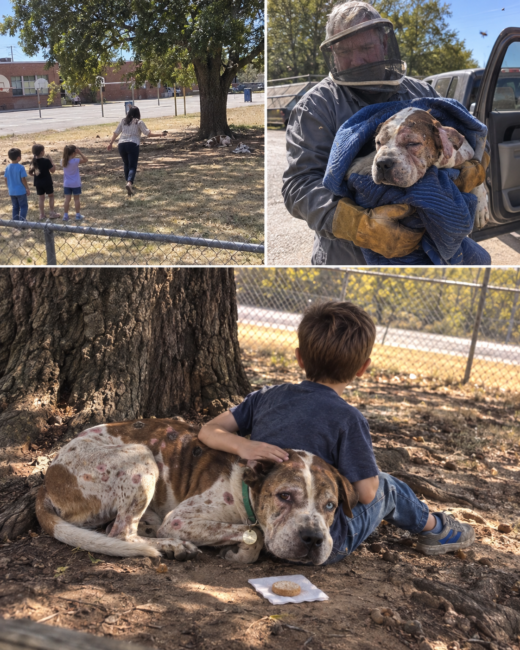
The dog’s name is Barker.
The kids named him that, before any of this, because he never barked. Not once. Kids think that’s hilarious and they’re right.
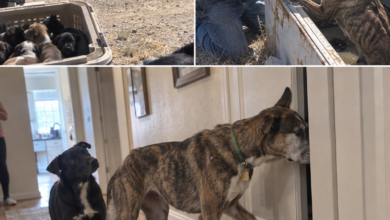
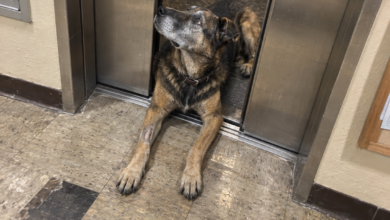
He’s a brown and white mix — some kind of bird dog in him, maybe pointer, with a heavy square head that doesn’t match the rest of him. Long legs. A white blaze up the middle of his face that goes crooked at the top.
He had one brown eye and one that was partly blue, what they call a split eye, and there was a notch missing out of the top of his right ear.
He weighed forty-four pounds that September.
Two things I noticed that afternoon and did not think about again for two weeks.
The first: the stings were almost all on his back and his sides.
His belly was clean. I remember that from the vet’s office, when they had him on the table and were shaving him — somebody said, “Nothing underneath,” and somebody else said, “Huh.”
Nobody followed up on it. We had other things happening.
The second: he had been on that playground for about seven months.
He turned up in February. He’d sleep in the culvert by the fence line. He never came up to an adult, not once, not for anything — and the kids fed him and we all knew the kids fed him and we ran a couple of half-hearted campaigns about not feeding the stray and then we let it go, because it was February and he was thin.
I had walked past that dog probably two hundred times.
I could not have told you one thing about him.
Part 3
The boy is Wendell Achterberg. He was six. First grade, Mrs. Loy’s class.
He’s the youngest of four and he’s small for his age and he has the kind of quiet that teachers notice and don’t always know what to do with.
He also has a severe allergy to wasp and hornet venom, which his mother had put on the form in August, which was in his file, which was in the nurse’s binder, and which was the reason there was an epinephrine auto-injector in a locked box in the front office ninety yards away.
Here’s what happened, as near as anybody has been able to put together.
Sixth-grade recess isn’t a thing. First grade had lunch recess from 12:15 to 12:40 that day and the yard aide had eleven kids on the play structure and four on the swings.
Wendell went to the pecan tree.
He did that most days. That’s what came out later, from other kids. He’d go to the pecan tree at the end of recess and he’d sit down on the dirt on the far side of the trunk where you can’t be seen from the blacktop.
There was a hornet nest in that tree about fourteen feet up. Bald-faced hornets. Nobody knew. It was up in the fork on the side away from the school and it had been there all summer getting bigger.
Something brought it down. The county guy who came out later said it was probably just weight and a dead branch and a hot dry September.
It came down on the hard dirt about four feet from a six-year-old boy.
I want to tell you about the seven months before that, because the seven months are the whole thing and I didn’t know it.
Barker showed up in February, thin, with a limp that went away.
He wouldn’t come to adults. He’d get up and move off at a trot if a teacher walked at him. He never came within twenty feet of me in seven months.
But he’d let the kids near him.
Not all of them. He didn’t like a crowd. If six kids ran at him he’d be gone.
But he’d sit at the fence line at the far corner and the quiet ones would sit near him.
That corner of our playground is where the kids go who don’t play. Every school has that spot. Ours is the fence line by the pecan tree.
We had a rule about feeding him. We announced it twice. I had a conversation with my own class about it in March, and I remember a boy in my class saying, “But he’s hungry,” and me saying something about how there are rules for a reason, and I would give a lot to have that one back.
They fed him anyway, obviously. Kids are not stupid and they are not obedient.
Somebody’s leftover half a sandwich. A cheese stick. Crackers.
I’d see a paper napkin out by the fence and I’d think they’re at it again and I’d pick it up and throw it away.
Two hundred times, probably.
In May the office got a call from a woman in town about a stray on school property and the principal, Yvonne Gadbois, called the county, and the county said they’d add it to the list.
Nobody followed up. That’s not a scandal. That’s a school with two hundred and forty kids and one and a half office staff.
In July, when the building was mostly empty, the custodian left a bowl of water out by the back door.
He never admitted that. We just all knew it was him.
And through all of it, that dog was somebody’s, and nobody in that building had any idea.
Part 4
Here’s what happened in the eleven minutes after I screamed.
Kendra Loy came off the blacktop at a dead run — she’s fifty-one and I have never seen a human being move like that — and she went straight past me and got on her knees on that dirt.
I was pulling at the dog.
I had both hands under his chest trying to lift him off Wendell and he wasn’t fighting me, he just wasn’t moving, he was dead weight and he was so hot and I could feel how fast his heart was going.
Kendra yelled at me to leave him and get the nurse.
I ran. Ninety yards. I have never in my life run like that either.
Our nurse is named Patrice and she’s part-time and she was on her one day a week, which is the kind of luck you don’t think about until later.
She came with the epi and the office called 911 and Yvonne Gadbois pulled the fire alarm — which was not protocol, and which got every child in that building out the front doors and away from the back field, and which she has never apologized for.
Wendell had three stings.
Three. One on the back of the neck, one on the left forearm, one on the ear.
His face was already swelling and he was not responsive and he had hives down both arms. Anaphylaxis. Patrice gave him the auto-injector in the outside of his thigh at 12:51 p.m.
Ambulance out of Kingfisher got there at 1:06. They had him at the hospital in Enid by 1:40.
He coded once in the ambulance. His mother told me that four months later and I had to sit down.
He lived.
Three days in the pediatric ICU in Oklahoma City and then a step-down floor and then home.
Now here’s the part I have to say carefully.
While all of that was happening, that dog was lying in the dirt under that tree, and nobody was doing anything about him.
I’m not going to pretend otherwise. There was a child not breathing right. That’s where every adult went.
It was the kids.
Marisol Betancur and three other second graders stood at that tree and would not come in when the alarm went and would not come in when a teacher told them to, and the teacher — who I will not name, because she was doing exactly what she was supposed to be doing — physically had to carry Marisol.
And Marisol screamed the whole way that somebody had to get the dog.
It was almost forty minutes before anybody did.
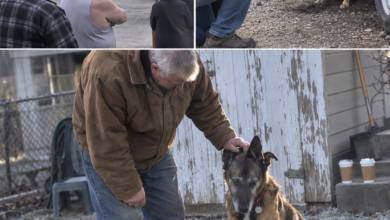
Our custodian, Dwight Furnish, put on canvas coveralls and welding gloves and a mesh hood he had in his truck for some reason, and he went out there with a moving blanket and he picked up a forty-four-pound dog covered in hornets and he carried him around the side of the building to his own pickup and he drove him to a vet clinic eleven miles away without telling anybody where he was going.
The vet’s name is Dr. Corliss Yeary.
She counted forty-one stings.
She told Dwight, honestly, that she did not expect him to live through the night, and that a dog that size that takes that much venom usually dies of the kidneys three or four days later even if he makes it through the first part.
Dwight sat in her parking lot until eleven o’clock at night.
He’s sixty-three. He’s worked at that school for twenty-six years. He told me later he didn’t go in because he didn’t want to be in the room if it happened.
And I thought — I want to be honest — I thought I understood the whole thing by Friday morning.
Hornet nest falls. Kid gets stung. Stray dog is lying there, maybe he panics, maybe he’s just where he is, and either way his body ends up over that boy and he takes the swarm.
That’s a beautiful story. That’s an accident that came out right.
That’s what I told my husband Thursday night with my own four stings throbbing on my forearm.
I was wrong about the most important part of it, and it took a six-year-old to tell me.
Part 5
Wendell came back to school on the fourteenth of October.
Before that, though — the second week, when he was home and finally talking in whole sentences again — his mother, Roselyn, called Kendra Loy.
She said Wendell wanted to ask a question and wouldn’t stop asking her, and she didn’t know the answer.
The question was: is Barker okay.
Kendra said, “He knows the dog’s name?”
And Roselyn said, “He says it’s his dog.”
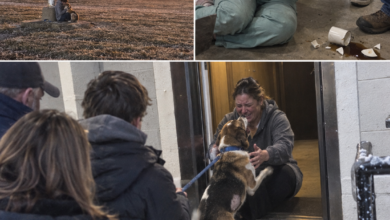
Kendra drove out to their house that evening.
Wendell was on the couch. He still had hives on his arms. He was six years old and he was worried about something and it came out all in a rush the way it does with kids that age.
He said he was sorry.
That’s the first thing he said. He said he was sorry because he wasn’t supposed to feed the dog and he did it anyway.
Kendra told him nobody was mad.
And then he told her.
He said he’d been giving Barker part of his lunch every day since February.
Every day.
He said he’d go to the pecan tree at the end of recess and put it down on the dirt and then back up, because Barker wouldn’t eat if you were close.
Kendra asked him what he gave him.
He said, “The cookie.”
Our lunch menu has a cookie on it two days a week. The other three days there’s fruit or a graham thing.
He said he saved the cookie on cookie days and on the other days he saved half his sandwich.
Kendra said — and she told me this in the parking lot the next morning and then had to stop talking for a second —
Kendra said she asked him, “Wendell, did you eat your lunch on those days?”
And he said, “I ate the rest of it.”
Part 6
I went back through everything after that.
Not because anybody asked me to. Because I couldn’t sleep.
The stings were on his back and his sides. His belly was clean.
Forty-one stings and not one on his underside.
A dog that panics in a swarm runs. A dog that’s stung rolls and bites at itself and thrashes. There is not one version of a frightened animal where every sting lands on the top of him.
They landed on the top of him because the underneath of him was over a boy.
He didn’t move when I threw a stick at him.
He was forty-one stings into anaphylaxis of his own, on the ground, in ninety-four degree heat, and a strange adult came at him and made noise and threw something at him.
And he tightened.
He got smaller around the thing he was covering.
He wouldn’t come near adults for seven months.
Not once. He wouldn’t take food from an adult hand. He’d trot off if a teacher walked toward him.
And he let me put both hands under his chest.
That’s what gets me at two in the morning. That dog hadn’t let a grown person touch him in seven months, and when I finally got my hands on him, the only reason he didn’t move is that he couldn’t.
And the corner by the pecan tree.
That’s where the kids go who don’t play. I have known that about that fence line for eleven years.
I knew that a boy in Mrs. Loy’s class was quiet. I knew there was a stray in the corner.
I did not put those two things together in seven months.
Here’s what I keep landing on, and I’ve said it out loud to exactly three people.
We had a rule against feeding him.
I enforced that rule. I gave a speech about it to twenty-two children in March.
And the whole time, a six-year-old was breaking that rule every single day, quietly, at the fence line, with half his lunch — and on the fourth of September a nest came out of that tree and that dog put himself on top of the only person in that building who had ever fed him.
He took thirty-eight more stings than the boy did.
He didn’t know what a hornet was. He didn’t understand allergies or anaphylaxis or that he was dying.
What he knew was that the small one who brings the cookie was on the ground and not getting up, and there was something bad in the air.
Dr. Yeary told me something in November that I think about more than anything else in this whole story.
She said the reason he lived — and it was close, it was fourteen days and two of them were very bad — was that he was forty-four pounds instead of thirty.
He’d been eating.
Half a sandwich and a cookie a day for seven months.
Part 7
The school paid the bill.
It was a little over six thousand dollars and it took about nine days to raise. Two hundred and forty kids in a town of thirteen hundred people, plus the internet, which found out in week two.
There was money left over. There is always money left over when it’s a dog.
Yvonne Gadbois put it in an account that pays for his food and his vet care, and when he got too old and needed a dental, it covered that too.
The Achterbergs tried to pay all of it back. Yvonne wouldn’t take it.
So Roselyn Achterberg did something else instead: she paid for that dog’s food, every bag, for the rest of his life, and she did it by driving to the feed store in Kingfisher and setting up a standing order, and she never once mentioned it to anybody.
Dwight built him a house.
Cedar, with a shingled roof and a concrete pad, in the corner of the yard by the fence line. He built it on a Saturday out of his own lumber and he would not let anybody help him.
The school adopted him formally in October. There’s a line item in the budget. There’s a photograph in the front hall.
And the kids run the club.
It’s called the Barker Club and it’s fourth and fifth graders and there’s a sign-up sheet on Yvonne’s door and an actual waiting list. Water, food, brushing, ten minutes of sitting with him at morning recess. Two kids a week.
Wendell Achterberg was never on that list.
He didn’t need to be. He had a standing pass from the office that let him go out to the fence line for ten minutes after lunch.
Every day.
He’d sit on the dirt by the pecan tree with his back against the trunk and that dog would lie down next to him, and Wendell would put his hand flat on Barker’s side and not say anything.
I watched it from my window for years.
And every single day — every day, for nine years — he brought the cookie.
Part 8
Barker died in May of last year.
He was old by then. Fourteen or fifteen, Dr. Yeary figured. His back end had gone and Dwight had built a ramp.
He died on a Tuesday afternoon in the shade by the fence line with about forty kids sitting in a half circle on the grass, which Yvonne allowed and which I was not sure about at the time and which I was wrong about.
Wendell was fifteen. He drove himself over from the high school.
They let him come out.
He sat down on the dirt with his back against that pecan tree the way he had since he was six, and he put his hand flat on that dog’s side.
He didn’t say anything. He never did.
The pecan tree is still there.
The kids who don’t play still go to that corner.
Follow this page for more stories about the ones who paid back something nobody ever knew they were given.