Part 2: A Saint Bernard Stole a Café Blanket and Vanished Into the Snow — Beneath the Bridge, a Freezing Stranger Spoke the Name We Had Never Known
Part 2, The Dog Who Would Not Sleep on His Blanket
My name is Claire Bennett. I was forty years old when Bishop stole the blanket, and I had owned North Star Café for eight years.
The café occupied the first floor of a narrow brick building in Northeast Minneapolis. I lived upstairs in an apartment where the kitchen floor tilted toward the river and the bathroom radiator hissed through the night. My father bought the building in 1998, when that stretch of Marshall Street held more repair shops than restaurants. After he died, I kept the café because selling it felt too much like changing the locks while his coat still hung behind the office door.
Bishop entered my life on November 3, 2022.
I went to the shelter intending to donate the café’s leftover towels. Rosa took them, thanked me, then asked whether I could sit near a Saint Bernard who had not eaten in three days.
He was six years old, one hundred forty-three pounds, and thinner than his heavy coat first suggested. Rust-red fur covered his back and ears. White ran from his muzzle down his chest. His right ear had a small triangular notch, and the pads of his front paws were split from walking on pavement.
A dark green blanket lay folded beside him.
Bishop did not approach when I entered the meeting room. He stood over the blanket and watched my hands. When I sat on the floor, he smelled my left shoe, then my sleeve, then the paper coffee cup I had carried from work.
He placed his head against my shoulder.
That was the entire interview.
The shelter had listed him as an owner surrender, but identifying details were protected. The person who brought him in had signed the relinquishment form with an X because his hand shook too badly to hold the pen. He had left no phone number that still worked.
One sentence appeared in the behavior notes:
Dog waits beside exits between 4:00 and 4:30 p.m.
I renamed him Bishop because he moved diagonally through every room, never taking the direct path if a chair or table stood in his way. He learned the café within one afternoon. He slept beneath the pastry case during opening, moved beside the radiator at noon, and sat near the front window when school let out.
At 4:17 each Thursday, he stood.
He went to the glass and watched the sidewalk.
The routine never varied. His head turned left when the Route 11 bus stopped. He studied every person who stepped down, especially older men in dark coats. After ten or twelve minutes, he returned to the reading chair.
He did not whine.
He did not scratch.
He only watched.
The green blanket remained folded across that chair. Customers used it on cold mornings, but Bishop never climbed onto it. If someone let one end touch the floor, he picked it up and placed it back on the cushion. If I carried it toward the laundry room, he followed until I closed the washing-machine lid.
Once, I tried replacing it with a new fleece throw.
Bishop took the new blanket off the chair and left it beside the door. Then he retrieved the green wool from the laundry basket and returned it to the chair himself.
I assumed the fabric smelled like his first home.
I was right.
I simply did not understand whose home that had been.
Bishop also refused to walk toward Lowry Avenue. Two blocks from the bridge, his steps shortened. Near the tire shop, he stopped completely and searched the pedestrian path on both sides of the road.
I called it fear.
After February 17, I would watch the same movement and give it another name.
He had not been afraid of the bridge.
He had been looking for someone beneath it.
Part 3, The Man Beneath Lowry Bridge
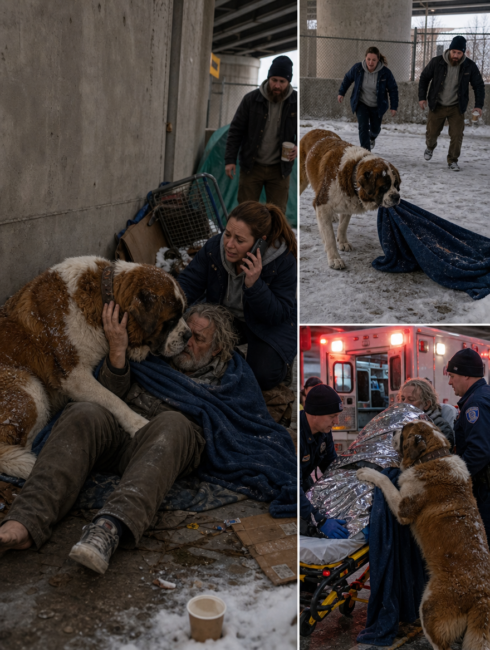
The ambulance crew identified the freezing man as Henry Vale after finding a Minnesota ID card sealed inside a plastic sandwich bag in his jacket.
Henry was sixty-two. He had no permanent address, no emergency contact listed in the county system, and forty-three dollars folded into a library receipt in his wallet. His body temperature was 87.9 degrees when paramedics loaded him into the ambulance.
They called it moderate hypothermia moving toward severe.
Bishop tried to follow the stretcher.
He caught the green blanket when a paramedic lifted it and planted his front paws against the rear step. The ambulance suspension dropped beneath his weight.
“He can’t ride with us,” the paramedic said.
Bishop looked at Henry.
The doors began closing.
He pushed his nose between them.
“Claire,” Jamal said, “he’s going to hurt himself.”
I wrapped both arms around Bishop’s chest and pulled. His paws slid across the snow. He made no attempt to bite or escape my grip, but every muscle beneath his coat tightened toward the ambulance.
Henry’s hand moved beneath the silver emergency blanket.
His index finger appeared at the edge.
Bishop stopped fighting.
The ambulance left at 6:14.
He watched the red lights until they disappeared beyond the bridge, then turned and walked to the place where Henry had been lying. A depression remained in the cardboard. Beside it sat an empty paper cup from North Star Café.
The cup was four months old.
Our winter design had changed in October, but that one carried the blue line drawing we had used during summer. Someone had washed it and reused it until the rim softened.
Bishop smelled the cup.
He picked it up and carried it back toward the café.
That was the first object he returned.
The green blanket remained in the ambulance with Henry.
Back at North Star, Bishop refused breakfast. He sat beside the delivery door and watched every vehicle that passed. At 7:30, customers began arriving, many already aware of what had happened because Darlene had told the snowplow crew.
People wanted to pet him.
Bishop moved away from every hand.
At 8:42, Hennepin Healthcare called. Henry had regained consciousness. His heart rhythm had stabilized, but frostbite in two toes and dehydration complicated his recovery.
The nurse asked whether I knew his dog.
I looked at Bishop beneath the window.
“I know my dog.”
“Mr. Vale says the Saint Bernard belongs to him.”
The words struck harder than I expected. I had adopted Bishop legally. Every document named me. Still, my hand closed around the counter until the brass edge pressed into my palm.
“What exactly did he say?”
“He said the dog’s name is Harbor, and he asked whether the green blanket made it there.”
I told Jamal to watch the café.
Bishop and I reached the hospital shortly before ten. A security officer stopped us in the lobby, but a physician named Dr. Elena Ruiz had already authorized a supervised visit after hearing how Bishop found him.
Henry occupied a bed near the nurses’ station. Warmed fluids ran through an IV line in his left arm. His beard had been cleaned, revealing the crescent scar near his ear. Hospital socks covered both feet.
The green blanket lay folded on a chair.
Bishop saw it first.
He walked to the blanket and smelled the lower corner where three loose threads formed a knot. Then he turned toward the bed.
Henry opened his eyes.
“Hello, Harbor.”
Bishop approached slowly.
Three feet from the mattress, he stopped.
Henry lowered his right hand. It shook from cold, medication, or something older. Bishop moved beneath it and raised his head until the palm settled between his ears.
Henry’s fingers found the notch in the right one.
“Still got that,” he said.
Bishop leaned forward.
The bed moved two inches across the floor.
Henry smiled without showing his teeth. His lower lip began trembling, and he turned his face toward the window as if the light had become too bright.
I stayed near the door.
Every part of me wanted an explanation. Another part wanted to take Bishop home before an answer changed who belonged to whom.
Henry looked at me.
“You’re Claire.”
I had never seen him before.
“How do you know my name?”
“Your apron. Café name’s on it. He lives there now.”
“You’ve seen him?”
“Thursdays.”
The time came back immediately.
4:17.
Henry volunteered at a church food pantry on Thursday afternoons. The Route 11 bus dropped him near Marshall Street, and he walked past North Star Café on his way to a warming center.
He watched Bishop through the glass.
He never entered.
“Why?”
Henry rubbed one thumb against a hospital sheet.
“Because I gave him away.”
Bishop rested his chin on the mattress between us.
Henry explained that he surrendered the dog eighteen months before I adopted him. He had not known Bishop remained at the county shelter so long. One afternoon, while walking to the pantry, he saw a Saint Bernard in our café window.
The dog had looked older and heavier.
The right ear still carried the notch.
“I stood across the street for nine minutes,” Henry said. “He was warm. Had people around him. Thought coming in would be for me, not him.”
“Bishop saw you.”
“I know.”
“Every Thursday, he waited.”
Henry’s eyes moved toward the dog.
“I started taking the later bus. Thought that would be easier.”
It was not.
Bishop simply waited longer.
The morning he collapsed, Henry had been walking from an overflow shelter after losing his bed in a dispute over a missing backpack. His coat became wet when he slipped near the river. He reached the bridge before his legs stopped working.
He remembered lying against the concrete.
He remembered wind beneath the tarp.
Then he remembered warmth across his shoulders and a body pressing against his back.
“How did he know you were there?” I asked.
Henry looked toward the green blanket.
“He followed Margaret.”
The name meant nothing to me.
Henry pointed to the frayed corner Bishop had smelled every night for twenty-seven months.
“Open the seam.”
Part 4, The Name Sewn Into the Wool
A nurse brought small scissors.
The lower corner of the green blanket had been repaired with darker thread. I had noticed the stitching many times but assumed someone at the shelter had closed a tear.
Henry watched as I cut three stitches.
Inside the folded seam lay a narrow strip of cotton, yellowed with age. Blue embroidery ran along it in small, uneven letters:
HARBOR — M.V. — 2017
Bishop smelled the strip before I fully exposed it.
His tail struck the floor.
Once.
Henry placed his hand across his mouth. The IV tube trembled against his wrist.
“Margaret made that,” he said.
Margaret Vale had been Henry’s wife for thirty-one years. She taught second grade in St. Paul and knitted blankets during the winter because arthritis made smaller work difficult. Green was the last color she could distinguish clearly after macular degeneration blurred the rest.
In January 2017, Henry found a Saint Bernard puppy beside an interstate entrance ramp.
The puppy had pushed himself beneath a concrete divider while freezing rain collected along the road. Two cars stopped. Both drivers called animal control. Henry climbed over the guardrail before anyone arrived.
The puppy weighed twenty-seven pounds, though his paws already looked too large for the rest of him. A torn plastic cord circled his neck. His right ear had been cut by wire.
Henry wrapped him in his work jacket and carried him into his pickup.
Margaret was undergoing chemotherapy then. Henry expected her to say they could not manage a growing dog.
She spread the unfinished green blanket across her lap.
“Put him here.”
The puppy lay against her knees for four hours while an emergency clinic warmed him. When he woke, he crawled farther beneath the wool until only his nose remained visible.
Margaret named him Harbor.
“Every storm needs one,” she told Henry.
The dog grew to one hundred fifty pounds. He slept beside Margaret’s recliner during treatment and learned the sound of the walker she used after her strength declined. If the walker struck a doorway, Harbor came from any room in the house and stood beside her left hip.
Nobody trained him.
He watched what happened.
When Henry brought a blanket, Margaret stopped shaking.
When the walker fell, Henry came.
When the kettle whistled, someone carried a warm cup into the living room.
Harbor learned objects through their outcomes.
Margaret died on October 9, 2019.
Afterward, Henry kept the green blanket across her chair. Harbor would not sleep on it. He touched one corner each night, then lay beside the chair.
The same corner.
The same ritual.
Henry lost his job as a building-maintenance supervisor seven months later. He missed work repeatedly, stopped answering calls, and spent several weeks sleeping through daylight. Medical bills had already consumed most of their savings.
The house was sold in 2021.
Henry moved into a studio apartment with Harbor. The building allowed dogs under fifty pounds. Henry told the manager the Saint Bernard was temporary.
Temporary lasted eleven months.
When the manager issued the final notice, Henry moved into his truck rather than surrender Harbor. They slept together behind a warehouse through part of the Minnesota winter. Harbor took the passenger seat. Henry lowered the driver’s seat as far as it would go.
The truck’s transmission failed in March.
Henry sold it for scrap and used the money for two weeks in a motel. Harbor’s food came first. Henry ate oatmeal made with hot water from the bathroom sink.
On April 18, 2022, Henry walked the dog to the county shelter.
The green blanket was folded beneath his arm.
He told the intake worker he was entering a hospital program and could no longer care for a giant dog. That was not the whole truth. He had no hospital bed arranged. He had slept beneath Lowry Bridge the previous night and woken with Harbor lying across his legs to keep them warm.
Henry believed the dog would die beside him if he waited longer.
“He wouldn’t go into the kennel,” Henry said. “So I put Margaret’s blanket inside.”
Harbor followed it.
Henry signed with an X because tremors had begun in his hand after years of untreated nerve damage. Then he left before the dog could see which door he used.
The county transferred Harbor twice. Both adoptions failed.
One family returned him after four days because he stood at the front window each afternoon and barked whenever an older man passed.
Another returned him because he pulled toward bus stops.
By the time I met him, he had waited eighteen months.
I thought I had rescued an unwanted Saint Bernard.
Henry had placed the dog in the shelter to rescue him from a winter beneath the bridge.
Bishop—Harbor—had spent every Thursday watching the sidewalk because the man who surrendered him kept walking past the glass.
Then, on the coldest morning of the year, the wind carried Henry’s scent toward the café.
The dog took the one object that had once stopped both of them from shaking.
He brought Margaret’s blanket back.
Part 5, What Harbor Learned from Margaret
Henry remained in the hospital for eleven days.
Bishop visited seven times.
I continued calling him Bishop because that was the name he had heard in my home for more than two years. Henry called him Harbor because that was the name Margaret had sewn into the blanket.
The dog answered to both.
On the third visit, Henry handed me a small brass key attached to a plastic tag. The tag carried the number 214.
“Storage locker,” he said. “If they haven’t auctioned it.”
The locker stood in a concrete building north of the city. Henry had paid eighteen dollars each month from a small disability check to keep it, even during weeks when he slept outside.
Inside were three plastic tubs, a wooden chair, four framed photographs, Margaret’s walker, and a metal dog bowl.
One photograph showed Henry kneeling beside Harbor on the day he found him. The puppy’s coat was soaked flat, his injured ear wrapped in white gauze, and the unfinished green blanket covered both of them.
Another showed Margaret in her recliner with Harbor’s head across her lap. She wore a knitted red cap. Her left hand rested on the dog’s right ear.
The third photograph explained the behavior I had noticed without understanding.
Margaret sat outside a coffee shop with the green blanket across her knees. Harbor stood beside her. A paper cup rested near his front paws.
The shop was North Star Café.
My father appeared in the background.
I carried the photograph to our office and searched through the café’s old receipt boxes. Dad kept everything—utility bills, handwritten schedules, supplier invoices, even loyalty cards customers had abandoned.
I found Margaret’s card in a box marked 2019.
Twenty-seven stamps filled the front. On the back, my father had written:
Henry and Margaret. Thursdays, 4:15. Green blanket. Dog gets ice water.
They had been regular customers.
Jamal remembered them after seeing the photograph. He had been a high school student washing dishes then.
“The big dog waited outside the window,” he said. “Your dad let them bring him in when she got sick.”
Thursday at 4:17 had not begun at the shelter.
That was when Margaret, Henry, and Harbor came for coffee.
Harbor’s body had held the routine after the people disappeared.
A chair beside glass.
The smell of coffee.
A green blanket.
A man arriving from the direction of the bus stop.
Each Thursday, Bishop did not merely search for Henry.
He waited for the missing hour to begin again.
The storage locker contained a notebook Margaret had used during treatment. Most pages held medication times, grocery lists, and notes for substitute teachers. The final pages recorded small observations about Harbor.
January 19: Brought Henry’s glove after he left it outside.
February 2: Pulled blanket from chair when my feet shook.
March 8: Waited beside kettle until Henry made tea.
May 11: Walker fell in bathroom. Harbor brought Henry’s boot from bedroom.
That last entry stopped me.
Harbor did not know that a boot represented a person. Margaret explained that when Henry worked in the garage, Harbor began carrying one of his boots into the hallway whenever she needed help.
The dog had connected objects to results.
Blanket meant warmth.
Boot meant Henry came.
Cup meant the Thursday café.
The green wool carried all three of them: Margaret’s hands, Henry’s coat, the café, the first night Harbor stopped shaking.
On February 17, Bishop had seen Jamal opening the delivery door. Wind entered from the river. Bishop lifted his head before he took the blanket.
He had probably smelled Henry.
No one could say how much of the route he remembered and how much he followed through scent. His choices showed both. At the locked construction gate, he changed paths. When the blanket snagged, he backed up. At the bridge, he followed the freshest boot prints.
He solved each obstacle in order.
Then he used the blanket for the function Margaret had taught him.
Warm the shaking body.
Henry believed Harbor saved his life because he recognized him. The shelter behaviorist who reviewed the timeline offered a simpler explanation.
“Recognition got the dog beneath the bridge,” she said. “Observation told him what to carry.”
The deeper fact lay between those answers.
Harbor remembered the man.
He also remembered what the man’s wife had done whenever someone was cold.
Part 6, The Man Who Stayed Across the Street
Henry’s discharge plan included a thirty-day medical respite bed and help applying for supportive housing.
He tried refusing the respite placement.
“They can give it to someone worse off.”
Dr. Ruiz placed his paperwork on the tray table.
“You were eighty-seven degrees when you arrived.”
Henry looked at the window.
“Still here.”
“That is not evidence you did not need help.”
Bishop sat between them. When Henry pushed the paperwork away, the dog picked up one corner and placed it back near his hand.
Dr. Ruiz looked at me.
“Does he do that often?”
“Only when humans make poor decisions.”
Henry signed.
The first week at respite care did not go smoothly. He slept on the floor because a bed felt too exposed. He kept his shoes on. He folded every meal napkin into a square and saved half his bread in his coat.
Bishop visited on Tuesdays and Thursdays.
During the second visit, Henry stood at the end of the hallway when we arrived. He did not call the dog. He held both hands against his sides and waited.
Bishop crossed the linoleum slowly.
He smelled Henry’s shoes, coat, wrists, and the scar near his ear. Then he leaned against Henry’s legs.
Henry’s knees bent.
An aide pulled over a chair before he fell.
“I shouldn’t have left him,” Henry said.
I sat across from him.
“You left him somewhere warm.”
“He waited.”
“So did you.”
Henry turned toward me.
I told him about the Thursdays at 4:17. I told him Bishop had watched each Route 11 bus and searched the men who stepped onto the sidewalk. I told him about the Lowry Avenue walks and how I had mistaken searching for fear.
Henry rubbed the notch in Bishop’s ear.
“I watched him from across the street because I thought seeing me would hurt him.”
“It did.”
His hand stopped.
“But disappearing hurt him too.”
The dog rested his chin on Henry’s knee. Henry’s fingers spread across the white fur between his eyes.
Nothing in that room erased what had happened. Henry had surrendered an animal who trusted him. Bishop had waited beside doors. Two families had returned him because they did not understand what he was waiting for.
Yet Henry had not chosen comfort over the dog.
He had chosen the shelter because the alternative was frozen concrete.
He lost Bishop to keep Bishop alive.
After Henry entered respite care, Jamal found something beneath the café’s suspended-coffee bowl. A folded five-dollar bill had been pushed into the crack between the counter and the wall. Written across it in pencil were four words:
For the big dog. Thursday.
Jamal checked the drawer where we stored old bills customers had left as keepsakes. He found six more five-dollar notes bearing the same message, dated over eighteen months.
Henry had been buying Bishop treats without entering the café.
He had less than fifty dollars in his wallet when paramedics found him. Still, once or twice each month, he pushed five dollars beneath the bowl and left before Bishop could reach the door.
I confronted him during our next visit.
“You were paying for his treats.”
Henry shrugged.
“Couldn’t send child support.”
“You went without lunch.”
“Some days.”
Bishop raised his head at the word treats.
Henry gave the first full laugh I had heard from him.
That was the third truth Bishop uncovered.
Henry had not forgotten the dog after surrendering him. He had organized part of his unstable life around knowing the dog remained safe. Thursdays meant the pantry, the warming center, and nine minutes across from North Star Café.
He watched Bishop sleep beside the radiator.
He watched customers place hands on the dog’s back.
He watched me lock the café and take Bishop upstairs.
Then he walked to whichever bed, doorway, bus station, or bridge would hold him until morning.
On March 21, Henry received a key to a small supportive-housing apartment eight blocks from North Star. The building allowed dogs of any size.
He stood in the empty living room with Bishop beside him.
“You can take him,” I said.
The sentence hurt to say, but I said it.
Henry looked at the dog, then at me.
“No.”
“He was yours.”
“He is his own.”
Bishop moved between us.
Henry knelt with difficulty.
“You choose,” he said.
Bishop smelled Henry’s hands. He leaned against his chest for twelve seconds. Then he crossed the room and placed his head beneath my hand.
Before I could speak, he returned to Henry.
Back to me.
Back to Henry.
He repeated the path three times, then lay down in the middle of the room with one paw touching each of our shoes.
Henry sat on the bare floor.
“Looks like we’re both getting supervised.”
The apartment became Bishop’s second address.
Part 7, The Thursday Blanket
Henry lives in apartment 308 now.
He works twelve hours a week repairing chairs, tables, and cabinet doors at the church pantry. His hands still shake, but he has learned to brace his wrists against the workbench before tightening screws.
Bishop spends Wednesday nights with him.
Every Thursday at 4:17, they walk to North Star Café together.
The green blanket waits on the same reading chair. Henry orders one coffee with milk. I pour a bowl of water. Bishop smells the frayed corner, looks toward the door, then lies between our chairs.
He sleeps on the blanket now.
Only on Thursdays.
Henry never asked me to change Bishop’s name, and I never asked him to stop using Harbor. Customers hear both and assume the dog carries a long formal title.
Perhaps he does.
Bishop is the name of the dog who lived above my café, guarded the reading chair, and brought me through six blocks of snow.
Harbor is the name of the puppy Margaret warmed beneath green wool, the dog Henry surrendered to keep alive, and the Saint Bernard who remembered exactly what a blanket was for.
Each December, North Star places a wooden rail near the entrance. Customers leave clean coats, gloves, and blankets there. Anyone may take one without asking.
We do not call it a campaign.
The rail simply stays full.
On February 17, Henry and I walk beneath Lowry Bridge with Bishop. We bring coffee, dry socks, and one folded blanket. We never photograph the people we meet.
Before we leave, Bishop carries the blanket the final few yards himself.
Last winter, we found no one beneath the bridge. Henry placed the blanket on the dry cardboard anyway.
“Someone will,” he said.
Bishop smelled the wool, then turned toward home.
Halfway up the embankment, a city bus crossed above us. Bishop stopped and looked toward the sound. Henry stood on one side of him. I stood on the other.
The dog checked us both.
Then he kept walking.
He no longer waits alone at 4:17.
Follow this page for more unforgettable dog stories about quiet courage, second chances, and the people rescued when someone finally follows where a dog is leading.