Part 2: A Puppy Was Left Suffocating Inside an Airport Suitcase — Years Later, He Returned to Search the Same Bags That Nearly Killed Him
Part 2 — The Puppy Who Feared Zippers
Atlas spent eleven days at the veterinary hospital.
His recovery moved in the uneven way damaged animals recover—one encouraging morning followed by a difficult night, one good meal followed by a coughing spell that sent every monitor into alarm.
The oxygen deprivation caused no obvious permanent neurological damage, but sedatives had weakened his breathing and coordination. For several days, he walked as if the floor shifted beneath him.
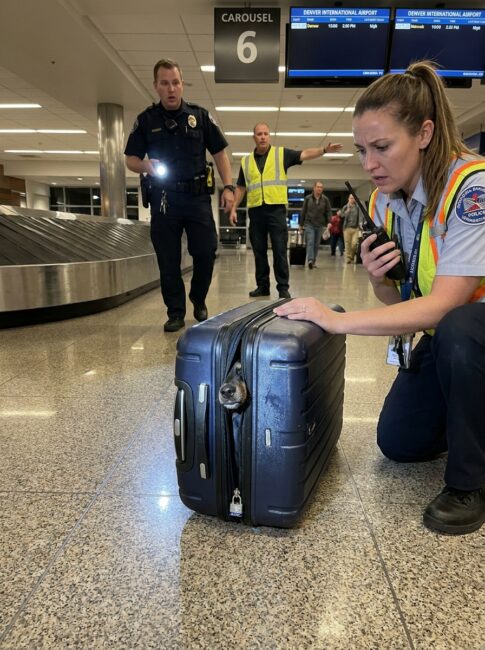
He was underweight beneath the thick puppy coat.
His gums showed small injuries from the tape.
The cloth restraints had rubbed the skin around his ankles raw.
And every time a nurse zipped open a supply bag, Atlas pressed himself against the back wall of the kennel.
That sound became his first known fear.
Zippers meant darkness.
Zippers meant pressure.
Zippers meant air disappearing.
The veterinary team began opening every bag outside his room. They used snap containers and folded blankets instead of carrying cases. When a technician forgot and unzipped her jacket nearby, Atlas urinated beneath himself and shook for almost twenty minutes.
People asked whether that reaction meant he would never be adoptable.
I did not understand the question.
Of course he would be adoptable.
He was frightened, not broken.
But confidence is easy when you are not yet responsible for the years required to prove it.
Airport police searched for an owner using the suitcase contents. Atlas had no microchip. No legitimate health certificate. No airline animal documentation. The serial numbers on the medication packages led to an online supplier associated with several previous smuggling investigations.
Inside a hidden compartment beneath the suitcase lining, officers found six counterfeit microchips, blank vaccination documents, and photographs of other puppies inside shipping crates.
The operation appeared to move high-demand breeds through airports using false papers, drugging animals and placing the smallest inside regular luggage to avoid transport fees, quarantine checks, and inspection.
Some puppies arrived.
Some did not.
The investigation crossed state lines and involved federal agencies. Yet none of that helped answer the immediate question of where Atlas should go.
The municipal shelter could accept him.
Several rescue groups offered temporary placement.
The airport police K9 supervisor mentioned a foster program, though Atlas was too young and medically fragile for any operational evaluation.
I told myself I was only visiting.
Every morning before work, I stopped at the veterinary hospital with a small cup of plain scrambled egg. Every evening after baggage claim closed, I sat beside Atlas’s kennel and read incident reports aloud because the steady human voice calmed him.
He did not understand delayed-flight complaints or employee scheduling disputes.
He understood that I came back.
On day five, he stood when I entered.
On day seven, his tail moved once against the bedding.
On day nine, the veterinarian allowed me to sit inside the recovery room with him.
Atlas approached slowly.
He sniffed my shoes, my knees, and the airport ID badge hanging from my neck.
Then he placed his front paws in my lap and rested his head beneath my chin.
“I’m not adopting you,” I whispered.
His tail moved again.
I had reasons.
My apartment was small.
My hours were unpredictable.
I had never owned a working breed.
My mother lived with me after knee surgery and feared large dogs after being bitten as a child.
There were sensible adults with yards, experience, schedules, and stronger furniture.
I submitted a foster application anyway.
Only temporary.
That is how rescue people lie to themselves with paperwork.
Atlas came home twelve days after the suitcase opened.
My mother, Rosa, watched from the kitchen as he entered on a harness borrowed from the hospital. She was sixty-three, Mexican American, five feet tall, and capable of making disapproval fill a room without changing her expression.
“That animal will become eighty pounds,” she said.
“He’s twenty-eight now.”
“That is not a defense.”
Atlas saw her cane and stopped.
Rosa tightened her grip.
The puppy lowered himself to the floor.
Then, without approaching, he rolled onto one hip and looked away.
My mother had spent her childhood around farm dogs. She understood a respectful gesture when she saw one, even if she did not want to admit it.
“He has manners,” she said.
That was the beginning.
The first month was built around small rules.
No zipped bags.
No closing him into tight spaces.
No sudden restraint.
Meals in wide metal bowls.
Sleep in an open exercise pen whose gate remained unlocked inside the closed bedroom.
Atlas refused the dog bed and slept beneath the dining table instead, where he could see every exit.
He followed me everywhere.
Kitchen.
Bathroom door.
Laundry room.
If I left for work, he sat by the front window until Rosa called him away with chicken.
The strangest habit appeared during week three.
Atlas collected luggage.
Not all luggage.
Only soft bags and small rolling suitcases.
He would drag them from closets and place them in the center of the living room. Then he circled them, sniffed every seam, and lay nearby.
The first time I found three suitcases arranged around his bed, I felt cold.
Rosa crossed her arms.
“He is guarding them.”
“Or checking them.”
“From what?”
I looked at Atlas pressing his nose along a zipper.
“Maybe he doesn’t know yet.”
We began gentle desensitization.
A trainer named Melanie Hart, who specialized in trauma and working dogs, helped us teach Atlas that zippers could open without trapping him. She placed an unzipped canvas bag across the room and scattered treats near it.
Atlas stayed ten feet away.
The next day, eight.
The next week, he placed one paw on the fabric.
The first time Melanie moved the zipper one inch, Atlas fled behind me.
We stopped.
Waited.
Tried again days later.
Healing did not require defeating fear.
It required giving Atlas enough control that fear stopped making every decision.
By month three, he could stand beside an open suitcase.
By month five, he would sniff inside.
By month seven, he learned a game that changed his future.
Melanie hid a tennis ball beneath a towel inside a rolling bag and asked him to find it.
Atlas sniffed once.
Twice.
Then placed his nose precisely against the zipper line and sat.
His focus became complete.
The fearful puppy vanished behind the work.
Melanie looked at me.
“Do that again.”
We did.
Atlas found the ball every time.
Soon he found it inside boxes, backpacks, duffel bags, and suitcases arranged around the training room.
The object that represented terror became a problem he knew how to solve.
That was the first time anyone said he might have operational potential.
I laughed.
Then I saw Melanie’s face.
She wasn’t joking.
Part 3 — The Dog Who Came Back to Baggage Claim
Atlas returned to Denver International Airport eleven months after his rescue.
Not as a police dog.
Not yet.
He returned for a controlled familiarization session after the airport K9 supervisor agreed to assess his environmental stability.
The terminal was closed to most passengers during the early morning window. We entered through a staff security checkpoint before sunrise.
Atlas wore a plain blue harness.
No badge.
No official patch.
His nails clicked softly against the polished floor.
The moment the sliding doors opened, his entire body changed.
His nose lifted.
His ears moved forward.
Then back.
Announcements echoed from the ceiling. Cleaning machines passed at the far end of the concourse. A luggage cart rattled behind us.
Atlas stopped.
I felt the leash tighten.
Melanie stood beside me.
“Let him decide.”
We waited.
The air around baggage claim carried rubber, coffee, cleaning chemicals, metal, perfume, and hundreds of layered human scents. Beneath all of it, Atlas seemed to find something older.
His breathing changed.
He turned toward Carousel 6.
The same carousel.
Airport police had not planned that route. Atlas chose it.
He walked slowly, nose close to the tile, until he reached the spot where the suitcase had lain.
Nothing remained there.
No stain.
No mark.
No indication that a dying puppy once pressed his nose through a zipper while strangers walked past.
Atlas stood still.
Then he looked at me.
I knelt.
“You’re not going back inside anything,” I said.
His tail moved.
He sniffed the base of the carousel, followed the edge, then sat beside a cleaning cart with a tennis ball hidden in its lower compartment.
Melanie looked at the supervisor.
The supervisor smiled despite himself.
“He’s working.”
Atlas completed four short scent searches that morning. He ignored the moving belt, the overhead announcements, and uniformed officers. He startled once when a passenger’s abandoned umbrella fell, but recovered within seconds.
The airport environment did not shut him down.
It activated him.
That did not automatically make him a candidate for detection work. Operational K9s require health, drive, confidence, obedience, environmental stability, and years of specialized training. Many talented dogs fail because they dislike slippery floors, crowds, vehicles, loud sounds, or repetitive searching.
Atlas had one advantage trainers could not manufacture.
He believed luggage mattered.
He did not merely enjoy searching bags.
He treated each one as a question that deserved an answer.
The K9 supervisor, Captain Marcus Reed, proposed a formal evaluation after Atlas turned eighteen months old. Until then, we focused on obedience, socialization, and play drive.
I remained skeptical.
Partly because I feared the work would expose him to pressure.
Partly because the idea of returning him to the place he nearly died felt cruel even when he appeared eager.
And partly because if Atlas entered a working-dog program, he might need to live with a trained handler instead of me.
That possibility sat inside every conversation.
I had stopped calling him my foster months earlier.
I had adopted him officially on the anniversary of the rescue. Rosa signed the witness line and pretended she did not cry.
Atlas slept beside my bed.
He waited at the window for my shift to end.
He followed Rosa through the apartment when her knee worsened and learned to pick up her cane if she dropped it.
He belonged to us.
Captain Reed explained that some detection dogs live with civilian handlers partnered through an agency, but the program demands were strict. Training days, certifications, emergency callouts, continuing assessments.
“You would need to qualify as a handler,” he said.
“I work baggage services.”
“You understand airport operations better than most applicants.”
“I’ve never been law enforcement.”
“This unit would be regulatory detection, not patrol.”
He looked at Atlas, who was searching a row of sample suitcases.
“And he already works for you.”
The idea was impossible.
Then it became paperwork.
Then weekend classes.
Then early-morning scent drills before my airport shift.
Then the hardest year of my life.
Atlas learned to detect controlled target odors associated with narcotics and prohibited agricultural products under a specialized airport partnership program. He learned passive alerts—sit, focus, hold position. He learned to search without scratching, biting, or damaging property.
I learned leash handling, search patterns, canine behavior, evidence preservation, reporting, legal limitations, and how quickly ego ruins communication between a handler and a dog.
Atlas passed some tasks easily.
Vehicles fascinated him.
Warehouses felt safe.
Crowds did not bother him if he had a search command.
Confined training rooms remained difficult.
One exercise required him to enter a narrow baggage-inspection bay. Atlas froze at the threshold.
His body lowered.
His breathing sharpened.
I felt every trainer watching.
The old instinct in me wanted to encourage him forward.
Melanie shook her head slightly.
Do not pull.
So I entered first, sat on the floor, and opened the door wider.
Atlas remained outside.
I placed his tennis ball beside me.
“No search,” I said. “Just me.”
Five minutes passed.
Then ten.
Atlas extended one paw over the threshold.
Another.
He entered.
Not because the fear disappeared.
Because trust outweighed it by a fraction.
We ended the session there.
No cheering.
No extra demand.
That choice mattered months later during certification, when Atlas entered the same room confidently and found a hidden target bag within thirty seconds.
He passed his final operational test at three years old.
The airport held a small badge ceremony.
Rosa attended wearing a dress she normally saved for weddings. Daniel Price, the officer who cut open the suitcase, pinned Atlas’s shield onto his harness.
The puppy who entered the airport as illegal cargo returned as K9 Atlas.
When we stepped toward Carousel 6 for the official photograph, he sniffed the floor once.
Then sat beside me.
Head high.
Ready.
Everyone thought that was the circle closing.
It wasn’t.
The real twist came during Atlas’s first major live alert.
Part 4 — The Bag He Wouldn’t Leave
Atlas had been operational for four months when he alerted on a gray suitcase arriving from an international connection.
The afternoon was busy. Weather delays had rerouted passengers through Denver, creating crowded concourses, missed connections, and a mountain of bags that needed secondary inspection.
Atlas and I were conducting a scheduled screening sweep in the international transfer area.
He worked methodically.
Left seam.
Handle.
Wheel housing.
Move on.
Most passengers smiled when they saw him. Some asked whether they could pet him. We declined while he worked.
A gray hard-shell suitcase came down the belt with a red priority tag and no passenger nearby.
Atlas stopped.
His nose moved toward the lower zipper line.
He sat.
Focused.
A clean passive alert.
I notified customs officers and confirmed the luggage information. The bag was associated with a passenger who had cleared the aircraft but had not appeared at baggage recheck.
Officers moved the suitcase to a secure inspection area.
Atlas followed.
That was unusual.
Once rewarded, he normally disengaged.
This time, he kept looking back.
Inside the inspection room, imaging showed several dense compartments and an organic shape inconsistent with normal luggage contents.
My stomach tightened.
Not again.
The suitcase was opened under protocol.
Inside were vacuum-sealed packages of narcotics hidden beneath false panels.
That alone would have justified Atlas’s alert.
But beneath a layer of clothing, officers found something else.
A small ventilated box containing two heavily sedated French Bulldog puppies, both struggling to breathe.
The room stopped.
For a second, I was back on the tile beside Carousel 6.
Hot plastic.
Pale tongue.
A paw on my wrist.
One puppy made a weak sound.
Atlas moved toward the crate and lowered himself beside it.
He did not bark.
He did not paw.
He lay close enough for his nose to touch the ventilation hole.
The veterinary emergency team was called.
Both puppies survived.
Investigators arrested the passenger near a rental-car shuttle after reviewing camera footage. The evidence connected him to the same broader trafficking network suspected in Atlas’s original case. The counterfeit microchip numbers found in the gray suitcase matched the numbering style of those recovered from Atlas’s suitcase years earlier.
The operation had changed routes, personnel, and methods.
It had not stopped.
Atlas’s alert reopened the investigation with current evidence.
Over the next six months, federal and local agencies identified several brokers, transporters, and fraudulent veterinary-document suppliers. Multiple animals were recovered from unsafe conditions.
The case attracted media attention.
Headlines called Atlas the suitcase puppy who returned as a K9.
People said he repaid the airport.
I understood the appeal of that sentence.
It was clean.
Poetic.
Shareable.
But it also bothered me.
Atlas did not owe us repayment.
A rescued animal does not carry a debt to humans because one group of people repaired what another group damaged.
He worked because he loved the search.
Because training gave structure to his intelligence.
Because the airport that once represented confinement had become a place where he moved freely beside someone he trusted.
If gratitude existed inside him, it was his own.
Not a bill we were entitled to collect.
Still, there was one moment I cannot explain without using the word return.
After the puppies were placed into transport incubators, Atlas stood and watched them leave.
Then he walked directly to the open gray suitcase.
He sniffed its empty interior.
Looked at me.
And sat.
Not an alert.
A completion.
As if confirming that nothing living remained inside.
I knelt beside him.
“You found them,” I said.
His tail struck the floor once.
Daniel Price was standing in the doorway. He had been promoted to lieutenant by then, gray beginning along his beard.
He looked at Atlas.
Then at me.
“First time, we heard him.”
I nodded.
“This time, he heard them.”
That was the real circle.
Not a dog repaying an airport.
A survivor recognizing a silence that once belonged to him.
Part 5 — What Atlas Gave Back
The investigation made Atlas famous for several weeks.
Morning programs requested interviews. Dog-food companies offered sponsorships. A children’s publisher wanted to turn his story into a picture book before anyone had even asked whether airport policy allowed his face on the cover.
Captain Reed protected him from most of it.
“He’s a working dog,” he told reporters. “Not a mascot.”
Atlas appeared at one press briefing wearing his K9 harness. He ignored the cameras, located a reporter’s snack bag, and sat beside it because smoked turkey remained more important to him than public reputation.
The airport used the attention to fund improved animal-trafficking detection training and emergency response kits. Staff learned what signs to watch for in suspicious luggage—condensation, unusual movement, ventilation holes, odors masked with perfume, excessive wrapping, false health records, or passengers unwilling to claim bags during increased inspection.
Employees who had once treated strange sounds from luggage as somebody else’s responsibility began calling quickly.
Several animals were intercepted over the following years.
Not all because of Atlas.
But his story changed how people paid attention.
That mattered.
At home, fame changed nothing.
Atlas still stole Rosa’s socks.
He still disliked closing bedroom doors.
He still needed to inspect every suitcase before anyone traveled.
When my mother packed for a trip to New Mexico, Atlas removed every shirt from her bag and placed them on the floor.
Rosa stared at him.
“He is abusing authority.”
“He’s conducting inspection.”
“He found nothing.”
“He found six pairs of socks he wanted.”
His zipper fear never vanished entirely.
If a suitcase closed suddenly behind him, he flinched.
If someone attempted to place him inside a travel crate, he refused unless both doors remained visible.
We never forced the issue.
Operational confidence and private vulnerability can exist in the same animal. One does not cancel the other.
Atlas worked around luggage because he controlled the approach.
He could move away.
He could alert.
He could look to me.
That freedom transformed the object.
Suitcases stopped being prisons.
They became puzzles.
His strongest search routine developed around abandoned bags.
Most detection dogs treat all target searches as work. Atlas became especially focused when luggage had no person standing near it. He circled once, checked the air around the handle, then worked every seam.
Captain Reed called it pattern recognition.
I called it biography.
The reverse-savior part of our story became clear during my fourth year handling him.
A restructuring plan threatened to eliminate several civilian-handler positions in the airport detection partnership. My role could have returned entirely to baggage services, while Atlas would be transferred to another agency or retired early.
I fought the decision through reports, performance data, and enough meetings to make me hate fluorescent lighting.
It was still moving forward.
Then Atlas alerted during a routine screening to a bag containing a large quantity of fentanyl concealed in consumer packaging. The seizure prevented distribution and led to an arrest connected to multiple overdose investigations.
More important bureaucratically, the case demonstrated the value of civilian operational handlers with specialized airport knowledge.
The program stayed.
So did we.
People congratulated me.
I went home and sat on the kitchen floor with Atlas’s head in my lap.
“I thought I rescued you,” I told him.
He looked toward the refrigerator.
His priorities remained healthy.
But the truth stood.
Atlas had given me a career I never imagined. He moved me from lost-luggage complaints into specialized detection, training, and later program coordination. He gave my mother confidence around dogs. He helped recover animals and contraband. He changed the way an airport looked at abandoned baggage.
I opened one suitcase.
Atlas opened dozens of doors.
Part 6 — The Ritual at Carousel 6
Every year on the anniversary of Atlas’s rescue, we arrived before the morning crowd and walked to Carousel 6.
It was not an official ceremony.
At first, only Daniel joined us.
Then Captain Reed.
Later, Rosa began coming with a container of scrambled eggs and enough food for every officer on duty because she did not understand private gestures that did not involve feeding people.
We stood beside the place where the navy suitcase had been found.
No plaque marked it.
Airports rarely memorialize luggage incidents.
Passengers moved through without knowing what happened there.
Atlas would sniff the floor, inspect the base of the carousel, then sit.
I gave him a tennis ball.
Daniel always said the same thing.
“Good thing you stuck your nose out.”
Atlas never found that funny.
As he grew older, the ritual changed.
His muzzle grayed.
His searches became shorter.
We added joint supplements, rest days, and orthopedic bedding in the K9 office.
But his focus around bags remained sharp.
The year he turned nine, a new baggage-service employee watched us at the carousel and asked why everyone had gathered.
I told her the short version.
She looked down at Atlas.
“So he protects the place that almost killed him?”
I considered correcting her.
Then I looked at the dog sitting calmly beside moving luggage, passengers, lights, and noise.
“Yes,” I said. “But not because he owes it anything.”
“Then why?”
“Because now he gets to choose what happens next.”
That was the part I wanted remembered.
The airport had not erased his trauma.
It gave him a different position inside the same story.
He was no longer the hidden thing.
He was the one searching.
No longer sealed inside.
Moving freely.
No longer waiting for somebody to notice.
Teaching everyone else to notice sooner.
Part 7 — The Last Search
Atlas retired at ten.
His hips had begun slowing, and although his nose remained strong, long terminal shifts left him stiff the next morning. Captain Reed allowed me to choose the date.
I postponed it twice.
Not because Atlas needed the work.
Because I did.
His retirement ceremony took place near the K9 training area rather than the crowded terminal. Officers, baggage employees, veterinarians, customs staff, and rescue volunteers attended.
Daniel removed Atlas’s working badge.
Rosa replaced it with a blue collar carrying a small silver luggage-tag charm engraved:
FOUND AT CAROUSEL 6
HOME EVERYWHERE AFTER
Atlas received a tennis ball and an inappropriate amount of chicken.
For his final ceremonial search, trainers arranged six empty suitcases in a row. One contained his ball.
Atlas worked slowly.
First bag.
Second.
Third.
At the fourth, he paused.
Not the target.
The bag was navy blue.
Hard shell.
Nearly identical to the suitcase that had contained him.
Everyone went quiet.
Atlas sniffed the zipper.
For a second, I saw the puppy in the oxygen kennel.
Then he moved on.
At the sixth suitcase, he found the ball and sat.
The room applauded.
Atlas picked up his reward and carried it back to me.
No hesitation.
No looking behind.
He lived with us in retirement for almost four more years.
He slept in sun patches.
Followed Rosa around the kitchen.
Inspected family luggage without authority.
Visited the airport occasionally, where employees greeted him like an old supervisor.
On his final anniversary visit, Atlas walked to Carousel 6 more slowly than before. The belt was empty. Morning light crossed the tile.
He sniffed the floor.
Then looked at me.
I sat beside him despite the uniform trousers and the passengers beginning to arrive.
“You’re okay,” I said.
His nose touched my wrist.
The same place his paw had rested years earlier.
Atlas died at home the following winter, with Rosa on one side and me on the other. Daniel came after his shift and left a tennis ball near his blanket.
The airport placed his retired badge inside a display case in the K9 office.
Beneath it is a photograph of Atlas standing beside a row of suitcases, ears high, eyes clear.
The caption reads:
K9 ATLAS
RECOVERED HERE
SERVED HERE
PROTECTED HERE
People still tell the story as if it is about repayment.
A dog was saved by an airport.
Then he returned to save the airport.
I understand why.
Circles make loss easier to hold.
But I think the truth is even better.
Atlas was placed in a suitcase because someone believed his life could be hidden, transported, sold, or discarded.
He spent the rest of his years proving that hidden lives still make noise.
Sometimes only a scratch.
Sometimes one breath.
Sometimes a nose through a zipper.
You only have to stop long enough to notice.
The first time I saw Atlas, he was trapped inside somebody else’s plan.
The last time I saw him at the airport, he stood beside me with no leash tension, no locked case, and no darkness around him.
The carousel began moving.
Atlas watched the luggage come forward.
One bag.
Then another.
His head remained high.
The airport had once been where his world almost ended.
Instead, it became where it opened.
And for years afterward, he guarded that opening.
Follow this page for more unforgettable dog stories about rescue, courage, and lives that return stronger.