Part 2: A Pit Bull Slept Outside My Laundromat Every Night — He Was Waiting for the Woman Who Gave Him Winter
Part 2, The Door He Would Not Leave
I want to describe the dog before I explain what happened to Nora Bennett, because strangers called him dangerous long before anyone learned what he was doing.
He was a male Pit Bull mix, somewhere between seven and nine years old, with a dark brindle coat broken by a white patch beneath his chin. A thin scar curved from his left shoulder toward his chest. His front teeth had been worn flat, and one rear paw turned outward whenever he stood after sleeping.
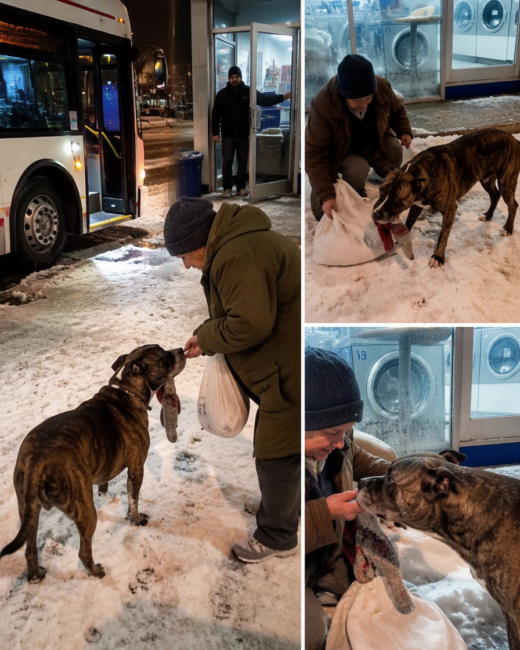
His eyes were brown.
Not amber. Not gold.
The brown of coffee after someone has added too much water.
Dorothy began calling him Tuesday, though he had first appeared on a Monday. She said Tuesday sounded like a name for something that came after a hard beginning and still expected the week to continue.
The dog responded to neither Tuesday nor any other name.
He responded to the dryer buzzer.
At 11:41 each night, washer fourteen completed its final high-speed cycle. Six minutes later, dryer eighteen usually stopped. The Pit Bull rose when the buzzer sounded, picked up the scarf, and inspected the door.
11:47.
The time was not a coincidence.
I lived in a two-bedroom apartment above the laundromat. My wife, Elena, had died four years earlier after a fast cancer that gave us five months between diagnosis and the last morning. Our daughter, Sofia, was studying nursing in Erie and called every Sunday, even when neither of us had enough news for a full conversation.
The laundromat had become the place where I stayed after everyone else left.
I repaired lint traps at midnight. I scrubbed machines that were already clean. I kept the lights on because turning them off made the apartment upstairs feel larger than it was.
Tuesday began sleeping below those lights.
The first time I took him to a veterinarian, we needed three people and a borrowed van. He allowed Dorothy to loop a leash around his neck, but he planted his feet when we turned away from the bus shelter.
The clinic found no microchip.
His blood work showed dehydration and mild anemia. His shoulder scar was old. The veterinarian guessed he had spent years on a chain because the lower edges of his teeth had been damaged by biting metal.
“He can stay at the county shelter tonight,” she said.
I agreed.
Tuesday escaped its outdoor run nine hours later.
At 11:52, I found him outside dryer eighteen with mud on his legs and the torn scarf between his teeth. He had crossed almost three miles through sleet.
He did not check any other laundromat.
He came back to mine.
That was the first detail I misunderstood.
The second was his reaction to keys.
Any woman who approached the door carrying a ring of loose keys received his full attention. He smelled her hands, listened to the metal strike against itself, and checked her left side.
When the keys sounded wrong, he returned to the scarf.
Nora Bennett had carried something that jingled.
We did not yet know what it opened.
Part 3, Forty Nights at 11:47
Tuesday’s routine became part of the laundromat.
Ruth Carter, my evening employee, left a stainless-steel bowl beside the vending machine. Dorothy brought an old orthopedic mat from her husband’s room. A mechanic named Leon cut a piece of clear vinyl to block the draft beneath the front door.
Tuesday accepted each gift.
He moved all three away from the threshold.
The bowl remained beside the parking meter. The mat stayed near dryer eighteen. The vinyl strip spent every night folded beside the trash can.
Nothing could block his view of the bus stop.
Customers began timing their laundry around him. Children sat on the blue tile and rolled tennis balls toward his paws. Tuesday watched the balls pass without touching them. Construction workers offered pieces of chicken. He carried each piece to the edge of the building before eating.
He was gentle with hands.
He guarded the scarf.
On January 17, a man reached down and tried to pull it away as a joke. Tuesday rose without barking and placed his body between the cloth and the man.
His tail stopped.
The man stepped back.
Tuesday picked up the scarf and checked the bus shelter.
I hung a photograph of Nora beside the register after an outreach worker gave us one from a warming-center intake form. The image showed a thin woman with gray-blond hair cut near her jaw, pale blue eyes, and a small crescent scar over her right eyebrow.
She was fifty-nine.
She had worked for seventeen years as a home health aide. A back injury ended that job. Medical bills followed. Her landlord sold the duplex where she rented a basement room, and the new owner doubled the rent.
Nora slept in her car for three months.
Then the transmission failed.
By the time she appeared near my laundromat in December, she had been without stable housing for eleven weeks.
The outreach worker, Camille Price, knew her habits. Nora avoided large shelters because a dormitory fire during childhood had left her unable to sleep inside rooms with locked windows. She accepted meals but refused beds behind security doors.
“She used laundromats,” Camille explained. “Bright windows. People coming and going. Doors she could open herself.”
“Did she own a dog?”
“Not when I met her.”
Camille had seen Tuesday beside Nora twice. The first time was December 20 outside a church pantry. Nora had wrapped a red-and-gray scarf around the dog’s body and tied the ends loosely beneath his chest.
The second time was Christmas Eve.
Nora stood outside Liberty Wash & Dry while Tuesday slept against her legs. Camille offered a shelter bed. Nora asked whether the dog could come.
The answer was no.
She refused.
“Why didn’t you tell me?” I asked.
“You were closed. I thought they moved on.”
They had not.
The old token inside the scarf gave us another clue. Before I replaced the laundromat’s payment system, each dryer used brass tokens stamped with a number. Dryer eighteen stood closest to a hot-water pipe and produced more heat than the others.
People who needed warmth knew that machine.
Security footage showed Nora entering the laundromat on seven nights between December 20 and January 4. She always arrived after midnight. She washed no clothes. She purchased one token from the vending machine, placed a damp towel in dryer eighteen, and sat beside Tuesday while it turned.
When the towel came out warm, she wrapped it around the dog.
Then she put her scarf around him.
Nora never stole.
She left exact change on the folding table if the vending machine failed.
On December 28, she wiped snowmelt from the floor with paper towels and returned the roll beneath the sink. On January 2, she folded three shirts another customer had forgotten and placed them in a clear bag.
She took nothing except forty minutes of heat.
I began looking for her at shelters, hospitals, churches, soup kitchens, and encampments along the Allegheny River. Camille checked the city’s outreach logs. Dorothy called every emergency department where she had received care during her husband’s final year.
No Nora.
Tuesday searched in his own way.
He inspected every Route 54 bus between 10:45 p.m. and 12:30 a.m. He followed women wearing green or charcoal coats. He reacted to limping steps, metal keys, and the smell of wood smoke.
At dawn, he traveled east.
I followed him twice.
The first morning, he walked beneath the Bloomfield Bridge, checked three empty sleeping sites, smelled a blue tarp, and returned to the laundromat.
The second morning, he entered an alley behind a closed bakery. He found a cardboard cup containing two quarters, picked it up, and carried it to Liberty Wash & Dry.
He dropped the cup beside the token machine.
Tuesday had never been taught to buy heat. He did not understand money.
He had watched Nora place round metal objects into a machine before warm cloth appeared.
Round metal meant warmth.
Warmth meant Nora remained beside him.
He understood the result.
That detail stayed with me.
On January 26, a woman came into the laundromat wearing Nora’s green coat.
Tuesday smelled her before the door closed. His entire body changed. His ears rose. His tail struck a chair. He pushed between two customers and pressed his nose against the woman’s left pocket.
The woman stepped back.
“What’s wrong with him?”
“Where did you get that coat?”
She had received it from a church donation room. The coat had been found beneath the Bloomfield Bridge on January 7, folded beside a blanket and one black glove.
Tuesday smelled every seam.
He found no Nora.
When the woman left, he tried to follow the coat, then stopped at the curb. He looked toward the bus shelter and back at dryer eighteen.
He returned to the door.
For the first time, he did not lie down on the scarf.
He carried it to the empty chair beside the dryer, placed it on the seat, and stood beneath the clock until 11:47.
The buzzer sounded.
Tuesday looked at the door.
No one entered.
He waited until morning.
The next day, I contacted the city police missing-person unit. An officer took Nora’s photograph, medical history, and last known locations. Because she had no permanent address and had sometimes gone weeks without contacting outreach workers, her absence had not triggered an immediate search.
The officer entered her name into the system.
At 4:20 that afternoon, he called back.
A woman matching Nora’s description had been transported by ambulance from Penn Avenue on January 6.
She carried no identification.
She had given the hospital a different last name before losing consciousness.
The officer would not tell me where she had gone.
He promised to check.
That night, Tuesday did not watch the first two buses.
An ambulance passed at 1:06 a.m.
The dog rose, grabbed the scarf, and ran east.
Dorothy and I followed him into the snow.
Part 4, The Night the Dog Followed the Siren
Tuesday ran differently when he heard the ambulance.
He did not stop beneath the bridge. He did not check the bakery alley or the church steps. He followed Penn Avenue until the siren turned south, then cut through a gas-station lot toward the place where the vehicle had disappeared.
Dorothy drove my van behind us. I ran beside the dog with a leash looped around my wrist, though he pulled hard enough to make my shoulder burn.
The temperature had fallen to six degrees.
Ice formed between Tuesday’s toes. Blood did not show, but his right rear foot began landing at an angle. Every few blocks, I tried to stop him.
He refused.
At Friendship Avenue, the siren faded.
Tuesday stood in the intersection, turning his head toward each side street. He smelled the air, searched the pavement, and chose the road leading to West Penn Hospital.
He had followed ambulances before.
That realization changed our search.
Hospital security would not allow a loose dog inside. Dorothy remained with Tuesday beneath the entrance canopy while I showed Nora’s photograph at the desk.
A nurse recognized her.
Nora had arrived on January 6 with severe hypothermia, pneumonia, and an infected wound in her left foot. A sanitation worker had found her unconscious behind a closed furniture store.
She had remained in intensive care for four days.
After recovering enough to leave the hospital, she had been transferred to a rehabilitation center outside the city. She registered under her former married name, Eleanor Reed, which explained why shelters and outreach teams could not find Nora Bennett.
“She asked about a dog,” the nurse said.
My fingers tightened around the photograph.
“What did she say?”
“She kept asking whether the brindle dog got into the ambulance.”
He had not.
The ambulance crew found no dog when they reached Nora. A second call had sent the same unit past my laundromat twenty-three minutes later. Tuesday must have followed the siren until he reached the door where he had last been warm with her.
He had been waiting ever since.
The rehabilitation center was thirty-eight minutes away. Camille contacted its case manager, explained the situation, and received permission for a visit the following afternoon.
We bathed Tuesday before taking him.
He tolerated water but refused to release the scarf. Ruth washed it by hand while he watched from two feet away. She placed it in dryer eighteen for twelve minutes.
When the buzzer sounded, Tuesday took the warm cloth from her hands.
He carried it into the van.
Nora was sitting near a window when we arrived. Her gray-blond hair had grown unevenly around her ears. A medical boot covered her left foot. Her face looked smaller than it had in the photograph.
Tuesday saw her through two sets of glass doors.
He stopped breathing through his mouth.
The scarf fell from his teeth.
Nora turned toward the sound of the inner door opening.
The dog crossed the lobby.
He did not jump. He did not bark. He moved close enough to place his nose against the medical boot, then smelled her coat, her hands, the crescent scar above her eyebrow, and the left pocket where her keys once hung.
His tail struck the floor.
Once.
Nora lowered both hands onto his head.
“You stayed,” she said.
Tuesday pressed his chest against her knees. His body shook, though the room was warm.
Nora picked up the scarf.
She wrapped it around his neck the same way she had on December 19, pushing the stitched edge beneath his white chest.
Everyone in the lobby went quiet.
I thought we had reached the ending.
A lost woman had been found. A waiting dog had reached her. The scarf had returned to the hands that tied it.
Then Nora looked at me.
“You think I saved him,” she said.
I nodded.
Her thumb moved over the yellow stitches.
“No. That dog was the reason anyone found me alive.”
Part 5, What Happened Before the Ambulance Came
Nora told us about January 6 while Tuesday lay across her feet.
She and the dog had spent the evening beneath the Bloomfield Bridge. Snow entered sideways, slipping past the tarp and collecting on their blankets. Nora’s infected foot had swollen until she could no longer fit it inside her boot.
At 10:20, she tried to walk toward Liberty Wash & Dry.
She made it six blocks.
Behind the furniture store, her left leg folded. She sat against the wall and told herself she would rest for five minutes.
Tuesday remained beside her.
Nora woke once after midnight. Snow covered the dog’s back. Her fingers would not close, and her words came out without full sounds.
She pushed the scarf around him.
“Find the warm door,” she said.
Tuesday left.
That was the part I had assumed.
The dog had been told to save himself.
Instead, he ran to Liberty Wash & Dry, found it closed, and struck the glass with both front paws. My security system had failed during the storm, so no recording survived. A newspaper delivery driver later remembered seeing the dog running from my door toward Penn Avenue.
Tuesday tried the warming center next.
The doors were locked after intake hours.
He waited until a sanitation truck stopped at a red light. Then he stood in front of it.
The driver honked.
Tuesday did not move.
When the driver stepped down, the dog ran toward the furniture store, stopped, and looked back. He repeated that sequence three times.
The driver followed.
He found Nora behind the building and called 911.
Tuesday remained until the ambulance doors opened. A paramedic tried to lift him into the vehicle, but dispatch sent the crew to the nearest emergency department without waiting for animal control.
The dog chased the ambulance for five blocks.
Then he lost it.
Twenty-three minutes later, another ambulance crossed Penn Avenue. Tuesday followed that siren until it passed Liberty Wash & Dry.
Warm door.
Dryer eighteen.
The last place Nora had taken him when winter became too hard.
He waited there because she had told him to find it.
Nora had saved Tuesday first by wrapping her scarf around a chained, half-frozen dog behind a vacant house on December 18. She used bolt cutters borrowed from a road worker and brought him to my laundromat because the shelter intake desk had closed.
Nineteen days later, the dog used every place she had shown him to bring help back to her.
Neither rescue belonged to only one of them.
The cloth around Tuesday’s neck was not the first towel Nora had ever given a cold animal. That was the final truth hidden in the yellow stitching.
Dorothy opened the seam carefully.
A small brass key fell into Nora’s palm.
Nora covered it with her fingers.
“That opened my linen closet,” she said.
The key belonged to a senior-care residence where Nora had worked before her injury. During winter, she kept donated blankets inside that closet. If she saw someone sleeping outside during her bus ride home, she carried one blanket off the bus.
Management had permitted it at first.
Later, a supervisor began counting.
Nora started replacing every blanket with one bought from her own paycheck. The yellow thread marked those she had repaired after washing.
When she lost her job, she kept the key because no one asked for it.
When she lost her apartment, she sewed it inside her scarf so it would not disappear.
Tuesday had guarded more than a scrap of wool.
He had guarded the last key Nora owned.
Part 6, The Warm Door Opens Both Ways
The rehabilitation center did not allow residents to keep animals overnight.
Nora learned that before our visit ended.
She took both hands from Tuesday’s head and began folding the scarf. Her movements became careful, practical, the way people move when they are trying to finish something before their bodies reveal too much.
“You should take him,” she told me.
“He came for you.”
“He needs a house.”
“So do you.”
Nora looked toward the window.
Her rehabilitation stay would end in twelve days. The case manager had found a women’s transitional shelter, but animals were prohibited. Nora could receive a bed if she surrendered Tuesday to the county shelter.
She refused to call that surrender.
She called it making sure one of them was safe.
Tuesday did not understand housing policy. He rested his chin on her medical boot and closed his eyes.
I wanted to promise that I would fix everything. Elena used to say I made promises whenever silence asked more of me than I knew how to give.
So I said nothing.
I returned to the laundromat with Tuesday that evening. He lay beside dryer eighteen but did not watch the door. Nora’s scent covered the scarf. For the first time in forty nights, he slept through the 11:47 buzzer.
The customers organized before I did.
Dorothy called Camille. Ruth contacted a neighborhood housing nonprofit. Leon asked the owner of the apartment above his garage whether dogs were permitted. Sofia created a list of pet-friendly rentals and crossed out every one that required income Nora could not yet prove.
The story spread through the laundromat in pieces.
A teacher placed twenty dollars beneath the register.
A bus driver brought a bag of dog food.
A former home health aide recognized Nora’s name and called the senior residence where she had worked.
The residence still had her old linen key on its inventory sheet.
It also had a new director.
Camille arranged a meeting. Nora attended wearing borrowed shoes and carrying the scarf inside a paper bag.
The director did not offer charity. She offered Nora part-time work managing donations and preparing winter-care kits for discharged residents. The job paid enough to support a subsidized apartment through a partner housing program.
The apartment allowed dogs under seventy pounds.
Tuesday weighed fifty-nine.
The process took five weeks.
During those weeks, Tuesday stayed with me above the laundromat. He slept beside the apartment door instead of my bed. At 11:41 each night, he rose and walked downstairs.
The first seed finally made sense.
Tuesday did not worship the number 11:47. He had learned a sequence: washer fourteen shook the floor, dryer eighteen stopped six minutes later, and Nora stood up to leave. The buzzer meant she was about to move.
The second seed made sense too.
He inspected women carrying keys because Nora’s old linen key struck against two brass tokens inside her pocket. He checked their left side because that was where the sound came from.
The dragged step mattered because Nora’s injured foot had changed her walk.
The green coat carried her scent.
The ambulance siren carried the last direction he had seen her travel.
The coins were not payment in his mind. They were the objects Nora placed into a machine before warmth appeared. Tuesday understood none of the systems around him, but he understood what those systems produced.
Keys opened cloth.
Coins created warmth.
Sirens took Nora.
The laundromat door was where she returned.
The scarf held her scent and the last piece of her former life.
Each strange behavior had been one part of the same map.
On February 27, I drove Tuesday to Nora’s new apartment in East Liberty. The building had faded red brick, a small fenced yard, and a lobby that smelled of floor wax and cooked onions.
Nora waited outside.
She wore a donated navy coat. Her medical boot had been replaced by a black walking shoe. The limp remained, but her left step had grown stronger.
Tuesday saw her through the windshield.
His nails struck the van floor.
I opened the side door.
He jumped down, ran ten feet, and stopped.
Nora held no leash.
She opened her coat and removed the repaired scarf. Ruth had added a soft lining but kept the yellow stitches visible. Nora wrapped it around Tuesday’s neck.
“Warm door,” she said.
Tuesday smelled the building entrance.
Then he looked back at me.
That pause lasted long enough to hurt.
I touched his shoulder scar.
“Go.”
He walked inside with Nora.
The apartment contained one chair, a mattress, two borrowed lamps, and a clean metal dog bowl beside the radiator. A folded red-and-gray towel lay near the window.
Tuesday inspected every room.
He returned to the front door and lay across the threshold.
Nora sat on the floor beside him.
“He still thinks I might leave,” she said.
“No,” I answered. “He thinks this is where you come back.”
Three months later, Nora began working twenty-four hours each week. She washed donated blankets at Liberty Wash & Dry on Thursday nights because our machines handled large loads better than the residence equipment.
Tuesday came with her.
At 11:41, washer fourteen entered its final cycle.
At 11:47, dryer eighteen stopped.
Tuesday stood.
Nora removed a warm blanket, folded it across her arms, and carried it toward the door. Tuesday followed without checking the bus shelter.
A man sleeping beneath the pharmacy awning received that blanket before midnight.
Tuesday walked beside Nora the entire way.
Part 7, The Towel Outside Dryer Eighteen
Nora never reclaimed the brass linen key.
She mounted it inside a small wooden frame and placed it above Tuesday’s bed. Beneath it, she kept the original red-and-gray scarf, still marked by Ruth’s repairs and Nora’s uneven yellow stitches.
Every Thursday at 11:47, Nora and Tuesday return to Liberty Wash & Dry.
They wash twelve donated blankets in machines fourteen through seventeen and warm them in dryer eighteen. Nora folds each one twice. Tuesday smells the corners, then waits beside the cart.
One blanket always stays behind.
Nora places it outside the door where Tuesday slept during those forty winter nights. A paper cup of water sits beside it. She leaves no sign and asks no one who uses it.
Sometimes the blanket is gone by morning.
Sometimes a person is sleeping beneath it.
Once, we found a small brown dog curled on top of it while its owner slept against the wall. Tuesday lay six feet away, facing the street.
He did not guard the blanket.
He guarded the doorway.
Dorothy still washes her sheets on Thursdays. Ruth still fills the water bowl. Leon finally installed a heater above the entrance, though Tuesday no longer needs it.
At 11:47, the dryer buzzer sounds.
Tuesday lifts his head.
Nora touches the old scarf beneath his collar and says, “I’m here.”
He no longer inspects the final bus.
He does not follow ambulances.
He waits until Nora locks the laundromat door, then matches his steps to her uneven walk as they cross Penn Avenue together.
One winter night, snow covered the same bottom step where I had first found his head rising above the drift. Nora placed a warm towel there, and Tuesday pressed one paw into its center.
Then both of them went inside.
Follow this page for more unforgettable dog stories about quiet loyalty, second chances, and the people animals refuse to stop waiting for.