Next part: A Young Pit Bull With a Swollen Paw Was Tied Beside a Dumpster in Freezing Rain — Then a Man With No Home for Her Brought Out a Chair and Refused to Leave
Part 2 — The Space Raymond Was Not Allowed to Cross
I arrived at the alley expecting an ordinary abandonment call.
The rain made it something else.
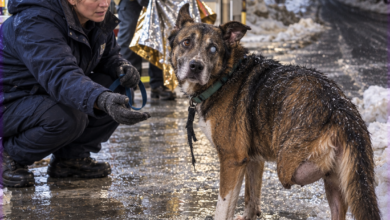
Water ran from the roof of the dumpster enclosure in continuous sheets. A flattened cardboard box had dissolved into pulp near the fence, and the blue rope around the dog’s collar had absorbed enough water to become heavy.
Raymond’s yellow umbrella was the only bright object in the alley.
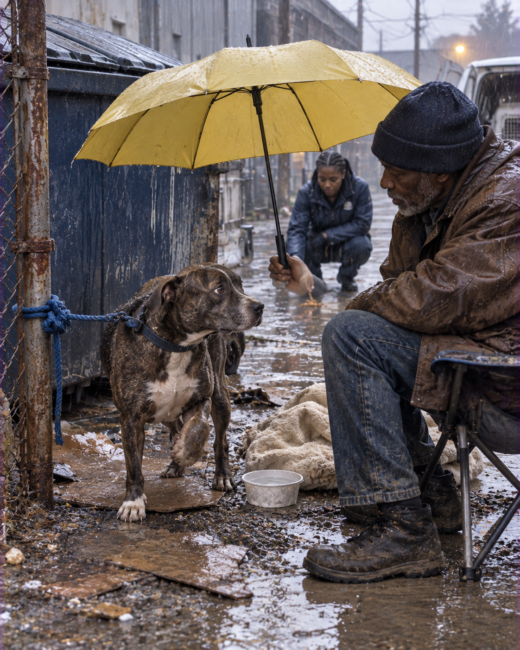
He sat with his knees apart and his hands visible. The Pit Bull lay on the towel between the chair and the fence, close enough to hear him but beyond his reach.
That distance told me Raymond had been paying attention.
People often believe a frightened dog needs immediate petting. Reaching can remove the animal’s only remaining sense of control. Raymond had recognized her retreat and stopped before kindness became pressure.
The dog appeared between ten and fourteen months old. Her short coat was dark brindle with thin tan striping. A broad white mark covered the center of her chest, and the toes of her left front paw were white.
The right front paw was enlarged from the toes to slightly above the carpal joint. A thin black cord had tightened beneath the wet fur, creating a deep indentation.
She held the limb off the ground.
I could not diagnose the cause in the alley. The swelling could reflect soft-tissue injury, impaired circulation, infection, fracture, or several problems together.
Cold exposure added urgency. The dog’s body trembled continuously. Her ears, paws, and abdomen were wet, and she had no dry shelter except the umbrella.
Still, rapid handling carried risk.
The rope limited retreat. The dumpster blocked one side. The fence blocked another. If I moved directly toward her, she had nowhere to go except through me.
I asked Raymond to continue speaking.
“What should I call her?” he asked.
“Whatever you’ve been saying.”
“Mostly little girl.”
He looked toward the fence rather than directly at her.
“You’re okay, little girl. They’re not leaving you here.”
I scattered pieces of warm chicken in an arc beginning outside her reach and ending closer to my knee. She ignored the first two, smelled the third, and ate the fourth.
Hunger competed with fear.
That gave us a starting point.
I placed a slip lead on the ground and used a long handling pole only as a guide, not to tighten around her neck. The dog stretched toward another piece of food, bringing her head through the loop.
I lifted gently.
Her body stiffened, but she did not lunge.
Once the second lead was secure, my partner cut the rope attached to the fence. Beneath it, the collar was so tight we could fit only one finger. We cut that too.
The dog took one hopping step away from the fence.
Then she turned toward Raymond.
The widened space should have encouraged escape. Instead, she moved close enough for her shoulder to touch the leg of his wet jeans.
Raymond did not reach down.
He let her choose the contact.
We wrapped a dry thermal blanket loosely around her back without covering the swollen limb. She tolerated it while Raymond remained beside her.
The crate waited approximately thirty feet away.
The dog followed food for half that distance. When Raymond turned toward the building, she stopped and lowered herself.
I asked him whether he could walk beside us.
“My housing manager wants me inside.”
“We need two minutes.”
Raymond looked toward the doorway, then at the dog. A staff member stood beneath the awning watching. I explained that Raymond would not bring the animal into his room or assume legal custody. He would only assist with a safe transfer.
The manager agreed.
Raymond walked beside the crate, holding the yellow umbrella above its door. The dog smelled the threshold, looked at him, and climbed inside using three legs.
We closed the door.
Raymond crouched, keeping his fingers outside the bars.
“I’ll stay until the car moves,” he said.
He did.
During transport, the dog remained pressed against the side of the crate nearest the window through which Raymond had disappeared.
At the emergency clinic, staff asked whether she had a name.
I entered “Jane Doe” on the intake form, then hesitated.
“Raymond called her little girl.”
The receptionist wrote “Little Girl” in quotation marks.
That temporary name stayed for the night.
The veterinary team cut away the black cord around her leg. It appeared to be a piece of thin electrical cable, separate from the blue rope at the fence.
It had been wrapped long enough for swelling to build around it.
The paw remained warm, which meant blood still reached the tissue. Whether circulation and nerves would recover fully remained uncertain.
Dr. Lena Foster ordered radiographs, blood work, pain control, gradual warming, and close monitoring.
The dog lay on the examination mat, exhausted.
When the clinic door opened, she raised her head.
Each time, she looked past the entering person as if expecting the man beneath the yellow umbrella to come through next.
Part 3 — What the Veterinarian Could Not Promise
Radiographs showed no fracture.
That was the first good finding.
The cord had compressed soft tissue and impaired venous drainage, causing fluid to accumulate in the paw. The indentation circled most of the lower limb, but the skin remained largely intact.
Dr. Foster used Doppler equipment to evaluate blood flow. Arterial circulation was present. The toes responded when touched, although the response was weaker than in the left paw.
The prognosis was cautiously hopeful.
Swelling might decrease once pressure was removed. Nerve irritation could improve over days or weeks. However, tissue damage sometimes became visible only after circulation returned, and infection remained a concern.
Nobody promised that the paw had been saved simply because it was still attached.
The dog also showed mild hypothermia. Her temperature rose gradually with dry blankets, warmed fluids, and a controlled environment. Rapid external heating could have caused discomfort or complications, so the clinic avoided placing intense heat directly against her skin.
The rubbed area on her neck required cleaning and topical treatment but no stitches.
A microchip scan found nothing.
Animal services documented the scene and began the required stray-hold process. Cameras near the housing complex did not cover the dumpster enclosure, and no one reported seeing who tied her there.
We did not invent an abuser.
Our job was to treat the dog in front of us.
For the first several hours, Little Girl refused food unless someone sat beside the kennel. Even then, she kept her body against the rear wall and lifted her head whenever footsteps stopped outside.
The clinic called me at noon.
“She settles when a male maintenance worker sits near her,” the technician said. “Do you think she’s looking for the man from the alley?”
We could not know, but the pattern was observable.
I called Raymond through the housing office. He did not own a cell phone at the time.
When he answered, his first question concerned the paw.
I explained what the veterinarian had found and what remained uncertain.
“Can I see her?”
The clinic did not normally permit unrelated finders into treatment wards. However, Raymond’s presence had directly supported safe handling, and animal services still held custody.
We arranged a brief controlled visit in a consultation room.
Raymond arrived wearing the same brown jacket, now dry but stained dark at the shoulders. He carried the folded yellow umbrella.
Little Girl entered on three legs with a technician supporting her in a padded harness. Her right front limb was wrapped in a soft bandage from the toes to above the wrist.
She saw Raymond.
Her tail moved once.
Then her body lowered, not in collapse but in a careful approach. She crossed the room and placed her chin on the toe of his boot.
Raymond sat on the floor.
He did not hug her.
He rested one hand beside her white chest while she smelled his sleeve.
The visit lasted fifteen minutes. When the technician returned, Little Girl followed her without resisting.
That mattered.
She had accepted comfort from Raymond without becoming unable to leave him. Trust had widened by one person.
The next forty-eight hours brought improvement. Swelling decreased enough for Dr. Foster to inspect the compressed tissue more clearly. The toes remained warm, and sensation strengthened.
The dog began placing the paw lightly on the floor.
Her weight-bearing was brief and uneven, but it was purposeful.
We replaced “Little Girl” with the name June because she had entered care on the first morning of the rescue’s summer-placement planning cycle despite the February weather. Raymond laughed when I told him.
“Does she know that?”
“Not yet.”
He visited every other afternoon while the stray hold continued. Housing rules prevented him from fostering, and the clinic was three bus transfers away. Sometimes he arrived late because a connection failed.
June waited near the consultation-room door whenever she heard his voice.
During those visits, Raymond practiced skills the behavior staff requested. He tossed treats rather than feeding from his fingers. He touched her shoulder before moving toward the bandage. He ended sessions while she remained calm.
He never told her she would be his.
That restraint was important.
His room at the transitional complex measured less than two hundred square feet and had no fenced outdoor space. The program prohibited pets, and Raymond was still completing employment and housing requirements.
Love could not alter those facts overnight.
June would need a foster home after discharge.
The practical question became whether she could transfer from the person she trusted to someone new without reliving the panic beside the transport crate.
Our foster coordinator selected Renee Wallace, a fifty-four-year-old veterinary receptionist living alone in a quiet one-story house. Renee had no other animals and could manage bandage care.
She visited the clinic twice before discharge.
June accepted food but avoided touch.
On the third visit, Raymond sat beside Renee without interacting directly with the dog. Renee held the leash. Raymond placed the yellow umbrella on the floor between them.
June smelled it.
Then she lay down with her injured paw extended toward Renee.
It was not surrender.
It was a small decision to remain in a room containing someone new.
Part 4 — The Umbrella Beside the Foster Bed
June left the clinic nine days after rescue.
Her paw remained swollen, though considerably smaller. She could place partial weight on it for short distances. A padded protective wrap prevented licking and supported the healing tissue.
Renee’s vehicle had a low entry. We used a portable ramp because jumping could reinjure the limb.
Raymond attended the transfer.
He stood beside the open rear door while Renee spread a nonslip mat across the floor. The yellow umbrella lay folded against the seat.
June approached the ramp, stopped, and looked backward.
Raymond crouched.
“This is the part where somebody takes you home,” he said.
The sentence was not entirely accurate. Renee’s home was foster care, and adoption remained weeks away. But the vehicle was taking June somewhere dry, quiet, and prepared for her.
She climbed the ramp.
Raymond did not enter the vehicle.
He remained on the pavement until Renee drove away.
At the foster house, June refused the orthopedic bed and lay beside the front door. She kept her body angled toward the exit, her head raised, and her bandaged paw tucked beneath her chest.
Renee placed the folded umbrella beside the bed.
June smelled the handle, then moved six inches closer.
That first night, she slept in short periods. Every time rain struck the window, her head rose. When a garbage truck stopped in the alley at 5:30 a.m., she began panting and searched the room.
The combination of rain, diesel noise, and metal bins appeared to resemble the rescue location.
Renee did not take her outside immediately. She waited for the truck to leave, then used the quieter front yard for a brief bathroom trip.
June returned on three legs.
She ate only half her breakfast.
This was shelter decompression complicated by physical pain, not evidence that foster care had failed.
Renee maintained a predictable schedule. Medication arrived at the same times. The food bowl remained in one location. Nobody stepped over June when she slept near the door.
Twice daily, Renee checked the bandage for moisture, odor, slipping, or toe swelling. On the third day, she noticed the outer wrap felt damp after a bathroom trip.
The bandage had to be replaced.
At the clinic, June reacted strongly when staff approached the paw. She pulled backward, rolled partly onto her side, and snapped once into the air without making contact.
The team stopped.
Pain and fear had exceeded her ability to cooperate. They used prescribed anti-anxiety medication, allowed time for it to work, and completed the change with minimal restraint.
The tissue looked viable. The swelling continued to decline.
However, the incident changed aftercare. Renee began cooperative handling exercises at home, touching the shoulder, then the elbow, then stopping before reaching the paw. Each step was paired with food.
Progress took days.
June eventually allowed Renee to lift the leg for two seconds.
Then four.
Then long enough to inspect the toes.
Meanwhile, Raymond asked whether visiting might disrupt adjustment. The behavior coordinator believed carefully structured contact could help if visits remained calm and ended predictably.
He came on Sunday afternoons.
The first time, June ran from the hallway and pressed her body against his knees. Her tail moved rapidly, but her breathing also increased. Raymond sat on the floor and waited for the arousal to settle.
After ten minutes, June carried a rope toy toward Renee.
That shift mattered. She could greet Raymond and then re-engage with the foster home.
One relationship did not have to erase another.
During the fourth week, June’s bandage was removed. The indentation around the lower leg remained visible, and hair had not yet returned. She walked with a mild limp, placing the paw carefully.
Rehabilitation consisted of short leash walks on level ground, controlled standing, and gentle range-of-motion exercises. No running, jumping, or rough play.
The first outdoor session ended after ninety seconds when a sanitation truck turned the corner.
June froze.
The truck’s brakes hissed. Metal containers struck one another.
She pulled backward toward the house, placing full weight on the healing paw and nearly slipping.
Renee followed rather than resisting the leash. They returned indoors.
For the next week, walks occurred during quiet hours. Recordings of distant truck sounds played softly during meals. Exposure remained below the level that caused panic.
Then rain arrived.
June refused to cross the porch.
Renee opened the yellow umbrella.
The dog stared at it, smelled the wet air, and stepped outside.
The umbrella no longer sheltered a man beside a dumpster.
It now marked a path from the foster door into a world that could still be safe when it rained.
Part 5 — The Home Raymond Could Not Offer
By the sixth week, June walked on all four paws inside the house.
The right front paw remained slightly enlarged compared with the left, especially after exercise. A pale groove marked where the cord had compressed the tissue. Hair grew unevenly across the lower limb.
Dr. Foster expected continued improvement but could not guarantee the paw would ever look entirely normal. Long walks and high-impact activity would need to increase gradually.
June did not care how the paw looked.
She cared whether movement hurt.
Her gait became our guide. If she shortened the right step, turned the toes outward, or began lifting the paw, activity ended.
Renee sent Raymond weekly videos. He watched June cross the kitchen, climb the low porch ramp, and carry her rope toy from one room to another.
He never asked to take her.
That question remained painful because the housing complex had begun helping Raymond apply for a permanent apartment. A few properties allowed dogs, but many required deposits and breed-neutral insurance documentation he could not yet afford.
The rescue offered to help with supplies if an appropriate home became available. Even then, adoption would require evaluating whether Raymond could provide stable housing, veterinary care, daily exercise, and emergency backup.
The standard did not change because his action in the rain had been compassionate.
Raymond understood.
“I don’t want her moved again just so I can feel better,” he said.
That was the most responsible promise he could make.
June became available for adoption after the stray hold ended, the paw stabilized, and behavior staff completed an assessment. Her profile described her accurately: young, people-oriented, frightened by sanitation trucks and heavy rain, improving with predictable handling, and still receiving follow-up care for the right front limb.
Applications arrived quickly because June was young and attractive.
Several applicants withdrew after learning that recovery involved rehabilitation and that she could not immediately accompany runners or play unrestricted in dog parks.
One family insisted the swollen paw looked minor in photographs and suggested she would “work through it.”
We declined.
Pain was not a training problem.
The strongest application came from Samuel and Denise Carter, a married couple in their late forties with a twelve-year-old son named Miles. They lived in a one-story house with a fenced yard and had previously cared for a dog recovering from orthopedic surgery.
They agreed to meet June at Renee’s house.
Miles sat on the floor and rolled treats rather than reaching over her head. June inspected his shoes and returned to Renee.
Samuel practiced clipping the leash. Denise reviewed the rehabilitation notes line by line.
They also met Raymond.
The rescue did not require adopters to maintain contact with finders, but June’s response to him was relevant. The Carters watched her greet Raymond, settle, and then carry her toy to Miles.
Denise asked whether Raymond wanted updates.
“Only if it isn’t trouble.”
“It wouldn’t be.”
The family completed two more visits and a home assessment. Their yard contained a section of slick concrete, so they added rubber runners between the back door and grass. A sanitation route passed the house twice weekly. On collection mornings, June would use the front yard until desensitization progressed.
The foster-to-adopt trial began during clear weather.
June entered the Carters’ vehicle using her ramp. Raymond was not present because the behavior team wanted to learn whether she could transfer without relying on him each time.
She hesitated, looked toward Renee, and climbed inside after Miles placed the rope toy on the mat.
At the Carter home, June explored the living room, drank water, and lay near the front door.
That night, rain began unexpectedly.
A truck struck a metal bin in the alley.
June bolted from her bed, slipped on the runner, and began barking at the door. Her recovered paw swelled slightly by morning.
The trial nearly ended on its second day.
The Carters called Renee rather than improvising. They reduced activity, applied the veterinarian-approved cold pack through a towel, and scheduled an examination.
No new structural injury was found. June had strained soft tissue around the previously compressed area.
She needed several days of restricted exercise.
The setback frightened the family, but it also revealed how they handled difficulty.
They did not blame June.
They did not hide the incident to protect the adoption.
They asked for help before fear became another abandonment.
Part 6 — Learning That People Could Leave and Return
June’s trial was extended from two weeks to four.
Her paw required rest, and the behavior team needed to observe whether the new home could support recovery without overwhelming her.
For three days, June’s movement was limited to brief leash trips outside. Miles sat near her bed and read quietly. He did not throw toys or encourage play.
The yellow umbrella stayed beside the front door.
On the fourth day, Raymond visited.
June heard his voice from the porch and stood too quickly. Denise asked Raymond to wait outside until she attached the leash and placed nonslip mats along the route.
When the door opened, June moved toward him with a mild limp.
Raymond crouched without calling her.
She smelled his jacket, touched her white chest against his knee, and remained there.
Then Raymond did something the behavior staff had requested.
He stood, walked back through the door, and disappeared for thirty seconds.
June stared after him.
Her mouth closed, and her weight shifted forward, but Denise offered food and kept the leash loose.
Raymond returned.
They repeated the exercise twice.
The lesson was simple: a person leaving the room could come back.
During the following weeks, the Carters practiced the same pattern in ordinary life. Denise walked to the mailbox and returned. Samuel moved the trash bin while June watched from behind a baby gate. Miles opened an umbrella indoors, closed it, and placed it beside her bed.
Nobody forced June toward the objects.
Distance decreased according to her body language.
Her repeated stress signals became familiar: closed mouth, lowered tail, weight shifted backward, eyes fixed on an exit. The family learned to respond before barking or flight.
The paw swelling subsided.
Rehabilitation resumed with controlled five-minute walks. June used all four legs but occasionally shortened the right-front stride on turns. The Carters avoided sharp changes of direction and kept exercise on level ground.
At the end of the fourth week, Dr. Foster approved the adoption.
The paw had nearly returned to normal size. The groove remained visible, and a small patch of hair had not grown back. June might experience periodic swelling after excessive activity.
The condition was manageable.
It was not erased.
Raymond attended the signing at the rescue office. He sat beside June while Denise completed the paperwork. Miles held the teal leash loosely.
When the final page was signed, nobody handed June from one owner to another in a staged ceremony. She walked around the room, smelled each person, and lay beneath the table.
Raymond placed the folded yellow umbrella beside Miles.
“For rainy days,” he said.
Miles accepted it with both hands.
The Carters promised updates but made no theatrical claim that Raymond had become part of their family. They lived separate lives. Connection would depend on consent, schedules, and what remained healthy for June.
Their first update arrived one week later.
June stood beneath the yellow umbrella beside Miles in light rain. Her right paw rested fully on the sidewalk. Denise’s message said they had walked only to the next driveway and returned.
Raymond printed the photograph at the housing office.
He kept it on the small desk beside his bed.
His own housing application progressed slowly. The pet-friendly unit he hoped for went to another applicant. He was disappointed but did not ask the Carters to reconsider June’s placement.
Instead, he enrolled in the rescue’s volunteer orientation.
His background check and schedule were reviewed like anyone else’s. He learned safe leash handling, kennel procedures, bite-prevention signals, and why volunteers could not make promises to animals about adoption.
His first assigned dog was not June.
It was a shy senior hound who would not leave the back of the kennel.
Raymond placed a chair outside the gate and sat down.
Staying had become something he could offer without claiming ownership of every animal that needed it.
Months later, the transitional-housing program approved Raymond for a permanent studio. The building permitted small pets, though he did not immediately adopt.
He wanted stable income, emergency savings, and time to understand his new routine first.
June remained with the Carters.
When Raymond visited, she greeted him, then returned to Miles.
The first time this happened, Raymond watched her leave his side and smiled.
“She knows I’m not disappearing,” he said. “She just knows where home is.”
Part 7 — The Umbrella Opened Again
One year after the rescue, rain returned to Memphis with the same cold, slanting force that had flooded the alley behind the temporary-housing complex.
June was no longer a small adolescent.
She had grown into a compact adult Pit Bull with a dark brindle coat, broad white chest, and one white left front paw. The right front paw remained slightly thicker around the wrist, and the pale pressure groove could still be seen beneath the short hair.
She walked without a regular limp.
Long outings remained limited, and the Carters continued checking for swelling after exercise. Sanitation trucks still made her cautious, but she no longer fled at the first metallic sound.
On that rainy anniversary, Denise drove June to the rescue for a scheduled veterinary recheck.
Raymond was volunteering in the kennel wing.
He heard June’s tags before he saw her.
She entered wearing a waterproof coat and stopped at the sound of a dumpster being moved outside. Her body tightened for a second.
Miles opened the old yellow umbrella.
June looked up at it.
Then she continued walking.
Inside the examination room, Dr. Foster measured both front limbs and observed June’s gait. The right paw remained functional, sensation was normal, and no ulceration or circulation problem had developed.
The veterinarian recommended continued weight management, moderate exercise, and monitoring after strenuous activity.
There was no final cure announcement.
There was a young dog using a limb that had once been hours away from lasting damage.
After the appointment, the group visited the alley behind the housing complex. Staff had replaced the rusted fence panel and installed a camera near the service area. The dumpster remained in approximately the same location.
June did not approach it.
Nobody led her closer for a photograph.
They stayed near the alley entrance, where she could see the space without entering it.
Raymond unfolded a chair.
Miles opened the umbrella above him.
June stood between them on a loose leash.
Rain tapped against the yellow fabric. For a few moments, she listened. Then she sat and leaned lightly against Miles’s leg.
Raymond did not call her over.
He understood that the ending was not June choosing him above everyone else. The ending was her having enough safe people that she no longer needed one person to remain forever in sight.
The Carters drove home after fifteen minutes.
As their vehicle left, June looked through the rear window. Raymond raised one hand. The yellow umbrella remained folded beneath his chair.
The following week, the rescue received another cold-weather call involving a dog under an abandoned porch. Raymond joined the field-support team, carrying blankets, water, and a folding chair.
He did not present himself as a hero.
He knew what it meant to have limited resources. He knew that compassion without safe procedure could cause harm. He also knew that sometimes the first useful action was neither ownership nor rescue.
Sometimes it was remaining nearby until qualified help arrived.
June continued visiting him several times a year. Her greetings became calmer. She smelled his coat, accepted a chest rub, and returned to whichever Carter held the leash.
On her second adoption anniversary, Miles sent Raymond a photograph taken during a spring shower.
June stood at the open front door with the yellow umbrella propped beside her. The right paw was planted firmly on the mat. Her ears were forward, and the teal leash hung loosely from Miles’s hand.
The message beneath the picture said:
“She wanted her walk even though it was raining.”
Raymond placed the new photograph beside the first.
In one, June looked fragile beneath the umbrella.
In the other, she waited to step beyond it.
The distance between those images had been built through veterinary care, foster routines, rehabilitation, honest adoption decisions, and people who left rooms only after teaching her that they could return.
But the first step had happened beside a dumpster, when a man who could offer no home decided he could still offer his presence.
Raymond could not promise to keep June that morning, so he gave her the one promise he could keep: she would not wait alone.
Follow the page for more compelling dog-rescue stories about quiet courage, patient healing, and ordinary people who stay when frightened animals need someone most.