Her Cloudy Eyes Made Every New Room Dangerous, but She Walked Straight Toward a Wheelchair — Then Lay Beside Its Footrest Before Anyone Understood Why
Part 2 — A House That Could Not Keep Changing
Juniper and her puppies came home three days later during a steady early-spring rain. The rescue transported them in two secured crates because I could not safely manage a nervous mother, five puppies, and my chair at once. My daughter, Claire, followed the van and carried supplies inside while I remained near the foster room, trying to make my voice the first predictable feature Juniper encountered.
We had converted my former dining room into a nursery. Nonslip runners covered the path from the exercise pen to the patio door. Low foam guards softened the furniture corners, and the water bowl sat on a rubber mat that smelled faintly of vanilla—the behavior specialist’s suggestion for creating a consistent scent landmark. Nothing unnecessary remained at Juniper’s head height.
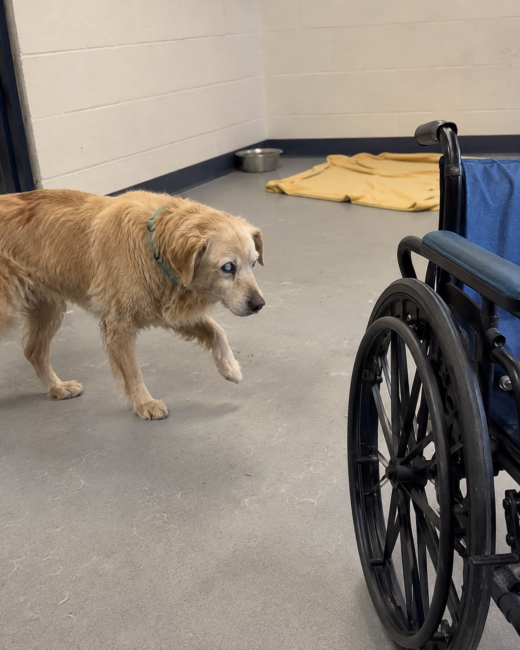
Before moving my chair, I said, “Rolling, Juniper.”
At first, the phrase meant nothing. She stiffened whenever the casters turned, stepping sideways until her shoulder found the nearest wall. The puppies were even less certain. They rushed toward the wheels when curious and fled when the chair moved, forcing me to check beneath the frame before every turn.
For the first two days, I traveled through my own home with the patience of someone navigating a crowded room in darkness. I announced every movement, moved only after locating all five puppies, and kept my routes consistent. Juniper learned the sound of the wheel locks first. When she heard the double click, she knew the chair had become still, and she approached to smell the footrest.
She did not allow me to touch her face. If my fingers moved above her cloudy eyes, she ducked so sharply that her chest nearly touched the floor. I began offering the back of my hand beside her shoulder instead. Sometimes she smelled it. Sometimes she stepped away. Trust was not measured by affection; it was measured by how quickly she recovered from surprise.
The puppies adapted faster. By the end of the third day, the bold honey-colored male was following my chair at a safe distance. I named him Button because he repeatedly carried away the soft fabric covers fastened over the caster hardware. His siblings began treating the stationary footrests as a shaded place to sleep.
Juniper remained watchful. She counted her puppies through scent, touch, and sound, nudging each body before lying down. If one squeaked from across the pen, she rose immediately and followed the edge of the enclosure until she found it. She rarely crossed an open space directly unless my chair was nearby.
During our first home visit, the behavior specialist watched Juniper approach when I said her name, then orient more accurately after I touched the wheel rim.
“She may be using the chair as an acoustic landmark,” she explained. “It has a consistent sound and shape. You also warn her before it moves.”
That did not make my wheelchair special. It made it predictable, and predictability was something Juniper had been missing.
Still, we discovered a serious complication. Juniper could not always distinguish a sleeping puppy from the darker sections of the rug. Twice she nearly stepped on the smallest puppy while searching for her water. We changed the bedding to a pale solid color, added shallow padded boundaries, and attached tiny breakaway bells to two monitored play toys—not to the puppies—so she could orient toward the area where they were active.
By the end of the first week, Juniper had drawn a mental map of the room. She could travel from the bed to the water, from the water to the patio, and from the patio back to the footrest without striking anything.
Then the veterinary appointment gave us news that would determine whether that map was temporary—or something she might need for the rest of her life.
Part 3 — What the Veterinarian Could Not Restore
The rescue veterinarian examined Juniper in a quiet room with the overhead lights lowered. Because hands approaching from above frightened her, the technician worked beside her, announcing each touch before it happened. I remained near Juniper’s shoulder with one wheel locked where she could smell the familiar rubber and hear the small creak of the footrest.
The blue-gray clouding in both eyes was diagnosed as mature cataracts. That explained why Juniper could detect brightness without seeing clear shapes, but the veterinarian cautioned us against assuming cataract surgery would restore useful vision. Further testing suggested underlying retinal degeneration, a condition that could prevent the brain from receiving a functional image even if the cloudy lenses were removed.
The words were difficult to hear, but the veterinarian was careful not to describe Juniper as hopeless. Her eyes were comfortable. There was no ulcer, active inflammation, or painful pressure at that examination. She needed monitoring, protective routines, and follow-up care, but she did not need people rearranging her life around a promised cure that might never come.
“Our goal is not to make her act sighted,” the veterinarian said. “It is to help her feel secure as the dog she is.”
I thought about how often well-meaning people praised Juniper for being “brave” when she crossed a room. She was not performing courage for us. She was gathering information through her paws, nose, ears, and whiskers because those were the tools available to her. The respectful response was not applause. It was keeping the water bowl where she expected to find it.
The examination also showed that nursing five puppies had left Juniper lean and tired. This was not a second dramatic illness, merely a practical nutritional concern. The veterinarian adjusted her food, recommended smaller frequent meals, and asked us to weigh her weekly while the puppies began transitioning to softened food.
The return trip unsettled her. Rain struck the roof of the rescue van, and the unfamiliar vibration made her pant. At home she stepped from the crate, turned in the wrong direction, and bumped her shoulder gently against the padded gate. She froze.
I moved several feet away, locked my wheels, and said, “Juniper, I’m here.”
Her head lifted. She followed the sound of my hand passing over the push rim until her nose reached the footrest. Only then did she continue toward the bed. That evening she slept against the chair for almost an hour while her puppies sprawled across the pale blanket.
The next several days became an exercise in consistency. “Rolling, Juniper” before movement. “Door open” before the patio latch clicked. “Dinner” before the bowl touched its vanilla-scented mat. When visitors entered, they spoke from the doorway and waited for her to approach. Nobody reached across her cloudy field of vision.
The puppies, meanwhile, became louder and faster. They climbed over foam barriers, wrestled beneath my chair, and discovered that shoelaces could be pulled. Their mother could no longer gather them with one sweep of her head, so we created a small open area where their movements produced recognizable sounds without exposing them to the wheels.
Juniper’s progress remained modest but repeatable. She began resting before the house became completely silent. She stopped tracing every wall after returning from the patio. Once, when I forgot to say “Rolling,” she startled but recovered after two breaths instead of fleeing.
That small recovery mattered more than a dramatic breakthrough. She was learning that surprise did not always mean danger.
By the third week, I could move between the kitchen and nursery while Juniper remained relaxed on her bed. We believed the hardest adjustment had passed. Then Claire arrived early one morning to clean—and changed two pieces of furniture that Juniper’s eyes could not warn her were no longer where they belonged.
Part 4 — “Rolling, Juniper”
Before the setback, our days had developed a rhythm so ordinary that I almost stopped noticing how carefully it had been built. At six each morning, Juniper heard my bedroom door open and moved toward the nursery gate. I greeted her before unlocking it, then rolled backward so she had room to smell my chair.
The puppies followed in a tumbling line. Button usually arrived first, while the smallest pale female—whom the rescue later named Wren—stayed close to Juniper’s front legs. I checked every puppy before moving and repeated our cue.
“Rolling, Juniper.”
My wheels made a soft rubber hiss over the runner. Juniper walked beside the left footrest, close enough to use the sound but far enough to avoid the caster. We practiced that distance with treats placed along the safe side of the chair. If she drifted inward, I stopped instead of steering around her. She learned that the cue predicted movement and the locked wheels predicted safety.
None of this looked dramatic. It was repetition: three feet to the water bowl, six feet to the patio, a turn near the cabinet, then back along the runner. Yet those uneventful journeys expanded Juniper’s world.
She began standing in the doorway to feel fresh air against her muzzle. On dry afternoons, I rolled onto the fenced patio while she followed a textured mat laid across the threshold. The first time a delivery truck rattled down the street, she retreated inside. The next time, she stayed with one paw on the mat and listened.
The puppies learned from her calm. They still scattered if my chair entered too quickly, but they returned when Juniper approached it. Soon they were climbing across the stationary frame, chewing the Velcro on the cushion pocket, and falling asleep beneath the footrests. I never allowed those games while the chair was moving, but their curiosity replaced the panic of our first meeting.
One evening, Wren crawled behind a low storage bin and began squeaking. Juniper heard her but could not determine which side of the bin was open. She circled twice, growing agitated, while the puppy pushed farther into the narrow space.
I positioned my chair near the opening and tapped the footrest once. Juniper followed the sound, found Wren, and guided her out with her muzzle. She then stood between the bin and the rest of the litter until I blocked the gap.
That moment exposed the limits of our system. Juniper could use familiar sounds to orient herself, but she remained vulnerable whenever an object changed the path. The rescue specialist reminded us that a blind dog’s mental map was not a general impression. It was a collection of exact distances, surfaces, scents, and echoes.
We taped a simple room plan inside the front door for visitors. The chair stayed beside the west wall when not in use. The feeding mat never moved. Gates opened in the same direction. Claire understood the rules, but because she had spent weeks helping me adapt the house, the arrangement began to feel intuitive to her.
That familiarity led to one careless morning.
I had a medical appointment, so Claire arrived before sunrise to feed the family. The puppies had spilled water across the runner during the night. Claire removed the wet rug, shifted a small table to reach the floor beneath it, and moved the exercise pen several inches so she could mop.
She intended to replace everything.
Before she could, a puppy knocked over the bag of food in the kitchen. Claire left the nursery for less than two minutes. Juniper woke to a room whose scent landmarks, floor texture, and boundaries had all changed at once.
When Claire returned, Juniper was no longer beside the puppies.
Part 5 — The Morning the Pen Moved
Claire called me from the nursery, trying to keep her voice level. Juniper had crossed the room toward the place where the water mat normally rested, but the shifted table now occupied part of that route. Her shoulder struck a wooden leg. She turned sharply, encountered the moved pen, and panicked.
By the time Claire reached her, Juniper had pushed behind the laundry nook near the blocked gap we had prepared before her arrival. She was trembling with her head lowered, refusing food and pulling away whenever Claire approached.
The puppies responded to their mother’s alarm. They gathered near the pen wall, whining instead of eating. Without Juniper’s body beside them, the room’s unfamiliar arrangement frightened them too.
I asked Claire not to pull Juniper out. We contacted the rescue’s behavior specialist, restored the furniture to its marked positions, replaced the runner with a dry spare, and set the vanilla-scented water mat where it belonged. Claire then sat several feet from the laundry nook and spoke quietly without reaching inside.
I returned ninety minutes later. The house looked exactly as it had the previous evening, but Juniper did not know that. From her hiding place, she could hear familiar echoes again; she could not verify that another collision was not waiting.
I stopped my chair at the entrance and locked both wheels.
“Juniper, I’m here.”
Her ears moved, but her body remained pressed against the wall. I touched the push rim, producing the soft metallic whisper she recognized. Then I waited.
Ten minutes passed. Juniper shifted one paw forward, withdrew it, and lowered her chin again. The puppies whined from the pen. I wanted to bridge the distance with my hands, yet touching her while she felt trapped could turn fear into defensive behavior.
So I stayed where she could leave me.
After nearly twenty-five minutes, her nose appeared beyond the edge of the laundry nook. She traced the wall, paused where the runner began, and tested it with one paw. I said “footrest” each time she moved toward the chair, although the word was new and carried no meaning yet.
Juniper crossed the final few feet and smelled the rubber. She did not lie down. She stood beside the chair, breathing hard, then turned toward the puppy pen.
Claire opened the gate from the usual side. The puppies rushed forward, and Juniper lowered her body while all five pushed beneath her. Only after counting them with her nose did she settle.
The setback changed our foster plan. For several days, Juniper again followed the walls instead of crossing open space. She startled at the table even though it had returned to its original location. At night she paced before resting. One collision had damaged a map that had taken weeks to build.
We shortened her routes and rebuilt them. Bed to water. Water to footrest. Footrest to patio. I used the same cues, but we no longer treated successful navigation as permission to relax the rules.
Claire felt terrible, yet blame would not help Juniper. She helped create tactile markers beneath the furniture and photographed every arrangement for future caregivers. We also placed small floor stops under the table so it could not shift accidentally.
A week later, Juniper crossed the nursery without touching the wall. Halfway to my chair, she paused where the collision had happened. She lowered her head, tested the floor, and continued.
When she reached me, she lay beside the footrest.
It was the same position she had chosen at the shelter, but now it meant something different. She was no longer approaching an unknown sound. She was returning to a landmark that had remained where it promised to be.
Part 6 — Five Small Departures
As Juniper regained confidence, her puppies began needing less from her. Their softened meals became solid food. Their legs steadied, their personalities emerged, and the nursery filled with the sounds of bowls sliding, toys squeaking, and small paws racing across the runners.
Juniper remained attentive, but she no longer rose at every whimper. Sometimes she listened from beside my chair while the puppies wrestled across the room. If one wandered too far, she oriented toward its movement and waited for it to return rather than searching frantically.
The rescue scheduled adoption meetings only after the puppies completed veterinary checks and reached the appropriate age. Families visited one at a time. They sat on the floor, allowed the puppies to approach, and listened while we explained that Juniper was still completing her own foster assessment.
Button left first with a couple who had an older Golden Retriever and a securely fenced yard. The dark red female went next. After each departure, Juniper searched the bed, the pen, and the patio threshold. We allowed her to smell the puppy’s blanket before it left, but there was no way to explain an adoption in words she understood.
Her response was quiet. She ate normally and rested, yet for several evenings she checked the empty places more often. I kept the room consistent while the shape of her family changed.
Wren was the last puppy selected. Her adopter had experience with shy dogs and visited three times before taking her home. On the final morning, Wren slept between Juniper and my left wheel, exactly where the litter had gathered during our first meeting.
After Wren left, Juniper returned to the nursery and walked around the pen twice. She smelled each fold of the blanket, then stood in the center of the room with her cloudy eyes turned toward the window.
I locked my wheels.
Juniper approached, touched her nose to the footrest, and lay down. There were no puppies to lead her there. She had chosen the place for herself.
The rescue had received several inquiries about adopting her, but every placement required careful consideration. Juniper needed a fixed layout, predictable cues, regular eye examinations, safe outdoor boundaries, and people who understood that her blindness would not disappear through affection alone.
One applicant lived in an upstairs apartment with frequently changing roommates. Another worked long shifts and hoped Juniper could immediately navigate a busy dog park. Both meant well, but neither environment matched what she had shown us she needed.
Meanwhile, Juniper had begun following my morning routine beyond the nursery. She learned the route to the kitchen and waited on a textured mat while I prepared her food. She rested outside the bathroom door. When Claire visited, Juniper recognized her voice and approached without retreating.
The foster coordinator eventually asked the question I had tried not to anticipate.
“Would you consider keeping her?”
I did not answer immediately. Love was not the only requirement. I discussed emergency care, transportation, finances, and backup support with Claire. We asked the veterinarian what changes might occur as Juniper aged and arranged for the rescue specialist to assess the entire home again.
Only when we had a practical plan did I complete the application.
Juniper’s adoption was not a grand surprise. It was the continuation of hundreds of small, repeatable promises: the bowl in the same place, the warning before movement, and a footrest that never rolled away without telling her first.
Part 7 — The Space Beside the Chair
Juniper has lived with me for fourteen months now. Her eyes remain blue-gray and severely impaired. We monitor them for discomfort, and the veterinarian checks their pressure regularly, but there has been no miraculous return of sight.
There has been something quieter: familiarity.
Juniper moves through the house with a confidence built from fixed pathways and spoken cues. I still say “Rolling, Juniper” before my chair moves. Most days, she steps calmly to the safe side before I finish the second word.
The puppies’ adopters send updates through the rescue. Button became a patient companion to the older Golden in his home. Wren still sleeps with the pale blanket carrying the faint scent of her earliest weeks. Juniper cannot see their pictures, but when I play short recordings of their voices, she raises her head and listens.
Her favorite place remains beside my left footrest. In the evening, she lowers herself onto the runner, rests her white-dusted muzzle against one paw, and turns her cloudy eyes toward the sound of my breathing. She no longer needs a puppy tucked beneath her neck before she can sleep.
Visitors sometimes assume she approached my wheelchair because she sensed that we shared some special understanding of disability. I do not tell the story that way. Juniper approached because the chair made a consistent sound, I stopped when she showed fear, and no one forced contact before she was ready.
What grew afterward was not magic. It was trust made from repetition.
On rainy Portland mornings, Juniper waits while I fasten my coat, then moves beside the chair when she hears the wheel locks release. The puppies once fled from that sound. Their mother walked toward it.
Now it is simply the sound of us leaving one room together.
Follow our page for more grounded dog rescue stories about patience, recovery, and the quiet choices that help frightened animals feel safe again.