The Husky Howled at Exactly 2:16 Every Morning Beside Two Forgotten Hospital Slippers — When We Checked the Camera, We Learned What She Was Still Trying to Finish
Part 2, The Man in the Blue House
I want to tell you about Walter before I tell you what happened after his daughter arrived, because Koda’s ritual makes sense only if you understand the life she had watched for five years.
My name is Maya Bennett. I was forty-four that winter, drove a school bus for Spokane Public Schools, and lived alone in the narrow white bungalow beside Walter’s house.
Walter had been a railroad electrician for thirty-eight years. He could diagnose a broken porch light by listening to the switch, but he refused to replace the kitchen faucet that dripped once every sixteen seconds.
He counted the drops while drinking coffee.
Koda usually lay beneath the table.
Walter adopted her from a county shelter when she was three. She had been returned twice because she climbed fences, opened cabinets, and screamed whenever left in a crate.
Walter read those reasons on her kennel card.
“She sounds qualified to supervise me,” he told the shelter worker.
He brought her home that afternoon.
Koda was silver-gray across her back and white along her chest, legs, and face. Her left eye was pale blue. The right was amber, almost the color of maple syrup held to a window.
A small V-shaped notch marked her left ear.
Walter claimed she lost it while arguing with a farm cat. The shelter record offered no explanation.
The first time Koda escaped Walter’s yard, she did not run down the street. She opened the side gate, crossed twelve feet of snow, and sat on my porch until I came outside.
Walter followed wearing one boot and one bedroom slipper.
“She picked the correct neighbor,” he said.
That became our arrangement. I kept a key to his house. Walter kept a key to mine. Koda treated both homes as parts of one territory divided by a narrow driveway.
Walter’s wife, Ellen, had died three years before he adopted Koda. Their daughter, Leah, lived near Eugene, Oregon, and called every Sunday until an argument about selling Ellen’s sewing machine ended those calls.
Walter told me only the final sentence.
“She said I cared more about dead things than living people.”
He never sold the sewing machine.
He never called Leah back.
Koda entered that quiet house and filled it with noise. She spoke in grunts when Walter cooked, sneezed whenever he opened black pepper, and released a sharp bark if he forgot the kettle.
She also learned his shoes.
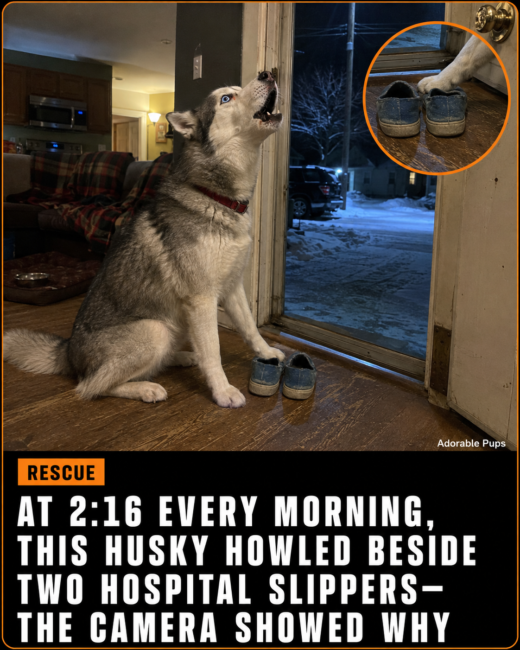
Walter wore brown work boots for yard repairs, white sneakers for medical appointments, rubber overshoes when snow covered the sidewalk, and blue hospital slippers after knee-replacement surgery.
Koda brought the correct pair whenever she recognized what came next.
If Walter picked up the snow shovel, she retrieved his overshoes. If I parked my school bus near the curb on Saturday, she brought his walking shoes because she knew we would take her to the river.
Nobody trained her.
Walter laughed and called it theft.
The blue slippers arrived after his knee surgery in 2021. Hospital staff gave them to him because the rubber soles gripped polished floors better than socks.
Walter wore them through six weeks of rehabilitation.
Koda watched him leave using a walker. Each afternoon, the medical van returned him wearing those same blue slippers. She met him at the door, sniffed both shoes, and walked backward until he reached his chair.
Blue slippers came to mean something narrow and dependable.
Walter left hurt.
Walter returned.
That was the first seed we missed.
Three years later, Walter’s heart began failing.
He hid the early signs. He stopped halfway through shoveling and pretended to inspect the mailbox. He carried laundry upstairs six pieces at a time. When I asked why he was breathing through his mouth, he blamed the cold.
Koda did not accept his explanations.
She began following him into the bathroom. She stood outside the shower. At night, she moved from the foot of the bed to the doorway, where she could watch both Walter and the hall.
Walter called her nosy.
She was collecting changes.
Part 3, The Night the Sequence Began
On February 6, the temperature in Spokane fell to nine degrees.
I finished my afternoon bus route at 5:28, stopped for groceries, and noticed Walter’s kitchen light burning when I carried the bags inside. Koda stood at his front window.
She did not wag.
Walter usually joined me for coffee on Thursday nights. At 7:10, he knocked on my door wearing a red flannel shirt, gray sweatpants, and the blue hospital slippers.
“Why are you dressed for surgery?” I asked.
“My feet are cold.”
Koda stood behind him with her nose pressed against his hip.
Walter drank half a cup. He complained that my coffee had become stronger since Christmas. At 7:36, he placed two fingers beneath his collarbone and held them there for four seconds.
I noticed.
He saw me notice.
“Pulled something carrying laundry.”
I asked whether he wanted me to drive him to urgent care.
“No.”
“Then call your cardiologist.”
“Tomorrow.”
Walter had used tomorrow to postpone his hearing test, furnace inspection, and twelve different conversations with Leah.
I let him leave.
That decision sat in my chest for months.
At 1:58 a.m., Koda struck my back door.
The first blow woke me. The second rattled the glass. On the third, she released a howl so close to the house that I felt it beneath my feet.
I opened the door.
Koda stood in the snow without a leash. Walter’s side gate hung open behind her.
She ran three steps toward his house, turned, and stared at me.
I grabbed my coat and followed.
Walter lay between the kitchen table and the refrigerator. One hand remained wrapped around the edge of a chair. His face had turned gray, and his breath came in small uneven pulls.
The blue slippers were still on his feet.
I called 911 at 2:04.
Koda stood beside Walter’s head while the dispatcher gave instructions. She did not lick him or paw his body. She kept looking between his chest and the front door.
Paramedics arrived at 2:09.
They cut open Walter’s flannel shirt, attached monitor leads, started oxygen, and prepared the stretcher. Koda backed into the hallway but refused to leave the room.
One paramedic asked me to secure her.
I took her collar.
When they lifted Walter, the left slipper fell beneath the kitchen bench. The right came off near the front threshold.
Koda pulled toward them.
A paramedic moved the right slipper aside with his boot so the stretcher could pass.
The front wheels crossed the porch at 2:14. Snow caught inside Walter’s open shirt. One of his hands hung over the stretcher rail until a paramedic tucked it beneath a blanket.
Koda howled.
Walter’s eyes opened once.
Then the ambulance doors closed.
At 2:16, the vehicle pulled away.
Red light crossed Walter’s living-room ceiling. The siren began at the end of the block.
Koda stood at the glass until the sound disappeared.
Then she returned to the slippers.
That was seed number two.
She found the left slipper first, carried it to the door, and placed it beside the right. I remember because the motion seemed pointless beside the torn medical packaging, dirty towels, and half-open front door.
I moved both slippers beneath the bench.
Koda pulled them out again.
“She wants his scent,” I told the paramedic who remained to collect equipment.
That answer was close.
It was not complete.
The emergency room called me at 4:38. Walter had suffered an acute aortic dissection, a tear inside the major artery carrying blood from his heart. Spokane surgeons stabilized him, but a specialist in Seattle needed to perform the repair.
A medical aircraft transferred him before sunrise.
I gave the hospital his insurance information and Leah’s old phone number. Nobody answered in Oregon.
Walter’s keys remained in my coat pocket.
Koda came home with me for breakfast. She ate, drank, and walked back to his house. When I tried closing her in my guest room that evening, she scratched once at the door.
I let her out.
She crossed the driveway and waited on Walter’s porch.
I opened his house.
Koda went straight to the blue slippers.
She did not howl that night. She slept beside the threshold and raised her head whenever tires passed over packed snow.
At 2:12 the next morning, she walked through the empty bedroom, kitchen, and bathroom.
At 2:16, she howled beside the slippers.
I did not see the sequence. I only heard the sound through my wall.
The second morning, she repeated it.
The third morning, Mr. Porter from two houses down called me. His wife had dementia and woke frightened by unfamiliar sounds.
“Can’t you bring the dog over there?” he asked.
“I’ve tried.”
“Then call somebody who knows what they’re doing.”
An animal behavior technician visited on day five. Koda accepted treats and allowed her pulse to be checked. She showed none of the pacing, drooling, destruction, or frantic door scratching associated with severe separation distress.
“She is waiting,” the technician said.
“For Walter?”
“For the next event.”
We did not know which event.
On day eight, I placed an indoor camera on Walter’s bookshelf. Koda watched me install it, sniffed the power cord, and went outside.
That night, the camera recorded her entire routine.
She woke before 2:16.
She checked Walter’s bed.
She carried the slippers.
She aligned them toward the driveway.
Then she looked at my house.
The howl was not the beginning.
It was step four.
Part 4, The Daughter Who Recognized the Slippers
Leah arrived on the twelfth morning in a gray rental car.
She was forty-three, close to my age, with Walter’s narrow shoulders and the same habit of pressing two fingers beneath her collarbone when worried. She carried his brown winter coat across both arms.
A social worker had located her through an old tax document. Leah drove from Eugene without stopping overnight.
Koda watched from behind the storm door.
Leah stepped onto the porch and said her name.
The dog did not bark.
She sniffed beneath the door, turned, and picked up one blue slipper.
Leah closed her eyes.
“Of course he kept those.”
I let her inside.
Koda approached carefully, nose working along the hem of Leah’s coat. The fabric carried Walter’s hospital scent because Leah had collected it from Spokane before following his transfer to Seattle.
Koda pushed her muzzle into the sleeve.
Then she backed away and looked toward the driveway.
Leah crouched beside the slippers.
“Did he put these on before he collapsed?”
“He was wearing them when I saw him that evening.”
“Then he knew.”
“Knew what?”
“That he might leave in an ambulance.”
Leah turned one slipper over. Black marker had faded across the rubber sole. I had seen the marks but assumed they were a room number.
Leah rubbed dirt away with her thumb.
The words became visible.
WALK ME HOME, DAD.
She had written them after Walter’s knee replacement three years earlier.
Walter hated physical therapy. On the third day, he refused to walk the hospital corridor. Leah bought a marker from the gift shop, wrote the sentence across both slipper soles, and placed them beside his bed.
“If you can read the whole thing,” she told him, “you’ve walked far enough for today.”
He walked.
Leah saved the slippers after his discharge. Each afternoon during rehabilitation, she placed them at the front door before the medical van brought him home.
Koda watched Walter return to them.
“Those slippers were always waiting when Dad came back from somewhere medical,” Leah said.
Koda placed her paw over the right one.
Leah’s hand stopped moving.
The camera footage gave us the next piece. We watched all eleven recordings on Walter’s laptop. The routine remained exact until morning nine, when Koda found one slipper beneath the bench and the other beside the radiator.
She carried both back.
On morning ten, I had moved them into a closet after mopping. Koda opened the folding door with her nose, retrieved them, and completed the sequence six minutes late.
She howled at 2:22.
That difference mattered.
Koda was not controlled by an internal alarm precise to the minute. She began the routine before 2:16, arranged the required objects, and howled after the scene matched her memory.
The clock was only one part.
Leah watched the footage twice.
“She’s rebuilding the night.”
I nodded.
“But why look at your house after she howls?”
“Because I came when she did it the first time.”
The room became quiet.
Koda had learned a chain of outcomes.
Walter wore the blue slippers.
Walter fell.
Koda howled at Maya’s door.
Maya came with a phone.
People arrived.
Walter left.
For years, hospital slippers had predicted Walter’s return. This time, they remained home without him. The sequence had stopped at the one point Koda had never experienced.
The slippers were waiting.
Walter was not coming through the door.
Leah sat on the floor beside Koda and pressed the two slippers against her knees.
“I haven’t walked him home in six years,” she said.
She did not explain the argument. She did not need to.
Koda lowered her head onto Leah’s wrist.
For several minutes, neither moved.
The hospital approved a video call that afternoon. Walter was awake but intubated, weak, and unable to speak. A nurse held a phone beside his bed.
Koda heard his breathing.
Her ears lifted.
Walter moved two fingers against the blanket.
Koda went to the front door, brought one slipper, and placed it beneath the phone.
She looked into the screen once.
Then she looked at the door.
The video call did not complete the sequence.
Walter’s face on glass was not Walter returning.
Part 5, The Rescue Koda Thought Was Unfinished
Walter survived eleven hours of surgery.
The repair saved his life, but complications kept him in Seattle for twenty-six days. His right hand remained weak. Fluid around his lungs made speaking difficult after doctors removed the breathing tube.
Leah stayed.
The hospital allowed her to sleep in a chair beside him. On the fourth night, Walter wrote three letters on a whiteboard.
K O D.
His hand slid before he finished the last one.
“She’s safe,” Leah said. “Maya has her.”
Walter shook his head.
Leah showed him the camera video.
Koda carried the slippers to the door. She placed them together. She howled at 2:16 and stared toward my house.
Walter watched the entire clip.
His fingers tightened around the marker.
On the board, he wrote one word.
HELP.
Leah assumed he was asking whether Koda needed help.
Walter drew a line through the word. Beneath it, he wrote:
SHE THINKS HELP DIDN’T WORK.
That became the twist none of us expected.
Koda was not howling because Walter had left at 2:16. She was repeating the action that had summoned me when he collapsed. From her perspective, howling had started a rescue sequence.
But a rescue had a familiar ending.
Walter returned.
During knee rehabilitation, hospital treatment always ended with Walter stepping through the door toward the waiting blue slippers. Koda had seen that outcome dozens of times.
After the heart emergency, he never came back.
Koda could not know Seattle was 278 miles away. She could not understand surgery, intensive care, or rehabilitation. She understood that she had performed the correct actions and the expected outcome had failed to happen.
So she tried again.
Each morning, she rebuilt the conditions.
The slippers signaled Walter’s injury and return.
The front door marked the place he disappeared.
My house held the human with the phone.
The howl brought help.
The minute connected every step.
Koda was troubleshooting.
If the first attempt did not bring Walter back, perhaps the slippers were misaligned. Perhaps she had howled from the wrong place. Perhaps the sound needed to happen at the exact minute the ambulance vanished.
She was not counting time.
She was repeating cause and effect.
Walter remembered another detail from the emergency. Before losing consciousness, he had seen Koda beside the bedroom dresser. He had told her, “Shoes.”
He wanted her to bring his walking shoes so he could reach my house.
Koda brought the blue hospital slippers instead.
They were the shoes connected to injury.
Walter had put them on because Koda selected them.
The dog understood something was wrong before he admitted it to me.
The slippers were not merely what he happened to be wearing.
They were Koda’s first response to his failing body.
That changed every frame.
At 7:10, when Walter visited my kitchen, Koda had already chosen the hospital slippers. She had followed him because his breathing and movement differed from ordinary evenings.
At 1:58, she came for me because Walter had fallen.
At 2:16, she watched the people with equipment take him away.
Each morning afterward, she returned to the first object in the chain.
The slippers.
Walter had spent years calling her shoe-carrying habit theft.
Koda had been studying what each pair made happen.
Part 6, Walking Him Home
Doctors transferred Walter back to Spokane on March 4.
He could sit in a wheelchair for forty minutes, stand with assistance, and speak four or five words before needing rest. The hospital expected another month of cardiac rehabilitation.
Leah asked whether Koda could visit.
The rehabilitation unit refused at first. Koda was not a registered therapy dog, and the hospital had strict infection-control rules.
Leah sent the medical director a three-minute section of the camera footage.
The exception came the following morning.
We bathed Koda at a self-service dog wash near Division Street. She objected to the dryer, shook water across Leah’s coat, and tried to steal a towel.
For ninety minutes, she looked like the dog Walter knew.
Then Leah picked up the blue slippers.
Koda became still.
We placed them inside a clear bag and drove to the hospital.
At 1:47 p.m., two nurses rolled Walter into a private rehabilitation room. He wore gray sweatpants, a blue cardigan, and nonslip hospital socks. A healing incision ran beneath the collar of his shirt.
Koda waited in the hallway with me.
She smelled him before the door opened.
Her nose lifted. Her front feet moved once against the vinyl floor. Then she stopped and looked at the bag in Leah’s hand.
Leah removed the slippers.
Koda took the right one gently.
The door opened.
Walter sat twelve feet away.
Koda walked into the room carrying the slipper. She did not run, jump, or howl. Her body remained low, and her tail moved in short uncertain sweeps.
Walter leaned forward.
“Koda.”
His voice sounded scraped thin.
The Husky stopped.
She placed the slipper on the floor between them.
Walter extended his weak right hand. Koda looked at it, then picked up the slipper and carried it the remaining distance.
She dropped it on his foot.
Everyone had expected a reunion built from noise. Instead, Koda stood beside the wheelchair and stared at Walter’s uncovered hospital socks.
Walter understood first.
“Other one,” he said.
Leah gave Koda the left slipper.
She placed it beside Walter’s other foot.
A nurse helped him remove the nonslip socks and slide his feet into the worn blue slippers. His heels no longer filled them. Weeks in intensive care had narrowed his legs.
Koda sniffed the left slipper.
Then the right.
She walked behind the wheelchair and stood facing the door.
Walter placed both hands on the armrests.
“I need up.”
The physical therapist shook her head. “Not without the walker.”
“Walker.”
They brought it.
Walter’s first attempt failed. His right knee folded before his hips cleared the chair. Koda turned but did not approach.
The second attempt lifted him two inches.
On the third, Walter stood.
His arms shook against the walker. The slippers remained on his feet.
Koda walked backward toward the door.
Walter followed.
One step.
Then another.
The room held six people, but nobody spoke. The therapist kept one hand at Walter’s gait belt. Leah walked beside his weak side.
Koda reached the threshold and stopped.
Walter crossed it.
The Husky released a breath through her nose. Her tail rose for the first time since we entered.
She did not howl.
She turned and pressed her forehead against Walter’s knee.
The reunion seemed complete, but the night brought one final test.
Hospital staff allowed Koda to stay in a family room until 3 a.m. Walter slept in an adjustable bed. Koda rested beside the blue slippers, which Leah had placed near the chair.
At 2:11, she stood.
Leah and I watched from the couch.
Koda picked up one slipper and carried it toward the door. She returned for the second.
At 2:15, she placed both at the threshold.
The old sequence had begun.
Walter slept.
The digital clock changed to 2:16.
Koda lifted her head.
Before she could howl, Walter moved beneath the blanket.
His hand reached toward the bedside rail and struck it twice.
“Koda.”
Her mouth closed.
Walter tapped the rail again.
“Here.”
Koda left the slippers and walked to his bed.
He lowered his fingers into the fur between her ears. The movement lasted three seconds before his arm grew tired.
Koda lay down.
For the first morning since the ambulance left, 2:16 passed without a howl.
Walter had given the sequence a new ending.
He had answered.
Recovery took another thirty-one days.
Koda visited every Wednesday and Saturday. She brought one slipper into the rehabilitation gym while Walter practiced walking. He followed her between two parallel bars, then along a hallway marked with strips of yellow tape.
Leah stayed in Spokane.
She and Walter did not repair six years of silence in one hospital room. They argued about medication, the stairs at his house, and the sewing machine he had refused to sell.
The machine, Walter finally explained, contained the unfinished quilt Ellen had been making for Leah’s daughter.
He had kept it because he could not bear to mail an unfinished piece.
Leah sat with that answer for a long time.
Then she took the machine home, finished the final border, and returned with the quilt folded over her arm.
Koda slept beneath it during Walter’s last week in rehabilitation.
On April 5, a medical van brought Walter back to the blue house.
Leah placed the hospital slippers on his feet before the door opened.
Koda waited beside me on the porch. She saw the van, checked the slippers through the open door, and looked at Walter.
The sequence matched.
Walter was hurt.
Walter wore the blue slippers.
The vehicle stopped.
The door opened.
Walter came home.
Koda descended the porch steps and walked beside his wheelchair to the threshold. Once inside, she picked up both slippers after Walter removed them and placed them beside his chair.
Then she slept for seven hours.
Part 7, One Minute After 2:16
Walter has been home for fourteen months.
He no longer uses the wheelchair. A four-wheeled walker remains in the hall for bad days, but most mornings he crosses the kitchen with a cane.
Leah moved to Spokane last fall. She rented a small apartment three blocks away and brings dinner every Tuesday. She and Walter still disagree about the amount of salt in soup.
They no longer use silence as a weapon.
Koda is nine now. Silver has spread across her face, making the line between gray fur and age harder to see. Her blue eye has clouded slightly. The amber one still follows every pair of shoes Walter touches.
She has not stopped carrying them.
When Walter reaches for the snow shovel, she brings his rubber overshoes. When Leah opens the car door, Koda finds his walking sneakers. On medical-appointment mornings, she still chooses the blue hospital slippers first.
Walter lets her.
He places them on his feet, walks once across the room, then changes into safer shoes. Koda watches the exchange and accepts it.
The slippers remain beside his bed at night.
Every morning at 2:15, a quiet alarm vibrates beneath Walter’s pillow. It makes no sound Koda can hear, but it wakes him before the old minute arrives.
At 2:16, he taps the wooden floor twice with his cane.
Then once more.
Koda opens one eye.
Walter says, “Here.”
She lowers her head.
Some mornings, he sleeps through the vibration. Koda wakes, checks his breathing, and touches one slipper with her nose. If Walter moves, she returns to her bed.
If he does not, she places her chin on the mattress until he opens his eyes.
The indoor camera remains on the bookshelf. I kept the recordings from those twenty-six mornings but have watched them only once since Walter returned.
The hardest frame is not the howl.
It is the moment afterward.
Koda sits behind the slippers and looks toward my house. Her body is still. Her mouth has closed. Everything about her posture says she expects the human with the key and phone to arrive.
She had followed the same steps that saved Walter.
She could not understand why the ending refused to appear.
Now, whenever my school bus passes Walter’s house at 6:42, I see two figures through the kitchen window. Walter sits at the table with coffee. Koda lies beneath it with one paw over his slipper.
On February 6, exactly one year after the ambulance left, Leah and I joined them before dawn.
Nobody planned a ceremony. Walter made toast. Leah complained that he had burned it. Snow rested along the porch rail.
At 2:15, Koda woke.
She looked at the slippers.
She looked at Walter.
The clock changed.
Walter tapped the floor three times.
Koda did not howl.
She carried one slipper across the kitchen and dropped it beside my chair.
I picked it up.
Walter smiled.
“She says you’re part of it.”
“Part of what?”
Walter looked down at the dog.
“The way home.”
Koda returned to his feet and closed her eyes.
The minute passed.
This time, nobody left.
Follow this page for more unforgettable dog stories about quiet loyalty, second chances, and the small rituals animals use to keep their people close.