Too Frightened to Face Visitors, the Hairless Shelter Dog Spent Every Day Staring at the Wall — Until One Volunteer Sat Beside Her Without Speaking
Part 2, The Routine Built Around One Hand
Eleanor returned the following morning at the same hour and sat in the same position. She wore soft-soled shoes, left her keys at the front desk, and brought the same paperback. The dog faced the wall, but her notched ear turned before Eleanor reached the kennel.
We began recording details rather than interpreting them. The dog’s breathing slowed after nine minutes instead of fifteen. Her white paw appeared after twelve. She looked at Eleanor’s hand twice, each glance lasting only a few seconds. No one called those movements affection. They were choices, and choices were enough.
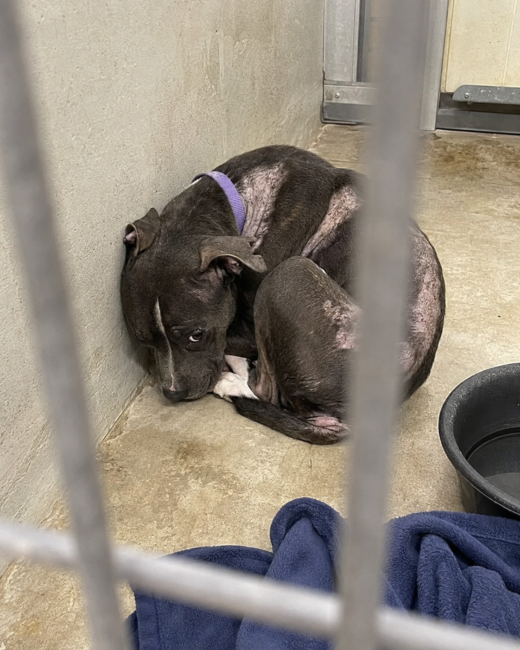
The shelter chart listed her temporary name as Lila, though she had not responded to it. Her feeding plan used small measured meals because she was underweight, and medication for skin discomfort had been mixed into food. She ate when alone, but the missing fur and thickened skin were not improving quickly enough to postpone a full veterinary examination.
The problem was access. Lila would not approach the front gate, and closing the guillotine divider behind her could trap her in the smaller indoor space with no retreat. A catch pole might secure her, but using one before exhausting slower options could connect every future approach with restraint.
We changed the environment first. Staff stopped placing bowls near the front of the kennel. Instead, we slid food along the wall until it rested halfway between the corner and Eleanor’s hand. A folded fleece mat went beside the bowl, not beneath Lila. The front half of the kennel remained open and predictable.
We also mapped the sounds that changed her posture. A leash clip made her head drop. Rolling laundry carts caused her rear legs to tremble. Quiet voices had little effect, but shoes stopping directly outside the bars made her press forward into the corner. Staff began passing without pausing unless they were assigned to her care, reducing the number of times she had to prepare for an approach that never came.
On the third day of Eleanor’s visits, Lila turned her head far enough to show her full muzzle. The white blaze looked thinner than it had from the intake photograph. Her mouth stayed closed, ears pinned, and body pressed to the floor. Eleanor moved no closer.
The next morning, Lila took one piece of food while Eleanor remained seated outside. She stretched her neck, lifted it quickly from the bowl, and retreated to the wall. Eleanor continued reading as if nothing had happened.
By the sixth visit, Lila rested her white paw on the edge of the fleece. She did not lie on it. She did not sniff the hand. Still, the distance between the paw and Eleanor’s fingertips had narrowed to eighteen inches.
That afternoon, the veterinarian joined us at the hallway entrance and watched without entering Lila’s direct view. She noted the symmetrical hair loss, scaling, low body condition, and careful way Lila avoided brushing her shoulders against the wall. Inflamed skin could make ordinary contact painful, she explained, which meant fear was not the only reason Lila resisted handling.
We planned an examination that would allow Lila to enter a transport crate voluntarily. The crate arrived without its door and remained at the far end of the run. For two days, she ignored it. On the third, Eleanor placed the paperback on the floor, extended her hand, and watched Lila take one slow step away from the wall.
Part 3, The Examination She Had Been Avoiding
The first step did not lead directly to the crate. Lila moved toward Eleanor’s hand, stopped at the fleece, and lowered her chin. Her nose remained ten inches from the fingertips. After several seconds, she pulled back—but she returned to the same spot before Eleanor left.
We used that distance to build a transport route. The fleece moved six inches closer to the open crate each day. Meals arrived on it. Eleanor’s hand stayed near the bars, never following Lila when she retreated. By the end of the week, Lila could cross half the kennel while Eleanor remained seated.
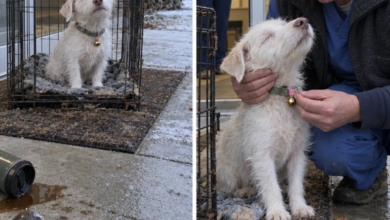
The medical complication became clearer as she moved. A thin line of fur beneath her lavender collar concealed another dry, scaly patch circling the lower neck. It was not an open wound, and the collar was loose, but the irritated skin beneath it made reaching for the buckle uncomfortable. We could not simply remove the collar through the bars.
On day eighteen, Lila entered the doorless crate for food and backed out immediately. On day nineteen, she remained long enough to finish half the meal. We attached the door only after she had repeated the behavior four times. The hinge made a faint metallic sound, and she returned to the wall for the rest of the afternoon.
The next morning, Eleanor began again without moving the crate. Lila’s recovery was not erased; she simply needed the predictable sequence restored. Ear turn. Visible eye. White paw on fleece. One step. Then another.
For two additional sessions, the crate door remained fastened open so it could not swing. Eleanor placed food just inside the threshold and withdrew her arm before Lila moved. On the third attempt, Lila entered with all four paws, turned carefully without brushing her sore shoulders against the sides, and stood facing outward. She stayed only seven seconds, but she had chosen the enclosure without being driven into it.
When Lila finally entered the crate and stayed, we closed the door slowly from outside the run. She froze but did not throw herself against it. The crate was covered on three sides and transported a short distance to the shelter clinic.
The veterinary team removed the crate top instead of pulling her through the front. After mild sedation and the least restraint necessary, they examined her skin, collected scrapings and coat samples, drew blood, and removed the faded collar. The hairless areas remained dry and intact, while the skin along her shoulders, flanks, tail base, and neck was thickened and mildly inflamed.
Testing supported generalized demodectic mange, a mite-related condition often associated with a weakened immune state. The veterinarian also found changes consistent with inadequate nutrition but no immediate organ crisis. Additional screening did not identify a clear endocrine cause, though follow-up would remain necessary if treatment failed.
Her weight confirmed what the kennel view had suggested. At forty-two pounds, she was approximately ten pounds below the veterinarian’s goal for her frame. The team avoided a sudden calorie increase and designed a measured feeding schedule that could support skin recovery without upsetting her digestion. Photographs documented the exact borders of the bald areas so future improvement would be compared against evidence rather than hope.
The plan included oral parasite medication, gentle medicated cleansing, measured high-quality meals, and repeated skin checks. Improvement would be assessed over weeks, not days. Because her skin was uncomfortable, handling sessions had to remain brief and predictable.
After the examination, Lila woke inside the rebuilt crate with clean fleece beneath her. Eleanor sat outside the recovery room, hand resting on the floor. Lila looked toward the nearest wall, then turned her head back toward that familiar hand before lowering her chin.
Part 4, The First Time She Chose the Hallway
Lila spent four days in the clinic’s quiet medical ward. Treatment reduced some of the itching, but the bald areas remained visible and her appetite changed with every unfamiliar sound. She ate if the room was empty and occasionally while Eleanor sat outside the gate. No one attempted to pet her.
The first medicated cleansing required planning. Warm water, even at a safe temperature, changed the sensation across skin that had been dry and irritated for months. Two technicians worked slowly while Lila stood on a rubber mat. Eleanor remained visible through the open doorway but did not enter. When Lila lowered her body, the water stopped. When her breathing slowed, it resumed.
Afterward, she returned to the wall of the recovery kennel and stayed there for nearly an hour. Eleanor sat on the floor with the paperback. Eventually Lila turned, crossed to the fleece, and lay down with her white paw facing the hallway.
Back in Kennel 18, we attached a light fabric lead before releasing her from the crate. It dragged loosely so staff would not need to reach for the tender skin beneath her neck. The lavender collar remained off; a soft temporary band marked her identification without contacting the irritated area.
The lead initially became another object to avoid. Lila stepped over it, then froze when it shifted beside her white paw. Eleanor placed a second strip of similar fabric on the floor outside the bars and moved it only when Lila looked away. Over several sessions, the sound and motion stopped predicting a hand descending toward her neck.
For the next week, Eleanor practiced no more than three minutes at a time. She lifted the lead, set it down, and placed food beside it. Lila learned that movement of the fabric did not always mean restraint. Her body stayed low, but she began facing the front bars during Eleanor’s visits.
The first attempt to leave the kennel stopped at the threshold. The hallway’s polished floor reflected overhead light, and carts rattled at the far end. Lila placed one paw outside, spread her toes, and backed into the enclosure. Eleanor turned away and sat beside the open gate.
On the second attempt, we laid a path of rubber-backed mats from the kennel to a small enclosed courtyard. Lila stepped onto the first mat, then the second. Her rear legs trembled. Her tail remained tucked, and her mouth stayed closed.
Halfway down the hallway, a metal bowl fell in the washroom. Lila spun toward Kennel 18, but Eleanor did not tighten the lead. She lowered herself to the nearest mat and placed her open hand on the floor.
Lila stopped retreating.
For almost a minute, she stood between the kennel and the courtyard, looking from the wall behind her to Eleanor’s fingers. Then she crossed the final mats and reached the open door.
Outside, she did not run or explore. She stood in a patch of pale March sunlight and lifted her nose. The hairless skin along her shoulders remained visible, her ribs still showed, and every muscle looked prepared to retreat. Yet when Eleanor sat on the courtyard bench, Lila walked three steps toward her and lay down facing the open space instead of the nearest wall.
The courtyard offered choices the kennel could not. Lila could stand behind the bench, return through the open door, or remain on the mat in the sun. Eleanor blocked none of those routes. When a bird landed on the fence, Lila’s ears rose together for the first time. She followed it with her eyes until it disappeared, then looked toward Eleanor’s hand resting beside the bench.
On the return trip, Lila stopped at Kennel 18 but did not enter immediately. She smelled the hallway mat, looked back toward the courtyard, and then walked inside. Choosing the familiar space was different from being forced into it, and we left the gate open until she settled on the fleece.
It was not a complete change. At the next sound from the hallway, Lila rose and returned inside. But she had learned the route, and the following day she chose it again.
Part 5, The Night She Slept Facing the Door
Treatment settled into a routine. Lila received oral parasite medication on schedule, small measured meals three times daily, and gentle skin cleansing according to the veterinarian’s plan. Staff photographed the same areas weekly under ordinary clinic light so progress could be judged without relying on memory.
During the second week, the scaling softened along her shoulders. The gray-pink skin remained visible, but she scratched less often. Her weight increased by two pounds, and the hollow line behind her ribs began to fill. The thin patch around her neck stayed sensitive, so the clinic continued using a harness that avoided direct pressure on it.
Meals were adjusted according to weekly weight checks rather than appetite alone. Lila had begun finishing food quickly, but rapid gain would not repair her coat faster. The veterinarian wanted steady nutrition, consistent parasite treatment, and enough time to detect any underlying illness that might be preventing recovery.
The skin photographs told a cautious story. Some bald borders had stopped expanding, while others looked unchanged. New growth had not yet appeared. Staff continued recording the location, texture, and color of each area, especially the left shoulder and tail base where scaling had been most pronounced.
Trust appeared in small, repeatable details. Lila ate while Eleanor sat four feet away. She approached the front bars when she heard the paperback placed on the floor. She sniffed the open hand once, withdrew, and returned thirty seconds later. Eleanor never closed her fingers around the muzzle or tried to turn the moment into a petting session.
The shelter closed at seven each evening. Before leaving, the overnight technician usually found Lila facing the side wall with her chin near the corner. On the twenty-eighth night, the camera showed her circling the fleece twice and lying down with her body parallel to the gate.
She slept facing the door.
When morning staff entered, she raised her head rather than pressing it into the wall. The movement lasted only until a cleaning cart rattled nearby, but she returned to the fleece after the sound passed.
The next stage was a quieter foster room inside the shelter. It resembled a small living room, with a washable rug, open crate, chair, and covered window. Moving Lila too early could replace one familiar corner with another, so Eleanor spent several sessions in the room before Lila entered.
We placed the chair away from every wall, leaving broad paths around it. The first time Lila entered, she circled the room’s perimeter and stopped in the farthest corner. Eleanor sat near the center rather than following. After twenty minutes, Lila moved from the wall to the rug, lay down, and kept the doorway in view.
That room also allowed staff to observe her when no bars separated her from ordinary household objects. She avoided a broom leaning beside the cabinet but showed interest in a folded blanket. A ceramic bowl made no difference to her; a metal bowl scraping the floor made her retreat. Each response helped shape the home environment she would eventually need.
On the first visit, Lila stayed beside the door. On the second, she crossed to the rug and placed her white paw near Eleanor’s shoe. On the third, she lowered herself beside the chair with eighteen inches between them.
Eleanor’s hand rested palm down on the rug. Lila stretched her muzzle forward and smelled the knuckles. Her ears stayed slightly back. Then she placed her chin beside the hand without making contact.
The quiet lasted nearly five minutes.
When Eleanor shifted her leg, Lila moved away but did not return to the wall. She entered the open crate, turned once, and faced outward. That choice told us she was beginning to use shelter rather than surrendering to a corner.
Her skin still required treatment, and the outcome remained uncertain. Adult generalized demodicosis can recur or reveal an underlying health problem, so the veterinarian scheduled repeat testing. Lila looked better, moved more freely, and trusted one person, but none of those changes guaranteed that the mites had cleared.
Part 6, The Test That Delayed Her Foster Home
At week five, soft charcoal fuzz appeared along the edges of Lila’s bald shoulders. New hair covered parts of her flanks, and her weight reached forty-seven pounds. Eleanor had completed foster training and prepared a quiet spare room at home. Everyone expected the next skin test to confirm that Lila could leave the medical program.
It did not.
The repeat scraping still showed active mites in two areas near the tail base and left shoulder. The skin looked calmer, but the condition had not fully resolved. The veterinarian extended medication and postponed the move, explaining that visible improvement could arrive before complete control.
The medication schedule itself did not change dramatically, but the delay meant more monitored cleansing and another month of restricted contact with unfamiliar dogs. Eleanor had already rearranged her home and work calendar. She accepted the postponement without bringing those expectations into Lila’s room.
The delay affected Lila’s routine. The additional examination and cleansing brought more handling than she had tolerated in several days. Back in the foster room, she turned toward the wall, refused dinner, and remained there through the afternoon.
Eleanor did not move the chair closer. She sat in the usual place and opened the paperback to the page she had marked weeks earlier. No food was pushed toward Lila, and no hand followed her into the corner.
After forty minutes, Lila’s notched ear turned.
The gesture looked almost identical to the first one in Kennel 18. This time, however, she did not remain facing the wall for eleven days. She turned before Eleanor finished the chapter, crossed the rug, and placed her white paw beside the open hand.
Treatment continued for another four weeks. Hair filled the shoulders unevenly, and the tail base remained thin. Lila gained three more pounds. Repeat testing finally showed no active mites, though monitoring and preventive care would continue.
During those weeks, Lila began offering a new signal before each cleansing session. She walked into the medical room, smelled the rubber mat, and placed her white paw on its edge. If her breathing stayed even, the team continued. If she turned away, they paused. The process took longer, but she no longer needed sedation for routine skin checks.
The day the repeat test came back clear, Eleanor did not celebrate inside the room. She completed the familiar routine, sat with her hand on the rug, and waited. Lila approached, smelled the fingers, and lowered her body beside the chair without searching for a corner.
Eleanor brought her home at the beginning of June. The spare room had an open crate, low bed, rubber bowls, and no furniture crowding the walls. For the first two days, Lila rested in the crate and watched the doorway. Eleanor sat in the hall rather than entering.
On the third morning, Lila followed her to the kitchen. She stopped when a cabinet door closed, looked toward the nearest corner, and chose the rug beneath the table instead. Eleanor prepared breakfast without reaching down.
Their first neighborhood walks lasted less than five minutes. Lila startled at metal gates and delivery carts, but the harness stayed loose and the route remained short. She returned home tired, checked the spare room, and then lay where she could see both Eleanor and the front door.
By the end of the second month, Lila accepted a brief stroke along the fully furred side of her neck. Eleanor stopped after one pass. Lila leaned forward—not into the wall, but toward the hand that had always allowed her to leave.
Part 7, The Corner Beside the Window
Eleanor adopted Lila after four months of fostering. The paperwork changed ownership, but their routine remained ordinary: breakfast on the kitchen mat, a short morning walk, medication checks, and quiet reading in the afternoon.
Lila weighed fifty-one pounds, close to the veterinarian’s target. Her charcoal coat had returned across most of her shoulders and flanks, though a thinner patch remained near the tail base. The skin beneath it stayed healthy, and follow-up examinations found no recurrence.
Visitors were introduced slowly. Eleanor asked them to sit sideways, keep their hands low, and allow Lila to decide the distance. Some days she remained in the spare room. Other days she watched from the hallway and approached after the conversation softened.
Her first voluntary greeting happened with Eleanor’s older sister, who sat near the window and spoke without looking directly at her. Lila watched for twelve minutes, crossed the rug, and smelled the hem of her coat. She withdrew before the woman moved, then returned and lay where she could see both sisters.
There were limits that remained part of daily life. Lila disliked hands reaching over her head, busy doorways, and sudden metal sounds. Eleanor did not test those limits for proof of recovery. The goal was not to make Lila tolerate every situation; it was to give her safe ways to leave and confidence that no one would follow her into retreat.
I visited during early winter, nearly nine months after she had arrived at the shelter. Lila met me beside the living-room window. Her white paw rested on the rug, and the small notch in her left ear remained visible when she turned toward my footsteps.
She did not rush forward. She studied my coat, smelled the air, and looked toward Eleanor. Then she approached in a shallow curve and stopped beside my chair.
I lowered my hand, palm down.
Lila smelled my knuckles and stepped away. A minute later, she returned and lay beside the window with her back near the wall. The difference was easy to miss. She was not pressing her face into the corner or hiding her eyes. She had chosen a place where afternoon light crossed the floor and where she could see every person in the room.
When a delivery cart rattled outside, her ears moved back. Eleanor left her hand open on the rug. Lila looked at it, then rested her white paw beside the fingers.
The wall had not disappeared. It simply no longer held all of her attention. Beyond it were a window, a quiet room, and a person willing to wait until Lila turned around on her own.
Follow our page for more true-to-life dog rescue stories, careful recovery updates, and quiet moments when frightened shelter dogs finally choose trust again.