Part 2: Everyone Keeps Telling Me to Sell the Four-Bedroom House Now That I Live Alone. They Don’t Understand Why I Won’t — Until They See Who Sleeps in the Other Three Rooms.
PART 2
I have to back up and tell you how the first one came, because none of this was a plan. I want to be clear about that. I did not decide, in some burst of grief, to become the dog lady on the edge of town. It happened to me one at a time, and each one has a name and a reason, and I can tell you all four.
The first one was Ray’s fault, in a way, even though Ray was already gone.
About eight months after he died, I was at my worst. I wasn’t eating right, wasn’t sleeping, wasn’t leaving the house except to teach — I taught third grade for thirty-four years, just retired last spring — and on the weekends I’d sit in that loud quiet house and not move. My sister kept saying I needed a project, a purpose, a reason to get up. I’d nod and not do anything about it.
And then one Saturday I saw a post from the county shelter. They did these desperate posts sometimes, the ones where a dog has run out of time. And there was a photo of a Pit Bull — gray, scarred up, one ear chewed half off, an old boy, eight or nine the shelter guessed, picked up as a stray, and nobody had so much as looked at him in the weeks he’d been there, and his time was up that Monday.
The post said his temperament test came back “gentle, submissive, good with everyone.”
And I don’t know what it was. I think it was the eyes in the photo. There was a particular kind of tired in them that I recognized, because I’d been seeing it in my own mirror for eight months — the tired of a creature who has stopped expecting anything good and is just waiting, politely, for the end.
I drove down there Sunday telling myself I was just looking.
I named him Ray.
I know. I know how that sounds. I named the scarred old Pit Bull after my dead husband, and my sister cried when I told her, and I have never once regretted it. Because here is the thing — Ray, my husband, had been a big, scarred-up, gentle man, a man people sometimes crossed the street from because of his size and his face, who was the softest soul I ever knew. And this dog was the same. Big, scarred, gentle, misjudged on sight. It wasn’t morbid. It was right. It was like a piece of him had found its way back to me wearing fur.
I put Ray-the-dog in one of the empty bedrooms the first night, on a bed in the corner, because he was nervous and the room felt safe and small to him, and I left the door open, and in the morning I found him asleep in there, in his own room, in our house.
And one of the held-breath rooms exhaled.
PART 3
I’d tell you I meant to stop at one. I did mean to stop at one. But let me tell you how the other three came, because I want you to understand it wasn’t accumulation. It wasn’t hoarding. Each one was a specific dog with a specific need at a specific moment, and each one filled a specific room, and I can walk you through it.
The second one came about six months after Ray-the-dog. The shelter knew me by then — once you adopt the eight-year-old scarred Pit Bull nobody wanted, the shelter remembers your face — and a woman named Patrice who worked intake called me directly. Not a post. A phone call. She said, “Diane, I’ve got one I can’t place and I think she’s your kind of dog.”
She was a young Pit Bull, two or three, who’d come out of a bad situation — I won’t detail it, it’s the kind of thing that makes you ashamed of people. She was terrified of men, terrified of raised hands, terrified of brooms and belts and a dozen other things that told you exactly what her life had been. She flinched at everything. She’d been at the shelter four months and every time someone came to look at her she’d press herself into the back corner of the kennel and shake, and you cannot adopt out a dog who shakes in the corner, no matter how sweet she is once she trusts you, and she was running out of time the way they do.
I named her Junie.
Junie got the second bedroom. She needed her own space more than any of them — she needed a door that closed, a place that was hers, where nothing could come at her, and for the first month she mostly lived in that room and I’d sit on the floor just inside the doorway and read out loud and not look at her directly, the way you earn a frightened thing’s trust, by being boring and safe and present until being near you stops being a threat. It took weeks. And then one night she crept across the room and put her head on my leg, and that was Junie’s room from then on, the safe room, the one she still goes to when there’s thunder.
The third came the next year. An owner surrender — an old man who was going into memory care and whose family didn’t want his dog, a big goofy brindle boy, four years old, perfectly nice, perfectly adoptable, except that he was a Pit Bull in a county where a lot of rentals won’t take them and a lot of families have absorbed a lifetime of being told the breed is dangerous, and so a perfectly nice dog sat and sat. His name was already Tank and I kept it because he answered to it and because changing a dog’s name when his whole world has already changed once seemed cruel.
Tank got the third bedroom. He’s the easy one, the joyful one, the one who makes the other three braver just by being so uncomplicatedly happy.
And the fourth.
The fourth is the one that closed the circle, and I have to tell it carefully.
PART 4
The fourth dog came two years ago, and by then I had three dogs in three bedrooms and I slept in the fourth, the master, the one Ray and I had shared, and the house was full and warm and loud in a good way now, and I had absolutely no intention of getting a fourth dog.
But the master bedroom had a problem.
I couldn’t sleep in it right. Two years a widow and I still slept on my side of the bed, the right side, and Ray’s side stayed empty and cold and I’d wake in the night and reach for it out of thirty-one years of habit and find nothing, and that reaching was the one wound that would not close no matter how full the rest of the house got. The dogs each had their rooms. I had mine. And mine still had a Ray-shaped hole in it that no rescue dog was going to fill, because that grief was a marriage-grief and the dogs were a different medicine.
Then Patrice called again.
She said, “Diane, I know you’ve got a full house. I’m not even supposed to be calling you. But I’ve got one, and I can’t stop thinking that he’s yours.”
He was a senior. Eleven, maybe twelve. A Pit Bull who’d belonged to an elderly woman who’d died, with no family to take him, and he was, Patrice said, “the saddest dog I’ve ever processed.” Not sick. Not aggressive. Just broken-hearted in the specific way of an old animal who has lost the one person who was his whole life and does not understand where she went and is too old to start over and knows it. He wouldn’t eat. He’d lie with his back to the kennel door. He was, she said, grieving himself to death, and a dog like that has no shot at adoption because who walks into a shelter and chooses the old dog lying with his back to you, refusing to be reached.
“He just wants the person he lost,” Patrice said. “And I can’t give him that. But maybe.”
I went down there. He was exactly as she said. An old gray-faced Pit Bull lying with his back to the world, having decided the world had nothing left for him.
I sat down on the floor of that kennel, an old woman myself, and I said to the back of an old dog, “Yeah. I know. I lost mine too.”
And he turned his head and looked at me.
I named him Saturday. Because Ray died on a Saturday, and because I needed to take the worst day of my week back, and because every day with that old dog has made Saturdays bearable again.
And here’s what I did, that I had not planned to do.
I gave Saturday the master bedroom.
My room. Ray’s side of the bed.
PART 5
Let me tell you what that meant, because it’s the twist of the whole thing, and I didn’t fully understand it myself until I’d done it.
People hear “four rescue dogs, one in each bedroom” and they picture a sad woman who’s turned her house into a kennel because she has nothing else. That’s the story my well-meaning friends tell themselves when they tell me to sell. Poor Diane, alone, filling the empty rooms with dogs because she can’t fill them with what she really wanted. Pity dressed up as concern.
They have it exactly backwards.
When I moved Saturday into the master bedroom, I did the thing I’d been unable to do for two years. That old dog took Ray’s side of the bed — literally, he sleeps on the left side, Ray’s side, on top of the covers — and the first night he did it, I reached out in the dark out of thirty-one years of habit, expecting the cold empty nothing that had been waking me up for two years.
And my hand landed on a warm living body.
I cried. Of course I cried. But it was the good kind, the kind that lets something out instead of grinding something in. Because the reaching had finally found something. Not Ray — I want to be clear, the dog is not a replacement for my husband and I would never insult either of them by pretending so. But the reaching, the involuntary nighttime reach of a body that spent half its life next to another body — that reach finally had somewhere to land. The wound that would not close had something warm pressed against it at last.
Now do you see it?
The four bedrooms are not four empty rooms I’m pathetically filling. They are four rescues, each one a dog that nobody else would take, each one with a specific need that this specific house — big, quiet, full of rooms — was uniquely built to meet.
Ray-the-dog needed a small safe space to feel secure: a room.
Junie needed a door that closed, a place nothing could come at her: a room.
Tank needed somewhere to be his uncomplicated joyful self: a room.
Saturday needed the one place in the world I could give him that was the warmest, most loved, most lived-in spot in the whole house — and that I needed him in, just as badly: my room.
A four-bedroom house is too big for one woman.
It is exactly the right size for one woman and four dogs who had nowhere to go.
I didn’t fail to downsize my life. I right-sized it. The house was always exactly this big. It just took me thirty-one years and one terrible Saturday to find the four souls who were the right shape to fill it.
PART 6
Let me lay it out plainly, because I’ve had to explain it to a lot of people who arrive certain I’ve lost my mind, and there’s a logic to it that lands once you stop seeing it through the lens of pity.
Every argument my friends make for selling is an argument that assumes a house is for resale value, for equity, for sensible downsizing, for the comfort and convenience of a single aging body. And by that math, yes, I’m a fool. I’m a sixty-two-year-old woman paying to heat and cool and maintain four bedrooms when I have one body to sleep.
But a house isn’t only for the body that owns it.
I spent twenty-seven years in this house grieving rooms that stayed empty because the children we wanted never came. Twenty-seven years of walking past three doors that were supposed to have life behind them and didn’t. That was the real emptiness — not square footage, but rooms built for a kind of love that had nowhere to go.
And then Ray died, and I nearly sold the whole thing, and I’m so glad I didn’t, because what I figured out, one rescue at a time, is that those rooms were never the problem. The problem was that I’d been told my whole life that there was only one right thing to put in a bedroom — a child, a family of the standard shape — and when that didn’t come, I’d called the rooms empty.
They were never empty. They were waiting.
Each of those four rooms is now full of a love that the standard math doesn’t count, because it has four legs and came from a shelter and is, in the eyes of the world, “just a dog,” and a breed people are afraid of at that. Ray the gentle scarred old man. Junie who learned that hands could be kind. Tank who is pure uncomplicated joy. Saturday who took the cold side of my bed and made it warm.
Four lives that would not exist now if I’d sold this house. Four dogs that every reasonable, sensible voice would have left to run out of time in a shelter, because they were old, or scared, or the wrong breed, or grieving — the exact dogs nobody picks. They’re alive, and warm, and home, and they each have a room, a thing most rescue dogs never dream of, because a widow refused to be sensible and downsize her grief into a tidy condo.
The friends who tell me to sell are counting one body in a four-bedroom house.
I count five hearts in a house with exactly enough rooms.
We’re not the ones doing the math wrong.
PART 7
I want to tell you what the house is actually like now, because I think people picture chaos, or sadness, or the grim determination of a woman white-knuckling through her widowhood with a pack of dogs.
It’s not any of that. It’s the happiest house I’ve ever lived in, and I include the years with Ray in that, and Ray would forgive me for saying so because Ray loved dogs more than he loved most people.
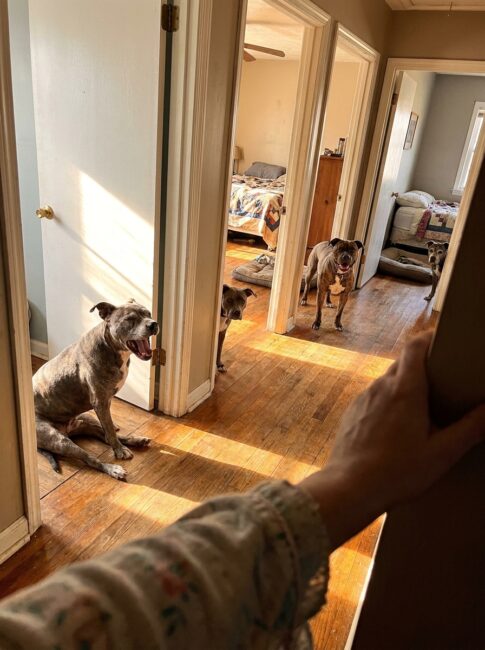
The mornings are a parade. Four Pit Bulls, three of them seniors now, coming out of their four rooms when I open the doors, the great slow stretch-and-yawn of it, the procession to the back door, the half-acre Ray died mowing now fenced and full of dogs in the morning light. Junie still checks the corners of every room before she relaxes — she always will — but she does it now with her tail going. Tank greets every single day like he’s never seen one before. Old Ray ambles. Saturday stays close to me, always, my shadow, the way you do when you’ve lost your person once and have decided not to let the next one out of your sight.
I cook now. I’d stopped, after Ray. You don’t cook for one. But you cook for five — well, I cook for one and supplement four bowls, but the kitchen is warm and busy again and it smells like something most nights.
I sleep. That was the thing I couldn’t do for two years, and now I sleep, because there’s a warm weight on the left side of the bed and when I reach out in the dark my hand lands on Saturday’s broad old back, and he sighs, and I sigh, and we both go back down.
My friends still bring it up sometimes, the selling. But they bring it up less, because most of them have been here now, have sat in my full warm loud house and watched four misjudged dogs live out good final chapters in rooms of their own, and even the most sensible of them has gone a little quiet and stopped pushing.
My sister, who cried when I named the first one Ray, said to me last Christmas, looking down the hall at the four open doors, “I was wrong. I kept telling you this house was too big.” She wiped her eyes. “It’s not too big, is it.”
“No,” I said. “It’s just right.”
PART 8
People ask what happens to the house when I’m gone, or too old. Worried, kind, sensible people.
I’ve made arrangements. The house goes to the rescue organization that Patrice works with, to be exactly what it already is — a place where the dogs nobody picks get a room of their own and a soft place to land.
Four bedrooms.
Four dogs who had nowhere to go.
One woman who was told her life was too empty.
They were counting wrong.
This house was never too big.
It was waiting to be exactly this full.
Follow this page for more stories about the dogs nobody picks — and the rooms that were waiting for them. And if Diane and her four reached you, leave the word “Saturday” in a comment and I’ll make sure you see the rest of this story and the ones that come after.