They Thought He Was the Danger — Until They Found What Was Crying Inside the Bag
People usually crossed the street to avoid Jax Mercer.
They would see him from half a block away—bright blue spiked hair cutting through the gray afternoon, chains clinking against ripped black denim, combat boots slamming against cracked sidewalks—and instinctively move to the other side. Mothers tightened their grip on strollers. Elderly couples lowered their eyes. Store owners watched him through dusty windows as if preparing to dial the police.
Jax was seventeen, tall, sharp-jawed, with tattoos creeping up one arm like inked vines. He had perfected the art of looking untouchable. Detached. Dangerous.
He didn’t blame them.
In a city where boarded-up storefronts outnumbered thriving businesses, where sirens replaced lullabies at night, appearances were everything. And Jax looked like trouble.
But today, in a condemned building on the east side known as the Old Mill, that “trouble” would become the only thing standing between life and death.
By nightfall, the same people who crossed the street to avoid him would be whispering his name for a different reason.
Because today, the boy everyone feared was the only reason a newborn baby was still breathing.
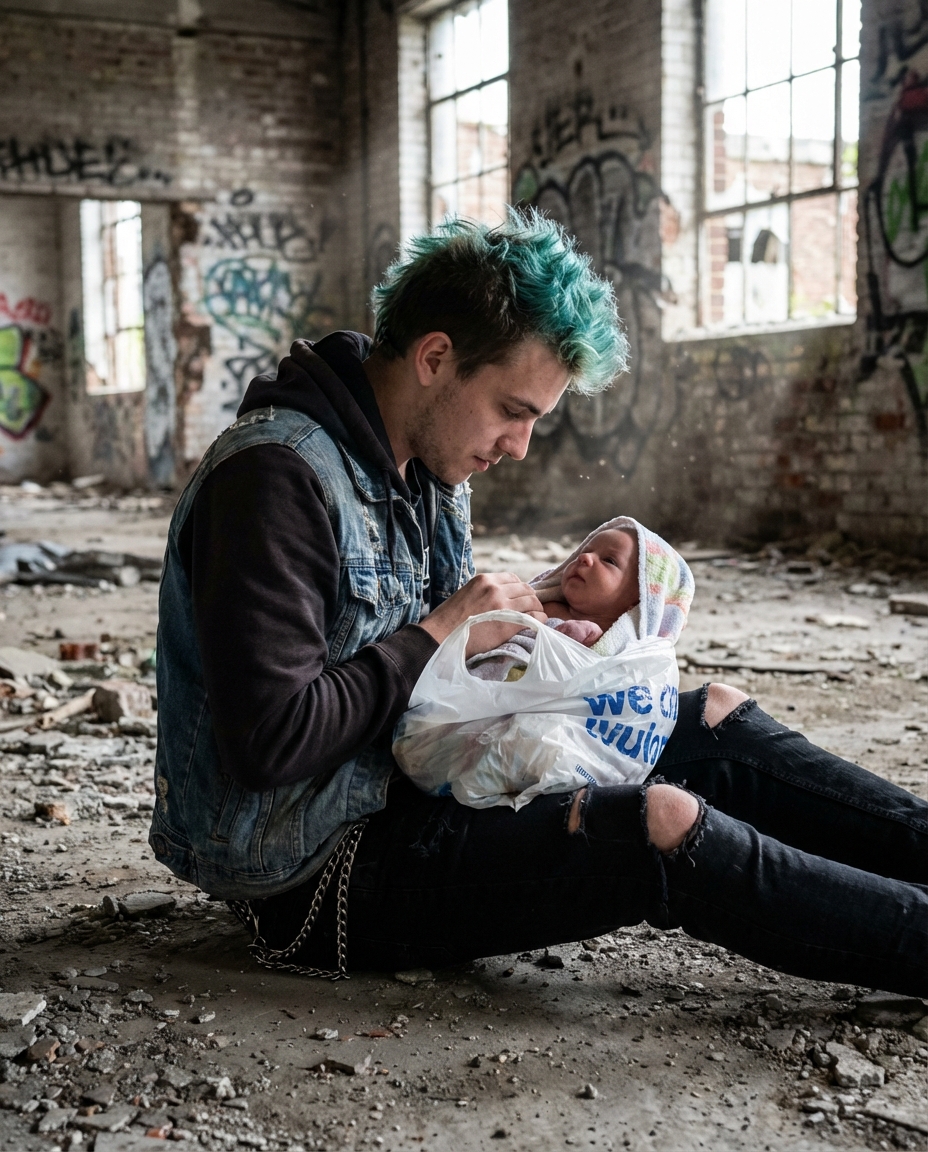
The Old Mill had been abandoned for nearly a decade.
Its windows were shattered, its walls spray-painted with layers of graffiti, the floors buried beneath broken glass, crushed beer cans, and the skeletal remains of forgotten machinery. The place carried a reputation—squatters, drug activity, fights that ended in blood.
It was exactly the kind of place people assumed Jax belonged.
But he wasn’t there to cause trouble.
He carried a camera.
Jax had fallen in love with filmmaking two years ago when a substitute teacher screened an indie documentary about urban decay. Since then, he and two friends had spent weekends exploring forgotten corners of the city, documenting the quiet collapse of neighborhoods no one in city hall wanted to acknowledge.
“There’s beauty in broken things,” he used to say.
His friends teased him about it, but they followed him anyway.
That afternoon, pale winter light filtered weakly through the cracked ceiling panels. Dust floated in the air like ghostly snow. Jax adjusted the lens on his camera, focusing on a rusted staircase twisting upward into shadow.
“Last shot,” his friend Mateo called out. “This place gives me the creeps.”
Jax nodded. He felt it too—the heavy silence that pressed against your ears.
They were turning toward the exit when he heard it.
A faint, rhythmic sound.
Not loud. Not dramatic.
Just… fragile.
At first, he thought it was the wind squeezing through broken glass. Then he paused.
There it was again.
A whimper.
Mateo rolled his eyes. “Probably a stray cat. Let’s go.”
They’d found kittens before in places like this. Abandoned. Starving. It wasn’t unusual.
But something about this sound felt different. It wasn’t sharp. It wasn’t feral.
It trembled.
Jax lowered his camera.
“Hold on.”
He followed the sound across the debris-strewn floor toward a collapsed corner where trash had collected in a damp heap. The smell hit him first—rot and mildew and something metallic underneath.
The whimper came again.
Soft.
Weak.
His chest tightened.
There, half-hidden beneath a torn blanket and fast-food wrappers, was a white plastic bag with blue letters across it.
Walmart.
It shifted slightly.
Mateo laughed nervously. “Dude, don’t. That’s how horror movies start.”
Jax knelt anyway.
For a split second, he hesitated. His heart hammered in his ears. Every assumption—every stereotype about places like this—flashed through his mind.
He expected claws.
Or teeth.
Or nothing at all.
Instead, he saw a tiny hand move inside the plastic.
And the world stopped.
It wasn’t a kitten.
It was a newborn baby boy.
The umbilical cord was still attached.
His skin was pale—almost blue. His lips trembled with weak, exhausted cries. He was wrapped loosely in a thin towel already damp from the cold concrete beneath him.
For a second, none of them moved.
Mateo dropped the camera.
“What—what is that?” he whispered, though the answer was obvious.
Jax’s stomach flipped. Panic clawed at his throat, but something stronger pushed through it.
Instinct.
He carefully lifted the baby from the plastic bag. The infant felt impossibly light. Fragile. Like he might break under the wrong touch.
“Call 911,” Jax barked, sharper than anyone had ever heard him speak.
Mateo fumbled with his phone, hands shaking.
The baby’s cry weakened.
Jax dropped to the ground without thinking, ignoring the glass biting into his jeans. He pulled off his denim jacket and wrapped it around the tiny body, pressing the baby against his chest.
He could feel how cold the child was.
Freezing.
“Hey, hey, stay with me,” Jax murmured, his voice cracking.
He rubbed the baby’s back gently, trying to generate warmth. He’d seen something once online about skin-to-skin contact helping newborns regulate temperature.
His chains clinked softly as he shifted, shielding the baby from the draft blowing through shattered windows.
Sirens still hadn’t come.
The cries were fading.
Mateo stared at him in disbelief. “Jax… he’s turning blue.”
“I know.”
But Jax didn’t move.
He pressed the infant closer, ignoring the grime, the smell, the fear crawling up his spine.
He didn’t look dangerous anymore.
He looked terrified.
And determined.
He didn’t care what anyone would think if they walked in right now—a punk kid sitting in filth, cradling a stranger’s child like it was his own.
The only thing that mattered was the faint, fragile rise and fall beneath his hand.
“Come on,” he whispered. “You’re not dying here.”
Outside, in a city that had learned to ignore boys like him, no one yet knew that in the ruins of the Old Mill, the most unlikely guardian had just found something worth protecting.
And this was only the beginning.
The sirens felt like they were taking forever.
Jax stayed on the concrete floor, cradling the baby inside his jacket, rocking slightly back and forth. He could feel the faintest flutter against his chest — too weak, too slow.
“Stay with me,” he whispered again.
Mateo paced near the doorway, giving frantic directions to the 911 operator.
The baby’s cries had stopped.
That terrified him more than anything.
Silence.
The kind of silence that makes your mind go somewhere dark.
Jax pressed his cheek against the infant’s head. Cold. Too cold.
He pulled his hoodie off and wrapped it tighter around the baby, ignoring the sting of winter air on his bare arms.
Then he heard it — not sirens.
Voices.
From deeper inside the building.
Low. Slurred. Angry.
Mateo froze.
“We need to go,” he hissed.
Two figures emerged from the shadows near the far hallway — men who clearly hadn’t expected company. One of them squinted toward Jax.
“What the hell are you doing in here?” the man barked.
Jax didn’t stand.
“I found a baby,” he said flatly.
The men laughed.
“Sure you did.”
One of them stepped closer, eyes darting to the bundle in Jax’s arms.
For a split second, Jax realized something horrifying.
What if they thought he brought the baby?
What if they assumed he was the one who left it here?
A punk kid. In an abandoned mill. Holding a newborn in a plastic bag.
The picture didn’t look good.
The man’s expression shifted from amusement to suspicion.
“You sick little—”
Before he could finish, sirens finally pierced the air outside.
Red and blue lights flashed through broken windows.
The men cursed and disappeared back into the building.
Jax didn’t move.
He stayed seated, arms locked around the child.
When paramedics burst through the door, they paused.
A blue-haired teenager, sitting in debris, shirtless, bleeding from a cut on his forearm, clutching a newborn.
For half a second, confusion crossed their faces.
Then training kicked in.
They rushed forward.
“How long has he been exposed?”
“About twenty minutes,” Jax replied.
“Did you move him?”
“I used body heat.”
The paramedic nodded sharply.
“Good.”
They checked the baby’s pulse.
One EMT looked up at Jax.
“If you hadn’t warmed him up when you did, hypothermia would’ve shut him down within the hour.”
Mateo exhaled shakily.
But the relief didn’t last long.
Because just as they began loading the baby onto a stretcher, two police officers stepped inside.
And their eyes went straight to Jax.
“Hands where we can see them.”
The words were automatic. Cold.
Jax slowly raised his hands.
One officer glanced at the Walmart bag. The cord. The blood.
“You want to tell us what’s going on?”
Mateo jumped in. “He found the baby! We were filming!”
The officer’s eyes narrowed at Jax’s appearance.
“You expecting us to believe that?”
Jax felt something sink inside him.
This wasn’t new.
Two years ago, he’d been arrested for breaking into an abandoned warehouse. Trespassing. Vandalism. A stupid mistake that stuck to his name like glue.
The charge had been minor, but it was enough.
Enough to label him.
Enough to make moments like this dangerous.
He swallowed.
“I heard him crying,” Jax said quietly. “That’s it.”
The officers exchanged looks.
One of the paramedics stepped forward.
“If this kid hadn’t been here, the baby would be dead.”
Silence.
The officer studied Jax again.
Not the hair.
Not the chains.
The shaking hands.
The blood on his arm from broken glass.
The way he kept looking at the baby on the stretcher.
Not like evidence.
Like something he was afraid to lose.
“You got ID?” the officer asked.
Jax nodded and slowly reached into his back pocket.
The tension stretched.
Finally, the officer exhaled.
“We’ll need statements.”
They didn’t cuff him.
But they didn’t thank him either.
As the ambulance doors slammed shut, Jax stood there in the cold, watching it drive away.
For the first time in years, he didn’t feel invisible.
He felt exposed.
And scared.
Not of trouble.
But of losing the one fragile life he’d just fought to save.
The story spread faster than he expected.
By the next morning, someone had uploaded Mateo’s shaky footage online.
The headline read:
“Punk Teen Saves Abandoned Newborn.”
Millions of views.
Thousands of comments.
Half of them praised him.
The other half questioned him.
“Why was he there?”
“Seems suspicious.”
“Check his record.”
Jax didn’t read them.
He was at the hospital.
He stood awkwardly in the NICU hallway, suddenly feeling smaller than he ever had.
The baby lay inside an incubator, wires attached, tiny chest rising and falling under soft blue light.
A nurse approached him.
“You’re Jax?”
He nodded.
“He’s stable. You kept him warm long enough for us to reverse the hypothermia.”
Jax exhaled.
“What’s his name?” he asked.
The nurse smiled faintly.
“The staff started calling him Phoenix.”
Rising from the ashes.
Jax swallowed hard.
“My sister’s name was Phoebe,” he said quietly.
The nurse tilted her head.
“She died when she was born,” he continued. “We didn’t get there in time. My mom never recovered from it.”
His voice cracked.
“I heard him cry… and I just—”
Now it made sense.
He hadn’t just heard a sound.
He’d heard a memory.
A second chance.
The nurse placed a gentle hand on his shoulder.
“You gave him one.”
And in that moment, the narrative shifted.
He wasn’t just a punk kid who happened to be there.
He was a boy who refused to let history repeat itself.
Weeks later, Jax walked down the same street where people used to cross to avoid him.
This time, someone stopped him.
An elderly woman.
“You’re that boy,” she said softly.
He braced himself.
Instead, she reached out and squeezed his arm.
“Thank you.”
More people followed.
Nods.
Smiles.
Recognition.
Not fear.
The city hadn’t changed overnight.
But something small had.
The Old Mill was scheduled for demolition.
A local nonprofit offered Jax an internship to document urban renewal instead of decay.
And in the NICU, a baby named Phoenix grew stronger every day.
On his last visit before the infant was transferred to foster care, Jax stood beside the incubator.
“You’re going to be okay,” he whispered.
For the first time in a long time, he believed someone when they said that.
Not just about the baby.
About himself.
Because sometimes the people we’re taught to fear are the only ones willing to listen closely enough to hear what the rest of the world ignores.
And sometimes, the cry that saves a life…
is the one that saves your own.