Part 2: I Smashed a Car Window to Save a Dog. That Night I Locked Myself in the Bedroom and Cried for an Hour.
I grew up in a small town in southern Indiana. My dad worked at a steel plant about thirty miles from our house. My mom worked nights at a hospital cafeteria. There were three kids — me in the middle, my older brother Greg, and my little sister Becca.
We had a dog.
His name was Rex.
He was a Golden Retriever, like Daisy. We got him when I was six and he was a puppy. He had cream fur, almost white at the ends. He had soft brown eyes. He had a habit of sleeping with his chin on my foot at night, on the floor next to my twin bed, because I was the kid who fed him and he had decided I was his.
My dad drank.
He drank a lot. He drank in the mornings before his shift, and he drank in the evenings, and on his days off he drank from breakfast onward. He was a quiet drinker until he wasn’t, and when he wasn’t, the house got smaller.
He was not violent with us. I want to be careful about that. He was not the kind of drunk who hit. He was the kind of drunk who disappeared — physically and emotionally — and then came back too loud, too unsteady, too unpredictable.
My mom worked nights to be away from him.
When I was about eight, my dad started taking Rex with him when he drove down to the bar.
He’d put Rex in the truck. He’d say, “Rex likes the ride.” He’d park outside the Cardinal Tavern on Main Street. He’d leave Rex in the cab. He’d go inside. He’d be in there for two, three, four hours.
Rex would sit in the truck and wait.
In the winter, it was fine.
In the summer, it was not.
My mom told my dad to stop. He’d say, “I cracked the windows. He’s fine.”
My older brother Greg told my dad to stop. He was twelve. My dad told him to mind his own business.
I was the one who ran out to the truck after school in the summer, when I’d see his truck parked outside the bar on my way home, and I’d open the cab and let Rex out and pour my school water bottle over his head. Rex would lap at my fingers. I’d sit on the curb with him for a while. Then I’d put him back in the truck before my dad came out, because if my dad came out and Rex was missing he’d be angry, and I had learned what to do to avoid that.
I was nine years old. I did not have language for what I was doing.
I just knew I did not want Rex to suffer.
This is the part of the story I have to tell. I’m sorry it’s long. I need you to understand it.
The summer I was ten was the worst summer of my childhood.
It was hot. The kind of midwestern August where the air sits on your skin and doesn’t move. My dad was drinking more than ever. My mom had picked up a second job. Greg had started staying at his friend’s house most nights. Becca was four and didn’t understand anything yet.
I was the one home.
I was the one with Rex.
On August 14th of 1994, my dad came home from his shift at the plant at 3:30 in the afternoon and changed into his bar clothes. He whistled for Rex. Rex went to the door, tail wagging, because Rex was a Golden Retriever and he loved everybody, even my father, even after everything.
I was in the kitchen.
I said, “Dad. It’s too hot. Don’t take him.”
My dad said, “Mind your business, kid.”
I said, “Dad. Please. Leave him here.”
My dad said, “He likes the ride.”
He took Rex.
I watched the truck pull out of the driveway. I stood at the screen door for a long time.
I should have followed.
I have spent thirty years thinking about whether I should have followed.
I didn’t. I was ten. I didn’t have a bike that worked. The bar was four miles away on a state road with no shoulder. My mom was at the hospital cafeteria. Greg was somewhere. Becca was watching cartoons.
I waited.
I watched the clock.
Four o’clock came. Five. Six.
At 6:42, my dad’s truck pulled back into the driveway.
He got out. He walked around to the passenger side. He stopped.
He stood there for a long time.
Then he started screaming.
I ran out.
Rex was on the floor of the cab. He was not moving. His tongue was out. His eyes were open. He had vomited. The truck cab smelled like a place I do not have words for.
I knew before my father said it.
I knew before I touched Rex’s body.
He was warm. Warmer than warm. Hot. The way a stone gets in the sun.
I was ten years old. I was holding a dog who had been my friend for four years and I knew he was dead.
I ran into the house.
I picked up the phone.
I dialed 911.
A woman answered.
She said, “911, what is your emergency?”
I said, “My dog. My dog is dying. He was in the truck. Please come.”
She said, “Sir, is this an animal emergency?”
I said, “Yes. Yes. He’s not moving. Please.”
She said, very calm, very professional, “I’m sorry, but a dog is not a 911 emergency. You’ll need to contact a veterinarian. If you don’t have a vehicle, animal control may be able to help, but their hours are weekdays nine to five.”
I said, “Please. Please, come. He’s dying. I think he’s already dead. Please.”
She said, “I’m sorry, sir. We can’t dispatch officers for an animal welfare call. Is there an adult there?”
I said, “Yes. My dad.”
She said, “Then I’m going to suggest you let your dad handle this.”
She hung up.
I stood in the kitchen with the phone in my hand for a long time.
I did not go back outside. I sat on the linoleum floor with my back against the cabinets. I could hear my dad still in the driveway. He was crying. I could hear him saying Rex, Rex, Rex over and over like a prayer.
I did not feel sorry for him.
I felt — I am still working on what I felt at ten years old, but the closest word I have is betrayed.
By my dad. By the woman on the phone. By the world. By the entire grown-up apparatus that was supposed to come when a child called for help.
Nobody came.
We buried Rex in the backyard the next morning. My dad dug the hole. He was sober for the first time in a year. He cried while he dug. He stopped drinking for six weeks after that.
Then he started again.
Some men do not learn.
I did not speak to my father for the next nine years. He died in 2003 of liver failure. I did not go to the funeral. My mom understood.
I joined the academy in 2005.
I did not tell anyone why.
For twenty years I have responded to every hot-car dog call I have heard come over the radio.
Every single one.
If I am on shift, I divert. If I am off shift and I hear it on a scanner at home, I tell my wife I’ll be back, and I go.
I have been the responding officer on forty-one of these calls in twenty years. Most of the dogs lived. Six did not. I have stood with six families in parking lots and told them I was sorry. I have stood with six dogs and stayed with the bodies until animal control arrived, because somebody should.
I have never told my wife why I do this.
I have never told my supervisor why I do this.
It is not in my file. It is not in any record. The only people who know the story I just told you are my mom — who is still alive, in Florida — and my older brother Greg, who I do not see often.
I had buried it. Or I thought I had.
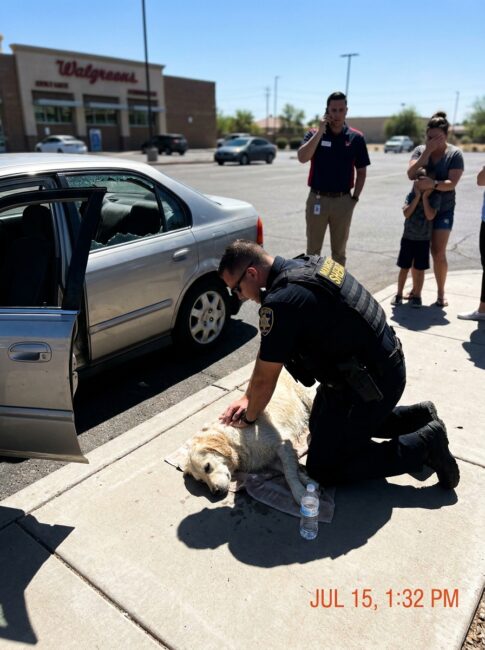
The Walgreens parking lot was a Tuesday afternoon in July of 2024.
Daisy was on the back seat. Cream-white fur. Soft brown eyes. The exact build and color of Rex.
I was looking at her through a closed window in 104-degree heat.
For one second — and this is the second I have not been able to stop thinking about — I was ten years old again.
I was in my dad’s truck cab in Indiana in 1994. I was looking at a body that used to be my friend. I was watching myself fail to save him because I had been too small and too late and the people who were supposed to come had said no.
Then the second passed.
I broke the window. I pulled Daisy out. I poured water on her. I breathed for her. She lived.
I went home at 7 p.m.
I locked myself in the bedroom.
Sarah knocked on the door.
She said, “Eli. Honey. What happened?”
I let her in.
I told her about Daisy.
She said, “Babe. You saved her. Why are you—”
She stopped.
She had been my wife for fourteen years. She had seen me come home from forty other calls like this. She had seen me come home from murder scenes. She had seen me come home from a school shooting that I will never describe to anybody. She had never seen me come home and cry like this.
She sat next to me on the bed.
She said, “Eli. Tell me.”
So I told her about Rex.
I told her about the bar, and the truck, and August 14th, 1994, and the phone call to 911, and the woman who said no.
I told her I had been keeping a promise for thirty years.
I had never said it out loud. I had never even said it to myself in language that direct. But sitting on the edge of our bed at forty years old, with my hand in my wife’s hand, I heard myself say:
I went into this job so no kid who calls 911 about a dog ever gets told no.
Sarah was very quiet.
Then she put her arms around me.
She said, “Oh, baby.”
She said, “You’ve been doing this for him.”
I said yes.
I said, “I’ve been doing this for him.”
Sarah and I sat on the bedroom floor that night for almost three hours.
She asked me to tell her the whole thing. From the beginning. From age six, when we got Rex, to the call on the linoleum floor. I had never told the whole thing to anybody, including a therapist, including my own mother in language this clear.
I told her.
I told her what Rex’s fur smelled like after he’d been outside in the rain. I told her the joke he’d had with my brother where he’d steal one of Greg’s socks every morning. I told her the song my mom used to sing to him in the kitchen — a Patsy Cline song. I told her the way he used to sleep with his chin on my foot.
I told her about the woman on the 911 call.
I told her I had memorized her voice.
I told her, with shame I had not realized I was carrying, that for years afterward I had wished she was dead. That I had imagined her in a hot car. That I had hated her, a stranger doing her job, more than I had hated my own father.
I told her I had become a cop in part because of my father, and in part because of that woman on the phone, and the truth was I did not always know which one I was making things right with on any given day.
Sarah listened. She did not interrupt. She did not try to fix it.
When I was done, she said one thing.
She said, “Eli. The boy who called 911 that day didn’t get help. But he grew up to be help. For forty-one other dogs. For forty-one other kids who called the police hoping somebody would care.”
I said, “I know.”
She said, “Have you let yourself know it?”
I had not.
I had spent twenty years going to the calls and never once stopping to look at myself in the mirror and saying: that ten-year-old boy did not know it then, but somebody finally came.
I came.
I am the somebody who came.
For forty-one Rexes. For forty-one ten-year-olds. For myself.
I am the somebody who came.
I cried again then. Sarah held me.
It was not the same crying as the crying earlier in the bedroom alone.
It was a different kind of crying. The kind where something that has been held too tightly for too long finally gets to set itself down.
I wrote a letter the week after the Walgreens call.
I wrote it to the woman who answered my 911 call on August 14th, 1994.
I will never send it. I do not know her name. I do not know if she is alive. I do not even know if I want to send it.
I wrote it anyway.
I wrote that I forgave her. That I knew she had been doing her job by the rules of the time, and that the rules of the time were wrong, and that I had spent thirty years of my career working to change them.
I wrote that I had become a sergeant. That I trained the deputies under me to take animal welfare calls seriously. That I had pushed for protocol changes in our county that now mandate response within fifteen minutes for a confirmed dog-in-hot-car call.
I wrote that I had gotten there because she had said no, and a small boy had remembered.
I wrote that I hoped she had a good life.
I keep the letter folded in a drawer in my bedside table.
Some nights I take it out and read it.
Bo, my Shepherd, lifts his head when I do, like he can tell.
He puts his chin back down.
He sleeps.
Daisy went home with her owner three days after the Walgreens call.
The owner cried, signed her citation, and took her dog home. I do not know if she has changed. I hope she has. People can.
I drove past the Walgreens on my way home from work last week.
I pulled into the parking lot. I sat in my cruiser in the spot where the Honda Civic had been.
I was not in uniform. I was off shift.
I sat there for a few minutes.
Then I said, out loud, to nobody and everybody, “I came, buddy.”
I said, “I came.”
Then I drove home to my wife.
Tag a first responder, or anyone who became their job because of something that broke them young.