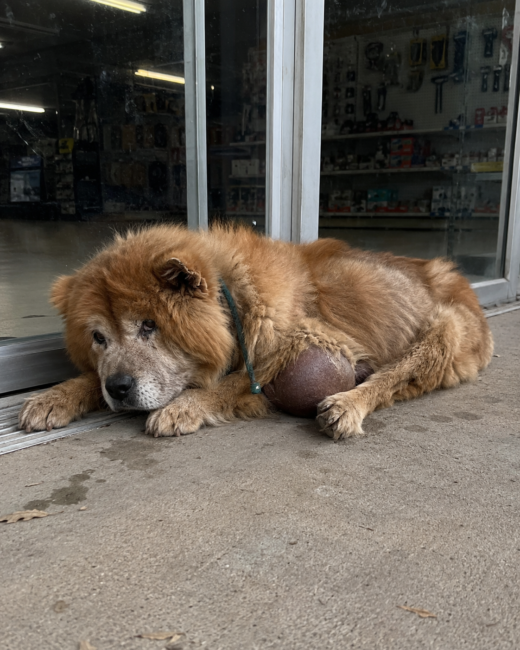
Part 2: The Senior Chow Chow With a Grapefruit-Sized Tumor Blocked Our Hardware Store Door — Then the Guard Opened a Stockroom He Had Hidden for Three Months
Part 2 — The Room Behind Receiving
The envelope had been pushed beneath the stockroom door sometime before Walter first appeared behind our loading dock. It contained no money and no request for the store to keep a dog. Inside was a photocopied vaccination record from four years earlier and a short unsigned note: His name is Walter. I lost my housing. He is ten, gentle, and afraid of being grabbed by the collar. Please give this to someone who can help him.
Whoever left it had written “please do not let him die alone” beneath the last sentence.
The listed telephone number had been disconnected. The address belonged to an apartment complex that had changed ownership, and the veterinary clinic named on the record had closed. Sam had tried all three before deciding that keeping Walter fed was better than doing nothing.
It was better than nothing—but it was not enough.
“I should’ve told you,” he said.
“Yes.”
“I thought you’d make me put him outside.”
“I might have, before seeing him.”
That was difficult to admit, but Sam deserved the truth.
Walter had initially slept beneath discarded pallets behind the loading dock. Sam began leaving water, then food. For almost two weeks, the dog would eat only after Sam stepped inside. During the third week, a thunderstorm drove him beneath the loading canopy, where Sam sat nearby for nearly four hours.
Walter finally approached when Sam placed Queenie’s old blanket on the concrete.
By July, the Chow Chow followed him into the stockroom on the hottest nights. Sam cleaned the floor before the morning staff arrived and opened the exterior loading door so Walter could leave before deliveries began. The arrangement became a routine built from caution, guilt, and affection.
But the tumor continued growing.
Sam had measured it with a strip of cotton tape every Sunday. His notebook showed an increase of almost two inches in seven weeks. Walter had also lost approximately eight pounds, although the kitchen scale could provide only rough measurements.
“I kept telling myself I was buying time,” Sam said. “Maybe I was only using it.”
I did not reassure him. Good intentions do not stop a tumor from growing, and pretending otherwise would have turned his kindness into an excuse.
Instead, I called the city’s non-emergency animal-services line and described Walter’s age, location, mobility, breathing, and visible mass. I emphasized that he was conscious, responsive, and not actively bleeding, but appeared painful and unable to walk normally.
The dispatcher asked us not to feed him in case sedation became necessary. She told us to keep the entrance quiet and avoid lifting him without guidance.
We delayed opening the store.
I taped a handwritten notice inside the glass—not on Walter’s side, where the movement might startle him—and directed employees through Receiving. One associate complained until he saw the dog. After that, nobody argued.
Sam brought Queenie’s blanket from the stockroom and placed it three feet from Walter. The dog smelled it but did not move. The doorway had become his line of sight to the parking lot, and he seemed unwilling to surrender it.
Thirty-eight minutes after my call, a white municipal animal-services van entered the lot without lights or sirens.
Field officer Elena Ruiz stepped out carrying a catch pole, a soft slip lead, towels, and a padded transport sling. She left the pole in the van after watching Walter for less than a minute.
“He’s not holding the door,” she said. “He’s holding onto the guard.”
Walter’s eyes had followed Sam through every movement.
Elena asked Sam to sit beside the stockroom blanket. She placed small pieces of soft food between the dog and the man, then waited.
Walter stretched his neck toward the first piece.
His left paw moved.
Then the weight of the tumor pulled his body sideways, and a sound barely louder than a breath escaped him.
Sam covered his mouth.
Elena did not rush forward. “Pain changes the plan,” she said. “We bring the ride to him.”
Part 3 — Moving a Dog Who Could Not Be Pulled
A standard leash was not safe. The rope collar sat too close to Walter’s throat, and any forward pressure would make him brace while shifting the tumor against his right leg. A harness was also unsuitable because the chest strap would cross the most painful part of his body.
Elena called the shelter clinic and requested a second officer, a rigid transfer board, and veterinary authorization for pre-transport pain medication. While we waited, she evaluated Walter from several feet away.
His gums appeared pale but not white. His breathing slowed when the parking lot became quiet. He could move all four limbs, although the right front leg carried little weight. The mass was not open or actively bleeding, which lowered the immediate risk but did not make it harmless.
“Large doesn’t tell us whether it’s malignant,” Elena explained. “A veterinarian needs cells, imaging, and bloodwork before anybody guesses.”
That sentence gave Sam something concrete to hold onto. The tumor was not yet a verdict.
The second officer arrived with a veterinarian-approved oral medication hidden inside a small amount of food. Walter accepted it from the concrete, then rested his head again. We waited nearly half an hour for the medicine to take effect.
During that time, Sam told Elena everything.
He admitted keeping Walter inside without permission. He showed her the measurements, receipts, and vaccination copy. He also admitted that the dog had begun coughing after longer walks and had stumbled twice during the previous week.
Elena praised the records but did not ignore the delay.
“You kept him alive,” she said. “Now we have to acknowledge that he needed medical help sooner.”
Sam nodded, eyes lowered.
When Walter became drowsy, we positioned the rigid board beside his left side. Elena and the second officer threaded a padded sling beneath his abdomen without touching the growth. Sam remained at Walter’s head, letting the old dog smell Queenie’s blanket.
“Stay with me, old man,” he murmured.
Walter’s tail tapped the floor.
On Elena’s count, four people shifted him only a few inches. His body stiffened, but Sam’s voice kept him from struggling. Once he was on the board, we tucked rolled towels beneath his chest so the tumor hung free instead of bearing his weight.
The entire transfer took less than a minute.
It felt much longer.
Customers gathered at the far edge of the parking lot despite our efforts to keep the area clear. Some raised phones. I asked them to stop recording and give the officers room. Walter did not need an audience; he needed a quiet path to the van.
Sam climbed inside after the board was secured. Although he was not authorized to ride to the clinic, Elena allowed him to remain until Walter settled. The dog pressed his muzzle into Queenie’s blanket and kept one paw against Sam’s boot.
When Sam stepped down, Walter tried to lift his head.
“I’m coming behind you,” Sam promised.
I drove him in my truck.
At the intake entrance, Walter was moved directly into an examination area. Because the shelter clinic had limited imaging equipment, the attending veterinarian, Dr. Priya Nanduri, arranged transfer to a partner hospital after stabilizing him with fluids and pain control.
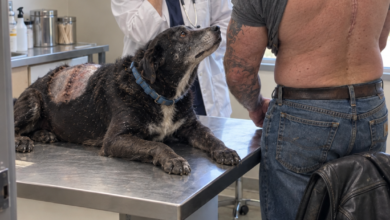
Her first estimate placed Walter’s age between ten and twelve. He weighed forty-seven pounds, at least eight pounds below a reasonable target for his frame. Bloodwork suggested dehydration, anemia, and inflammation, but his kidney and liver values were encouraging enough to continue diagnostics.
The mass measured more than eleven inches at its widest point.
Dr. Nanduri used ultrasound to determine that it arose from tissue along the chest wall rather than from the lung. A fine-needle sample was collected, but she warned us that needle samples do not always identify soft-tissue tumors clearly.
“We’ll know more after pathology,” she said.
Sam stood beside the examination table without touching Walter.
“Is he going to make it?”
Dr. Nanduri looked at the dog, not the mass.
“He made it here,” she answered. “Tonight, that is the first thing that matters.”
Part 4 — The Days Before an Answer
Walter spent his first night on intravenous fluids with pain medication, a padded bed, and rolled towels supporting the space around the tumor. Staff members entered from the front of his kennel so he could see them, but nobody reached over his head.
He refused dinner until Sam arrived.
The hospital allowed a supervised visit because his presence had already proved useful during transport. Sam sat on the floor, placed one hand where Walter could smell it, and waited. After four minutes, Walter leaned forward and touched his nose to Sam’s knuckles.
Then he ate half a bowl of softened food.
That became the first measurable sign of trust inside the clinic.
The preliminary cytology report described spindle-shaped cells and recommended a surgical biopsy. Those words frightened Sam, but Dr. Nanduri explained them carefully. Some spindle-cell masses behave aggressively; others grow slowly and remain localized. Size alone could not answer the question.
Chest radiographs showed no obvious spread to Walter’s lungs. An abdominal ultrasound found no significant internal mass. His heart was mildly enlarged, likely related to age, but an electrocardiogram did not reveal a rhythm severe enough to rule out anesthesia.
There was still no promise.
There was, however, a path forward.
The medical team planned to improve Walter’s hydration and nutrition for ten days before performing an incisional biopsy. Removing the entire tumor immediately would have made a long anesthetic procedure even riskier. First, they needed to know what they were treating and whether the tissue near the right foreleg could be preserved.
Our store owner approved a fundraiser at the register and matched the first thousand dollars, provided the collection went directly through the hospital’s assistance fund. Employees who had never met Walter before that morning donated vacation hours so Sam could attend appointments without losing pay.
The most important help came without publicity. A local foster coordinator offered to manage Walter’s recovery placement if surgery became possible. A retired veterinary technician volunteered an orthopedic bed. One customer returned with washable pads after hearing that Walter could not lie on his right side.
Sam accepted each item with visible discomfort.
“I should’ve done this three months ago,” he told me.
“You should have asked for help three months ago,” I replied. “That doesn’t mean you stop helping now.”
The biopsy was performed on September 20. Walter returned to his kennel with a small covered incision and more soreness than before. He growled when a technician checked the bandage, then immediately turned his face away.
The technician did not label him aggressive. She wrote “pain response—use slow approach” on his chart.
That distinction protected him.
Five days later, pathology confirmed a low-grade soft-tissue sarcoma. It was cancer, but the sampled cells showed a slower rate of division than the team had feared. Imaging suggested the mass had not invaded bone, although its position near muscle and blood vessels made removal complicated.
The surgeon believed she could remove most or all of it while preserving Walter’s leg. Clean margins were not guaranteed. Recurrence would remain possible, and he would need regular examinations.
Sam listened without interrupting.
“What happens if we do nothing?” he asked.
The surgeon explained that the mass would continue restricting the leg, stretching the skin, increasing pain, and eventually risking ulceration or infection.
“What happens if we operate?”
“He gets a chance to walk without carrying it.”
That was not a cure. It was not certainty.
It was a chance measured in ordinary things: standing without trembling, turning around on a bed, walking beside Sam without the tumor striking his leg.
Sam looked down at Walter.
“Then give him that.”
Part 5 — The Empty Space Beside His Leg
Walter’s surgery lasted three hours and seventeen minutes.
The surgeon removed the mass along with a margin of surrounding tissue, then reconstructed the area so his right front leg could move without excessive tension across the incision. The tumor weighed just under nine pounds—nearly one-fifth of Walter’s underweight body.
When Sam saw him afterward, Walter appeared smaller in a way that was difficult to process. For months, everyone had unconsciously understood the tumor as part of his silhouette. Now there was an empty space beside his leg, covered by a clean dressing and protected by a loose recovery garment.
Walter did not attempt to stand that evening.
The following morning, two technicians supported him with a sling. He placed his left front paw, then both hind paws. When his right front paw touched the rubber mat, he lifted it again.
Sam crouched several feet away.
“Take your time.”
Walter tried once more.
The paw remained down.
He managed three short steps before fatigue overtook him, but those steps were the first he had taken without the tumor swinging beneath his chest.
Recovery was not a straight line. On the fourth day, fluid collected beneath part of the surgical site, forming a soft swelling called a seroma. Walter became less willing to eat and developed a mild fever. The medical team cultured the fluid, adjusted his medication, and extended hospitalization.
For twenty-four hours, Sam believed the operation had failed.
Dr. Nanduri reminded him that complications required attention, not panic. The incision remained closed, Walter’s blood pressure was stable, and no severe infection was identified. Compression was avoided because of the location, so the team managed the swelling with restricted activity, monitoring, and careful drainage.
Walter also had to relearn how to position his body. He continued lowering himself onto his left side, guarding a mass that was no longer there. At night, kennel cameras showed him circling, stopping, and staring toward the door.
Sam’s stockroom blanket helped.
When staff spread it across the orthopedic bed, Walter smelled every corner before lying down. For the first time since admission, he slept with all four legs relaxed.
The final pathology report showed narrow but complete margins along most of the removed tumor and one uncertain area near the muscle. Additional aggressive surgery could have damaged the leg, so the team recommended surveillance instead: examinations every three months, chest imaging every six months, and immediate assessment if new swelling appeared.
Walter’s future remained imperfect.
That made it real.
By the third postoperative week, he could walk for seven minutes at a time. His right elbow still angled outward from months of compensation, and arthritis in both hips limited his pace. But he no longer stumbled after several steps.
Meanwhile, the foster coordinator inspected Sam’s duplex. His sister owned the property and approved one dog. The yard was small but securely fenced, and the front entrance had only one low step. Sam moved his television into the bedroom so Walter could have the quietest part of the living room.
The store manager in me wanted paperwork, schedules, and rules.
The woman who had watched Walter place his paw beside Sam’s boot wanted the old dog to wake beside the person he already trusted.
The foster application was approved for six weeks, with the rescue retaining medical responsibility.
On discharge day, Sam knelt beside the vehicle ramp.
Walter looked at it, looked at Sam, and sat down.
For a moment, everyone assumed he was afraid.
Then Sam stepped onto the ramp first.
Walter followed.
Part 6 — What Sam Had Really Been Hiding
Walter’s first week in Sam’s home was quiet and difficult.
He woke whenever the refrigerator clicked. Delivery trucks made him pace. He would not cross the kitchen doorway if Sam stood directly in front of it, and he refused to eat from a metal bowl because its reflection moved beneath his face.
Sam replaced it with the shallow ceramic dish from the stockroom.
Walter ate immediately.
Each small discovery revealed that survival had shaped his rules. He needed an open route to the exit. He slept facing the front door. Sudden hands made him duck, but a hand placed low and still invited him closer.
Sam kept meticulous records again, this time under veterinary supervision. He documented medications, appetite, bowel movements, incision checks, walking time, and any swelling around the surgical area. What had once been a secret notebook became a medical recovery log shared with an entire team.
Three weeks after discharge, Walter returned to Westline Tool & Supply for a brief visit before opening. We used the loading entrance, kept the sales floor empty, and placed his old blanket near Receiving.
Walter walked slowly through the aisle of toolboxes.
When he reached the back corridor, he turned toward the stockroom.
Sam opened the door.
The fan was gone, and the hidden food had been removed. The room had been cleaned and converted into an approved staff rest area with a washable dog bed for supervised visits. Above the bed hung no photograph or dramatic sign—only Walter’s faded green rope collar, sealed inside a clear storage box because it was no longer safe for him to wear.
Walter sniffed the blankets, circled twice, and lay down.
That was when Sam finally told me why he had been so terrified of reporting him.
Years earlier, Queenie had developed an abdominal tumor. Sam and his wife delayed care because they feared the cost. By the time they sought help, Queenie’s condition was beyond treatment. Sam’s wife died the following year, and he carried both losses as if asking for help had become evidence of failure.
When Walter appeared with a mass, Sam repeated the pattern in a different form. He fed him, sheltered him, and documented every change, but avoided the one step most likely to save him.
“I thought keeping him comfortable was mercy,” he said. “Really, I was afraid somebody would tell me it was too late again.”
Walter lifted his head at the sound of his name.
Sam rubbed the floor beside him rather than reaching down. Walter closed the distance himself and rested his chin across the toe of Sam’s boot.
“You didn’t abandon him,” I said. “But fear nearly made the decision for both of you.”
“I know.”
There was no need to soften that truth. Rescue was not a single heroic act. It was a chain of imperfect people finally choosing the next responsible step.
At Walter’s six-week examination, the incision had healed, the seroma had resolved, and his weight had increased to fifty-three pounds. His hip muscles remained weak, but the rehabilitation therapist found improved balance and a wider, more comfortable stride.
No new mass was detected.
The rescue approved Sam’s adoption application, but one question remained: if Walter could choose, would he remain with the man who had once hidden him—or was their bond only a habit created by hunger?
The answer came before anyone opened the adoption papers.
Part 7 — The Door He No Longer Needed to Block
The coordinator placed Walter’s leash on the floor between Sam and a second approved foster volunteer. Both men sat quietly several feet apart. Nobody called his name, offered food, or patted a knee.
Walter stood in the middle of the room.
He looked toward the volunteer first. The man had a large yard, another calm senior dog, and more experience managing medical cases. On paper, he offered an excellent home.
Then Sam shifted his boot.
Walter crossed the room and lowered himself beside it, placing his right front paw over the leather toe.
The choice was quiet, but nobody misunderstood it.
Sam signed the adoption agreement that afternoon. The rescue retained access to pathology records and helped schedule Walter’s surveillance appointments. Our store’s assistance fund covered the first year of imaging, while Sam paid for food, routine care, and pet insurance that excluded the existing tumor but covered future unrelated emergencies.
He did not call himself Walter’s savior.
“I was his night watchman,” he said. “Now I get to be his person.”
At the three-month recheck, Walter weighed fifty-six pounds. His coat had begun filling in across his hips, though the fur around the surgical site remained shorter. He still had arthritis, cloudy changes in one eye, and a possibility of recurrence.
He was not presented as cured.
He was comfortable, monitored, wanted, and no longer hidden.
Walter continued visiting the store before opening every other Friday. He walked through Receiving, inspected the old stockroom, and rested on the approved bed while Sam completed his security report.
He never lay across the front entrance again.
One cold morning, I watched him stop several feet inside the glass doors. Cars moved through the parking lot, and the automatic doors opened behind an employee carrying coffee. Walter did not turn toward the road.
Instead, he listened for the familiar scrape of Sam’s boots.
When Sam appeared, the Chow Chow stood, crossed the floor, and leaned his left shoulder against the guard’s leg—the same shoulder he had once pressed into concrete to protect the tumor on his other side.
Sam rested two fingers against Walter’s gray muzzle.
“There you are, old man.”
Walter’s tail moved once.
Then again.
The stockroom had begun as a secret built from fear. The doorway had become a plea nobody could ignore. But the life that followed was created when several people accepted the difference between hiding pain and helping carry it.
Walter had blocked our entrance because he knew someone inside would recognize him.
In the end, we finally opened the right door.