Part 2: A 10-Year-Old Foster Kid Held Up a Stuffed Bear in Court. What He Said Made the Judge Stop the Hearing.
Theo arrived at our house with one black duffel bag.
Rita carried it inside. Theo carried his own jacket, folded, in his arms. He was small for his age. Brown hair that needed cutting. Brown eyes that did not look at any of us directly for the first six hours.
Rita helped him put his bag in the bedroom we’d set up for him. We’d painted it pale blue the weekend before. We’d put a desk under the window. We’d bought a quilt from a thrift store because we’d read that brand-new things sometimes felt sterile to kids who’d had hard placements.
Theo stood in the doorway of the room and looked at it.
He said, “I don’t need to unpack.”
Rita said, gentle, “Sweetheart. You can. You’re going to be here for a while.”
He said, “It’s okay. I’ll just keep it in the bag.”
He set the duffel against the wall, zipped, and walked back out.
Rita gave us a look I did not know how to read at the time. I have learned to read it since. It was the look of a social worker watching a kid do a small thing she had seen too many kids do.
The first two weeks, Theo did not unpack his duffel.
He took out one set of clothes each morning, wore them, put them in the laundry hamper, and put on the next set the next day. Hannah would wash and fold his laundry and leave it on his bed. He would carry it back to the duffel and put it inside.
He ate everything we gave him. He never asked for seconds. He said please and thank you in a voice that sounded like it had been trained.
He did not touch Biscuit.
Biscuit, of course, tried.
Biscuit met every new person in our house with the assumption that they were here to love him. Theo had been in our house for forty minutes when Biscuit padded up to him on the living room rug, sat down at his feet, and offered a paw.
Theo looked at the paw.
He did not take it.
He folded his hands in his own lap and tucked his feet under the chair and said, polite, to the floor, “I’m okay.”
Biscuit waited a minute. Then he walked away.
He came back ten times that day.
Theo said, “I’m okay,” ten times.
By the end of week one, Hannah said to me in our bedroom at midnight, “Dan. He thinks the dog is something he’s going to lose too.”
I had not thought about it that way.
I started watching Theo and Biscuit more carefully after that.
The duffel bag stayed zipped against the wall for fourteen days.
Theo went to school. He came home. He did his homework at the kitchen table. He let Hannah help him with math. He did not call us anything — not by name, not Mom and Dad, not Mr. and Mrs. He just made eye contact when he wanted our attention and waited until we looked at him.
He spoke to Biscuit when he thought no one was listening.
I overheard him on the third night.
He was sitting on the floor of the living room with his back against the couch. Biscuit had brought him a tennis ball — uninvited, the way Biscuit did everything — and dropped it in front of him.
Theo did not pick it up.
He said, very quiet, “I can’t keep that, buddy. I’m sorry.”
I was standing in the hallway. He didn’t see me.
Biscuit, who is the dumbest sweetest dog in the world, took the tennis ball back, walked it over to his bed, and lay down on top of it.
I went into the bathroom and ran the water and cried for ten minutes.
The next day at dinner, I told Hannah. She nodded. She had heard a similar moment two nights earlier. He had said something to Biscuit about not wanting to get used to him.
She said, “Dan, what do we do?”
I said, “I don’t know.”
She said, “I think we wait.”
We waited.
In the middle of week three, on a Wednesday afternoon, something happened that I have replayed in my head for two years.
Theo was sitting on the living room floor doing his homework. He had a math worksheet on the rug in front of him. He was working in pencil. He had his back against the couch — his usual spot.
Biscuit was lying on his bed across the room.
Biscuit got up.
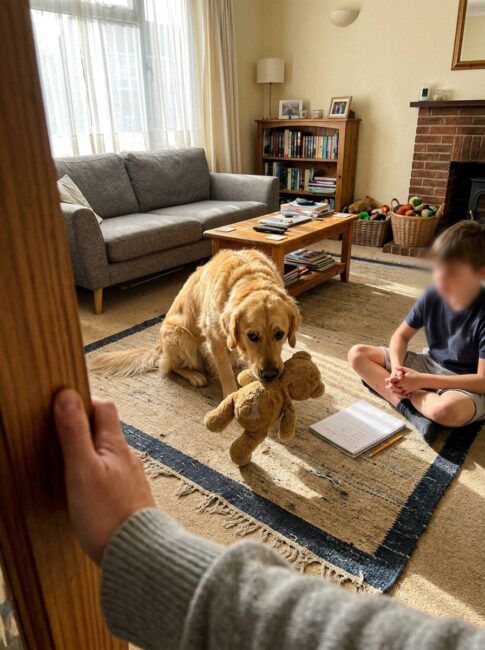
He walked, not to Theo, but to the basket of dog toys we kept by the fireplace. He nosed through the basket for a long time. He pulled out a small stuffed bear.
I want to describe this bear to you. It is important.
It was about six inches tall. It had been brown once, but it was now mostly gray from being in Biscuit’s mouth for three years. Its left ear had been chewed off completely. Its right eye was missing. The stuffing was leaking out of one paw. It was the oldest, most loved, most ruined toy Biscuit owned. He had carried it to bed every single night since the day we brought him home.
It was the only toy he ever took into his crate.
Biscuit walked over to Theo with the bear in his mouth.
He stopped in front of him.
He set the bear down on the rug, between Theo’s worksheet and his knee.
Theo looked at the bear.
He did not pick it up.
He said, very quiet, “That’s yours, buddy. I can’t take it.”
Biscuit lowered his head. He pushed the bear, with his nose, an inch closer to Theo.
Theo said, again, “I can’t take it.”
Biscuit pushed it again.
Closer.
Until the bear was touching Theo’s knee.
Theo looked at the bear for a long time.
He looked up at Biscuit.
Biscuit’s tail thumped the floor. Once. Twice.
Theo picked up the bear.
He held it in both hands. Carefully. Like it was made of glass.
Biscuit lay down at his feet.
Hannah, from across the room, watching from the kitchen doorway with her hand over her mouth, made a small sound.
Theo looked up at her.
He said, “Is it okay?”
Hannah said, “Yes, baby. It’s okay.”
He held that bear for the rest of the afternoon.
Theo unpacked his duffel that weekend.
I am not making that up. I am not embellishing. The morning after the bear afternoon, on a Saturday, I came downstairs to make coffee, and his duffel bag was open on the floor of his room. His clothes were in the dresser. His three books — Rita had given him three books when he came to us, and he had not opened any of them — were lined up on the desk.
The bear was on his pillow.
He came into the kitchen and asked for pancakes.
He had never asked us for anything.
I made him pancakes. I made him a stack the size of his head. He ate them. He said, polite, “Thank you, Daniel.”
It was the first time he had used my name.
I had to turn toward the stove so he wouldn’t see my face.
The next year is too long to write here. I will say this: he started calling Hannah by her name in week six. He started saying our house instead of the house in week ten. He started laughing — really laughing, with his whole body — at one of Biscuit’s antics in week fourteen. He had a hard month in November. He had a harder month in February. He cried in front of Hannah for the first time in March, when his caseworker called to tell him a relative he had been hoping might take him had said no for a final time.
Hannah sat with him on the kitchen floor for two hours. Biscuit lay across both of them. The bear was in Theo’s pocket.
He had carried the bear in his pocket every day since the afternoon Biscuit gave it to him.
He did not let it out of his sight.
Rita filed the paperwork to begin adoption proceedings in May.
The hearing was set for September 14th.
I did not know yet that the most important moment of my life as a parent was going to be a sentence said by a ten-year-old in a courtroom while holding a one-eyed teddy bear.
The morning of the adoption hearing, Theo got dressed in a button-down shirt and the tie I’d helped him pick out three days earlier.
He came into the kitchen. He stood in front of Hannah and me. He said, “How do I look?”
Hannah said, “You look so handsome, baby.”
I said, “Sharp, kid. Real sharp.”
He nodded. He looked relieved.
He went into the living room. He crouched down next to Biscuit. He put his face in Biscuit’s neck for about ten seconds. He whispered something I did not hear.
Then he stood up, and he reached into the small backpack we had bought him, and he pulled out the bear.
The chewed-up, one-eyed, gray bear. The bear from the basket. The bear Biscuit had pushed across the rug five hundred and thirty-seven days earlier.
He put the bear in the front pocket of his backpack.
He zipped it carefully.
He said, “Okay. I’m ready.”
In the courtroom, the judge was a woman named Judge Patterson. She had a kind face and reading glasses and a folder full of paperwork. The hearing was, on paper, a formality. Rita had walked us through every step. Theo had been with us for eighteen months. The adoption was approved. We were just there to sign the final papers and have them entered into the record.
Judge Patterson looked at Theo.
She said, “Hi, Theo. I just need to ask you a few questions. Is that okay?”
Theo said, “Yes, ma’am.”
She asked him if he understood what was happening. He said yes. She asked him if he wanted Daniel and Hannah to be his parents. He said yes. She asked him if he had any questions for the court.
He said, “Can I show you something?”
She said, “Of course.”
He walked up to the bench. He had his backpack with him. He unzipped the front pocket. He took out the bear.
He held it up.
He said, “I got this from my dog Biscuit a year and a half ago.”
He said, “He gave it to me when I didn’t think I was going to keep anything anymore.”
He said, “I have had it for five hundred and thirty-seven days. That’s the longest I’ve ever had anything.”
He paused.
He looked at the bear.
He said, “Nobody took it from me.”
He said, “It’s the first thing I ever got to keep.”
The courtroom went quiet.
Judge Patterson took her glasses off. She set them down on her desk. She looked at the court reporter and said, soft, “Off the record for a moment.”
The court reporter stopped typing.
Judge Patterson said, “Theo. Can you come closer please.”
Theo walked up to the bench. The judge leaned over. She put her hand out — palm up, the way you do when you’re not sure if a kid will take your hand.
Theo took her hand.
She said, “I want you to know something. I have been a judge for nineteen years. I have signed a lot of papers. Today is the most important paper I will sign this year.”
Theo nodded. His eyes were full.
She said, “You get to keep this family. You get to keep the bear. You get to keep all of it.”
She squeezed his hand once.
She said, “Back on the record.”
She signed the papers.
It was 11:14 a.m. on September 14th, 2025.
We went home that afternoon.
Theo sat in the back seat. He held his backpack on his lap. He did not say much during the drive. Hannah looked over her shoulder at him a few times. He smiled at her. He looked out the window. He smiled some more.
When we pulled into the driveway, Biscuit was in the front window of the house. He had been in the window when we left that morning. He was in it when we came back. He started barking the moment our car came around the corner — that high, undignified, hysterical bark Goldens do when their person comes home from a war they did not know was happening.
Theo got out of the car.
He ran up the front steps.
I unlocked the door.
Biscuit bowled into him at the entryway. Both of them went down on the rug. Theo started laughing — the loud, full-body laugh I had not heard until week fourteen of his placement, the one I had wanted to record but had been too afraid to interrupt.
He had Biscuit’s face in both his hands.
He was saying, “We did it, buddy. We did it. We did it.”
I sat down on the floor of the entryway. Hannah did too. Biscuit climbed into Theo’s lap. Theo climbed into Hannah’s lap. We ended up in a pile on the rug, all four of us, for a long time.
I thought about something Rita had said to us a year and a half earlier, on the day before Theo arrived.
She had said: animals don’t lie to kids. Kids know.
I had not understood what she meant at the time.
I understood now.
For five hundred and thirty-seven days, Theo had been watching us — Hannah and me — to see if we would lie to him the way the world had been lying to him for nine homes in a row. We were doing our best. We were saying all the right things. We were trying every day. And he had been holding back, watching, waiting, because we were grown-ups, and grown-ups had said a lot of right things to him before they sent him somewhere else.
Biscuit was not a grown-up.
Biscuit had given Theo the most important thing Biscuit owned in week three of Theo’s placement. Biscuit had pushed his most loved possession across a rug and given it to a kid who was holding back from the rest of us. Biscuit had not asked for anything in return. He had not made it conditional. He had not taken it back when Theo had a hard month. He had simply, on a Wednesday afternoon, decided that this kid needed to keep something — and he had given him the only thing in his power to give.
And Theo had believed him.
Because dogs don’t lie.
Hannah and I, by being constant and patient for five hundred and thirty-seven days, eventually became people Theo could trust.
But Biscuit was the bridge.
Biscuit was the one who built it.
Theo is eleven now.
He has been our son for seven months as of this writing. Officially, legally, court-recorded. He has a different last name than he had a year ago. He says his new last name with a small private pride that I notice and try not to make a big deal of.
He still has the bear.
It lives on his pillow now. He does not carry it in his pocket every day anymore. He told me, last summer, very serious, that he didn’t need to. He said, “I know it’s gonna be there when I get back.”
I said, “Yeah, buddy. It is.”
He sleeps with Biscuit in his bed every night. We tried, for the first month after the adoption, to keep Biscuit in the living room — old habit. Theo asked, careful, if Biscuit could come into his room. We said yes. Biscuit has not slept anywhere else since.
Theo started fifth grade in August.
He has friends. He’s quiet about them. He brought one home in October — a kid named Marcus from his class — and Marcus and Theo and Biscuit ran around the backyard for two hours. I watched from the kitchen window and tried not to be a creep about it. Hannah was crying into a dish towel.
Theo made the school spelling bee. He came in third. He wore the bronze ribbon for two days.
He calls us Mom and Dad now. It started in week thirty-four. He worked up to it slowly. He has not stopped since.
Last night Theo came into the kitchen at 9 p.m.
He had the bear in his hand.
He said, “Dad.”
I said, “Yeah, kid.”
He held up the bear. He said, “Do you think Biscuit ever wants it back?”
I thought about it for a second.
I said, “No, buddy. I think he gave it to you because you were supposed to have it.”
Theo nodded.
He looked at the bear.
He said, quiet, “Yeah. I think so too.”
He went back to bed.
Biscuit followed him.
The bear went with them.
Tag a foster parent, an adoptive parent, or a kid who finally got to keep something — they need this.